
Rho options greek interest rate sensitivity Introduction Most options traders...
اقرأ المزيدBid-Ask Spreads In Forex
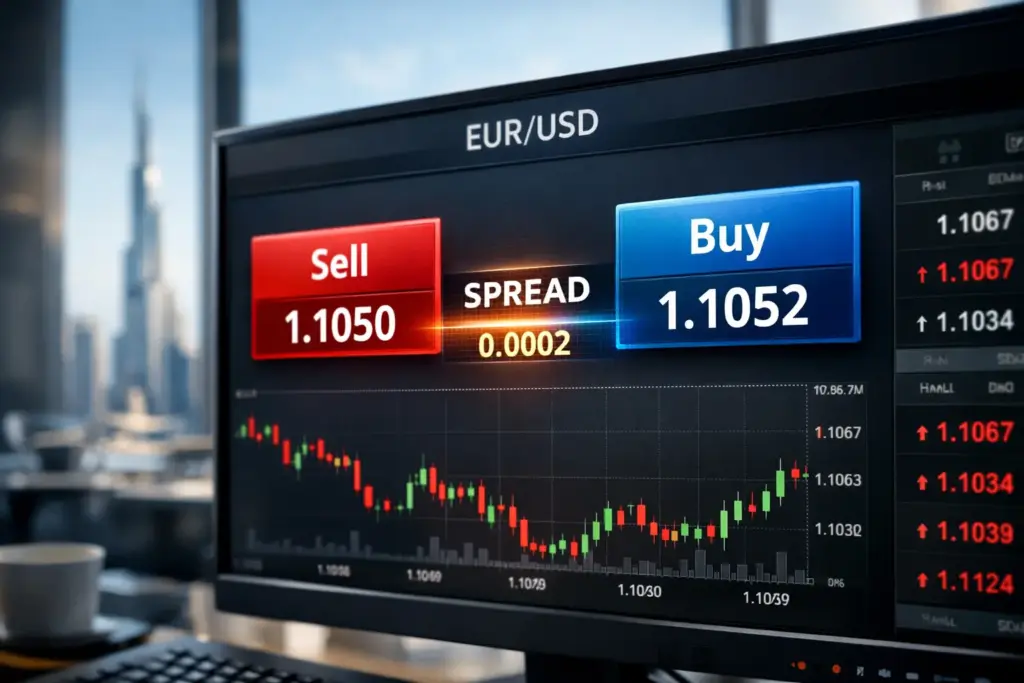
Table of Contents
- What Exactly Is a Bid-Ask Spread in Forex?
- How Is the Spread Calculated in Pips?
- Fixed vs. Variable Spreads: Which Is Better for Your Strategy?
- What Factors Cause Spreads to Widen or Tighten?
- How Do Spreads Impact Your Overall Trading Profitability?
- What Strategies Can help Manage and Minimize Spread Costs?
- Conclusion

What Exactly Is a Bid-Ask Spread in Forex?
In the global foreign exchange markets, currencies are never traded at a single price point. Instead, every currency pair—whether it is a major pair like EUR/USD or an exotic pair—has two distinct prices: the Bid price and the Ask price.
The Bid price represents the highest price a buyer (the broker or the market) is willing to pay for a currency pair. This is the price at which you, as a trader, can sell. Conversely, the Ask price (sometimes called the “Offer”) is the lowest price at which a seller is willing to sell. This is the price at which you can buy.
The Bid-Ask Spread is simply the difference between these two figures. It represents the primary transaction cost of opening a trade. For example, if you are trading Spot FX and the EUR/USD is quoted at 1.1050/1.1052, the spread is the difference between 1.1052 and 1.1050. While this cost might seem negligible on a single trade, it is a critical component of liquidity and market structure that professional investors must monitor closely.
How Is the Spread Calculated in Pips?
To understand the cost of a trade, you must calculate the spread in pips (Percentage in Point). For most major currency pairs, a pip is the fourth decimal place.
The formula is straightforward: Spread = Ask Price – Bid Price
Let’s look at a practical calculation using the GBP/USD pair:
- Ask Price: 1.2505
- Bid Price: 1.2502
- Calculation: 1.2505 – 1.2502 = 0.0003
In this scenario, the spread is 3 pips.
However, for pairs involving the Japanese Yen (JPY), the pip is the second decimal place. If the USD/JPY is quoted at 130.50/130.52, the difference is 0.02, which equals 2 pips.
Understanding this calculation is vital when trading الفوركس الفوري وعقود الفروقات, as it directly affects where your trade needs to move just to break even.
Start Trading with Competitive Spreads
Experience institutional-grade execution on the world’s most popular trading platform
Fixed vs. Variable Spreads: Which Is Better for Your Strategy?
When selecting a trading environment, you will typically encounter two types of spreads: fixed and variable (floating).
Fixed Spreads remain constant regardless of market conditions. Whether the market is calm or highly volatile, the spread stays the same. This provides certainty regarding transaction costs, which can be beneficial for traders who rely on precise cost calculations for automated strategies.
Variable Spreads, which are more common in the interbank market and offered by brokers like Phillip Capital DIFC, fluctuate based on supply and demand. In times of high liquidity—such as the overlap between the London and New York sessions—variable spreads on major pairs can be extremely tight, often tighter than fixed spreads. This offers a significant advantage for active traders seeking the best possible market price. However, during major economic news releases or low-liquidity periods, these spreads can widen to reflect market risk.
For most professional and retail traders seeking authentic market access, variable spreads are often preferred as they reflect true market depth and liquidity
What Factors Cause Spreads to Widen or Tighten?
The Bid-Ask spread is not static; it “breathes” with the market. Three primary factors influence its width:
- Liquidity: This is the most significant factor. Major pairs like the EUR/USD or USD/JPY typically have the tightest spreads because billions of dollars are traded in them daily. There is always a buyer for every seller. In contrast, Minor and Exotic Currency Pairs, such as the USD/TRY (Turkish Lira) or USD/ZAR (South African Rand), often have wider spreads due to lower trading volumes.
- Volatility: During periods of economic uncertainty or immediately following critical data releases (like US Non-Farm Payrolls), market participants may pull their orders, causing liquidity to dry up and spreads to widen rapidly.
- Time of Day: The Forex market operates 24/5, but liquidity is not uniform. Spreads are generally tightest when major sessions overlap (e.g., afternoon in Dubai when London and New York are both open). Conversely, during the “rollover” period (typically 1:00 AM Dubai time), spreads may temporarily widen as banking institutions reset for the next trading day.
Access Global Liquidity
Trade EUR/USD, GBP/USD, and other majors with deep market liquidity and fast execution.
How Do Spreads Impact Your Overall Trading Profitability?
Many novice investors overlook the spread, focusing solely on profit targets. However, the spread is an upfront cost that must be overcome before a trade becomes profitable.
For Scalpers and Day Traders, who open and close numerous positions throughout the day to capture small price movements, the spread is critical. If you are targeting a 10-pip profit, a 2-pip spread represents 20% of your potential gain. Over hundreds of trades, a slightly wider spread can significantly erode net returns.
For Swing Traders or Position Traders who hold trades for days or weeks, the spread is less impactful relative to the total potential profit. Since these traders aim for moves of 50, 100, or more pips, a small difference in the spread is a minor percentage of the overall trade.
Effective Forex Market Structure knowledge helps traders time their entries to avoid periods of widened spreads, thereby protecting their profit margins.
What Strategies Can help Manage and Minimize Spread Costs?
While you cannot eliminate the spread, you can manage its impact on your portfolio:
- Trade During Peak Hours: Align your trading schedule with the most liquid market sessions. For UAE investors, the sweet spot is typically between 11:00 AM and 8:00 PM, covering the London and early New York sessions.
- Focus on Major Pairs: If you are sensitive to transaction costs, prioritize highly liquid pairs like EUR/USD or GBP/USD, where spreads are naturally tighter.
- Monitor the Economic Calendar: Avoid executing market orders exactly when high-impact news is released. Spreads can spike momentarily during these events.
- Use Limit Orders: Instead of buying at the current market price (Ask), you can set a Limit Order to buy at a specific lower price. While this doesn’t change the spread itself, it allows you to enter the market only when the price meets your criteria, potentially improving your entry point.

Conclusion
The Bid-Ask spread is an integral part of the Forex trading ecosystem. It is not just a fee; it is a reflection of market conditions, liquidity, and volatility. For investors in the UAE and beyond, understanding the mechanics of the spread—from how it is calculated to how it fluctuates—is essential for transparent and cost-effective trading.
By choosing the right trading hours, focusing on liquid assets, and partnering with a regulated broker that offers competitive variable spreads, you can optimize your strategy and navigate the global currency markets with greater precision.
Frequently Asked Questions (FAQs)
This occurs during the “rollover” period when the New York session closes and the Tokyo session has not fully ramped up. During this brief window, banking institutions settle their accounts for the day, causing liquidity to drop sharply. Lower liquidity forces brokers to widen spreads to manage the increased risk.
The EUR/USD almost always has the tightest spread because it is the most heavily traded pair in the world, ensuring massive liquidity. It is often followed closely by the USD/JPY and GBP/USD.
Yes, but there is a trade-off. Some brokers offer “Raw” or “ECN” accounts with spreads as low as 0.0 pips. However, these accounts typically charge a fixed commission per lot traded. Standard accounts usually have no commission but include a slightly wider spread to cover costs.
You effectively pay the spread the moment you open the trade. This is why every trade starts slightly negative (in the red) immediately upon execution. You must overcome this spread cost before the position begins to show a profit.
Disclaimer:
Trading foreign exchange and/or contracts for difference on margin carries a high level of risk, and may not be suitable for all investors as you could sustain losses in excess of deposits. The products are intended for retail, professional and eligible counterparty clients. Before deciding to trade any products offered by PhillipCapital (DIFC) Private Limited you should carefully consider your objectives, financial situation, needs and level of experience. You should be aware of all the risks associated with trading on margin. The content of the Website must not be construed as personal advice. For retail, professional and eligible counterparty clients. Before deciding to trade any products offered by PhillipCapital (DIFC) Private Limited you should carefully consider your objectives, financial situation, needs and level of experience. You should be aware of all the risks associated with trading on margin.
Rolling Spot Contracts and CFDs are complex instruments and come with a high risk of losing money rapidly due to leverage. 78% of our retail client accounts lose money while trading with us. You should consider whether you understand how Rolling Spot Contracts and CFDs work, and whether you can afford to take the high risk of losing your money.
Vega and Volatility Risk
Vega and volatility risk Vega and Volatility Risk: How Implied...
اقرأ المزيدGamma Risk and Gamma Scalping
Gamma Risk and Gamma Scalping Gamma Risk and Gamma Scalping:...
اقرأ المزيدDelta Hedging and Delta Neutrality

Delta Hedging and Delta Neutrality Delta Hedging and Delta Neutrality:...
اقرأ المزيدThe Greeks: Delta, Gamma, Theta, and Vega

Options Greeks : Delta, Gamma, Theta, Vega The Greeks: Delta,...
اقرأ المزيدBlack-Scholes Model Basics

Black-Scholes model Black-Scholes Model Basics: How Options Traders Understand Fair...
اقرأ المزيدRepurchase Agreements (Repos)

Repurchase Agreement (Repo) Introduction Every day, banks, governments, and institutional...
اقرأ المزيدUnderstanding the Money Market

Understanding the Money Market Introduction Every investor eventually asks the...
اقرأ المزيدFixed Income Yield Curve

Fixed Income Yield Curve Table of Contents Introduction What Is...
اقرأ المزيدBond Trading Mechanics

Bond Trading Mechanics Table of Contents Introduction What Does Bond...
اقرأ المزيدPrimary vs Secondary Bond Markets

Primary vs Secondary Bond Markets Table of Contents Introduction What...
اقرأ المزيدBond Market Structure and Participants

Bond Market Structure and Participants Table of Contents Introduction What...
اقرأ المزيدOne-Touch and No-Touch Features

One-Touch and No-Touch Features Table of Contents Introduction What Are...
اقرأ المزيدBarrier Levels and Payoff Impact

Barrier Levels and Payoff Impact Introduction Structured products often look...
اقرأ المزيدContinuous vs Discrete Observation

Continuous vs Discrete Observation Table of Contents Introduction What Does...
اقرأ المزيدKnock-Out Barriers

Knock-Out Barriers Table of Contents Introduction What Is a Knock-Out...
اقرأ المزيدBarrier Levels and Types

Barrier Levels and Types Introduction Structured products are built around...
اقرأ المزيدIndustry Growth Prospects

Industry Growth Prospects Table of Contents Introduction What Are Industry...
اقرأ المزيدRegulatory Environment Impact

Regulatory Environment Impact on Stocks Table of Contents Introduction What...
اقرأ المزيدSupply Chain Analysis

Supply Chain Analysis for Equity Investors Table of Contents Introduction...
اقرأ المزيدMarket Share Analysis

Market Share Analysis How Investors Measure Company Dominance in an...
اقرأ المزيدCompetitive Positioning

Competitive Positioning Table of Contents Introduction What Is Competitive Positioning...
اقرأ المزيدIndustry Analysis Framework

Sector Classification Systems Table of Contents Introduction What Is an...
اقرأ المزيدSector Classification Systems

Sector Classification Systems Introduction Every listed company belongs somewhere. Whether...
اقرأ المزيدOptions Exercise & Assignment

Options Exercise & Assignment Table of Contents Introduction What Does...
اقرأ المزيدAmerican vs European Options

American vs European Options Table of Contents Introduction What Is...
اقرأ المزيدOptions Expiration Dates
Options Expiration Dates Table of Contents Introduction What Is an...
اقرأ المزيد