

Rho options greek interest rate sensitivity Introduction Most options traders...
اقرأ المزيدRho options greek interest rate sensitivity
Introduction
Most options traders can explain Delta in their sleep and have a rough feel for Theta decay eating into a long option’s value. Rho rarely gets the same attention, yet it answers a question that becomes very relevant whenever central banks are actively moving interest rates: how much does an option’s price actually change when the risk-free rate shifts?
This guide breaks down what Rho measures, why interest rates affect an option’s fair value at all, and how the answer differs between calls and puts. It also looks at why Rho matters far more for long-dated contracts and interest rate-linked instruments than it does for a two-week equity option, and how investors evaluating exchange traded derivatives can factor it into their overall risk picture.
By the end, the goal is not to turn Rho into a headline number an investor checks daily. It is to understand why it exists, when it genuinely matters, and when it can reasonably be set aside in favour of the Greeks that usually drive an option’s price more directly.
Table of Contents
- What Is Rho and Why Does It Matter to Options Traders?
- How Does Rho Actually Measure Interest Rate Sensitivity?
- Why Do Interest Rates Affect an Option’s Price in the First Place?
- Do Call Options and Put Options Respond to Rho in the Same Way?
- Call Rho vs Put Rho: A Side-by-Side Comparison
- Why Is Rho Larger for Long-Dated Options Than Short-Dated Ones?
- How Do Central Bank Rate Decisions Affect an Options Portfolio?
- What Real-World Scenarios Make Rho Worth Watching?
- What Mistakes Do Investors Make When They Ignore Rho?
- How Can Investors Build Rho Awareness Into Their Risk Management?
- الأسئلة الشائعة
What Is Rho and Why Does It Matter to Options Traders?
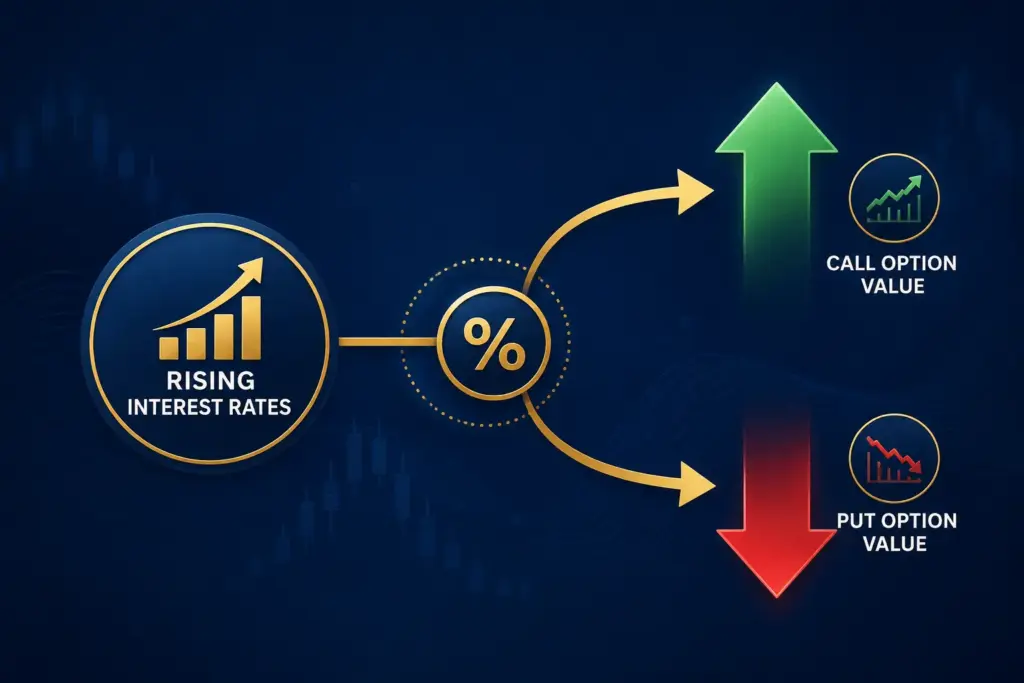
Rho measures how much an option’s price is expected to change for every one percentage point move in the risk-free interest rate, holding everything else constant. It is one of the five main Greeks generated by options pricing models, alongside Delta, Gamma, Theta, and Vega, but it is usually the smallest and least discussed of the group.
Rho exists because every options pricing model needs an interest rate input to calculate a theoretical fair value. The Black-Scholes model, the most widely used framework for pricing options, takes the underlying price, strike price, time to expiry, volatility, and the risk-free rate and produces a theoretical premium. Rho is simply the sensitivity of that output to changes in the last input, the interest rate.
For most retail investors trading short-dated equity options, Rho barely moves the needle day to day, because interest rates change slowly and short-dated contracts have little time for that sensitivity to compound. For investors holding longer-dated positions, trading interest rate-linked derivatives, or operating during a period of active central bank rate changes, Rho becomes a genuinely useful piece of the puzzle rather than a footnote.
How Does Rho Actually Measure Interest Rate Sensitivity?
Rho is expressed as the dollar or point change in an option’s price for a one percentage point, or 100 basis point, move in the risk-free interest rate. A Rho of 0.15 on a call option means the option’s theoretical value would rise by roughly 0.15 if interest rates increased by one percentage point, all else held equal.
In practice, the numbers involved tend to be small compared with Delta or Vega. A typical at-the-money equity call option might carry a Rho in the range of 0.01 to 0.10 per one-point move in rates, depending on time to expiry and the strike distance from the current price. Compare that with a Delta of 0.50 responding to every single point move in the underlying stock, and it becomes clear why traders often check Rho last, if at all.
That said, “small” does not mean irrelevant in every context. Central bank rate moves are usually measured in increments of 0.25 percentage points, but a full hiking or cutting cycle can move rates by several full percentage points over a year or two. For an investor holding a long-dated option through such a cycle, the cumulative effect of Rho over that period stops being trivial, even if any single rate decision barely shows up in the option’s daily price movement.
Why Do Interest Rates Affect an Option's Price in the First Place?
Interest rates influence an option’s price through two related channels: the cost of carrying the underlying asset and the present value of the strike price paid or received at expiry. Both effects push in the same direction for calls and in the opposite direction for puts.
The first channel relates to how the underlying asset itself is valued. When interest rates rise, the theoretical forward price of a non-dividend-paying stock or index tends to rise as well, since holding cash and earning the higher risk-free rate becomes a more attractive alternative to holding the asset outright, and that opportunity cost gets built into forward pricing. A higher expected forward price for the underlying generally supports a higher call option value and a lower put option value.
The second channel involves the strike price itself. Exercising a call option means paying the strike price at expiry to receive the underlying. Exercising a put option means receiving the strike price at expiry in exchange for delivering the underlying. In both cases, that strike price payment or receipt happens in the future, so its value today depends on the discount rate applied to it. When interest rates rise, the present value of a future strike price payment falls. For a call holder, who will pay that strike price later, a lower present value of that future payment is a benefit, since it effectively reduces the real cost of exercising. For a put holder, who will receive that strike price later, a lower present value of that future receipt is a drawback, since the amount they will eventually collect is worth less in today’s terms.
Investors comparing this mechanism with how Options Greeks: Delta, Gamma, Theta, and Vega isolate other pricing forces will notice a common thread: each Greek separates one variable so its individual contribution to the option’s price becomes measurable rather than tangled up with everything else moving at once.
Do Call Options and Put Options Respond to Rho in the Same Way?
Call options and put options respond to Rho in opposite directions. Call options generally carry positive Rho, meaning their value tends to rise when interest rates increase. Put options generally carry negative Rho, meaning their value tends to fall when interest rates increase, and rise when rates fall.
This opposite behaviour follows directly from the two channels described above. Rising rates increase the attractiveness of holding cash over the underlying asset, which supports call values and works against put values through the forward pricing channel. Rising rates also reduce the present value of the strike price that a call holder will eventually pay, which is favourable for the call, while reducing the present value of the strike price a put holder will eventually receive, which is unfavourable for the put.
An investor holding a long call position during a period of rising rates gets a small tailwind from Rho, on top of whatever Delta, Gamma, Theta, and Vega are contributing. An investor holding a long put position during the same period faces a small headwind from Rho, working quietly against the position even if the underlying asset moves favourably. Neither effect is usually large enough to change a trading decision on its own, but it explains a piece of the price action that Delta alone cannot account for.
Call Rho vs Put Rho: A Side-by-Side Comparison
Rho behaves differently depending on whether an investor holds a call or a put, and understanding that contrast side by side makes the mechanism easier to internalise.
| Factor | Call Options | Short Volatility |
|---|---|---|
| Typical sign of Rho | Positive | Negative |
| Effect of rising interest rates | Value tends to increase | Value tends to decrease |
| Effect of falling interest rates | Value tends to decrease | Value tends to increase |
| Driver via forward pricing | Higher rates support a higher forward price for the underlying, benefiting the call | Higher rates support a higher forward price for the underlying, working against the put |
| Driver via strike present value | Present value of the future strike payment falls, reducing the real cost of exercising | Present value of the future strike payment falls, reducing the real cost of exercising |
| Sensitivity to time to expiry | Increases with more time remaining | Increases with more time remaining |
A useful way to read this table is to notice that both channels reinforce the same direction for calls and both reinforce the same direction for puts. That consistency is precisely why Rho, while small, is predictable and directional rather than noisy.
Why Is Rho Larger for Long-Dated Options Than Short-Dated Ones?
Rho grows larger, in absolute terms, the further out an option’s expiry date sits. A one-week option has almost no meaningful Rho because there is barely any time for the interest rate effect on present value to accumulate. A two-year LEAPS-style contract can carry a Rho many times larger than a comparable short-dated option on the same underlying.
This time dependence comes from the same discounting logic used to explain the strike price effect. Discounting a payment that arrives in one week barely changes even with a full percentage point move in rates, since so little time separates today from that future date. Discounting a payment that arrives in two years changes far more meaningfully for the same rate move, because the discounting effect compounds over the longer horizon.
This is one reason retail traders focused on weekly or monthly equity options rarely think about Rho at all, while professional desks running longer-dated hedges, structured payoffs, or interest rate options treat it as a standard part of their Greek exposure review. Investors exploring how Theta Decay and Time Value behaves across different expiries will recognise a similar pattern: several Greeks scale meaningfully with time to expiry, just in different directions and for different underlying reasons.
Explore Futures & Options Trading With Full Greeks Visibility
Access exchange traded options, real-time pricing, and standardised contracts across major global underlyings through a DFSA-regulated brokerage.
How Do Central Bank Rate Decisions Affect an Options Portfolio?
Central bank rate decisions affect an options portfolio primarily through Rho, but the practical impact depends heavily on how long-dated the positions are and how large the rate move turns out to be. A single 0.25 percentage point move from a central bank rarely shifts option prices in a way a trader would notice against the backdrop of Delta and Vega moves on the same day.
The picture changes over a full policy cycle. When a central bank moves through a sustained hiking or cutting cycle, cumulative rate changes of one to several percentage points can meaningfully affect the value of long-dated options and interest rate-linked derivatives, even without any change in the underlying asset’s price or implied volatility. Institutional desks running large books of longer-dated options, or trading products directly tied to interest rates, monitor this cumulative Rho exposure much the way they monitor cumulative Theta decay or aggregate Vega.
Investors following official rate-setting activity, such as the schedule and outcomes published by the U.S. Federal Reserve’s monetary policy communications, get a useful reference point for how frequently and by how much benchmark rates actually move over a given period. That context helps put Rho’s real-world magnitude into perspective: it is a genuine, directional effect, but one that plays out over months and years rather than single trading sessions.
Trade Interest Rate-Linked Derivatives With Institutional-Grade Access
Professional and institutional desks managing rate-sensitive portfolios get direct access to global futures and options markets, backed by dedicated derivatives specialists.
What Real-World Scenarios Make Rho Worth Watching?
Rho becomes genuinely relevant in a handful of specific situations rather than in everyday short-term trading. Recognising these scenarios helps investors decide when it is worth a closer look and when it can reasonably stay in the background.
- Holding long-dated options through a rate cycle. An investor holding a two-year call option through a period where a central bank raises rates by two full percentage points will see a measurable, positive contribution from Rho over that period, separate from whatever the underlying stock or index does.
- Trading options on interest rate futures. Contracts tied directly to interest rate instruments naturally carry much larger and more immediately relevant Rho exposure than equity options, since the underlying itself is a rate-sensitive instrument.
- Running structured payoffs with long tenors. Multi-year structured positions that embed option-like features accumulate Rho exposure over their life in a way a standard 30-day equity option never will.
- Positioning ahead of a major, well-telegraphed policy shift. When markets widely expect a central bank to move rates by an unusually large increment, longer-dated option positions can show a more noticeable Rho-driven price adjustment than usual.
- Comparing similar options across very different expiries. An investor deciding between a one-month and a two-year call on the same underlying should recognise that a meaningful part of the price difference reflects accumulated Rho, alongside Vega and Theta, not just the additional time value from Theta alone.
What Mistakes Do Investors Make When They Ignore Rho?
The most common mistake is not ignoring Rho itself, since that is usually a reasonable simplification for short-dated trades, but assuming that simplification holds true for every position regardless of tenor or instrument type.
- Applying short-dated intuition to long-dated positions. An investor who correctly treats Rho as negligible for a monthly option can misjudge a two-year position by carrying over that same assumption, missing a real source of price movement that has nothing to do with the underlying asset or volatility.
- Overlooking Rho when comparing calls and puts of similar structure. Two options with identical strikes and expiries but opposite types will drift apart slightly over time purely from Rho, in addition to any other differences, and investors comparing them without accounting for this can misattribute the gap to other factors.
- Ignoring Rho in interest rate-linked instruments specifically. Treating an option on an interest rate future the same way as a standard equity option, without recognising that Rho plays a far larger role in that instrument’s pricing, can lead to underestimating a genuine risk exposure.
- Failing to reassess Rho exposure when a position’s tenor changes. As a long-dated option’s remaining life shortens over time, its Rho sensitivity shrinks too, and investors who set a hedge once and never revisit it can end up over-hedging an exposure that has already diminished.
- Assuming Rho works the same way for every underlying. Foreign exchange options, for example, involve two interest rates rather than one, since both the domestic and foreign risk-free rates matter to the pricing model, which changes how Rho behaves compared with a standard single-currency equity option.
How Can Investors Build Rho Awareness Into Their Risk Management?
Investors can build Rho awareness into their risk management by matching the level of attention it receives to the actual tenor and type of position they hold, rather than applying a single blanket rule to every trade.
- Scale attention to time to expiry. A position expiring within a few weeks rarely needs a dedicated Rho check. A position with a year or more remaining is worth reviewing for Rho exposure alongside the other Greeks, particularly during active central bank policy cycles.
- Pay closer attention around instruments directly tied to rates. Options on interest rate futures, or structured products with embedded rate sensitivity, deserve a standard Rho review as part of normal due diligence, not just an occasional glance.
- Consider Rho when comparing calls and puts as substitutes for each other. If an investor is deciding between a long call and a short put with similar payoff characteristics, a modest but real Rho difference is one more factor to weigh alongside the more obvious differences in margin, assignment risk, and capital efficiency.
- Reassess exposure as positions age. A long-dated option’s Rho shrinks as it approaches expiry, so any hedge built around that exposure should be revisited periodically rather than left static for the life of the trade.
- Keep it in proportion. For the vast majority of short-to-medium-dated equity and index options, Delta, Gamma, Theta, and Vega will explain the overwhelming majority of price movement. Rho earns a place in the conversation, not the leading role, for most retail options strategies.
Building a full picture of a position also benefits from understanding how Delta Hedging and Delta Neutrality works, since professional desks that neutralise Delta exposure often turn their attention next to the smaller, secondary Greeks like Rho once the dominant directional risk has been managed.
Start Trading Options With Transparent, Regulated Pricing
Access live Greeks data, standardised exchange traded contracts, and a full range of global underlyings through a DFSA-regulated brokerage built for informed decision-making.

Options trading on exchange traded derivatives, including consideration of the Options Pricing and Greeks that drive their value, is educational in nature and Investors should evaluate their own objectives, financial situation, and risk tolerance before trading any product. Rho is one of several factors that determine an option’s price, and past patterns in interest rate sensitivity do not guarantee future pricing behaviour.
Frequently Asked Questions (FAQs)
What is Rho in options trading?
Rho is the Greek that measures how much an option’s price is expected to change for every one percentage point move in the risk-free interest rate. It is generated by the same pricing models that produce Delta, Gamma, Theta, and Vega, but it usually has the smallest day-to-day impact on an option’s value.
Why do interest rates affect option prices at all?
Interest rates affect option prices through the forward pricing of the underlying asset and the present value of the strike price paid or received at expiry. Higher rates tend to support higher call values and lower put values through both channels.
Do call options or put options have positive Rho?
Call options generally carry positive Rho, meaning their value tends to rise as interest rates increase. Put options generally carry negative Rho, meaning their value tends to fall as interest rates increase, and rise as rates fall.
Why is Rho considered the least important Greek for short-term traders?
Rho’s effect on an option’s price scales with time to expiry, so short-dated options barely feel it even during a full percentage point rate move. Rho becomes far more relevant for long-dated options, LEAPS-style contracts, and instruments directly tied to interest rates, where the compounding effect of the discount rate has more time to accumulate.
Disclaimer:
Trading foreign exchange and/or contracts for difference on margin carries a high level of risk, and may not be suitable for all investors as you could sustain losses in excess of deposits. The products are intended for retail, professional and eligible counterparty clients. Before deciding to trade any products offered by PhillipCapital (DIFC) Private Limited you should carefully consider your objectives, financial situation, needs and level of experience. You should be aware of all the risks associated with trading on margin. The content of the Website must not be construed as personal advice. For retail, professional and eligible counterparty clients. Before deciding to trade any products offered by PhillipCapital (DIFC) Private Limited you should carefully consider your objectives, financial situation, needs and level of experience. You should be aware of all the risks associated with trading on margin.
Rolling Spot Contracts and CFDs are complex instruments and come with a high risk of losing money rapidly due to leverage. 78% of our retail client accounts lose money while trading with us. You should consider whether you understand how Rolling Spot Contracts and CFDs work, and whether you can afford to take the high risk of losing your money.
Vega and Volatility Risk
Vega and volatility risk Vega and Volatility Risk: How Implied...
اقرأ المزيد
Gamma Risk and Gamma Scalping
Gamma Risk and Gamma Scalping Gamma Risk and Gamma Scalping:...
اقرأ المزيد
Delta Hedging and Delta Neutrality
Delta Hedging and Delta Neutrality Delta Hedging and Delta Neutrality:...
اقرأ المزيد
The Greeks: Delta, Gamma, Theta, and Vega
Options Greeks : Delta, Gamma, Theta, Vega The Greeks: Delta,...
اقرأ المزيد
Black-Scholes Model Basics
Black-Scholes model Black-Scholes Model Basics: How Options Traders Understand Fair...
اقرأ المزيد
Options Exercise & Assignment
Options Exercise & Assignment Table of Contents Introduction What Does...
اقرأ المزيد
American vs European Options
American vs European Options Table of Contents Introduction What Is...
اقرأ المزيد
Options Expiration Dates
Options Expiration Dates Table of Contents Introduction What Is an...
اقرأ المزيد
Intrinsic Value and Time Value
Intrinsic Value and Time Value Introduction When you buy or...
اقرأ المزيد
In-the-Money, At-the-Money, Out-of-the-Money Options
In-the-Money, At-the-Money, Out-of-the-Money Options Introduction If you have started exploring...
اقرأ المزيد

Call Options Explained
Call Options Explained Table of Contents Introduction What Exactly Is...
اقرأ المزيد
Options Fundamentals
Options Fundamentals Table of Contents Introduction What Is an Option...
اقرأ المزيد
VIX Futures & Volatility Futures
VIX Futures & Volatility Futures Table of Contents Introduction What...
اقرأ المزيد
Precious Metals Futures
Precious Metals Futures What Are Precious Metals Futures? A Guide...
اقرأ المزيد
Agricultural Futures
Agricultural Futures Agricultural Futures: Hedging and Trading Strategies Agricultural futures...
اقرأ المزيد
Energy Futures Trading
Energy Futures Trading Introduction Energy is the lifeblood of the...
اقرأ المزيد
Commodity Futures
Commodity Futures What Are Commodity Futures? A Comprehensive Guide for...
اقرأ المزيد

Interest Rate Futures
Interest Rate Futures Mastering Interest Rate Futures: A Strategic Guide...
اقرأ المزيد

Cash Settlement vs Physical Delivery
Cash Settlement vs Physical Delivery in Trading Cash Settlement vs...
اقرأ المزيد
Futures Settlement Methods
Futures Settlement Methods Introduction Navigating the financial markets requires a...
اقرأ المزيد
Margin Calls & Mark-to-Market
Margin Calls & Mark-to-Market Table of Contents Introduction to Futures...
اقرأ المزيد
Initial vs. Maintenance Margin
Initial vs. Maintenance Margin Understanding Initial and Maintenance Margins: A...
اقرأ المزيد
Contango & Backwardation Explained
Contango and Backwardation Explained Contango and Backwardation Explained: Navigating Futures...
اقرأ المزيد
Forward-Looking Basis
Forward-Looking Basis in Futures Trading Table of Contents Introduction What...
اقرأ المزيد