Understanding Exchange Rates In an increasingly interconnected global economy, the...
Read MoreUnderstanding Exchange Rates
In an increasingly interconnected global economy, the movement of currencies acts as the pulse of international trade and investment. For investors operating within the Dubai International Financial Centre (DIFC) and beyond, understanding the nuances of exchange rates is not merely an academic exercise—it is a fundamental requirement for risk management and capital preservation.
Table of Contents
- How are exchange rates determined in global financial markets?
- What is the difference between fixed and floating exchange rate regimes?
- How do interest rate differentials influence currency value?
- In what ways do exchange rates impact international investment portfolios?
- How can investors hedge against foreign exchange risk?
- Conclusion: The Strategic Importance of Currency Literacy

How are exchange rates determined in global financial markets?
At its core, an exchange rate is the price of one currency expressed in terms of another. Like any asset in a free market, these prices are primarily driven by the laws of supply and demand. However, the “supply” and “demand” in the Forex market are influenced by a complex web of macroeconomic indicators, geopolitical stability, and market sentiment.
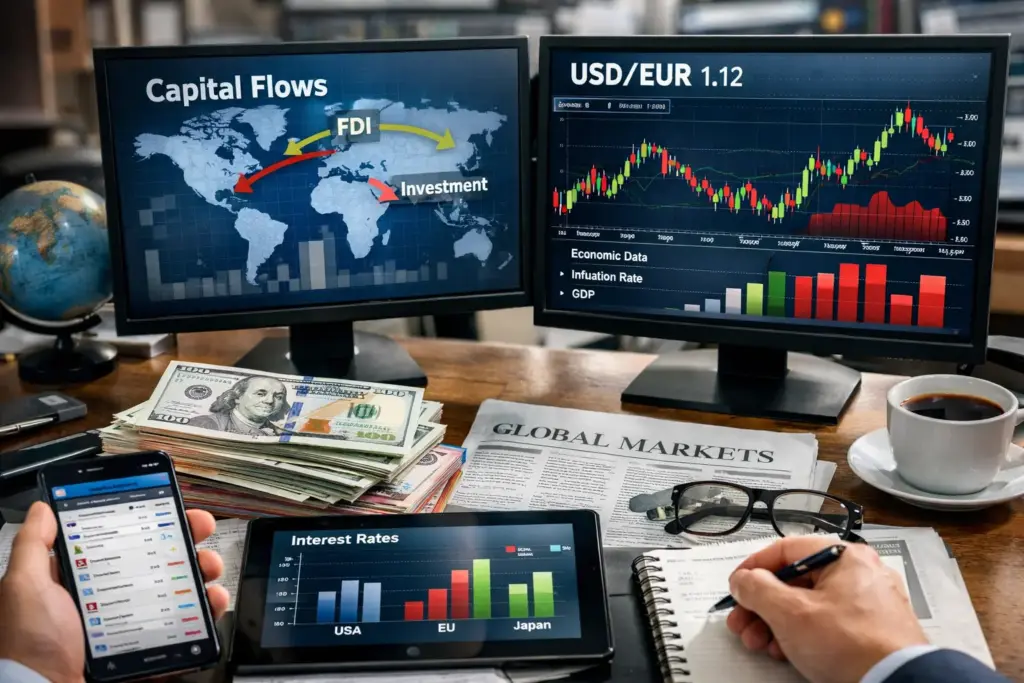
At its core, an exchange rate is the price of one currency expressed in terms ofWhen global demand for a country’s goods, services, or financial assets increases, the demand for its currency typically rises, leading to appreciation. Conversely, if a country experiences high inflation, its purchasing power erodes, often leading to a depreciation of its currency relative to others. For sophisticated investors, monitoring economic calendars and market insights is essential to anticipate these shifts. Capital flows, driven by foreign direct investment (FDI) and institutional trading, also play a pivotal role in daily price discovery. another. Like any asset in a free market, these prices are primarily driven by the laws of supply and demand. However, the “supply” and “demand” in the Forex market are influenced by a complex web of macroeconomic indicators, geopolitical stability, and market sentiment.
What is the difference between fixed and floating exchange rate regimes?
Currency regimes generally fall into two categories, each offering different levels of predictability and risk for the international investor.
Floating Exchange Rates
A floating rate is determined entirely by the private market through speculation and supply/demand. Most major economies, such as the United States, the UK, and the Eurozone, utilize this system. This flexibility allows the currency to act as a shock absorber for the economy; however, it introduces significant volatility for those holding multi-asset investment portfolios.
Fixed (Pegged) Exchange Rates
Under a fixed regime, a government or central bank ties its currency’s value to another major currency or a basket of currencies. A prominent example is the UAE Dirham (AED), which is pegged to the US Dollar. This provides immense stability for trade and regional investment, as it eliminates the “currency surprise” when transacting with USD-based assets. Understanding this peg is vital for clients utilizing DIFC-based financial services to fund international ventures.
How do interest rate differentials influence currency value?
Interest rates provided by central banks are perhaps the most potent drivers of exchange rate fluctuations. There is a high correlation between interest rates and currency demand because higher interest rates offer lenders in an economy a higher return relative to other countries.
This creates a phenomenon known as “hot money” flows, where investors move capital to countries with higher yields. For example, if the Federal Reserve increases rates while the European Central Bank remains dovish, the US Dollar often strengthens against the Euro. Investors must analyze these differentials when considering global brokerage opportunities to ensure they are positioned on the right side of the yield curve. It is not just the current rate that matters, but the expectation of future rate hikes or cuts.
Maximize Your Global Reach
Access international markets with a partner who understands global macro trends.

In what ways do exchange rates impact international investment portfolios?
For a diversified investor, the exchange rate is a “double-edged sword.” Even if the underlying asset—such as a stock or a piece of real estate—increases in value, the gain can be wiped out if the currency in which that asset is denominated weakens against the investor’s base currency.
The Impact on Equity Returns
If you hold US-denominated equities and the US Dollar appreciates, your returns (when converted back to a local currency or a different base currency) receive a significant boost. However, for corporations, a strong local currency can make exports more expensive and less competitive, potentially hurting the earnings of multinational companies within your portfolio.

Diversification Benefits
Currency itself can be an asset class. By holding assets in various denominations, investors can achieve a layer of diversification that protects against the devaluation of a single national economy. Leveraging professional wealth management perspectives can help in balancing these currency exposures effectively.
How can investors hedge against foreign exchange risk?
Risk mitigation is the hallmark of professional investing. To protect against adverse currency movements, institutional and retail investors alike employ several hedging strategies.
- Forward Contracts: These allow investors to “lock in” an exchange rate for a future date, providing certainty for upcoming transactions.
- Currency Options: Options give the holder the right, but not the obligation, to exchange money at a set rate, offering protection against downside risk while allowing for participation in favorable movements.
- Natural Hedging: Some investors align their costs and revenues in the same currency. For those trading in the UAE, the USD peg simplifies this process significantly.
By utilizing advanced trading platforms, investors can execute these strategies with precision, ensuring that currency volatility does not undermine their long-term financial goals.
Secure Your Investments
Protect your portfolio from market volatility with our expert hedging solutions.
Conclusion: The Strategic Importance of Currency Literacy
Understanding exchange rates is far more than tracking daily fluctuations; it is about recognizing the underlying economic forces that dictate the value of capital across borders. From interest rate pivots to the stability provided by pegged regimes like the UAE Dirham, currency dynamics influence every facet of the investment lifecycle.
As you look to expand your footprint in the global markets, staying informed and utilizing the right financial instruments is key. Whether you are managing corporate liquidity or personal wealth, a deep-seated knowledge of FX mechanics ensures you remain proactive rather than reactive in an ever-changing financial landscape.
Frequently Asked Questions (FAQs)
Currency shifts can eat your gains when converting back.
Timing the FX market is notoriously difficult. Many investors prefer “Dollar Cost Averaging” for currency exchange—breaking a large sum into smaller, periodic transfers. This strategy reduces the risk of exchanging all your capital at a single, unfavorable peak in the exchange rate.
Money moves to the Dollar, making other currencies weaker.
Google shows the raw rate; banks add a hidden fee or cut.
Disclaimer:
Trading foreign exchange and/or contracts for difference on margin carries a high level of risk, and may not be suitable for all investors as you could sustain losses in excess of deposits. The products are intended for retail, professional and eligible counterparty clients. Before deciding to trade any products offered by PhillipCapital (DIFC) Private Limited you should carefully consider your objectives, financial situation, needs and level of experience. You should be aware of all the risks associated with trading on margin. The content of the Website must not be construed as personal advice. For retail, professional and eligible counterparty clients. Before deciding to trade any products offered by PhillipCapital (DIFC) Private Limited you should carefully consider your objectives, financial situation, needs and level of experience. You should be aware of all the risks associated with trading on margin.
Rolling Spot Contracts and CFDs are complex instruments and come with a high risk of losing money rapidly due to leverage. 78% of our retail client accounts lose money while trading with us. You should consider whether you understand how Rolling Spot Contracts and CFDs work, and whether you can afford to take the high risk of losing your money.
Base Currency vs Quote Currency
Base Currency vs Quote Currency Table of Contents What is...
Read MoreMinor and Exotic Currency Pairs
Minor and Exotic Currency Pairs A Trader’s Guide to Global...
Read MoreForex Market Structure and Hours

Forex Market Structure and Hours The Complete Guide for UAE...
Read MoreWhat is Spot FX Trading and How Does It Work?
Decoding the Market What is Spot FX Trading and How...
Read MoreIntroduction to the Forex Market
Introduction to the Forex Market Your Gateway to Global Currency...
Read More