How Futures Exchanges Work

Understanding the Mechanics of Global Futures Exchanges

As the global financial landscape becomes increasingly sophisticated, futures exchanges remain the bedrock of price discovery and risk management. For investors looking to hedge exposure or capitalize on market volatility, understanding the structural “engine room” of these marketplaces is essential.

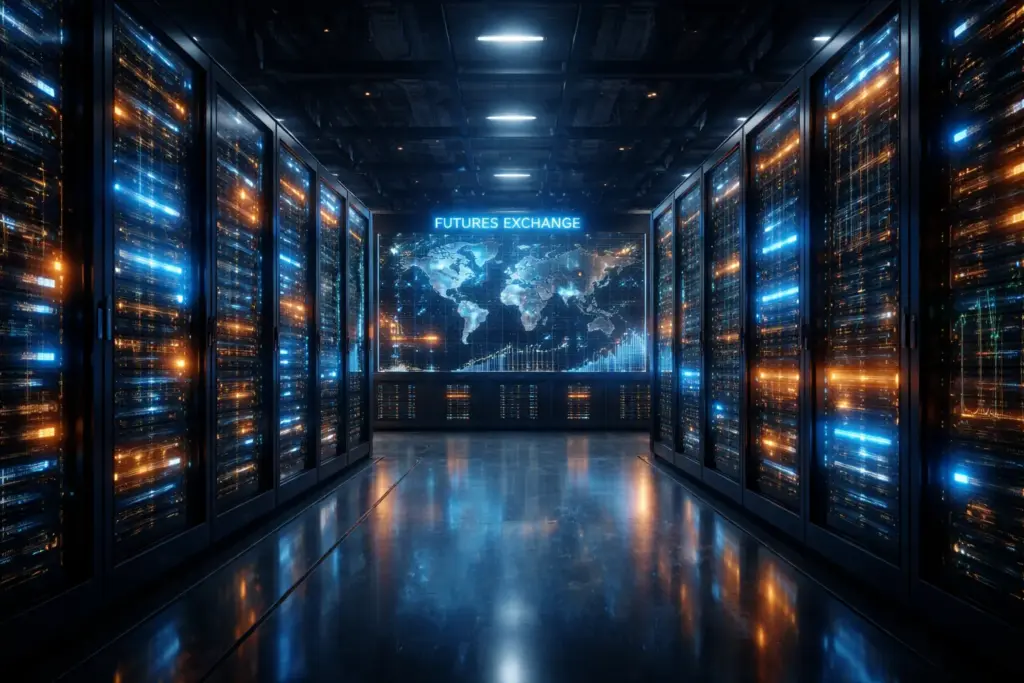
Ultrarealistic wide-angle view of a modern financial data center with blue and amber server racks representing global futures exchange infrastructure

What is a Futures Exchange and its Primary Role?

A futures exchange is a central financial marketplace where participants buy and sell standardized futures contracts and options on futures. Unlike the decentralized over-the-counter (OTC) markets, an exchange acts as a highly regulated ecosystem that ensures transparency, liquidity, and efficiency.

The primary role of the exchange is to provide a platform for price discovery. By bringing together a vast pool of buyers and sellers, the exchange reflects the real-time equilibrium price of assets ranging from gold and crude oil to equity indices. For those exploring diversified investment products in Dubai, the exchange serves as the gateway to global macro trends. It eliminates the need for traders to find a specific counterparty manually, as the exchange’s automated matching engines pair buy and sell orders in milliseconds.

How is Trade Execution Standardized?

One of the defining features of a futures exchange is standardization. In a private contract, two parties might disagree on quality or delivery dates; however, an exchange removes this ambiguity by pre-defining every variable of a contract except for the price.

When you trade through a regulated futures and options broker, you are dealing with contracts that specify the underlying asset, contract size, and fixed expiry dates. This uniformity allows for high-frequency trading and deep liquidity, making it easier for investors to enter and exit positions without significant slippage. This system is what distinguishes these products from more flexible instruments like OTC derivatives and CFDs, which can be tailored to specific needs.

Navigate Global Markets with Precision

Access world-class exchanges with a trusted, DFSA-regulated partner.

What is the Role of the Clearinghouse in Risk Mitigation?

Perhaps the most critical “hidden” component of a futures exchange is the Clearinghouse. Once a trade is executed between a buyer and a seller, the clearinghouse steps in to become the buyer to every seller and the seller to every buyer. This process is known as novation.

By acting as the central counterparty (CCP), the clearinghouse effectively eliminates counterparty risk. If one trader fails to meet their financial obligations, the clearinghouse uses its default fund and margin requirements to ensure the other party is still paid. This institutional guarantee is a core part of futures fundamentals and is why professional traders often prefer accessing international futures markets through regulated entities.

Polished chrome shield with a glowing digital grid overlay on a marble boardroom table, symbolizing protection and risk mitigation

How Does Margin and Daily Mark-to-Market Work?

To maintain the integrity of the market, futures exchanges operate on a margin system. Unlike equities, where margin is a loan, futures margin is a “performance bond” or good faith deposit. At the end of every trading day, the exchange calculates the gain or loss on your position based on the closing price—a process called Mark-to-Market.

This daily settlement prevents the buildup of massive unpaid losses. However, because these products are leveraged, it is crucial to understand the differences between notional and market value. While your deposited margin might be small, your notional exposure to price fluctuations remains at the full contract size, meaning losses can theoretically exceed your initial deposit.

Who are the Primary Participants in a Futures Exchange?

The ecosystem of a futures exchange is fueled by two main groups whose opposing goals create a balanced market:

  • Hedgers: These are often producers or consumers of physical commodities. They use DGCX futures and gold products to lock in prices and protect themselves against adverse price movements in the local and global markets.
  • Speculators and Investors: This group provides the liquidity that hedgers need. By analyzing long vs short trading strategies, they accept price risk in pursuit of profit, ensuring that there is always a counterparty available for every trade.

Tailored Investment Solutions

Connect with our experts to align your trading strategy with global benchmarks

Conclusion: The Strategic Value of Exchange-Traded Derivatives

Futures exchanges are far more than just “trading floors”; they are sophisticated regulatory and technological hubs that facilitate global commerce. By providing a standardized environment, eliminating counterparty risk through clearinghouses, and ensuring daily financial transparency, these exchanges allow for efficient capital allocation.

For the modern investor, the exchange offers a transparent window into the future value of assets. Whether you are seeking to hedge a corporate currency risk or diversify a retail portfolio, choosing a trusted and regulated broker ensures that you are supported by world-class infrastructure and regulatory oversight throughout your investment journey.

Frequently Asked Questions (FAQs)

Do I have to take physical delivery of the goods?

No, the vast majority of traders never see a physical barrel of oil. Most contracts are either cash-settled or closed out before the expiration date by taking an offsetting position. Only a tiny fraction of participants, typically large industrial hedgers, engage in the actual physical delivery process.

Can I lose more than my initial deposit?

Yes. Because futures utilize leverage, you are controlling a large contract value with a relatively small amount of capital. If the market moves sharply against you, your losses can exceed your initial margin. This is why strict risk management and maintaining a sufficient account balance are critical.

What is the difference between a futures contract and an option?

The main difference is obligation. In a futures contract, both the buyer and seller are legally obligated to fulfill the trade at the set price upon expiration. An option, however, gives the buyer the right, but not the obligation, to trade.

Why do futures prices differ from the current "spot" price?

The difference, often called the basis, is primarily driven by the “cost of carry.” This includes expenses like storage, insurance, and interest rates required to hold the asset until the future delivery date, alongside the market’s expectation of future value.

Disclaimer:

Trading foreign exchange and/or contracts for difference on margin carries a high level of risk, and may not be suitable for all investors as you could sustain losses in excess of deposits. The products are intended for retail, professional and eligible counterparty clients. Before deciding to trade any products offered by PhillipCapital (DIFC) Private Limited you should carefully consider your objectives, financial situation, needs and level of experience. You should be aware of all the risks associated with trading on margin. The content of the Website must not be construed as personal advice. For retail, professional and eligible counterparty clients. Before deciding to trade any products offered by PhillipCapital (DIFC) Private Limited you should carefully consider your objectives, financial situation, needs and level of experience. You should be aware of all the risks associated with trading on margin.

Rolling Spot Contracts and CFDs are complex instruments and come with a high risk of losing money rapidly due to leverage. 78% of our retail client accounts lose money while trading with us. You should consider whether you understand how Rolling Spot Contracts and CFDs work, and whether you can afford to take the high risk of losing your money.