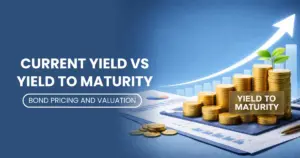
Understanding Current Yield vs. Yield to Maturity

Understanding Current Yield vs. Yield to Maturity: A Comprehensive Guide for Bond Investors

In the sophisticated world of fixed-income investing, understanding how to calculate and interpret returns is paramount. While many investors focus solely on the “coupon rate,” seasoned professionals look deeper into yield metrics to determine the true value of an asset. Two of the most critical metrics used by traders and global institutions are Current Yield and Yield to Maturity (YTM).

This guide explores the nuances of these calculations, helping you make informed decisions in the evolving debt markets of the DIFC and beyond.

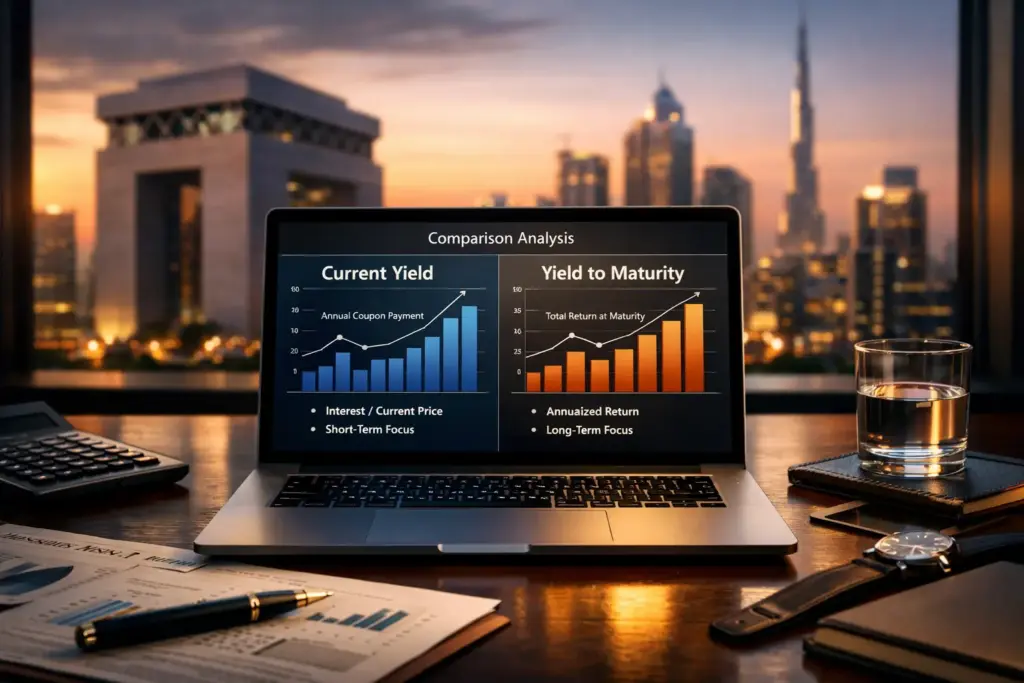
Ultra-realistic Dubai office desk with laptop showing Current Yield vs Yield to Maturity chart at sunset

What is the fundamental difference between Current Yield and Yield to Maturity?

The primary distinction lies in the scope of the calculation and the time horizon of the investment. Current Yield is a “snapshot” metric. It represents the annual income (interest) an investment generates relative to its current market price. It is a straightforward calculation that does not account for any capital gains or losses that occur if the bond is held until it matures.

In contrast, Yield to Maturity (YTM) is a “total return” metric. It is the theoretical rate of return an investor will receive if they hold the bond until its expiration date. YTM is more complex because it factors in the current market price, the par value, the coupon interest rate, and the time remaining to maturity. For those looking to optimize their investment products through fixed-income assets, understanding that YTM accounts for the time value of money is essential for accurate forecasting.

How is Current Yield calculated and when is it most useful?

Current Yield is calculated by dividing the annual coupon payment by the bond’s current market price. For example, if a bond with a face value of $1,000 pays a 5% coupon ($50) but is currently trading at a discount price of $900, the current yield is 5.55% ($50 / $900).

This metric is particularly useful for income-oriented investors who prioritize immediate cash flow over long-term capital appreciation. If you are exploring tailored wealth management solutions to supplement cash flow, the current yield tells you exactly what your “cash-on-cash” return looks like today. However, it is a lagging indicator of total performance because it ignores the eventual profit made when the bond matures at its full face value.

Discover Custom Investment Solutions

Align your portfolio with expert-led structured strategies.

Why is Yield to Maturity considered the 'Gold Standard' for bond valuation?

Yield to Maturity is widely regarded as the most accurate measure of a bond’s value because it offers a holistic view. It allows investors to compare bonds with different coupons and maturities on an “apples-to-apples” basis. By factoring in the “pull to par”—the process where a bond’s price moves toward its face value as it nears maturity—YTM captures the total economic benefit of the investment. 

Professional traders and family offices often use YTM to identify mispriced securities. When the YTM is higher than the current yield, the bond is likely trading at a discount; conversely, when YTM is lower, the bond is trading at a premium. For those utilizing institutional-grade brokerage services, YTM serves as the internal rate of return (IRR) used to determine if a debt instrument meets the specific requirements of a sophisticated investment mandate.

Ultra-realistic image of a golden balance scale weighing coupon payments against maturity date in a modern glass-walled DIFC boardroom

How do market fluctuations impact these yield metrics?

Bond prices and yields have an inverse relationship. When central banks adjust interest rates, the market price of existing bonds shifts, immediately impacting both yield metrics. If interest rates rise, existing bond prices typically fall to remain competitive with newer issues.

This causes the Current Yield to rise (since you are paying less for the same fixed coupon). Simultaneously, the YTM will increase, reflecting the enhanced value of the bond at its new, lower price. Navigating these fluctuations requires a deep understanding of global market risk and return profiles and how macro-economic shifts influence volatility. Understanding these movements is key to “locking in” yields before market cycles turn.

Which metric should an investor prioritize for a long-term portfolio?

For the majority of long-term investors, Yield to Maturity is the superior metric. It provides a realistic expectation of the annualized return, assuming the issuer does not default and the bond is held until the end. It is the essential metric for compounding wealth over several years.

However, Current Yield remains a vital tool for managing liquidity. For instance, when trading via advanced multi-asset platforms, current yield helps you understand the immediate yield-on-cost. This is important for investors who may need to exit positions early or those who require consistent income to fund other global investment opportunities.

Master Global Debt Markets

Access fixed income, equities, and derivatives with a trusted partner.

Conclusion: Integrating Yield Analysis into Your Strategy

Navigating the complexities of “Current Yield vs. Yield to Maturity” is a hallmark of a sophisticated investor. While Current Yield offers a clear view of immediate income, Yield to Maturity provides the comprehensive “total picture” necessary for long-term capital preservation and growth.

By understanding the interplay between these two figures—especially in a fluctuating interest rate environment—investors can better position their portfolios for success. Whether you are seeking immediate income or long-term appreciation, a disciplined approach to yield analysis will ensure your fixed-income strategy remains robust and aligned with your financial objectives in the global capital markets.

Frequently Asked Questions (FAQs)

Is Current Yield more important than YTM for a short-term investor?

 Yes. If you plan to sell a bond within a year, Current Yield is more relevant as it measures your immediate cash flow relative to the purchase price. However, keep in mind that it doesn’t account for the price change you might experience when you eventually sell the bond on the secondary market.

Why does my bond’s YTM differ from its original coupon rate?

This happens because bond prices change after they are issued. If you buy a bond at a discount (below its face value), your YTM will be higher than the coupon rate. If you buy it at a premium (above face value), your YTM will be lower. YTM adjusts the coupon return to include these capital gains or losses.

If I hold a bond until it matures, will I actually earn the YTM?

Generally, yes, provided the issuer does not default. YTM is the annualized return you realize if you hold the bond to the end and—crucially—if you reinvest all your coupon payments at that same YTM rate. If you spend the interest instead of reinvesting it, your actual realized return may differ slightly.

Can a bond have a high Current Yield but a low Yield to Maturity?

Absolutely. This typically happens with “Premium Bonds” that have high coupon rates but are trading well above their face value. While the annual interest check is large (high Current Yield), the loss you take when the bond matures at par value drags down the total return (low YTM).

Disclaimer:

Trading foreign exchange and/or contracts for difference on margin carries a high level of risk, and may not be suitable for all investors as you could sustain losses in excess of deposits. The products are intended for retail, professional and eligible counterparty clients. Before deciding to trade any products offered by PhillipCapital (DIFC) Private Limited you should carefully consider your objectives, financial situation, needs and level of experience. You should be aware of all the risks associated with trading on margin. The content of the Website must not be construed as personal advice. For retail, professional and eligible counterparty clients. Before deciding to trade any products offered by PhillipCapital (DIFC) Private Limited you should carefully consider your objectives, financial situation, needs and level of experience. You should be aware of all the risks associated with trading on margin.

Rolling Spot Contracts and CFDs are complex instruments and come with a high risk of losing money rapidly due to leverage. 78% of our retail client accounts lose money while trading with us. You should consider whether you understand how Rolling Spot Contracts and CFDs work, and whether you can afford to take the high risk of losing your money.