Decoding the Market

What is Spot FX Trading and How Does It Work?

In the world of global finance, the foreign exchange (Forex) market stands as the largest and most liquid asset class, with trillions of dollars exchanged daily. At the heart of this ecosystem is Spot FX, the primary vehicle for currency exchange. But for traders in the UAE and beyond, understanding the mechanics of “on-the-spot” trading is crucial before entering the market.

In this , we break down exactly what Spot FX trading is, how it functions in the DIFC regulatory environment, and why it remains a popular choice for sophisticated investors.

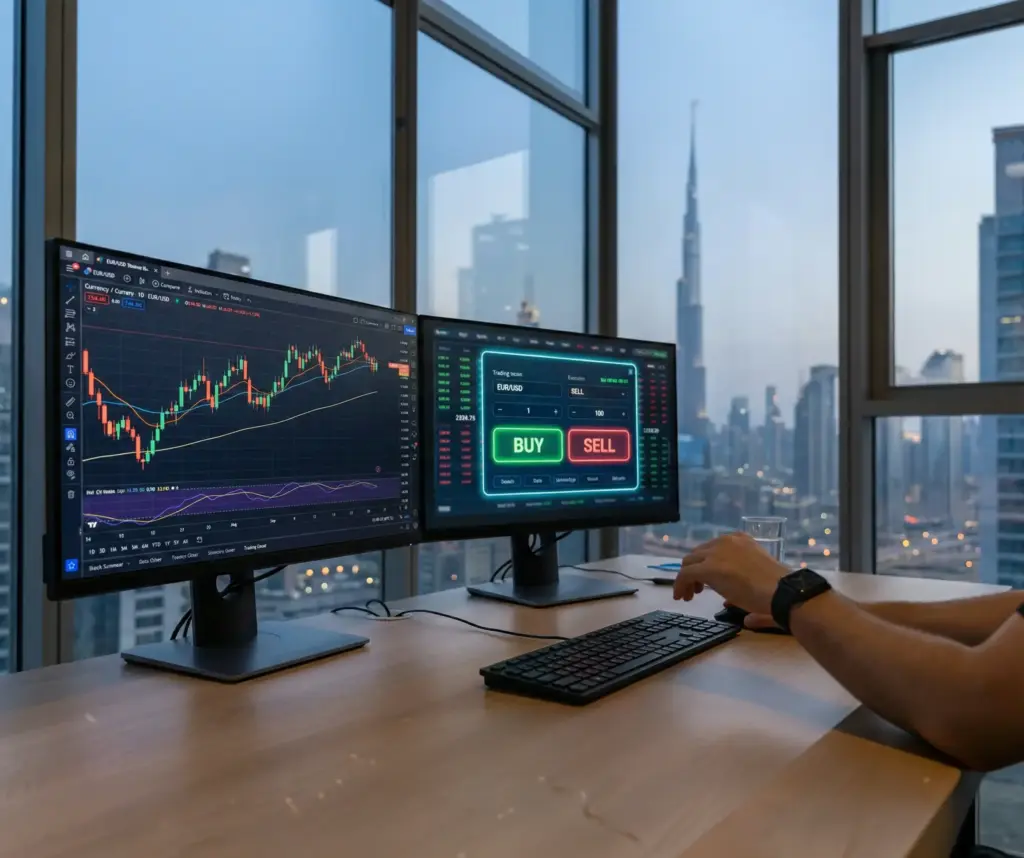
A close-up, photorealistic view of a dual-monitor trading station in a Dubai office, displaying a EUR/USD candlestick chart on one screen and a sharp focus on "Buy" and "Sell" buttons on the execution terminal, set against a blurred city skyline.

What exactly is Spot FX Trading?

Spot FX (Foreign Exchange) trading refers to the purchase or sale of foreign currencies for “immediate” delivery. Unlike futures or options—which are contracts to buy or sell at a specific date in the future—a spot deal is settled effectively “on the spot.”

Technically, while the price is agreed upon instantly, the standard settlement period for most currency pairs is T+2 (two business days after the trade date). This short timeframe is why it is called the “spot” market; it reflects the current market price of a currency right now, rather than a speculative price for next month or next year.

When you trade Spot FX, you are participating in the Over-the-Counter (OTC) market. There is no central physical exchange like the New York Stock Exchange. Instead, trades are conducted electronically between a network of banks, brokers (like PhillipCapital DIFC), and liquidity providers, ensuring the market operates 24 hours a day, 5 days a week.

How does a Spot FX trade actually work mechanically?

Mechanically, every Forex trade involves the simultaneous buying of one currency and the selling of another. This is why currencies are always quoted in pairs, such as EUR/USD or GBP/USD.

Let’s break down a trade using the EUR/USD pair:

  • Base Currency (EUR): The first currency in the pair.
  • Quote Currency (USD): The second currency in the pair.

If the EUR/USD price is 1.1050, it means 1 Euro is worth 1.1050 US Dollars.

  • Buying (Going Long): If you believe the Euro will rise in value against the Dollar, you buy the pair. You profit if the exchange rate goes up.
  • Selling (Going Short): If you believe the Euro will weaken against the Dollar, you sell the pair. You profit if the exchange rate goes down.

In the context of Spot FX with a broker, you are typically trading on margin. This means you don’t need to put up the full value of the €100,000 contract. Instead, you put up a small percentage (margin) to open the position, allowing for capital efficiency.

Ready to access global currency markets?

How is Spot FX different from Currency Futures?

This is a critical distinction for professional traders. While both instruments allow you to speculate on currency movements, their structure differs significantly:

  1. Settlement Date:
    • Spot FX: Settles almost immediately (T+2). However, most retail and professional traders “roll over” their positions to avoid physical settlement, effectively keeping the trade open indefinitely.
    • Currency Futures: Have a fixed expiration date (e.g., usually the third Wednesday of the delivery month). You are trading a contract that expires in the future.
  2. Market Structure:
    • Spot FX: Decentralized (OTC). Prices can vary slightly between brokers but generally track the global interbank rate.
    • Currency Futures: Centralized exchange trading (e.g., DGCX or CME). Prices and volumes are recorded on a central exchange.
  3. Contract Size:
    • Spot FX: Highly flexible. You can trade micro lots (1,000 units) or standard lots (100,000 units), allowing for precise position sizing.

Currency Futures: Standardized contract sizes that cannot be customized.

What are the primary benefits of trading Spot FX?

Spot FX is the preferred instrument for many active traders due to several unique advantages:

  • Deep Liquidity: The Forex market sees over $6 trillion in daily turnover. This liquidity means you can usually enter and exit trades instantly without significant price slippage, even in large sizes.
  • 24/5 Accessibility: The market follows the sun, opening in New Zealand/Australia on Monday morning and closing in New York on Friday afternoon. This allows you to react to news events (like US Non-Farm Payrolls or ECB interest rate decisions) whenever they happen.
  • Leverage: Spot FX allows traders to control large positions with a smaller initial deposit. While this increases profit potential, it is vital to remember that it also increases risk.
  • Two-Way Opportunities: Unlike buying stocks where you typically only profit if the price goes up, in Spot FX, selling (shorting) is just as easy as buying. You can potentially profit from falling economies as easily as rising ones.
A photorealistic view of a professional forex trader's workstation in a dimly lit room, featuring ultra-wide monitors displaying real-time EUR/USD charts, liquidity heatmaps, and an economic calendar. A trader's hand rests on a keyboard ready to execute a trade, with a digital world map in the background indicating active global market sessions.

What are the risks I should be aware of?

Trading Spot FX involves significant risk, primarily due to leverage.

  • Leverage Risk: While leverage magnifies gains, it also magnifies losses. A small market movement against your position can result in the loss of a significant portion of your capital.
  • Volatility Risk: Currencies can be highly volatile. Geopolitical events or sudden economic announcements can cause rapid price spikes (whipsaws) that may trigger stop-loss orders.
  • Counterparty Risk: In the OTC market, you rely on the financial stability of your broker. This is why trading with a regulated entity like PhillipCapital DIFC (regulated by the DFSA) is paramount for the safety of your funds.

Risk management is key to longevity in trading

Visit our Risk Disclosure page to understand how we protect our clients.

Why trade Spot FX with PhillipCapital DIFC?

Choosing the right broker is as important as choosing the right currency pair. PhillipCapital DIFC offers a distinct advantage for traders in the UAE and MENA region:

  1. Regulatory Trust: We are regulated by the Dubai Financial Services Authority (DFSA), providing you with a secure, transparent, and compliant trading environment.
  2. Global Footprint: As part of the PhillipCapital Group (Singapore), we have over 50 years of experience in global financial markets.
  3. Institutional-Grade Platforms: We provide access to robust trading platforms that offer low latency execution—essential for Spot FX trading.
  4. Local Support: Our team is based right here in the DIFC, meaning you have access to local support and expertise rather than a remote call center.

Spot FX trading offers a dynamic way to participate in the global economy. Whether you are hedging foreign currency exposure for your business or speculating on the direction of the US Dollar, the spot market provides the liquidity and flexibility you need. However, success requires education, discipline, and a trusted broker by your side.

Disclaimer:

Trading foreign exchange and/or contracts for difference on margin carries a high level of risk, and may not be suitable for all investors as you could sustain losses in excess of deposits. The products are intended for retail, professional and eligible counterparty clients. Before deciding to trade any products offered by PhillipCapital (DIFC) Private Limited you should carefully consider your objectives, financial situation, needs and level of experience. You should be aware of all the risks associated with trading on margin. The content of the Website must not be construed as personal advice. For retail, professional and eligible counterparty clients. Before deciding to trade any products offered by PhillipCapital (DIFC) Private Limited you should carefully consider your objectives, financial situation, needs and level of experience. You should be aware of all the risks associated with trading on margin.

Rolling Spot Contracts and CFDs are complex instruments and come with a high risk of losing money rapidly due to leverage. 78% of our retail client accounts lose money while trading with us. You should consider whether you understand how Rolling Spot Contracts and CFDs work, and whether you can afford to take the high risk of losing your money.

Ready to start your trading journey?

Open Your Account Today