

Convexity in Bond Pricing Explained Master the Basics: What is...
Read MoreBond Duration & Interest Rate Risk Explained
Table of Contents
- Introduction: The Seesaw Effect of Bonds and Interest Rates
- What Is Bond Duration and Why Does It Matter?
- How Exactly Does Interest Rate Risk Affect Bondholders?
- What Is the Direct Relationship Between Duration and Interest Rate Risk?
- How Can Investors Use Duration to Manage Portfolio Risk?
- Conclusion: Key Takeaways for Fixed-Income Investors
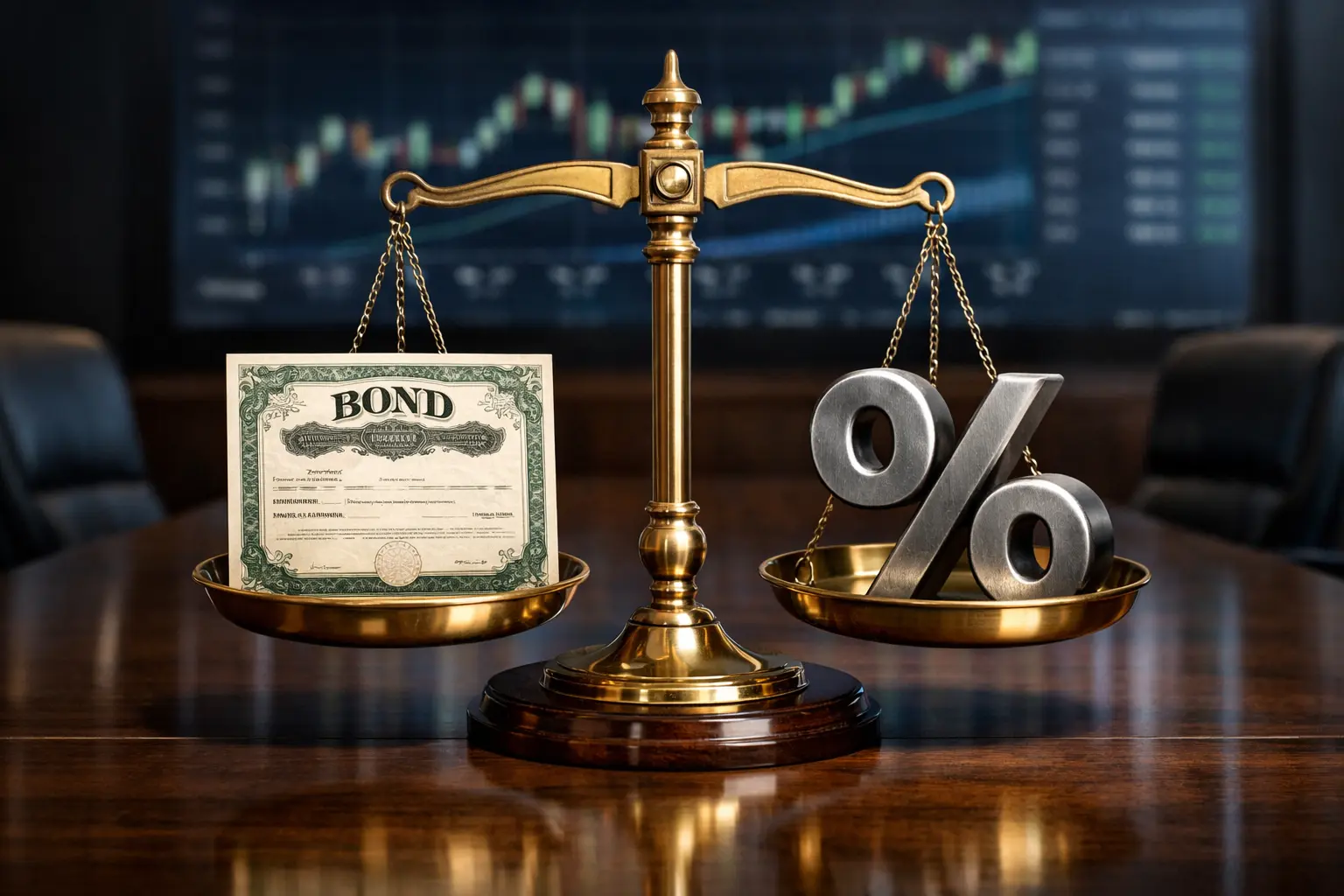
Introduction: The Seesaw Effect of Bonds and Interest Rates
For many investors, bonds represent stability. They are the cornerstone of a balanced portfolio, designed to provide a steady stream of income and preserve capital during volatile stock market cycles. However, labeling bonds as “risk-free” is a dangerous misconception. The market has its own set of shifting dynamics, and the most prominent among them is the movement of interest rates.
When you invest in fixed-income assets, understanding the invisible forces that influence their market value is crucial. This brings us to a fundamental concept every fixed-income investor must master: bond duration. It is the ultimate measuring stick for understanding how vulnerable your investments are to changing economic tides. In this guide, we will break down the relationship between duration and interest rate risk, providing you with the insights needed to make smarter, more resilient investment decisions.
What Is Bond Duration and Why Does It Matter?
When most people hear the word “duration,” they immediately think of time—specifically, how long it takes for a bond to reach its maturity date. While time is a factor, in the financial world, duration means something much more specific.
Bond duration is a measurement of a bond’s price sensitivity to changes in interest rates. It is expressed in years, but it is not simply the lifespan of the bond. Instead, duration calculates the weighted average time it takes for an investor to receive all the cash flows (interest payments and the return of principal) from a bond.
Why does this matter? Because duration acts as a financial thermometer. It tells you exactly how much the price of your bond will heat up or cool down when central banks adjust interest rates. A higher duration means the bond’s price will swing more drastically when rates change. A lower duration means the bond’s price will remain relatively stable. If you are exploring various investment products and solutions to preserve your capital, knowing the duration of the assets within your portfolio is the first step in defending against unexpected market fluctuations.
How Exactly Does Interest Rate Risk Affect Bondholders?
Interest rate risk is the potential for investment losses that result from a change in interest rates. To understand this, you must understand the golden rule of fixed income: bond prices and interest rates move in opposite directions. They operate on a seesaw.
Imagine you buy a 10-year bond paying a 4% fixed interest rate. A year later, the central bank raises rates to curb inflation, and new bonds are now being issued with a 6% interest rate. Suddenly, your 4% bond looks far less attractive to other investors. If you decide to sell your bond before it matures, you will have to sell it at a discount (a lower price) to make it competitive with the new 6% bonds. This drop in your bond’s market value is interest rate risk in action.
Conversely, if interest rates fall to 2%, your 4% bond becomes highly desirable, and its market price will rise. For investors who plan to hold a bond until maturity, daily price fluctuations might seem irrelevant since they will eventually receive their principal back. However, for those actively applying specific trading strategies or holding mutual funds and ETFs, interest rate risk is a constant, daily reality that requires proactive management.
Ready to Diversify Your Portfolio?
Explore tailored structured notes and global bonds
What Is the Direct Relationship Between Duration and Interest Rate Risk?
Duration and interest rate risk are inextricably linked. In fact, duration is the exact mathematical formula used to quantify interest rate risk.
Here is the simple rule of thumb: For every 1% change in interest rates, a bond’s price will move in the opposite direction by a percentage roughly equal to its duration.
Let’s look at a practical example:
- Bond A has a duration of 2 years.
- Bond B has a duration of 8 years.
If global interest rates rise by 1%:
- The price of Bond A will fall by approximately 2%.
- The price of Bond B will fall by approximately 8%.
If interest rates drop by 1%:
- The price of Bond A will rise by about 2%.
- The price of Bond B will rise by about 8%.
This simple calculation reveals why long-term bonds, which typically have higher durations, carry significantly more interest rate risk than short-term bonds. As you build your portfolio, selecting the right mix of durations is essential. Leveraging professional, institutional services for funds and family offices can help you accurately calculate your portfolio’s overall duration, ensuring it aligns with your personal risk tolerance and the current macroeconomic climate.
How Can Investors Use Duration to Manage Portfolio Risk?
Understanding duration is only half the battle; applying it to protect your wealth is where true strategy comes into play. Astute investors and fund managers use duration actively to shield their capital from adverse rate movements while positioning themselves for growth.
Here are the primary ways to manage your risk using duration:
- Shortening Duration in a Rising Rate Environment If economic indicators suggest that central banks are preparing to raise interest rates, it is generally wise to reduce the average duration of your bond portfolio. By shifting investments into short-term bonds or floating-rate notes, you minimize the negative price impact when rates inevitably climb.

- Lengthening Duration in a Falling Rate Environment If the economy slows down and interest rates are expected to be cut, longer-duration bonds become highly advantageous. Because they are highly sensitive to rate changes, their prices will surge significantly higher than short-term bonds when rates drop, allowing investors to capture substantial capital gains.
- Building a Bond Ladder Bond laddering is a defensive strategy where an investor purchases multiple bonds with staggered maturity dates (e.g., bonds maturing in 1, 3, 5, and 7 years). As the short-term bonds mature, the principal is reinvested into new, longer-term bonds at the current interest rates. This naturally blends different durations, providing a steady income stream while smoothing out the impact of interest rate volatility over time.
Whether you are executing these trades independently or utilizing comprehensive institutional execution capabilities, adjusting your duration strategy based on global forecasts is critical for long-term fixed-income success.
Optimize Your Corporate Strategy
Access institutional-grade brokerage and custody support across major asset classes.
Conclusion: Key Takeaways for Fixed-Income Investors
Bonds remain a vital tool for capital preservation and income generation, but navigating the fixed-income market requires a clear understanding of its underlying mechanics. By mastering the concepts of duration and interest rate risk, you transition from a passive saver to a strategic investor.
Key Takeaways:
- The Seesaw Rule: Bond prices and interest rates always move in opposite directions.
- Duration is a Risk Metric: It measures a bond’s price sensitivity to interest rate changes, not just its time to maturity.
- The 1% Rule: A bond’s price will generally drop by a percentage equal to its duration for every 1% rise in interest rates.
- Active Management is Key: Adjusting your portfolio’s duration based on the economic cycle is an essential strategy for protecting your capital and maximizing returns.
By keeping a close eye on interest rate trends and actively managing your portfolio’s duration, you can confidently navigate the complexities of the bond market and secure your financial future.
Frequently Asked Questions (FAQs)
Is bond duration the exact same thing as maturity?
No. Maturity is simply the date when the bond issuer returns your original investment. Duration is a risk metric that measures how much the bond’s price will fluctuate when interest rates change. While longer maturity generally leads to a higher duration, they are measuring two entirely different concepts (time versus price sensitivity).Yes, it is generally considered riskier than standard session trading. While it allows you to react to earnings released before the bell, the “Pre-Market” suffers from significantly lower liquidity. This means there are fewer buyers and sellers, which leads to “wider spreads” (a larger gap between the bid and ask price). A stock might look stable, but a small order can cause a sudden price jump or drop that wouldn’t happen during regular hours.
What happens to my bond ETF or mutual fund if interest rates rise?
If interest rates go up, the Net Asset Value (NAV) of your bond fund will drop. The severity of that drop depends on the fund’s average duration. For instance, if your ETF has a duration of 6 years and rates rise by 1%, the fund’s value will decline by roughly 6%. However, the fund will subsequently begin reinvesting in newer, higher-yielding bonds.
If I hold an individual bond until it matures, does duration still matter?
Yes and no. If you hold the bond to maturity, you will receive your full principal back (barring a default), so the temporary price drops driven by duration won’t result in a realized loss. However, duration still represents your opportunity cost—meaning you are locked into earning a lower interest rate while the rest of the market is earning more.
Should I completely avoid long-duration bonds when interest rates are high?
Not necessarily. While long-duration bonds suffer the most when rates are actively rising, they are actually the best performers when rates peak and begin to fall. If economic conditions shift and central banks cut interest rates, the prices of long-duration bonds will surge the highest, offering significant capital appreciation.
Disclaimer:
Trading foreign exchange and/or contracts for difference on margin carries a high level of risk, and may not be suitable for all investors as you could sustain losses in excess of deposits. The products are intended for retail, professional and eligible counterparty clients. Before deciding to trade any products offered by PhillipCapital (DIFC) Private Limited you should carefully consider your objectives, financial situation, needs and level of experience. You should be aware of all the risks associated with trading on margin. The content of the Website must not be construed as personal advice. For retail, professional and eligible counterparty clients. Before deciding to trade any products offered by PhillipCapital (DIFC) Private Limited you should carefully consider your objectives, financial situation, needs and level of experience. You should be aware of all the risks associated with trading on margin.
Rolling Spot Contracts and CFDs are complex instruments and come with a high risk of losing money rapidly due to leverage. 78% of our retail client accounts lose money while trading with us. You should consider whether you understand how Rolling Spot Contracts and CFDs work, and whether you can afford to take the high risk of losing your money.
Bond Duration & Interest Rate Risk Explained
Bond Duration & Interest Rate Risk Explained Table of Contents...
Read More
Macaulay Duration Explained
Macaulay Duration Explained Macaulay Duration Explained: A Comprehensive Guide for...
Read More
Modified Duration and Its Impact on Price
Modified Duration and Its Impact on Bond Prices Introduction Navigating...
Read More
Understanding Bond Duration
Understanding Bond Duration Introduction When stepping into the fixed-income market,...
Read More