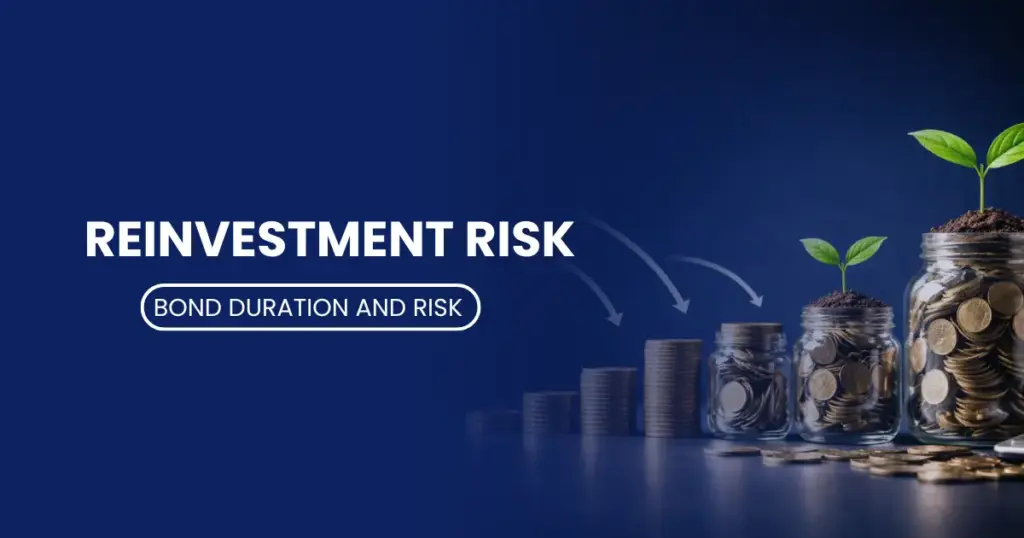
Reinvestment Risk
Reinvestment Risk Reinvestment Risk in Bonds: Managing the Impact of Falling Rates When constructing a resilient portfolio, fixed-income assets are widely celebrated for providing steady, predictable cash flows. However, securing a stable income stream requires navigating various market dynamics. While many investors focus heavily on the immediate threat of rising interest rates, there is a secondary, often overlooked challenge that surfaces when economic tides turn: reinvestment risk. Understanding how this risk functions is critical for safeguarding long-term yields and maintaining the true earning power of your capital in a shifting global market. Table of Contents What Exactly is Reinvestment Risk in the Bond Market? How Do Interest Rate Fluctuations Trigger Reinvestment Risk? Which Types of Bonds Are Most Vulnerable to Reinvestment Risk? How Does Reinvestment Risk Differ from Interest Rate Risk? What Strategic Approaches Can Mitigate Reinvestment Risk? Conclusion & Key Takeaways What Exactly is Reinvestment Risk in the Bond Market? Reinvestment risk is the likelihood that an investor will be unable to reinvest cash flows received from an investment at a rate comparable to their original rate of return. When you hold fixed-income securities, you periodically receive cash in the form of interest payments (coupons) and eventually the return of your principal amount at maturity. If market interest rates drop during the life of your investment, you are forced to put those cash returns into newly issued assets that offer lower yields. Over time, this erodes the compound growth and total return of your portfolio. For example, imagine purchasing a 10-year corporate bond that pays a 6% annual coupon. If central banks cut interest rates a few years later and new bonds are only yielding 3.5%, every coupon payment you receive from your original bond must now be reinvested at that much lower 3.5% rate. If you are still exploring the foundational elements of these securities, understanding the basics of how a bond works is vital before managing the complexities of reinvesting your returns. How Do Interest Rate Fluctuations Trigger Reinvestment Risk? The fixed-income market is deeply tethered to the broader macroeconomic environment. When a central bank decides to lower its benchmark interest rate to stimulate economic growth, the cost of borrowing drops. Consequently, governments and corporations begin issuing new debt at these lower rates. While falling rates are generally positive for the price of existing bonds in the secondary market, they create a hostile environment for income generation. As your current investments pay out their scheduled coupons, or as older bonds in your portfolio reach their maturity date, you are handed cash that needs a new home. Because the prevailing market rates have dropped, the financial landscape no longer offers the attractive yields you previously enjoyed. You are effectively penalized for having cash on hand during a low-rate cycle. To grasp how these market shifts dictate the exact worth of your assets before they mature, it helps to understand bond pricing fundamentals and how yields interact with market rates. Master the Mechanics of Bond Valuation Learn how yields, coupons, and market rates determine fixed-income pricing. Read Our Bond Pricing Guide Which Types of Bonds Are Most Vulnerable to Reinvestment Risk? Not all fixed-income assets carry the same level of exposure to this specific risk. The vulnerability of a bond depends heavily on its structure and its payout schedule. Callable Bonds Callable bonds are uniquely susceptible to reinvestment risk. These instruments give the issuer the right to pay off the debt early, before the official maturity date. Issuers typically exercise this right when interest rates fall, allowing them to refinance their debt at a cheaper borrowing cost. When a bond is called, the investor suddenly receives their entire principal back early and is forced to reinvest the whole sum into a lower-yielding market. Mortgage-Backed Securities (MBS) Similar to callable bonds, Mortgage-Backed Securities face early repayment variables. When interest rates drop, homeowners inevitably rush to refinance their mortgages to lock in lower monthly payments. This surge in refinancing returns capital to the MBS investor earlier than anticipated. This dynamic is deeply tied to prepayment risk and extension risk, both of which can significantly disrupt long-term financial planning. High-Coupon Bonds Even if a bond cannot be called early, bonds that pay unusually high coupon rates carry inherent reinvestment risk. Because they distribute larger amounts of cash at regular intervals, the investor has a higher volume of capital that must be continuously reinvested. In a declining rate environment, those large coupon payments will suffer from diminished compounding power. How Does Reinvestment Risk Differ from Interest Rate Risk? It is common for investors to confuse reinvestment risk with interest rate risk, but they are actually two sides of the same coin, operating in complete opposition to one another. Interest rate risk (often associated with price risk) is the danger that a bond’s market value will decline when interest rates rise. If you hold a bond paying 3% and market rates jump to 5%, your 3% bond is no longer attractive to buyers, causing its market price to fall. This is a crucial metric to monitor, and evaluating bond duration and interest rate risk provides the exact mathematical sensitivity your portfolio has to these rate hikes. Conversely, reinvestment risk materializes when interest rates fall. While falling rates will boost the current market price of your bond, they ensure that any cash generated by that bond will have to be reinvested at a less profitable rate. Simply put: rising rates hurt the price of your bonds (interest rate risk), while falling rates hurt your future income streams (reinvestment risk). What Strategic Approaches Can Mitigate Reinvestment Risk? Eliminating reinvestment risk entirely is nearly impossible if you want to maintain a liquid, cash-generating portfolio, but seasoned investors use precise strategies to control and mitigate its impact. Constructing a Bond Ladder A bond ladder involves purchasing a diversified portfolio of bonds with staggered maturity dates. For instance, instead of investing all your capital into a single 10-year bond, you might distribute it evenly across bonds maturing in