
Minimum Funding Required
USD 25,000
Settlement Terms
- Settlement: Cash only.
- Leverage: Not applicable.
Execution
Online (E Trading Platform) & Offline

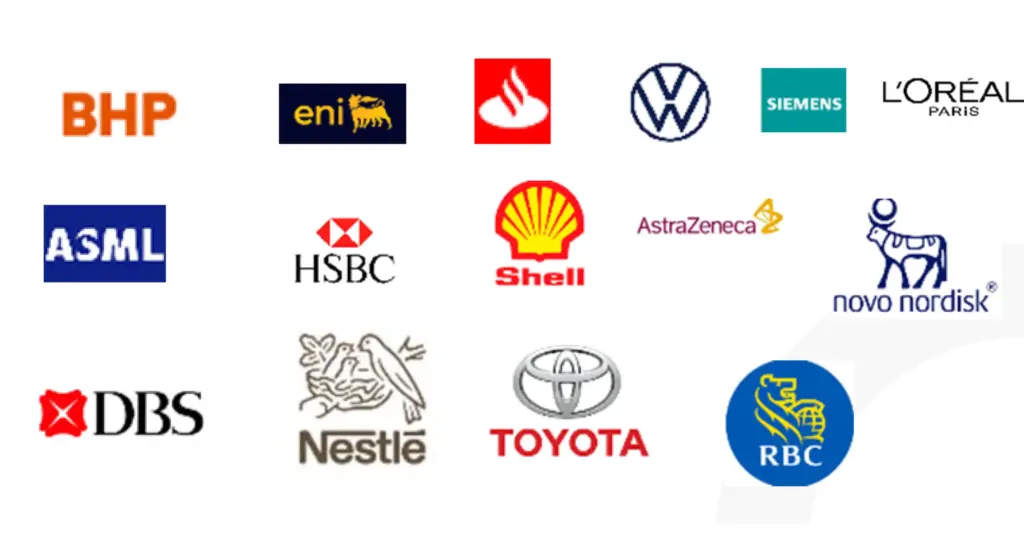

Deliverable Equity – Global Equity (Non-US): Access a diverse range of international stocks and ETFs from major global markets outside the United States for portfolio diversification.
1. Nestlé S.A. – Swiss Multinational (Listed as GDR)
2. Tencent Holdings Ltd. – Chinese Tech Conglomerate (GDR)
3. Samsung Electronics Co. Ltd. – South Korean Tech Giant (GDR)
1. BHP Group – Australia ( Australian Securities Exchange) – Mining
2. EniMilano ( BorsaItaliana) – Oil & Gas
3. Banco Santander – Spain ( Bolsade Madrid ) – Banking
4. Volkswagen – Germany ( Deutsche Börse) – Automotive
5. Siemen s – Germany ( Deutsche Börse) – Conglomerate
6. L’Oréal – Euronext ( France) – Cosmetics
7. ASML Holding – Euronext ( Nether lands ) – Semiconductor Equipment
8. HSBC Holdings – Hong Kong ( Hong Kong Stock Exchange) – Banking
9. Shell – UK ( London Stock Exchange) – Oil & Gas
10.Astra Zeneca – UK ( London Stock Exchange) – Pharmaceuticals
USD 25,000
Online (E Trading Platform) & Offline
While US markets often dominate financial headlines, limiting a portfolio to a single jurisdiction introduces significant “concentration risk.” When you trade global equities across non-US markets—such as the LSE in the UK, the HKEX in Hong Kong, or the Deutsche Börse in Germany—you gain exposure to different economic cycles, regulatory environments, and industrial strengths that the US may lack.
For instance, Europe offers unparalleled access to “Old Economy” giants in luxury goods, high-end automotive engineering, and renewable energy. Meanwhile, trading equities in Asian markets provides a direct gateway to the world’s fastest-growing middle-class consumer bases. By diversifying geographically, investors can capture growth in regions where valuations may be more attractive and dividend yields traditionally higher than their American counterparts.
One of the most strategic reasons to trade global equities is the inherent currency exposure. When you hold deliverable stocks in denominations such as the Euro (EUR), British Pound (GBP), or Japanese Yen (JPY), your portfolio is no longer solely dependent on the strength of the US Dollar.
In a professional investment strategy, this functions as a natural hedge. If the local currency of the exchange strengthens against your base currency, the value of your holdings increases independently of the stock’s price performance. At PhillipCapital DIFC, we provide the infrastructure necessary to manage these multi-currency settlements, allowing investors to treat currency fluctuation as a strategic tool rather than a peripheral risk.
Choosing to trade global equities through a deliverable model means the investor takes actual ownership of the underlying asset. Unlike CFDs or other derivative products, deliverable equities are held in custody. This is a critical distinction for institutional and long-term private investors who prioritize security and shareholder rights.
When you trade deliverable global equities, you are entitled to corporate actions, including cash dividends and voting rights. Because these positions are typically non-leveraged (cash-only), they do not carry the “overnight financing” costs associated with margin trading, making them a more cost-effective solution for long-term wealth preservation and capital appreciation strategies.
Global markets operate across different time zones, liquidity pools, and settlement cycles (such as T+2 or T+3). To trade global equities effectively, an investor requires a partner with a robust global footprint. PhillipCapital DIFC leverages the extensive network of the PhillipCapital Group, which has been a mainstay in global finance since 1975.
We provide a seamless execution interface that bridges the gap between the Dubai International Financial Centre (DIFC) and major hubs like Singapore, London, and Tokyo. Our desk provides both high-touch offline execution for large blocks and advanced online platforms for real-time market access. This ensures that even in markets with complex local requirements, our clients receive price transparency and efficient settlement.
Trade Global Equities beyond the United States to diversify your portfolio with deliverable assets from leading European, Asian, and Emerging Market exchanges.
Common Questions on How to Trade Global Equities Beyond the United States

PhillipCapital DIFC is the best online trading broker in the UAE, offering secure and advanced solutions for global investors and traders.
You should carefully consider your objectives, financial situation, needs, and level of experience before engaging in trading activities. You should be aware of all the risks associated with trading on margin. Rolling Spot Contracts and CFDs are complex instruments and carry a high risk of losing money rapidly due to leverage.
PhillipCapital (DIFC) Private Limited (a member of the PhillipCapital Group) is incorporated in the Dubai International Financial Centre (“DIFC”) with its business address at 417, Liberty House, Financial Centre, Dubai, United Arab Emirates, and is regulated by the Dubai Financial Services Authority (“DFSA”) under reference No. F003474. Some of the products and services mentioned on this site may be offered through other PhillipCapital group offices and not directly by PhillipCapital (DIFC) Private Limited. All Rights Reserved.
PhillipCapital (DIFC) Private Limited does not offer its services to residents of the Democratic Republic of Korea, Iran, and the Russian Federation.
The information on this site is not directed at residents of the United States and is not intended for distribution to, or use by, any person in any jurisdiction where such distribution or use would be contrary to local law or regulation.