Bond Valuation Methods Mastering Bond Valuation Methods and Formulas: A...
Read MoreThe Inverse Relationship Between Bond Prices and Yields

Understanding the Fundamentals of Fixed Income
What is the core definition of a bond yield compared to its price?
To navigate the fixed-income markets effectively, investors must first distinguish between the face value of a bond and its market price. When you purchase a bond, you are essentially lending capital to an issuer—whether a government or a corporation. The price is the amount you pay for that bond today, which can fluctuate based on market demand.
The yield, specifically the Yield to Maturity (YTM), is the total return anticipated on a bond if the bond is held until it matures. It is expressed as an annual percentage. While the coupon rate (the interest paid) typically remains fixed, the yield fluctuates dynamically. This distinction is critical because, in the secondary market, bonds rarely trade at their exact face value (par). They trade at a premium or a discount, and this price variance directly dictates the yield an investor effectively locks in.
For a deeper dive into the mechanics of these instruments, you can explore our detailed guide on what a bond is and how it works, which breaks down the terminology of coupons, principal, and maturity dates for new investors.

Why Do Bond Prices and Yields Move in Opposite Directions?
What is the mathematical and logical reasoning behind the "Seesaw Effect"?
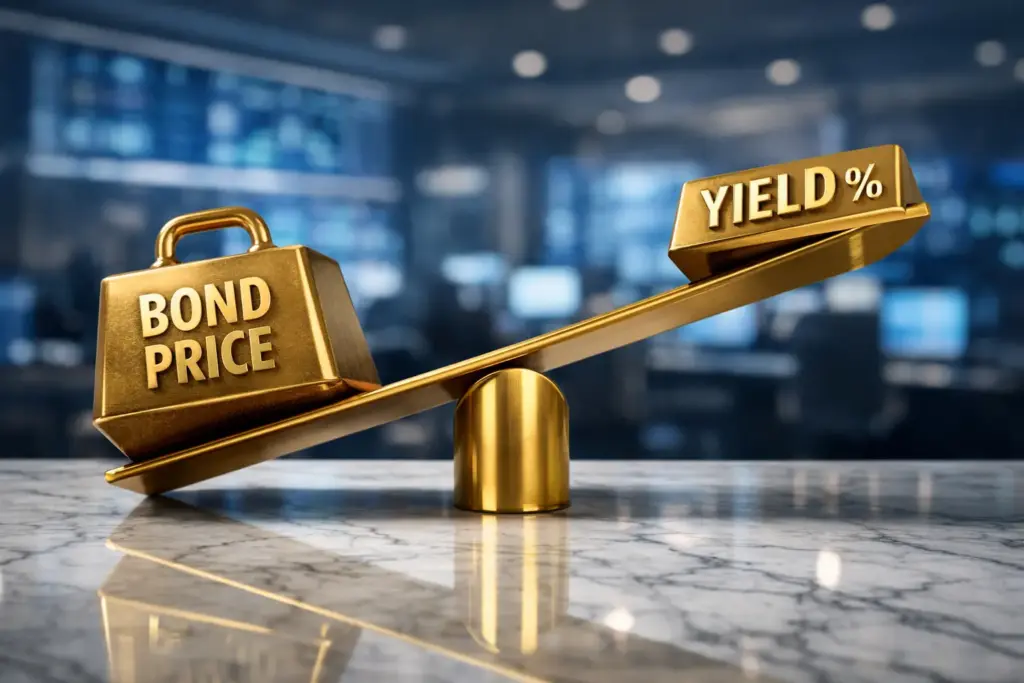
The inverse relationship between bond prices and yields is often described as a “seesaw.” When prices go up, yields go down, and vice versa. This is not merely a market anomaly; it is a mathematical certainty required to keep the bond competitive with newer issues.
Imagine a scenario where you hold a bond issued five years ago with a fixed coupon of 5%. If prevailing interest rates in the economy rise to 6%, no rational investor would pay full price for your 5% bond when they can buy a new one paying 6%. To sell your existing bond, you must lower its price (sell it at a discount) until its effective yield matches the new 6% market rate. Conversely, if market rates fall to 4%, your 5% bond becomes highly valuable. Investors will bid up its price (trading at a premium) until the yield compresses down to match the 4% environment.
This dynamic ensures that older bonds remain liquid and tradable against new government and corporate bond issues, maintaining equilibrium in the global capital markets.
Master the Fixed Income Market
Access Global Bonds & Debentures with PhillipCapital DIFC
The Role of Central Banks and Interest Rates
How do Federal Reserve and Central Bank policies impact this relationship?
Central banks, such as the Federal Reserve or the ECB, exert a gravitational pull on bond markets. When a central bank raises its benchmark interest rate to combat inflation, the immediate effect is a reset in the cost of borrowing. New bonds are issued with higher coupons to reflect this higher base rate.
As a result, the prices of existing bonds—which carry lower, older coupon rates—must fall significantly to align with the new, higher-yield environment. This period is often characterized by capital depreciation for holders of long-term debt. Conversely, when central banks cut rates to stimulate the economy, existing bonds with higher coupons become prized assets, seeing their prices appreciate.
Investors monitoring these macroeconomic shifts often look at Investment Grade vs. Non-Investment Grade bonds to decide where to position their capital, as different credit ratings react with varying volatility to interest rate announcements.
Duration and Convexity: Measuring Sensitivity
Why does the maturity of a bond amplify price volatility?
Not all bonds react to yield changes with the same intensity. This sensitivity is measured by a concept called Duration. In simple terms, duration estimates how much a bond’s price will change for a 1% change in interest rates.
Long-term bonds generally have a higher duration than short-term bonds. For instance, a 30-year Treasury bond will see a much sharper price decline than a 2-year Treasury note if interest rates rise by the same amount. This is because the cash flows (coupons) of the long-term bond are further in the future, making them more vulnerable to the eroding effects of inflation and opportunity cost.

For professional investors managing complex portfolios, understanding duration (and the curvature of this relationship, known as Convexity) is essential for hedging risk, especially when trading derivatives and futures alongside cash bonds.
Strategic Implications for Investors
How can investors turn this inverse relationship into an opportunity?
Understanding that prices and yields move inversely allows investors to employ specific strategies based on their economic outlook:
- Riding the Yield Curve: In a stable interest rate environment, investors might buy longer-term bonds to capture higher yields, profiting as the bond rolls down the yield curve closer to maturity.
- Defensive Positioning: If an investor anticipates a rate hike (which hurts bond prices), they may shorten the duration of their portfolio. This involves shifting capital into short-term bills or notes that are less sensitive to price drops.
- Capital Appreciation: If an economic slowdown is forecast and rate cuts are expected, investors might lock in long-term bonds. As rates fall, the prices of these bonds will rise, offering significant capital gains on top of the coupon income.
Diversification is key here. Integrating fixed income alongside global equities and ETFs ensures that a portfolio can withstand volatility in any single asset class.
Conclusion
The inverse relationship between bond prices and yields is the foundational gravity of the fixed-income universe. Whether you are a retail investor seeking stable coupons or a professional trader managing duration risk, acknowledging that higher yields equate to lower prices (and vice versa) is the first step toward clearer market analysis.
By keeping a close eye on central bank policies and understanding the sensitivity of your specific holdings, you can navigate interest rate cycles with confidence. At PhillipCapital DIFC, we provide the access and infrastructure you need to trade these movements effectively across global markets.
Frequently Asked Questions (FAQs)
If you hold a bond until it matures, the day-to-day price fluctuations generally do not affect you. Regardless of how low the market price falls during the bond’s life, you will still receive the full face value (principal) back at maturity, assuming the issuer does not default. The price drop only represents an “opportunity cost”—meaning you are stuck earning a lower interest rate while newer bonds in the market are paying more.
Stocks and bonds compete for investor capital. When bond yields rise, fixed-income assets become more attractive because they offer decent returns with lower risk than stocks. Additionally, higher yields usually mean higher borrowing costs for corporations, which can eat into company profits and lower their stock valuations.
This is a critical distinction. If you own an individual bond, you can simply hold it until maturity to get your principal back. However, bond funds (ETFs or mutual funds) constantly buy and sell bonds to maintain a specific duration. If rates rise, the Net Asset Value (NAV) of the fund will drop immediately, and because the fund never strictly “matures” like a single bond, it may take a significant amount of time to recover those paper losses through higher interest payments.
Yes, this happens when bond prices are bid up so high that the purchase price exceeds the sum of the coupons and principal you will receive. In this scenario, investors are effectively paying the government or issuer for the privilege of holding their cash, often to protect capital during times of extreme economic uncertainty or deflation.
Disclaimer:
Trading foreign exchange and/or contracts for difference on margin carries a high level of risk, and may not be suitable for all investors as you could sustain losses in excess of deposits. The products are intended for retail, professional and eligible counterparty clients. Before deciding to trade any products offered by PhillipCapital (DIFC) Private Limited you should carefully consider your objectives, financial situation, needs and level of experience. You should be aware of all the risks associated with trading on margin. The content of the Website must not be construed as personal advice. For retail, professional and eligible counterparty clients. Before deciding to trade any products offered by PhillipCapital (DIFC) Private Limited you should carefully consider your objectives, financial situation, needs and level of experience. You should be aware of all the risks associated with trading on margin.
Rolling Spot Contracts and CFDs are complex instruments and come with a high risk of losing money rapidly due to leverage. 78% of our retail client accounts lose money while trading with us. You should consider whether you understand how Rolling Spot Contracts and CFDs work, and whether you can afford to take the high risk of losing your money.
The Inverse Relationship Between Bond Prices and Yields
The Inverse Relationship Between Bond Prices and Yields Table of...
Read MoreCurrent Yield vs Yield to Maturity
Understanding Current Yield vs. Yield to Maturity Understanding Current Yield...
Read MoreBond Yield Vs Interest Rates

Bond Yield Vs Interest Rates Understanding the Relationship Between Bond...
Read MoreBond Yield to Maturity (YTM)
Bond Yield to Maturity (YTM) Understanding Bond Yield to Maturity...
Read MoreCalculating Bond Price And Yield
Calculating Bond Price And Yield Understanding Bond Valuation: A Comprehensive...
Read MoreBond Pricing Fundamentals
Bond Pricing Fundamentals A Guide for Investors Table of Contents...
Read MoreShort-Term, Intermediate, and Long-Term Bonds
Bond Maturities Short-Term, Intermediate, and Long-Term Bonds Table of Contents...
Read MoreInvestment Grade vs Non-Investment Grade Bonds
Investment Grade vs Non-Investment Grade Bonds A Guide for UAE...
Read MoreBonds: Face Value, Par Value & Coupon Rate
Bonds: Face Value, Par Value & Coupon Rate When venturing...
Read MoreBond Issuers Government vs Corporate Bonds
Bond Issuers Government vs Corporate Bonds What UAE Investors Need...
Read MoreUnderstanding Bond Fundamentals: A Guide for Smart Investing
Understanding Bond Fundamentals: A Guide for Smart Investing In the...
Read More