
Cash Settlement vs Physical Delivery in Trading Cash Settlement vs...
Read MoreForward-Looking Basis in Futures Trading
Table of Contents
- Introduction
- What Exactly is the Forward-Looking Basis in Futures Contracts?
- How is the Basis Calculated and Why Does it Change?
- What is the Difference Between Contango and Backwardation?
- How Do Professional Traders Use Basis for Hedging?
- Can Arbitrageurs Profit from a Forward-Looking Basis?
- How Does the Cost of Carry Influence Futures Pricing?
- Conclusion
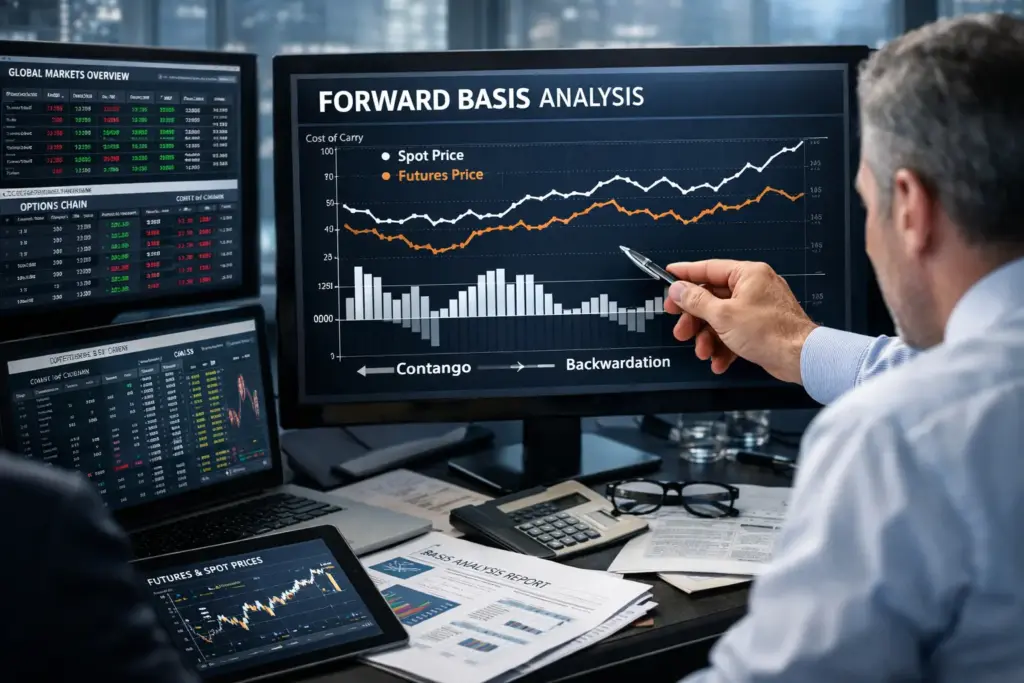
Understanding Forward-Looking Basis in Futures Contracts: A Comprehensive Guide
In the dynamic landscape of global capital markets, institutional investors and sophisticated retail traders rely heavily on derivatives to forecast price movements and manage risk. One of the most critical concepts for anyone trading these instruments is the “basis”—specifically, the forward-looking basis. This metric serves as the financial pulse of the market, revealing the true cost of holding an asset over time and the market’s aggregate expectation of future supply and demand. Understanding this complex mechanism is essential for executing advanced hedging strategies, maximizing capital efficiency, and identifying pricing inefficiencies across global exchanges.
What Exactly is the Forward-Looking Basis in Futures Contracts?
The basis, in its purest mathematical form, represents the numerical difference between the current cash (or spot) price of an underlying asset and its corresponding futures contract price. When we refer to a “forward-looking basis,” we are analyzing the market’s premium or discount priced into the future delivery of that specific asset.
Because the spot market reflects immediate supply and demand, and the futures market reflects anticipated valuations at a specific expiration date, the two prices rarely align perfectly until the contract matures. This dynamic spread is heavily influenced by carrying costs, interest rates, and dividend yields. For institutional traders, dissecting this spread is vital, as it dictates the viability of entering a trade. Grasping the intricate relationship between the spot and futures price ensures that investors are not merely guessing directional movement, but actively calculating the mathematical realities of time-valued money.
How is the Basis Calculated and Why Does it Change?
Calculating the basis is straightforward in theory: Basis = Spot Price – Futures Price. However, interpreting its continuous fluctuation requires a deep understanding of macroeconomic variables.
The basis changes continually—often referred to as “basis risk” when the spread widens or narrows unexpectedly—due to shifts in the underlying costs associated with the asset. If a central bank suddenly hikes interest rates, the cost of financing the underlying asset increases, which immediately alters the forward-looking basis. Similarly, an unexpected shortage in a physical commodity, such as crude oil or wheat, will drive the spot price up faster than the futures price, shifting the basis dramatically.
Traders must continually monitor these fluctuations. A widening basis might indicate supply chain bottlenecks, whereas a narrowing basis as the contract approaches maturity demonstrates the inevitable mathematical phenomenon of “convergence,” where the futures price and spot price become identical on the final delivery date. Those committed to understanding futures contracts know that mastering basis calculation is non-negotiable for long-term strategic profitability.
Master Global Derivatives Trading
Access global exchanges and trade futures with precision using our advanced platforms.
What is the Difference Between Contango and Backwardation?
The forward-looking basis visually manifests as the “forward curve,” which typically assumes one of two primary market states: contango or backwardation.
Contango occurs when the futures price is higher than the current spot price, resulting in a negative basis (Spot – Futures < 0). This is the standard, expected state for most non-perishable commodities and financial assets. The premium paid on the futures contract accounts for the cost of carry—which includes storage, insurance, and interest rates incurred by the seller to hold the asset until the expiration date.
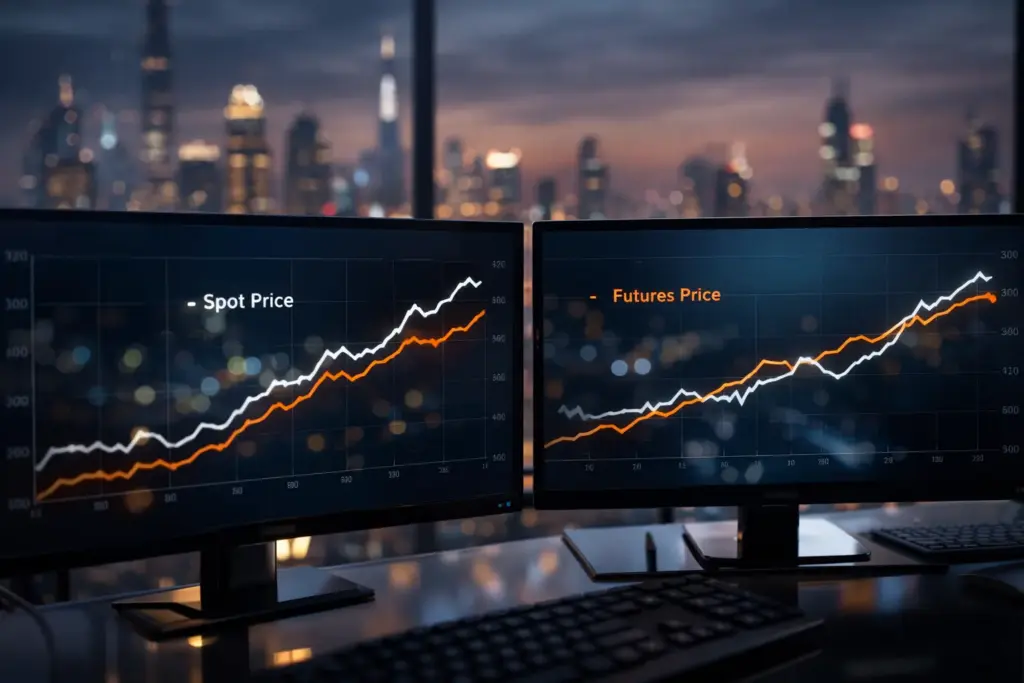
Backwardation, conversely, happens when the futures price is lower than the spot price, creating a positive basis (Spot – Futures > 0). This relatively rare phenomenon signals an immediate, urgent demand for the underlying asset, often driven by severe supply shocks, geopolitical crises, or extreme weather events. Investors are willing to pay a heavy premium to secure the asset now rather than wait for a future delivery. Identifying these structural shifts is a core component of the purpose of derivatives in modern portfolio theory, allowing traders to position themselves ahead of macroeconomic adjustments.
How Do Professional Traders Use Basis for Hedging?
Hedging is not about generating massive speculative profits; it is fundamentally about securing price certainty. Commercial entities, producers, and portfolio managers use the forward-looking basis to lock in profit margins and protect against adverse market volatility.
When a corporation hedges its exposure, it faces “basis risk”—the risk that the value of the futures contract will not move perfectly in tandem with the underlying asset’s spot price. For example, a commercial airline utilizing crude oil futures to stabilize jet fuel costs will continuously analyze the basis to ensure their hedge ratio is optimized. If the basis unexpectedly widens, the hedge may become less effective, potentially leading to unforeseen financial exposure. By systematically rolling contracts forward and calculating the exact cost of carry, professional hedgers mitigate this operational risk. Developing these specialized strategies is one of the foundational essentials of derivatives trading for institutional risk managers.
Protect Your Portfolio from Volatility
Discover robust risk management tools and hedge against adverse price movements today.
Can Arbitrageurs Profit from a Forward-Looking Basis?
Yes, arbitrageurs play a vital, often unseen role in maintaining the efficiency of the forward-looking basis. An arbitrage strategy known as “cash and carry” exploits moments when the basis misprices the actual, real-world cost of carry.
If a futures contract is trading at an unjustifiably high premium to the spot price (an abnormally steep contango), an arbitrageur will simultaneously buy the physical asset in the spot market and sell (short) the overpriced futures contract. By holding the physical asset and delivering it upon the contract’s expiration, the trader locks in a risk-free profit—the difference between the inflated futures premium and the actual carrying costs. This continuous buying and selling pressure from arbitrageurs forces the basis back into equilibrium. Understanding how futures exchanges work is crucial, as the exchange’s centralized clearinghouses and highly transparent order books make identifying and executing these fleeting arbitrage opportunities possible.
How Does the Cost of Carry Influence Futures Pricing?
The “cost of carry” is the mathematical engine driving the forward-looking basis. It aggregates all the expenses associated with holding a physical or financial asset over a specific timeframe until the contract’s maturity.
For physical commodities like gold, silver, or crude oil, the cost of carry includes warehousing fees, insurance premiums, and transportation costs. For financial derivatives like equity index futures, the cost of carry involves the risk-free interest rate used to finance the position, subtracted by the dividend yields generated by the underlying stocks. When global interest rates rise, the cost of carry naturally increases, steepening the contango curve and driving futures prices higher relative to the spot market. Conversely, high dividend payouts can push financial futures into a discounted state.
Investors looking to capitalize on these nuanced pricing models frequently explore localized and international markets, such as DGCX products, which offer specialized contracts like Shariah-compliant gold that possess highly unique carrying cost and settlement profiles.
Trade DGCX Futures with PhillipCapital DIFC
Leverage localized expertise and seamless access to Dubai Gold & Commodities Exchange products.
Conclusion
The forward-looking basis is far more than a simple subtraction of two prices; it is a sophisticated, real-time indicator of global market sentiment, carrying costs, and impending supply-demand imbalances. Whether the market is exhibiting a steep contango curve due to high central bank interest rates, or flashing early warning signs of backwardation during an international supply crisis, the basis provides traders with the quantitative data required to make highly informed decisions. By mastering the dynamics of the forward curve, minimizing basis risk, and recognizing the structural forces at play, investors can utilize futures contracts not just for pure speculation, but as highly precise instruments for capital preservation, disciplined hedging, and strategic portfolio growth.
Frequently Asked Questions (FAQs)
Why is the futures price almost never the same as the spot price?
The difference exists because holding a physical or financial asset over time costs money. Factors like storage fees, insurance, and interest rates—collectively known as the “cost of carry”—are baked into the futures price. Until the contract actually expires, the futures price reflects both the current value of the asset and the cost of time.
Does the basis always shrink to zero at expiration
Yes, mathematically it has to. This phenomenon is known as “convergence.” On the exact day a futures contract expires, the futures price and the immediate cash (spot) price must equal each other. If a gap still existed, arbitrageurs would instantly buy the cheaper asset and sell the more expensive one, forcing the prices to align perfectly.
How can "basis risk" cause a supposedly safe hedge to lose money?
Basis risk occurs when the spot price and the futures price fail to move in perfect synchronization. If you hedge a portfolio expecting the spread to remain steady, but an unexpected market shock causes the spot price to spike while the futures price lags, the two legs of your trade become disconnected. Because of this unpredictable widening or narrowing of the basis, your hedge might not fully offset your losses.
Why do traders care so much about contango versus backwardation?
These terms describe the structural shape of the forward-looking basis and reveal market psychology. Contango (futures > spot) is the normal state, reflecting standard holding costs. Backwardation (spot > futures) is relatively rare and signals an urgent, immediate demand or a severe supply shortage of the physical asset. Traders monitor for backwardation closely, as it often indicates a highly stressed or intensely bullish immediate market.
Disclaimer:
Trading foreign exchange and/or contracts for difference on margin carries a high level of risk, and may not be suitable for all investors as you could sustain losses in excess of deposits. The products are intended for retail, professional and eligible counterparty clients. Before deciding to trade any products offered by PhillipCapital (DIFC) Private Limited you should carefully consider your objectives, financial situation, needs and level of experience. You should be aware of all the risks associated with trading on margin. The content of the Website must not be construed as personal advice. For retail, professional and eligible counterparty clients. Before deciding to trade any products offered by PhillipCapital (DIFC) Private Limited you should carefully consider your objectives, financial situation, needs and level of experience. You should be aware of all the risks associated with trading on margin.
Rolling Spot Contracts and CFDs are complex instruments and come with a high risk of losing money rapidly due to leverage. 78% of our retail client accounts lose money while trading with us. You should consider whether you understand how Rolling Spot Contracts and CFDs work, and whether you can afford to take the high risk of losing your money.

Futures Settlement Methods
Futures Settlement Methods Introduction Navigating the financial markets requires a...
Read More
Margin Calls & Mark-to-Market
Margin Calls & Mark-to-Market Table of Contents Introduction to Futures...
Read More
Initial vs. Maintenance Margin
Initial vs. Maintenance Margin Understanding Initial and Maintenance Margins: A...
Read More
Contango & Backwardation Explained
Contango and Backwardation Explained Contango and Backwardation Explained: Navigating Futures...
Read More
Forward-Looking Basis
Forward-Looking Basis in Futures Trading Table of Contents Introduction What...
Read More
Futures Pricing And Valuation
Futures Pricing And Valuation Table of Contents What is the...
Read More
How Futures Exchanges Work
How Futures Exchanges Work Understanding the Mechanics of Global Futures...
Read More
Understanding Futures Contracts
Understanding Futures Contracts Understanding Futures Contracts in Global Markets In...
Read More