Real Effective Exchange Rates Understanding Real Effective Exchange Rates (REER):...
Read MorePurchasing Power Parity (PPP)
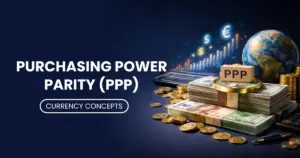
Introduction
For investors navigating international markets from dynamic financial hubs like the UAE, understanding the true value of capital across borders is a critical skill. When evaluating foreign assets or trading currencies, the nominal exchange rate on your screen only tells part of the story. To truly measure economic productivity and living standards between two countries, economists and investors rely on a concept called Purchasing Power Parity (PPP).
But what exactly is this metric, and how does it influence the decisions of global market participants? This guide breaks down the mechanics of PPP, exploring how it shapes currency valuations and why it deserves a place in your macroeconomic toolkit.

What Exactly is Purchasing Power Parity (PPP)?
Purchasing Power Parity (PPP) is an economic theory used to compare the absolute purchasing power of different countries’ currencies. At its core, the theory suggests that in the absence of transaction costs and trade barriers, identical goods should have the same price across different countries when the prices are expressed in a common currency.
To calculate this, economists use a “basket of goods.” This basket includes everyday items like electronics, groceries, and housing costs. By comparing how much it costs to buy this exact same basket in the United States versus, for example, the United Kingdom, analysts can determine the PPP exchange rate.
Perhaps the most famous, albeit simplified, example of this is the “Big Mac Index.” Because this popular burger is manufactured in almost identical ways around the world, comparing its price in various local currencies gives a quick snapshot of whether a currency is currently overvalued or undervalued relative to the US Dollar.
How Does PPP Impact Currency Exchange Rates?
In the short term, currency markets are driven by news events, interest rate decisions, and geopolitical shifts. However, in the long term, exchange rates tend to move toward their Purchasing Power Parity levels.
If a country experiences high inflation, the cost of its local “basket of goods” will rise. According to the PPP theory, that country’s currency should depreciate to maintain parity with nations experiencing lower inflation. For traders actively exploring the forex market, keeping an eye on these long-term valuation models is essential for spotting major macroeconomic trends before they fully materialize in the market.
While daily trading relies on technical analysis and immediate fundamental data, PPP serves as an anchor. When a currency wanders too far from its PPP valuation, it is often viewed as an anomaly that will eventually correct itself over time.
Strategic Market Access
Capitalize on global currency movements with institutional-grade tools.
Why is Purchasing Power Parity Important for Global Investors?
Understanding PPP goes beyond academic economics; it has practical implications for building a robust portfolio.
Firstly, it helps in evaluating international investments. If you are looking to diversify your portfolio by allocating capital into global equities, PPP helps you assess whether a foreign stock market is genuinely cheap, or if its currency is simply undervalued.
Secondly, it aids in inflation hedging. Investors use PPP data to identify regions where purchasing power is being preserved versus where it is eroding. By reallocating assets to countries with stable purchasing power trajectories, wealth managers can better protect long-term capital. It allows you to see past the noise of nominal GDP figures and understand the real economic output of a region.

What Are the Main Limitations of the PPP Theory?
While PPP is highly valuable, it is not a flawless forecasting tool, particularly in the short term. The theory assumes a frictionless world, which does not exist in reality.
Several factors disrupt perfect parity:
- Non-Tradable Goods: Services like haircuts, real estate, and local utilities cannot be exported. Their prices are dictated purely by local supply and demand, heavily skewing the “basket of goods.”
- Taxes and Tariffs: Government policies, import taxes, and local VAT differences mean that an identical good will naturally have different final retail prices across borders.
- Shipping and Logistics: The physical cost of moving goods from a manufacturer to a distant market adds to the price, breaking the rule of absolute parity.
Because of these variables, investors should never use PPP in isolation. Instead, it should be combined with other macroeconomic indicators and a deep understanding of exchange rates to form a comprehensive investment thesis.
Navigate Global Markets with Confidence
Build a diversified portfolio tailored to your long-term goals.
Conclusion: Key Takeaways
Purchasing Power Parity is a foundational concept that helps reveal the underlying economic realities beneath fluctuating exchange rates. By measuring what money can actually buy across different borders, investors gain a clearer picture of global market health.
Key Takeaways:
- True Valuation: PPP provides a theoretical exchange rate based on the actual cost of a universal basket of goods, helping identify if a currency is over or undervalued.
- Long-Term Anchor: While short-term forex markets are volatile, currencies historically trend toward their PPP levels over the long run.
- Investment Clarity: For those investing globally, PPP is vital for stripping away currency distortions to assess the true value of international equities and assets.
- Real-World Friction: Investors must account for limitations like local taxes, shipping costs, and non-tradable goods when applying PPP to real-world market strategies.
By integrating the principles of Purchasing Power Parity into your analysis, you can make more informed, strategic decisions when allocating capital across the global financial landscape.
Frequently Asked Questions (FAQs)
The nominal exchange rate is the live market price you see on your trading screen right now. PPP, on the other hand, is an economic theory showing what the exchange rate should be if identical goods cost exactly the same in both countries. PPP reflects true purchasing power, while nominal rates reflect immediate market sentiment.
Created by The Economist, the Big Mac Index is a popular, simplified way to measure PPP. Because a McDonald’s Big Mac is made almost identically worldwide, comparing its local price across different countries provides a quick snapshot of whether a currency is currently overvalued or undervalued compared to the US Dollar.
Generally, no. PPP is a long-term macroeconomic indicator. While it helps investors identify long-term valuation trends (where a currency might head over several years), short-term forex markets are driven by immediate factors like central bank interest rates, economic data releases, and geopolitical news.
Nominal GDP can be heavily distorted by sudden, volatile swings in currency exchange rates. GDP adjusted for PPP factors in the local cost of living and inflation rates, providing a much more accurate and stable picture of a nation’s actual economic output and the living standards of its citizens.
Disclaimer:
Trading foreign exchange and/or contracts for difference on margin carries a high level of risk, and may not be suitable for all investors as you could sustain losses in excess of deposits. The products are intended for retail, professional and eligible counterparty clients. Before deciding to trade any products offered by PhillipCapital (DIFC) Private Limited you should carefully consider your objectives, financial situation, needs and level of experience. You should be aware of all the risks associated with trading on margin. The content of the Website must not be construed as personal advice. For retail, professional and eligible counterparty clients. Before deciding to trade any products offered by PhillipCapital (DIFC) Private Limited you should carefully consider your objectives, financial situation, needs and level of experience. You should be aware of all the risks associated with trading on margin.
Rolling Spot Contracts and CFDs are complex instruments and come with a high risk of losing money rapidly due to leverage. 78% of our retail client accounts lose money while trading with us. You should consider whether you understand how Rolling Spot Contracts and CFDs work, and whether you can afford to take the high risk of losing your money.
Purchasing Power Parity (PPP)
Purchasing Power Parity (PPP) Introduction For investors navigating international markets...
Read MoreCurrency Carry Trade
Currency Carry Trade Unlocking Global Yields: The Definitive Guide to...
Read MoreCross Currency Pairs Explained

Cross Currency Pairs A Guide for Investors Introduction The foreign...
Read MoreDirect and Indirect Quotes

Direct vs. Indirect Quotes Demystifying Direct and Indirect Quotes in...
Read MoreUnderstanding Exchange Rates
Understanding Exchange Rates In an increasingly interconnected global economy, the...
Read MoreBase Currency vs Quote Currency

Base Currency vs Quote Currency Table of Contents What is...
Read MoreMinor and Exotic Currency Pairs

Minor and Exotic Currency Pairs A Trader’s Guide to Global...
Read MoreForex Market Structure and Hours
Forex Market Structure and Hours The Complete Guide for UAE...
Read MoreWhat is Spot FX Trading and How Does It Work?
Decoding the Market What is Spot FX Trading and How...
Read MoreIntroduction to the Forex Market

Introduction to the Forex Market Your Gateway to Global Currency...
Read More