Fixed Income

interest rate risk management bonds thumbnail

Interest Rate Risk Management

Interest Rate Risk Management Master Interest Rate Risk Management in Bond Investing Investing in bonds is often viewed as a stable, conservative way to build wealth and generate consistent income. However, the bond market is not entirely without its fluctuations. One of the most critical factors that can impact the value of your fixed-income portfolio is the movement of global interest rates. When economic environments shift, interest rates often follow, creating a ripple effect across capital markets. Understanding how these changes affect your investments—and more importantly, how to navigate them—is essential for any prudent investor. In this comprehensive guide, we will break down the mechanics of interest rate risk, explain the vital concept of bond duration, and share actionable strategies to safeguard your capital. Table of Contents What Exactly is Interest Rate Risk in Capital Markets? Why Do Interest Rates and Bond Prices Move in Opposite Directions? How Does Bond Duration Measure Interest Rate Risk? Are All Bonds Equally Affected by Changing Interest Rates? What Are the Best Strategies to Manage Interest Rate Risk? How Does a Bond Laddering Strategy Protect Investors? Conclusion & Key Takeaways What Exactly is Interest Rate Risk in Capital Markets? Interest rate risk is the potential for investment losses that result from a change in overall interest rates. While this risk can affect various asset classes, it is most heavily associated with fixed-income securities like government and corporate bonds. Before analyzing market risks, it is helpful to clearly understand what a bond is and how it works. When you purchase a bond, you are essentially lending money to an issuer in exchange for regular interest payments at a fixed rate, known as the coupon rate. If current market interest rates rise after you purchase your bond, new bonds will be issued offering those new, higher rates. Suddenly, your existing bond, which pays a lower, older rate, becomes less attractive to other investors. As a result, its market value drops. Conversely, if interest rates fall, your bond paying a higher fixed rate becomes highly desirable, and its market value increases. Navigating this dynamic requires a deep understanding of market trends and a proactive approach to your fixed-income strategy. Why Do Interest Rates and Bond Prices Move in Opposite Directions? The inverse relationship between bond prices and interest rates can be confusing at first, but it is driven by basic supply and demand. Imagine you buy a 10-year bond with a face value of $1,000 that pays a 4% fixed annual return. A year later, central banks raise interest rates, and newly issued 10-year bonds now offer a 6% return. If you need to sell your 4% bond before it matures, no rational investor will pay you the full $1,000 for it when they can buy a new bond paying 6% for the same price. To make your older bond attractive to a buyer, you must lower its asking price. You have to discount it until the yield (the return based on the lower price) roughly matches the new 6% market standard. This is why active investors frequently monitor bond yields versus interest rates to predict portfolio adjustments. It is the fundamental reason why rising interest rates trigger a decline in existing bond prices. Navigate Market Shifts with Expert Guidance Protect your wealth in a changing interest rate environment. Explore Investment Products & Solutions How Does Bond Duration Measure Interest Rate Risk? To effectively manage risk, investors need a way to measure exactly how sensitive a specific bond is to interest rate changes. This is where “bond duration” comes into play. While “maturity” simply tells you the exact date when the bond issuer will return your principal, “duration” is a more complex, highly useful metric. Grasping bond duration and interest rate risk allows you to calculate how long it takes, in years, for an investor to be repaid the bond’s price by its total cash flows. For an even deeper level of portfolio immunization, institutional investors use a sophisticated formula known as Macaulay Duration to find their exact breakeven timeline. More importantly, standard duration serves as a predictive tool. It estimates how much a bond’s price will drop or rise for every 1% change in interest rates. For example, if a bond has a duration of 5 years, its price will drop by approximately 5% if interest rates rise by 1%. If rates fall by 1%, the bond’s price will rise by about 5%. Are All Bonds Equally Affected by Changing Interest Rates? No, different bonds react differently to shifting rates. The level of interest rate risk a bond carries is primarily determined by two factors: its maturity date and its coupon rate. Time to Maturity: Long-term bonds carry significantly higher interest rate risk than short-term bonds. If you lock up your money for 30 years, there is a much higher probability that interest rates will fluctuate drastically during that timeframe compared to a bond that matures in 2 years. Therefore, reviewing the differences between short-term, intermediate, and long-term bonds is essential when structuring your timeline. Longer-term debt has a higher duration and greater price volatility. Coupon Rate: Bonds with lower coupon (interest) rates are generally more sensitive to interest rate changes than bonds with higher coupon rates. A bond paying a high interest rate returns your initial investment faster, lowering its overall duration and shielding it slightly from market shifts. Zero-coupon bonds, which pay no regular interest and only return a lump sum at maturity, have the highest duration and are the most sensitive to rate changes. What Are the Best Strategies to Manage Interest Rate Risk? Professional investors utilize several strategic approaches to mitigate the impact of fluctuating interest rates on their portfolios. Here are the most effective methods: Diversification: Never put all your capital into bonds with the exact same maturity date. By holding a mix of short-term, medium-term, and long-term bonds, you balance out the high volatility of long-term bonds with the stability of short-term ones. Adding Floating-Rate Bonds: Unlike traditional fixed-rate

Interest Rate Risk Management Read More »

convexity in bond pricing thumbnail

Convexity in Bond Pricing

Convexity in Bond Pricing What is Convexity in Bond Pricing? When you step into the world of fixed-income investments, the concepts of yields, maturity dates, and coupon rates are usually the first things you learn. However, as your portfolio grows, relying on these basic metrics is no longer enough to protect your capital from market volatility. To truly navigate the bond market like a professional, you need to understand the deeper layers of risk management. While most investors stop at duration to measure risk, the most successful investors take it a step further. They look at the hidden curve of the market. Welcome to the concept of convexity. Table of Contents: How Do Interest Rates Directly Affect Bond Prices? If Duration Measures Risk, Why Do We Need Convexity? What Exactly is Convexity in Bond Pricing? Why Does Convexity Matter for Your Fixed-Income Strategy? How Do Positive and Negative Convexity Differ in the Market? Conclusion: Key Takeaways for Fixed-Income Investors How Do Interest Rates Directly Affect Bond Prices? Before diving into complex market metrics, it is vital to understand the foundational “seesaw effect” of the financial markets. Bond prices and interest rates share an inverse relationship. When central banks raise interest rates, newly issued bonds enter the market offering higher, more attractive yields. Because these new bonds pay more, the older, existing bonds with lower payouts instantly become less desirable. To convince someone to buy an older bond, the seller must reduce its price. This means that as interest rates go up, the market value of existing bonds goes down. Conversely, if interest rates fall, older bonds with higher fixed payouts become highly sought after, causing their market prices to surge. Grasping this basic seesaw mechanic is the first step in calculating bond price and yield accurately and predicting how your portfolio will behave in changing economic climates. If Duration Measures Risk, Why Do We Need Convexity? As you learn about the seesaw effect, you will inevitably encounter the term “duration.” Duration is an excellent tool that tells you roughly how much a bond’s price will drop for every 1% increase in interest rates. However, duration has a significant flaw: it assumes the relationship between bond prices and interest rates is a perfectly straight line. In the real financial world, the relationship is not a straight line; it is actually a curve. When interest rate changes are very small, duration is highly accurate. But when interest rates experience large, sudden swings—as they often do during turbulent economic times—duration begins to lose its accuracy. It underestimates the price increase when rates fall and overestimates the price drop when rates rise. This is why understanding bond duration is only half the battle. To see the full picture, you need a metric that accounts for the curve. Enhance Your Fixed-Income Strategy Today Explore global bond markets and build a resilient, balanced portfolio. Discover Bond Trading What Exactly is Convexity in Bond Pricing? Convexity is the metric that fills the gap left by duration. Simply put, convexity measures the actual curvature of the relationship between a bond’s price and its yield. If duration is the straight-line estimate of how a bond will behave, convexity is the mathematical adjustment that corrects that estimate to match reality. Think of it as a financial shock absorber. Convexity tells you the rate at which a bond’s duration changes as interest rates move. A bond with higher convexity will see its price rise faster when interest rates drop, and its price will fall slower when interest rates climb. In essence, it is a measure of how well your investment is protected against unpredictable rate hikes and how well positioned it is to profit from rate cuts. Why Does Convexity Matter for Your Fixed-Income Strategy? For global investors looking to preserve wealth and generate stable returns, convexity is not just an academic term; it is a practical tool for maximizing profits and minimizing losses. When you compare two bonds that have the identical duration and the same yield, the bond with the higher convexity is almost always the superior choice. Why? Because the high-convexity bond will experience a larger price gain if interest rates drop, and a smaller price decline if interest rates rise. It gives you an asymmetric advantage. By actively seeking out bonds or bond funds with high convexity, you are effectively managing interest rate risk while maintaining a strong upside potential. This makes your portfolio far more resilient against unexpected macroeconomic shifts and central bank policy changes. Master the Mechanics of the Bond Market Learn how to safeguard your capital against interest rate volatility. Read the Duration Guide How Do Positive and Negative Convexity Differ in the Market? Not all bonds curve the same way. When analyzing global capital markets, you will encounter two main types of convexity. Positive Convexity Most standard, traditional bonds exhibit positive convexity. This is the ideal scenario for an investor. As yields fall, the bond’s duration increases, accelerating price gains. As yields rise, the duration shortens, slowing down price drops. Positive convexity acts as a built-in safety net for your investments, ensuring that price increases are always mathematically larger than price decreases for the same magnitude of interest rate change. Negative Convexity Negative convexity typically occurs in bonds that have “embedded options,” such as callable bonds or mortgage-backed securities. With a callable bond, the issuer has the right to buy the bond back from you early if interest rates fall. Because the issuer will naturally cancel the bond to issue new debt at lower rates, the bond’s price upside is artificially capped. In these cases, the price does not rise as fast as a standard bond when rates drop, creating a negatively curved graph. Investors demand a higher initial yield on these bonds to compensate for the poor convexity. Conclusion: Key Takeaways for Fixed-Income Investors Transitioning from a novice to a sophisticated participant in the capital markets requires looking beyond the surface-level numbers. While coupon rates and maturity dates set the foundation,

Convexity in Bond Pricing Read More »

Duration and Interest Rate Risk thumbnail

Bond Duration & Interest Rate Risk Explained

Bond Duration & Interest Rate Risk Explained Table of Contents Introduction: The Seesaw Effect of Bonds and Interest Rates What Is Bond Duration and Why Does It Matter? How Exactly Does Interest Rate Risk Affect Bondholders? What Is the Direct Relationship Between Duration and Interest Rate Risk? How Can Investors Use Duration to Manage Portfolio Risk? Conclusion: Key Takeaways for Fixed-Income Investors Introduction: The Seesaw Effect of Bonds and Interest Rates For many investors, bonds represent stability. They are the cornerstone of a balanced portfolio, designed to provide a steady stream of income and preserve capital during volatile stock market cycles. However, labeling bonds as “risk-free” is a dangerous misconception. The market has its own set of shifting dynamics, and the most prominent among them is the movement of interest rates. When you invest in fixed-income assets, understanding the invisible forces that influence their market value is crucial. This brings us to a fundamental concept every fixed-income investor must master: bond duration. It is the ultimate measuring stick for understanding how vulnerable your investments are to changing economic tides. In this guide, we will break down the relationship between duration and interest rate risk, providing you with the insights needed to make smarter, more resilient investment decisions. What Is Bond Duration and Why Does It Matter? When most people hear the word “duration,” they immediately think of time—specifically, how long it takes for a bond to reach its maturity date. While time is a factor, in the financial world, duration means something much more specific. Bond duration is a measurement of a bond’s price sensitivity to changes in interest rates. It is expressed in years, but it is not simply the lifespan of the bond. Instead, duration calculates the weighted average time it takes for an investor to receive all the cash flows (interest payments and the return of principal) from a bond. Why does this matter? Because duration acts as a financial thermometer. It tells you exactly how much the price of your bond will heat up or cool down when central banks adjust interest rates. A higher duration means the bond’s price will swing more drastically when rates change. A lower duration means the bond’s price will remain relatively stable. If you are exploring various investment products and solutions to preserve your capital, knowing the duration of the assets within your portfolio is the first step in defending against unexpected market fluctuations. How Exactly Does Interest Rate Risk Affect Bondholders? Interest rate risk is the potential for investment losses that result from a change in interest rates. To understand this, you must understand the golden rule of fixed income: bond prices and interest rates move in opposite directions. They operate on a seesaw. Imagine you buy a 10-year bond paying a 4% fixed interest rate. A year later, the central bank raises rates to curb inflation, and new bonds are now being issued with a 6% interest rate. Suddenly, your 4% bond looks far less attractive to other investors. If you decide to sell your bond before it matures, you will have to sell it at a discount (a lower price) to make it competitive with the new 6% bonds. This drop in your bond’s market value is interest rate risk in action. Conversely, if interest rates fall to 2%, your 4% bond becomes highly desirable, and its market price will rise. For investors who plan to hold a bond until maturity, daily price fluctuations might seem irrelevant since they will eventually receive their principal back. However, for those actively applying specific trading strategies or holding mutual funds and ETFs, interest rate risk is a constant, daily reality that requires proactive management. Ready to Diversify Your Portfolio? Explore tailored structured notes and global bonds View Investment Products What Is the Direct Relationship Between Duration and Interest Rate Risk? Duration and interest rate risk are inextricably linked. In fact, duration is the exact mathematical formula used to quantify interest rate risk. Here is the simple rule of thumb: For every 1% change in interest rates, a bond’s price will move in the opposite direction by a percentage roughly equal to its duration. Let’s look at a practical example: Bond A has a duration of 2 years. Bond B has a duration of 8 years. If global interest rates rise by 1%: The price of Bond A will fall by approximately 2%. The price of Bond B will fall by approximately 8%. If interest rates drop by 1%: The price of Bond A will rise by about 2%. The price of Bond B will rise by about 8%. This simple calculation reveals why long-term bonds, which typically have higher durations, carry significantly more interest rate risk than short-term bonds. As you build your portfolio, selecting the right mix of durations is essential. Leveraging professional, institutional services for funds and family offices can help you accurately calculate your portfolio’s overall duration, ensuring it aligns with your personal risk tolerance and the current macroeconomic climate. How Can Investors Use Duration to Manage Portfolio Risk? Understanding duration is only half the battle; applying it to protect your wealth is where true strategy comes into play. Astute investors and fund managers use duration actively to shield their capital from adverse rate movements while positioning themselves for growth. Here are the primary ways to manage your risk using duration: Shortening Duration in a Rising Rate Environment If economic indicators suggest that central banks are preparing to raise interest rates, it is generally wise to reduce the average duration of your bond portfolio. By shifting investments into short-term bonds or floating-rate notes, you minimize the negative price impact when rates inevitably climb. Lengthening Duration in a Falling Rate Environment If the economy slows down and interest rates are expected to be cut, longer-duration bonds become highly advantageous. Because they are highly sensitive to rate changes, their prices will surge significantly higher than short-term bonds when rates drop, allowing investors to capture substantial capital gains. Building

Bond Duration & Interest Rate Risk Explained Read More »

Macaulay Duration Explained thumbnail

Macaulay Duration Explained

Macaulay Duration Explained Macaulay Duration Explained: A Comprehensive Guide for Investors Navigating the fixed-income market requires more than just looking at the interest rate a bond pays. To truly manage risk and build a resilient investment portfolio, you need to understand the timing of your returns. This is where Macaulay Duration comes in. Named after the economist Frederick Macaulay, who introduced the concept in 1938, this metric remains one of the most powerful tools for fixed-income investors globally. In this guide, we break down the concept of Macaulay Duration into simple English, explaining what it is, how it works, and how you can use it to make informed investment decisions. Table of Contents What is Macaulay Duration? How Does Macaulay Duration Work in Simple Terms? Why is Macaulay Duration Important for Bond Investors? Measuring Interest Rate Risk Comparing Different Bonds What is the Difference Between Macaulay Duration and Modified Duration? How Does the Coupon Rate Affect Macaulay Duration? How Does Maturity Impact Macaulay Duration? How Can Investors Use Macaulay Duration in Their Portfolio? Portfolio Immunization Strategic Trading Conclusion: Key Takeaways on Macaulay Duration What is Macaulay Duration? In the simplest terms, Macaulay Duration is the weighted average amount of time it takes for an investor to receive all the cash flows from a bond. When you buy a bond, you generally receive regular interest payments (called coupons) and then get your initial investment (the principal) back at the end of the bond’s life. Macaulay Duration calculates the exact point in time when you effectively “break even” on your investment, factoring in the time value of money. The result is always expressed in years. For example, if you buy a bond that matures in 10 years, its Macaulay Duration might be 8.5 years. This means that because of the steady interest payments you collect along the way, it only takes 8.5 years for the bond to pay for itself. How Does Macaulay Duration Work in Simple Terms? To visualize how it works, imagine a seesaw. The cash flows you receive in the near future (your first few coupon payments) sit on one side, and the massive principal repayment you receive at maturity sits at the very end. The Macaulay Duration is the exact balancing point (the fulcrum) of that seesaw. Because money received today is worth more than money received five years from now, the calculation assigns a “weight” to each payment based on when it arrives. Bonds that pay high interest rates return your cash faster, which moves the balancing point closer to today. Zero-coupon bonds, which pay no interest along the way and only give you a lump sum at the very end, have a balancing point that sits exactly on the maturity date. Therefore, the Macaulay Duration of a zero-coupon bond is always exactly equal to its time to maturity. Why is Macaulay Duration Important for Bond Investors? Understanding the timeline of your cash flows is critical, but the real value of Macaulay Duration lies in how it helps investors manage uncertainty. Measuring Interest Rate Risk The primary reason financial professionals care about this metric is its connection to price volatility. In the capital markets, there is an inescapable inverse relationship between bond prices and yields. When general interest rates go up, the value of existing bonds goes down. Macaulay Duration acts as a gauge for this sensitivity. A higher duration means the bond’s price will swing more violently when interest rates change, making it a riskier asset to hold during unpredictable economic times. Comparing Different Bonds Macaulay Duration allows investors to compare apples to oranges. You might be looking at two bonds: one matures in 7 years paying a 6% yield, and the other matures in 10 years paying an 8% yield. Looking at just maturity dates or yields doesn’t tell the whole story regarding your risk exposure. By calculating the bond price and yield alongside the duration, investors can accurately determine which bond carries more interest rate risk and structure their wealth management strategies accordingly. Ready to Master Fixed-Income Investing? Discover how duration affects your portfolio and explore strategies to manage interest rate risk effectively. Read Our Complete Guide to Bond Duration What is the Difference Between Macaulay Duration and Modified Duration? While they sound similar, Macaulay Duration and Modified Duration serve two distinct purposes, though one is derived directly from the other. As discussed, Macaulay Duration is measured in years. It tells you the weighted average time to get your money back. It is a time-based measurement. Modified Duration, on the other hand, takes the Macaulay Duration number and adjusts it mathematically to measure price sensitivity. It tells you exactly how much the price of a bond is expected to drop if interest rates rise by 1%. For example, if a bond has a Modified Duration of 5, its price will fall by approximately 5% for every 1% increase in market interest rates. Professional traders use Macaulay Duration to understand the timeline, but they use Modified Duration to calculate immediate price risk. How Does the Coupon Rate Affect Macaulay Duration? The coupon rate (the interest the bond pays) has a massive and direct impact on duration. There is an inverse relationship between the two: the higher the coupon rate, the lower the Macaulay Duration. Why does this happen? If a bond pays a high interest rate, you are receiving a larger portion of your original investment back with every single payment. Because you are recovering your cash faster, the weighted average time to break even shrinks. Conversely, if a bond pays a very low interest rate, you are heavily reliant on the final principal repayment at maturity to recover your value. This pushes the balancing point further into the future, resulting in a higher duration and, consequently, higher price risk. How Does Maturity Impact Macaulay Duration? Maturity is the second major pillar influencing this metric. Generally speaking, the longer the time until the bond matures, the higher the Macaulay Duration. When you lock your

Macaulay Duration Explained Read More »

Modified Duration and Its Impact on Price thumbnail

Modified Duration and Its Impact on Price

Modified Duration and Its Impact on Bond Prices Introduction Navigating the fixed-income market requires a solid understanding of how external economic factors influence your investments. For bond investors, interest rates act as an invisible hand, constantly pushing and pulling on the value of their portfolios. But how do you measure exactly how much a bond’s price will change when central banks adjust their rates? Enter the concept of modified duration. While it may sound like complex financial engineering, it is simply a practical tool that investors use to measure risk. Understanding this metric allows you to anticipate market movements, protect your capital, and make informed decisions about your wealth. In this comprehensive guide, we will break down what modified duration is, how it works in simple terms, and why it is a critical component of successful investing. Table of Contents What is Modified Duration in Simple Terms? How Does Modified Duration Differ from Macaulay Duration? How Exactly Does Modified Duration Impact Bond Prices? Why Should Investors Care About Interest Rate Risk? How Can You Use Modified Duration to Build a Better Portfolio? Conclusion and Key Takeaways What is Modified Duration in Simple Terms? Whenever you invest in bonds, you face an undeniable reality: bond prices and interest rates move in opposite directions. When interest rates rise, the prices of existing bonds fall, and vice versa. Modified duration is a specific mathematical measurement that tells you exactly how sensitive a bond’s price is to these interest rate changes. Think of it as a risk indicator. It provides a straightforward estimate of how much a bond’s price will drop or increase for every 1% change in interest rates. For example, if you are analyzing the broader mechanics of understanding bond duration, knowing the modified duration helps you gauge whether a particular bond is a safe harbor or a highly volatile asset during periods of shifting monetary policy. How Does Modified Duration Differ from Macaulay Duration? If you have spent any time reading about bonds, you might have also encountered the term “Macaulay duration.” While they are closely related, they serve two different purposes for an investor. Macaulay duration measures time. It calculates the weighted average number of years it will take for an investor to get back the original cost of the bond through its cash flows (interest payments and principal return). Modified duration, on the other hand, takes that time measurement and translates it into price sensitivity. While knowing how long it takes to recoup your money is helpful, modified duration answers the more immediate question: “If the central bank raises rates tomorrow, how much money will my bond lose in value?” Enhance Your Bond Portfolio Today Discover tailored fixed-income strategies and global bond options designed to weather market volatility. Explore Global Bond Trading How Exactly Does Modified Duration Impact Bond Prices? The impact of modified duration on price is straightforward once you know the rule of thumb. The modified duration number directly represents the percentage change in the bond’s price for a 1% change in interest rates. Let’s look at a practical, real-world example using basic bond valuation methods: Imagine you own a bond with a modified duration of 5 years. If interest rates rise by 1%: The price of your bond is expected to fall by approximately 5%. If interest rates fall by 1%: The price of your bond is expected to rise by approximately 5%. If you hold a bond with a modified duration of 10 years, it will be twice as sensitive. A 1% rise in rates would cause a 10% drop in price. This illustrates why longer-term bonds are generally considered riskier in a rising-rate environment. By keeping an eye on these metrics, investors can better predict how macroeconomic announcements will immediately impact their portfolio’s net asset value. Why Should Investors Care About Interest Rate Risk? Interest rate risk is arguably the most significant threat to a fixed-income investor’s capital. Even if you buy a bond from a highly secure government or a blue-chip corporation with zero risk of default, you are still exposed to interest rate risk. If you plan to hold a bond until it matures, daily price fluctuations might not bother you, as you will still receive your principal back at the end. However, if you need to sell the bond before maturity to free up capital or rebalance your assets, selling during a high-interest-rate period could result in a noticeable loss. Understanding this dynamic prevents investors from being blindsided by portfolio drawdowns when central banks pivot their policies to combat inflation or stimulate economic growth. How Can You Use Modified Duration to Build a Better Portfolio? Savvy investors use modified duration as a steering wheel to navigate changing economic climates. Here is how you can apply this concept strategically: In a Rising Rate Environment If inflation is high and central banks are hiking rates, bond prices will drop. To protect your capital, you should lower the overall modified duration of your portfolio. You can achieve this by shifting capital into short-term bonds. Because they have a lower duration, their prices will barely flinch when rates go up. In a Falling Rate Environment If the economy is slowing down and central banks are cutting rates to encourage borrowing, bond prices will rise. To maximize your capital gains, you would want to increase the modified duration of your portfolio by investing in longer-term bonds. A higher duration means your bonds will experience a larger price jump as rates decline. By actively adjusting your duration exposure, you transform a passive investment into a strategic asset class that works in tandem with global economic cycles. Ready to Master Your Investments? Connect with our experts to proactively manage your portfolio’s interest rate risk and discover secure trading solutions. Contact Our Advisory Team Conclusion and Key Takeaways Modified duration is not just a theoretical concept; it is a highly practical tool that brings clarity to the often unpredictable world of investing. By understanding how sensitive your assets

Modified Duration and Its Impact on Price Read More »

Understanding Bond Duration thumbnail

Understanding Bond Duration

Understanding Bond Duration Introduction When stepping into the fixed-income market, many investors focus solely on two metrics: the yield they will receive and the date they will get their money back. However, to truly navigate the bond market like a professional, there is a third, equally critical metric you must master: bond duration. Whether you are building a conservative portfolio or actively trading debt instruments, understanding bond duration is the key to managing risk and anticipating how your investments will perform when market conditions change. Table of Contents What is Bond Duration? How Does Bond Duration Differ from Maturity? Why is Bond Duration Important for Investors? What are the Different Types of Bond Duration? Macaulay Duration Modified Duration How Do Different Bonds Respond to Duration? How Can You Use Duration in Your Portfolio Strategy? Conclusion: Key Takeaways on Bond Duration What is Bond Duration? Bond duration is a crucial risk management metric that measures how sensitive a bond’s price is to changes in interest rates. Expressed in years, duration tells you exactly how much the price of your bond is expected to drop if interest rates rise, or conversely, how much it will increase if interest rates fall. In the financial markets, bond prices and interest rates move in opposite directions. Think of it as a seesaw. If new bonds are issued with higher interest rates, the older bonds paying lower rates become less attractive, causing their price to drop. Duration is the mathematical formula that calculates the exact speed and steepness of that price drop. How Does Bond Duration Differ from Maturity? It is common for investors to confuse duration with maturity, but they serve two very different purposes. Maturity simply refers to the exact calendar date when the bond issuer is obligated to return your principal investment. It is a timeline. Duration, on the other hand, is an economic measurement of risk. While a bond might have a maturity of 10 years, its duration might only be 8 years. Why? Because the interest payments you receive along the way help you recover the true cost of the bond before the actual maturity date. Bonds with higher interest payments return your money faster, lowering the duration. To fully grasp how these calculations come together, it helps to first establish a strong foundation in how face value and coupon rate directly influence your payout timeline. Expand Your Fixed-Income Portfolio Access a wide range of global bonds tailored to your risk appetite and investment goals Explore Global Bonds Why is Bond Duration Important for Investors? Bond duration is the ultimate tool for managing interest rate risk. If you do not know the duration of your fixed-income portfolio, you are essentially flying blind into central bank policy changes. The general rule of thumb is that for every 1% increase in interest rates, a bond’s price will fall by an amount equal to its duration. For example, if you hold a bond with a duration of 5 years, a 1% rise in interest rates will cause the bond’s market value to drop by approximately 5%. Conversely, if rates fall by 1%, that same bond’s value will rise by 5%. Knowing this allows you to stress-test your portfolio before economic shifts occur. What are the Different Types of Bond Duration? To evaluate debt securities accurately, financial professionals rely primarily on two specific calculations of duration. Macaulay Duration Named after the economist who created it, Macaulay Duration calculates the weighted average time it takes for an investor to receive all the cash flows (both interest payments and the final principal) from a bond. It measures the time required to break even on the investment. If a bond does not pay any interest (a zero-coupon bond), its Macaulay Duration is exactly equal to its maturity. Modified Duration Modified Duration takes the Macaulay Duration and adjusts it to show the direct mathematical impact of yield changes on the bond’s price. This is the more practical number for everyday investors, as it provides a clear, actionable percentage. When a brokerage platform shows you a bond’s “duration,” they are almost always displaying the Modified Duration. How Do Different Bonds Respond to Duration? The sensitivity of a bond depends entirely on its specific structure. Zero-coupon bonds, which pay no periodic interest, have the highest duration and are therefore the most volatile when interest rates shift. Conversely, bonds with high coupon rates have lower durations because the investor is receiving larger amounts of cash upfront, reducing the time their capital is at risk. Furthermore, when you are analyzing government vs corporate bonds, you will find that higher-yielding corporate debt generally has a lower duration than standard government debt of the same maturity, simply because the corporate bond is paying cash back to the investor at a faster rate. Need Expert Guidance on Bond Investments? Speak with our specialized dealing desk in the DIFC to optimize your fixed-income strategy today Contact Our Experts How Can You Use Duration in Your Portfolio Strategy? Active fixed-income investors use duration strategically based on their macroeconomic outlook. If inflation is rising and you expect central banks to increase interest rates, the smart strategy is to shorten your portfolio’s duration. By moving capital into short-duration bonds, you protect your portfolio from steep price drops while keeping cash available to reinvest when yields eventually peak. On the other hand, if you anticipate an economic slowdown and expect central banks to cut rates, lengthening your duration becomes highly profitable. Locking in long-duration bonds before rate cuts happen ensures you capture significant capital appreciation as the bond prices surge upward. Conclusion: Key Takeaways on Bond Duration Navigating the bond market successfully requires looking beneath the surface of yields and maturity dates. By mastering bond duration, you unlock the ability to accurately assess and control risk. Here are the vital takeaways: It Measures Risk, Not Time: Duration shows how much a bond’s price will fluctuate for every 1% change in interest rates. Inverse Relationship: When rates go up, prices go

Understanding Bond Duration Read More »

Bond Valuation Methods and Formulas thumbnail

Bond Valuation Methods and Formulas

Bond Valuation Methods Mastering Bond Valuation Methods and Formulas: A Comprehensive Guide for Investors In the sophisticated landscape of global finance, bonds are often perceived as the “steady hand” that balances a volatile portfolio. However, the true value of a bond is not found in its face value alone, but through rigorous mathematical assessment. For investors navigating the markets via PhillipCapital DIFC, understanding bond valuation methods is the difference between speculative trading and strategic wealth preservation. This guide delves into the core formulas and methodologies used by institutional analysts to determine the intrinsic value of debt securities. Table of Contents The Fundamental Concept of Bond Valuation The Time Value of Money in Pricing The Standard Bond Valuation Formula Valuing Zero-Coupon Bonds Understanding Yield to Maturity (YTM) Interest Rates and Price Sensitivity Advanced Valuation Adjustments Conclusion What is the Fundamental Concept of Bond Valuation? Bond valuation is the technical process of determining the fair market value of a debt security. It is based on the principle that a bond’s price today should equal the sum of the present value of all future cash flows it is expected to generate. These cash flows include periodic coupon rates and the return of the principal (par value) at the end of the bond’s term. When you engage in investment advisory services, valuation acts as your primary filter. If a bond’s calculated intrinsic value is higher than its current market price, it is considered undervalued (trading at a discount). Conversely, if the market price exceeds the intrinsic value, the bond is overvalued (trading at a premium). How Does the Time Value of Money Apply to Bond Pricing? The “Time Value of Money” (TVM) is the bedrock of bond pricing. It dictates that a dollar received today is worth more than a dollar received in the future due to its potential earning capacity. To value a bond, we must “discount” future cash flows back to their present value using a specific discount rate, which typically reflects current market interest rates and the issuer’s credit risk. In professional wealth management, this discounting process ensures that investors are compensated for the opportunity cost of locking away their capital. The Essential Bond Valuation Formula: Step-by-Step Breakdown Formula: To calculate the price of a standard coupon-paying bond, analysts use the following formula: Where: P = Current price of the bond. C = Periodic coupon payment (Coupon Rate × Face Value). r = Required rate of return or market yield (discount rate). t = The specific time period. n = Number of periods until maturity. F = Face value (Par value) of the bond. This formula combines an annuity (the coupons) with a single future sum (the face value). By calculating each component, you can determine if a fixed income security is priced fairly relative to its risk. Optimize Your Fixed-Income Strategy Leverage our expertise to build a robust portfolio with over 1,000+ global bond instruments. Explore Global Bonds How Do You Value Zero-Coupon Bonds? Zero-coupon bonds do not provide periodic interest. Instead, they are issued at a significant discount to their face value. The investor’s return is the difference between the purchase price and the amount received at maturity. The Zero-Coupon Formula: Because there are no intermediate cash flows, zero-coupon bonds are highly sensitive to changes in the bond yield vs interest rates environment. They are often used by institutional investors for long-term liability matching. What is Yield to Maturity (YTM) and Why is it the Gold Standard? Yield to Maturity (YTM) is the most comprehensive measure of a bond’s return. It is the internal rate of return (IRR) an investor will earn if the bond is held until the end of its term and all payments are reinvested at the same rate. While the coupon rate is static, the YTM is dynamic. It accounts for the bond’s current market price, par value, coupon interest, and time to maturity. For clients utilizing institutional services, comparing YTM across different debt instruments is essential for identifying the best risk-adjusted returns. How Do Interest Rate Fluctuations Influence Valuation? The relationship between bond prices and interest rates is strictly inverse. When market interest rates rise, newly issued bonds offer higher coupons, making existing bonds with lower rates less valuable. To attract buyers, the price of these older bonds must fall until their yield matches the new market rate. Understanding this sensitivity is a core part of risk and return profile management. Long-term bonds generally have higher “duration,” meaning their prices fluctuate more significantly when rates move. Secure Your Financial Future Get expert guidance on global bond markets and fixed income. Contact Our Desk Advanced Valuation: Dealing with Semi-Annual Coupons and Accrued Interest In the real world, most bonds pay interest semi-annually. To value these accurately, the standard formula must be adjusted: Divide the annual coupon (C) by 2. Divide the annual discount rate (r) by 2. Multiply the number of years to maturity (n) by 2. Additionally, if you buy a bond between coupon dates, you must account for accrued interest—the interest earned since the last payment. This leads to the “Dirty Price” (actual price paid) versus the “Clean Price” (quoted price). Our trading platforms provide real-time calculations for these technical nuances, ensuring transparency in every transaction. Conclusion: Integrating Valuation into Your Investment Strategy Mastering bond valuation methods and formulas is not just for mathematicians; it is a prerequisite for successful long-term investing. By understanding how to discount cash flows and calculate YTM, you move beyond surface-level metrics and gain a deeper understanding of market value. At PhillipCapital DIFC, we empower our clients with the tools and research necessary to apply these principles, ensuring that every bond in their portfolio serves its purpose of providing stability, income, and growth. Frequently Asked Questions (FAQs) Why is bond valuation important for retail investors? It helps determine if a bond is a good deal compared to other investments like stocks or savings accounts, ensuring you don’t overpay for a fixed stream of income. What is the

Bond Valuation Methods and Formulas Read More »

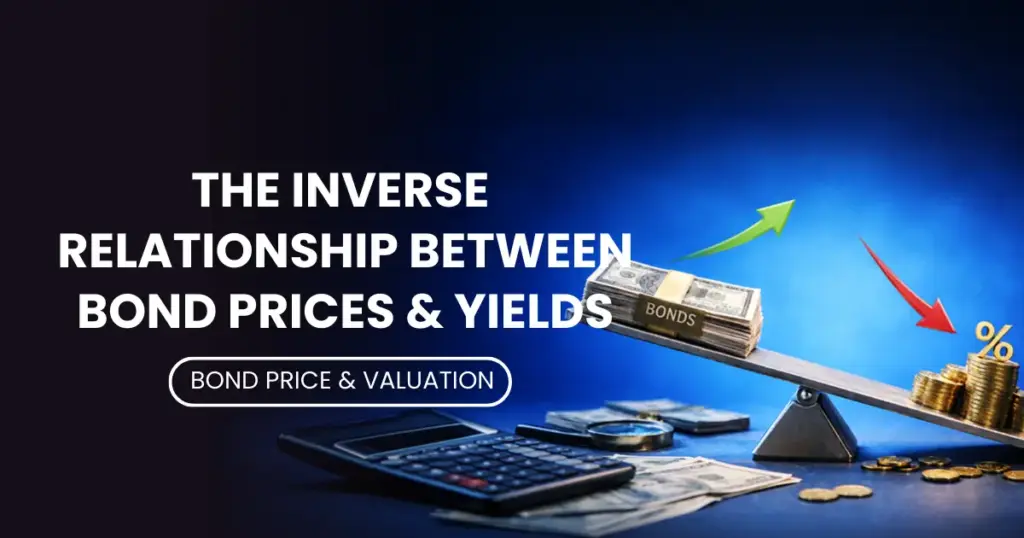
The Inverse Relationship Between Bond Prices and Yields thumbnail

The Inverse Relationship Between Bond Prices and Yields

The Inverse Relationship Between Bond Prices and Yields Table of Contents Understanding the Fundamentals of Fixed Income Why Do Bond Prices and Yields Move in Opposite Directions? The Role of Central Banks and Interest Rates Duration and Convexity: Measuring Sensitivity Strategic Implications for Investors Conclusion Understanding the Fundamentals of Fixed Income What is the core definition of a bond yield compared to its price? To navigate the fixed-income markets effectively, investors must first distinguish between the face value of a bond and its market price. When you purchase a bond, you are essentially lending capital to an issuer—whether a government or a corporation. The price is the amount you pay for that bond today, which can fluctuate based on market demand. The yield, specifically the Yield to Maturity (YTM), is the total return anticipated on a bond if the bond is held until it matures. It is expressed as an annual percentage. While the coupon rate (the interest paid) typically remains fixed, the yield fluctuates dynamically. This distinction is critical because, in the secondary market, bonds rarely trade at their exact face value (par). They trade at a premium or a discount, and this price variance directly dictates the yield an investor effectively locks in. For a deeper dive into the mechanics of these instruments, you can explore our detailed guide on what a bond is and how it works, which breaks down the terminology of coupons, principal, and maturity dates for new investors. Why Do Bond Prices and Yields Move in Opposite Directions? What is the mathematical and logical reasoning behind the “Seesaw Effect”? The inverse relationship between bond prices and yields is often described as a “seesaw.” When prices go up, yields go down, and vice versa. This is not merely a market anomaly; it is a mathematical certainty required to keep the bond competitive with newer issues. Imagine a scenario where you hold a bond issued five years ago with a fixed coupon of 5%. If prevailing interest rates in the economy rise to 6%, no rational investor would pay full price for your 5% bond when they can buy a new one paying 6%. To sell your existing bond, you must lower its price (sell it at a discount) until its effective yield matches the new 6% market rate. Conversely, if market rates fall to 4%, your 5% bond becomes highly valuable. Investors will bid up its price (trading at a premium) until the yield compresses down to match the 4% environment. This dynamic ensures that older bonds remain liquid and tradable against new government and corporate bond issues, maintaining equilibrium in the global capital markets. Master the Fixed Income Market Access Global Bonds & Debentures with PhillipCapital DIFC Explore Bond Trading Products The Role of Central Banks and Interest Rates How do Federal Reserve and Central Bank policies impact this relationship? Central banks, such as the Federal Reserve or the ECB, exert a gravitational pull on bond markets. When a central bank raises its benchmark interest rate to combat inflation, the immediate effect is a reset in the cost of borrowing. New bonds are issued with higher coupons to reflect this higher base rate. As a result, the prices of existing bonds—which carry lower, older coupon rates—must fall significantly to align with the new, higher-yield environment. This period is often characterized by capital depreciation for holders of long-term debt. Conversely, when central banks cut rates to stimulate the economy, existing bonds with higher coupons become prized assets, seeing their prices appreciate. Investors monitoring these macroeconomic shifts often look at Investment Grade vs. Non-Investment Grade bonds to decide where to position their capital, as different credit ratings react with varying volatility to interest rate announcements. Duration and Convexity: Measuring Sensitivity Why does the maturity of a bond amplify price volatility? Not all bonds react to yield changes with the same intensity. This sensitivity is measured by a concept called Duration. In simple terms, duration estimates how much a bond’s price will change for a 1% change in interest rates. Long-term bonds generally have a higher duration than short-term bonds. For instance, a 30-year Treasury bond will see a much sharper price decline than a 2-year Treasury note if interest rates rise by the same amount. This is because the cash flows (coupons) of the long-term bond are further in the future, making them more vulnerable to the eroding effects of inflation and opportunity cost. For professional investors managing complex portfolios, understanding duration (and the curvature of this relationship, known as Convexity) is essential for hedging risk, especially when trading derivatives and futures alongside cash bonds. Strategic Implications for Investors How can investors turn this inverse relationship into an opportunity? Understanding that prices and yields move inversely allows investors to employ specific strategies based on their economic outlook: Riding the Yield Curve: In a stable interest rate environment, investors might buy longer-term bonds to capture higher yields, profiting as the bond rolls down the yield curve closer to maturity. Defensive Positioning: If an investor anticipates a rate hike (which hurts bond prices), they may shorten the duration of their portfolio. This involves shifting capital into short-term bills or notes that are less sensitive to price drops. Capital Appreciation: If an economic slowdown is forecast and rate cuts are expected, investors might lock in long-term bonds. As rates fall, the prices of these bonds will rise, offering significant capital gains on top of the coupon income. Diversification is key here. Integrating fixed income alongside global equities and ETFs ensures that a portfolio can withstand volatility in any single asset class. Expert Guidance for Your Portfolio Speak to our desk for personalized market insights Contact Now Conclusion The inverse relationship between bond prices and yields is the foundational gravity of the fixed-income universe. Whether you are a retail investor seeking stable coupons or a professional trader managing duration risk, acknowledging that higher yields equate to lower prices (and vice versa) is the first step toward clearer market analysis.

The Inverse Relationship Between Bond Prices and Yields Read More »

Current Yield vs Yield to Maturity

Current Yield vs Yield to Maturity

Understanding Current Yield vs. Yield to Maturity Understanding Current Yield vs. Yield to Maturity: A Comprehensive Guide for Bond Investors In the sophisticated world of fixed-income investing, understanding how to calculate and interpret returns is paramount. While many investors focus solely on the “coupon rate,” seasoned professionals look deeper into yield metrics to determine the true value of an asset. Two of the most critical metrics used by traders and global institutions are Current Yield and Yield to Maturity (YTM). This guide explores the nuances of these calculations, helping you make informed decisions in the evolving debt markets of the DIFC and beyond. Table of Contents What is the fundamental difference between Current Yield and Yield to Maturity? How is Current Yield calculated and when is it most useful? Why is Yield to Maturity considered the ‘Gold Standard’ for bond valuation? How do market fluctuations impact these yield metrics? Which metric should an investor prioritize for a long-term portfolio? Conclusion: Integrating Yield Analysis into Your Strategy What is the fundamental difference between Current Yield and Yield to Maturity? The primary distinction lies in the scope of the calculation and the time horizon of the investment. Current Yield is a “snapshot” metric. It represents the annual income (interest) an investment generates relative to its current market price. It is a straightforward calculation that does not account for any capital gains or losses that occur if the bond is held until it matures. In contrast, Yield to Maturity (YTM) is a “total return” metric. It is the theoretical rate of return an investor will receive if they hold the bond until its expiration date. YTM is more complex because it factors in the current market price, the par value, the coupon interest rate, and the time remaining to maturity. For those looking to optimize their investment products through fixed-income assets, understanding that YTM accounts for the time value of money is essential for accurate forecasting. How is Current Yield calculated and when is it most useful? Current Yield is calculated by dividing the annual coupon payment by the bond’s current market price. For example, if a bond with a face value of $1,000 pays a 5% coupon ($50) but is currently trading at a discount price of $900, the current yield is 5.55% ($50 / $900). This metric is particularly useful for income-oriented investors who prioritize immediate cash flow over long-term capital appreciation. If you are exploring tailored wealth management solutions to supplement cash flow, the current yield tells you exactly what your “cash-on-cash” return looks like today. However, it is a lagging indicator of total performance because it ignores the eventual profit made when the bond matures at its full face value. Discover Custom Investment Solutions Align your portfolio with expert-led structured strategies. Explore Wealth Management Why is Yield to Maturity considered the ‘Gold Standard’ for bond valuation? Yield to Maturity is widely regarded as the most accurate measure of a bond’s value because it offers a holistic view. It allows investors to compare bonds with different coupons and maturities on an “apples-to-apples” basis. By factoring in the “pull to par”—the process where a bond’s price moves toward its face value as it nears maturity—YTM captures the total economic benefit of the investment.  Professional traders and family offices often use YTM to identify mispriced securities. When the YTM is higher than the current yield, the bond is likely trading at a discount; conversely, when YTM is lower, the bond is trading at a premium. For those utilizing institutional-grade brokerage services, YTM serves as the internal rate of return (IRR) used to determine if a debt instrument meets the specific requirements of a sophisticated investment mandate. How do market fluctuations impact these yield metrics? Bond prices and yields have an inverse relationship. When central banks adjust interest rates, the market price of existing bonds shifts, immediately impacting both yield metrics. If interest rates rise, existing bond prices typically fall to remain competitive with newer issues. This causes the Current Yield to rise (since you are paying less for the same fixed coupon). Simultaneously, the YTM will increase, reflecting the enhanced value of the bond at its new, lower price. Navigating these fluctuations requires a deep understanding of global market risk and return profiles and how macro-economic shifts influence volatility. Understanding these movements is key to “locking in” yields before market cycles turn. Which metric should an investor prioritize for a long-term portfolio? For the majority of long-term investors, Yield to Maturity is the superior metric. It provides a realistic expectation of the annualized return, assuming the issuer does not default and the bond is held until the end. It is the essential metric for compounding wealth over several years. However, Current Yield remains a vital tool for managing liquidity. For instance, when trading via advanced multi-asset platforms, current yield helps you understand the immediate yield-on-cost. This is important for investors who may need to exit positions early or those who require consistent income to fund other global investment opportunities. Master Global Debt Markets Access fixed income, equities, and derivatives with a trusted partner. View Our Investment Products Conclusion: Integrating Yield Analysis into Your Strategy Navigating the complexities of “Current Yield vs. Yield to Maturity” is a hallmark of a sophisticated investor. While Current Yield offers a clear view of immediate income, Yield to Maturity provides the comprehensive “total picture” necessary for long-term capital preservation and growth. By understanding the interplay between these two figures—especially in a fluctuating interest rate environment—investors can better position their portfolios for success. Whether you are seeking immediate income or long-term appreciation, a disciplined approach to yield analysis will ensure your fixed-income strategy remains robust and aligned with your financial objectives in the global capital markets. Frequently Asked Questions (FAQs) Is Current Yield more important than YTM for a short-term investor?  Yes. If you plan to sell a bond within a year, Current Yield is more relevant as it measures your immediate cash flow relative to the

Current Yield vs Yield to Maturity Read More »

Bond Yield Vs Interest Rates thumbnail

Bond Yield Vs Interest Rates

Bond Yield Vs Interest Rates Understanding the Relationship Between Bond Yields and Interest Rates As a cornerstone of the global financial system, the interplay between bond yields and interest rates dictates the flow of capital, influences corporate borrowing, and shapes investor portfolios. For investors navigating the diverse investment services offered in the UAE and international markets, mastering this inverse relationship is essential for effective risk management and capital preservation. Table of Contents How Do Interest Rates Influence Bond Prices and Yields? What Is the Difference Between a Bond’s Coupon Rate and Its Yield? Why Do Bond Yields Move Inversely to Interest Rates? How Does Inflation Impact the Bond Yield-Interest Rate Dynamic? What Should Investors Consider When Rates Are Rising? Conclusion: Strategic Fixed-Income Positioning How Do Interest Rates Influence Bond Prices and Yields? The relationship between interest rates and bond prices is fundamentally inverse. When central banks—such as the Federal Reserve or the Central Bank of the UAE—adjust benchmark interest rates, they effectively reset the “cost of money” for the entire economy. When interest rates rise, newly issued bonds enter the market offering higher coupon payments to attract investors. Consequently, existing bonds with lower fixed coupons become less attractive. To entice buyers, the market price of these older bonds must drop. Conversely, when interest rates fall, existing bonds with higher fixed coupons become highly sought after, driving their market prices upward. Yield, in its simplest form, represents the return an investor realizes on a bond. As the price of a bond falls, its yield rises (because the fixed interest payment now represents a larger percentage of the discounted purchase price). Understanding this mechanism is vital when reviewing your multi-asset portfolio performance, as it explains why fixed-income valuations may fluctuate despite stable interest payments. What Is the Difference Between a Bond’s Coupon Rate and Its Yield? It is a common misconception among retail investors that a bond’s coupon and its yield are the same. The coupon rate is the fixed annual interest payment established when the bond is issued, expressed as a percentage of the face value. The bond yield, specifically the “Yield to Maturity” (YTM), is a more dynamic metric. It accounts for the coupon rate, the current market price, and the time remaining until maturity. If you purchase a bond at a “premium” (above face value), your yield will be lower than the coupon rate. If purchased at a “discount” (below face value), your yield will be higher. For those engaging in global wealth management, distinguishing between these two is critical. The coupon provides the cash flow, but the yield tells the true story of the investment’s total return potential in the current economic climate. Enhance Your Fixed-Income Strategy Access institutional-grade bond market insights today. Access Global Bond Market Why Do Bond Yields Move Inversely to Interest Rates? The inverse movement is driven by the concept of “Opportunity Cost.” Imagine you hold a bond paying 3% interest. If the central bank raises interest rates, new bonds might start paying 5%. No rational investor would buy your 3% bond at face value when they can get 5% elsewhere. To sell your 3% bond, you must lower the price until the total return (the 3% coupon plus the capital gain when the bond matures at full face value) equals the current market rate of 5%. This “price adjustment” is what causes the yield to climb as rates rise. This phenomenon is a primary driver of volatility in fixed income trading, requiring active duration management to protect against interest rate shocks. How Does Inflation Impact the Bond Yield-Interest Rate Dynamic? Inflation is the silent predator of fixed-income returns. When inflation rises, the purchasing power of a bond’s fixed future payments diminishes. To compensate for this loss of value, investors demand higher yields, which exerts upward pressure on interest rates. Central banks typically respond to high inflation by raising interest rates to cool the economy. This creates a “double-whammy” for bondholders: prices fall due to rising rates, and the real value of the coupons falls due to inflation. Professional investors often look toward diversified investment funds that include inflation-protected securities or shorter-duration assets to mitigate these specific risks during inflationary cycles. What Should Investors Consider When Rates Are Rising? In a rising rate environment, “duration” becomes the most important metric. Duration measures a bond’s sensitivity to interest rate changes. Bonds with longer maturities generally have higher duration, meaning their prices will fall more sharply when rates rise. Investors should consider a “laddering” strategy—staggering the maturities of their bond holdings. As shorter-term bonds mature, the principal can be reinvested into new bonds at higher current interest rates. This proactive approach to asset management ensures that the portfolio is not locked into low yields for an extended period, allowing the investor to benefit from the changing interest rate landscape. Optimize Your Global Portfolio Tailored capital market solutions for professional investors. Contact Now Conclusion: Strategic Fixed-Income Positioning The relationship between bond yields and interest rates is a fundamental pillar of finance that every serious investor must respect. While the inverse correlation between price and yield can introduce volatility, it also creates opportunities for those who understand market cycles. By distinguishing between coupon rates and yields, monitoring inflationary trends, and managing portfolio duration, investors can navigate fluctuating rate environments with confidence. At PhillipCapital DIFC, we provide the expertise and financial brokerage services necessary to help you interpret these market signals and align your fixed-income strategy with your long-term capital goals. Frequently Asked Questions (FAQs) Why do bond prices fall when interest rates go up? When market interest rates rise, new bonds are issued with higher coupons. This makes existing bonds with lower rates less attractive. To sell these older bonds, owners must lower their price until the total return matches the current market rates. Is a higher bond yield always better for an investor? Not necessarily. While a higher yield means more potential return, it often signals higher risk—such as the issuer’s creditworthiness or rising inflation. Additionally,

Bond Yield Vs Interest Rates Read More »