Futures Pricing And Valuation Table of Contents What is the...
Read MoreFutures Pricing And Valuation
Table of Contents
- What is the Fundamental Difference Between Futures Pricing and Valuation?
- How is the ‘Fair Value’ of a Futures Contract Calculated?
- What Do ‘Contango’ and ‘Backwardation’ Tell Us About Market Sentiment?
- How Does Daily ‘Mark-to-Market’ Valuation Impact My Account?
- Can Arbitrage Opportunities Arise from Pricing Inefficiencies?
- Conclusion
What is the Fundamental Difference Between Futures Pricing and Valuation?
While often used interchangeably in casual conversation, pricing and valuation represent two distinct concepts in the derivatives market. Futures pricing refers to the current market price at which a contract trades on an exchange. This price is determined by the interaction of supply and demand in real-time, reflecting the aggregate consensus of buyers and sellers regarding the future value of an underlying asset. It is dynamic, fluctuating constantly throughout the trading day as new information enters the market.
Valuation, on the other hand, is a theoretical or mathematical assessment of what that contract should be worth based on specific economic factors. This is often referred to as “Fair Value.” Professional traders and institutional investors compare the theoretical valuation against the actual market price to identify discrepancies. If the market price deviates significantly from the fair value, it may signal an overbought or oversold condition, providing a potential entry or exit point. Understanding this distinction is crucial for anyone navigating futures fundamentals, as it shifts the focus from simple speculation to calculated risk assessment.

How is the 'Fair Value' of a Futures Contract Calculated?
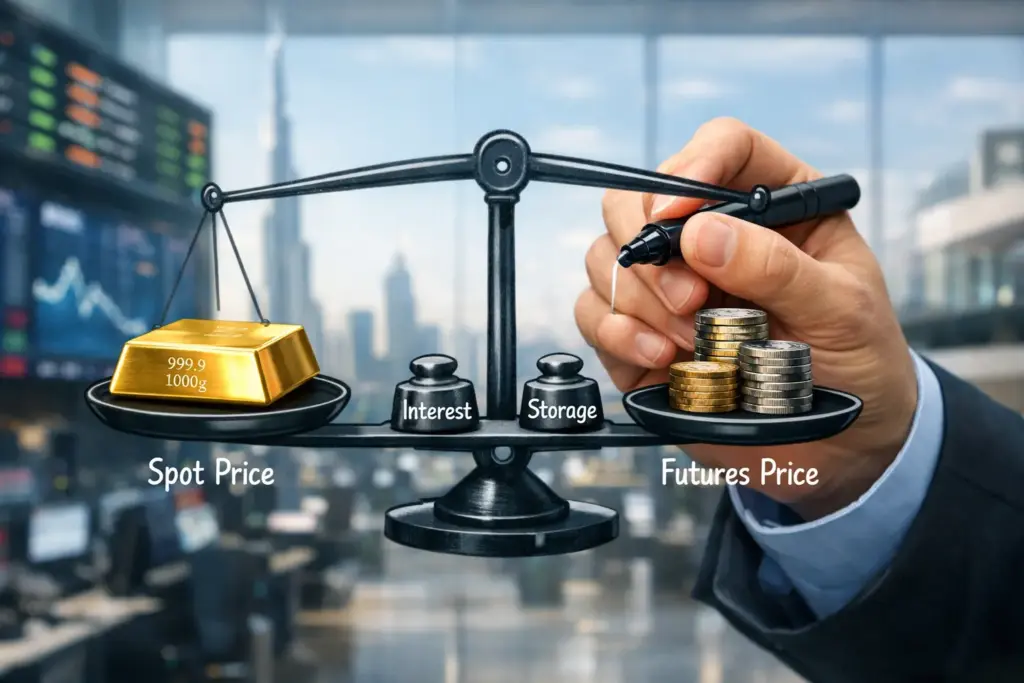
The calculation of fair value relies heavily on the Cost of Carry model. This model assumes that the futures price should theoretically equal the spot price of the underlying asset plus the cost of holding that asset until the contract’s expiration date.
The formula generally accounts for three primary components:
- Spot Price: The current market price of the asset (e.g., Gold, S&P 500, or Crude Oil).
- Financing Costs (Interest): The cost of borrowing capital to purchase the underlying asset.
- Storage or Carrying Costs: Relevant for commodities like oil or wheat, where physical storage incurs fees.
- Income (Dividends or Yields): Any income generated by the asset (such as stock dividends) is subtracted, as holding a futures contract typically does not entitle the holder to these payouts.
For example, when trading equity indices, the fair value is the spot price plus interest, minus expected dividends. If the futures price trades significantly higher than this calculated fair value, the market is pricing in a premium, potentially due to bullish sentiment or higher expected interest rates. Conversely, a price below fair value might indicate bearish sentiment.
Master Global Markets with Advanced Tools
Access top-tier liquidity and diverse asset classes
What Do 'Contango' and 'Backwardation' Tell Us About Market Sentiment?
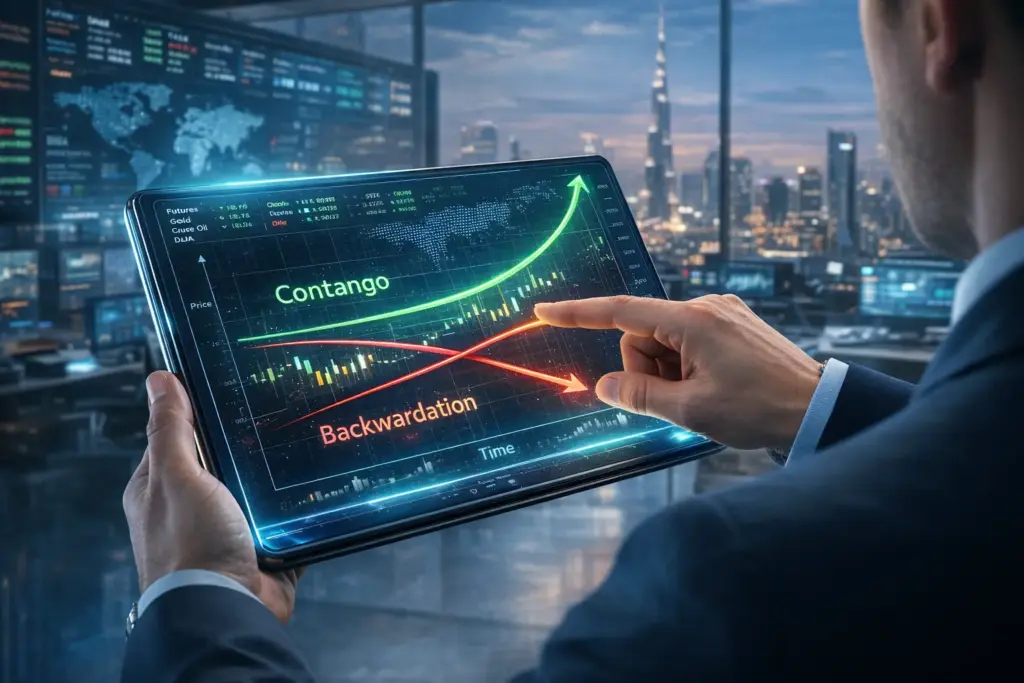
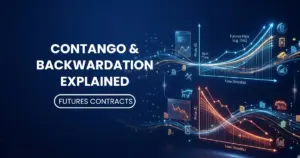
The relationship between the spot price and the futures price creates a “forward curve,” and the shape of this curve offers critical insights into market conditions.
- Contango: This occurs when the futures price is higher than the spot price. This is considered the “normal” market structure for non-perishable commodities because of the Cost of Carry (storage and interest). However, a steep contango curve can indicate that the market expects the asset’s price to rise significantly in the future.

- Backwardation: This is the opposite scenario, where the futures price is lower than the spot price. This is often a signal of immediate shortage or high demand for the physical asset now. For instance, if there is a supply disruption in the oil market, refiners might pay a premium for immediate delivery, pushing spot prices above future delivery prices.
Recognizing these states is essential when understanding futures contracts, as rolling over a position in a contango market can be costly (selling low expiring contracts to buy high expensive ones), whereas backwardation can be profitable for long-term holders rolling positions.
How Does Daily 'Mark-to-Market' Valuation Impact My Account?
Unlike traditional stock trading where gains or losses are realized only when you sell the asset, futures operate on a daily settlement cycle known as Mark-to-Market (MTM).
At the end of every trading day, the exchange calculates the settlement price for all open contracts. If the market moves in your favor, the profit is immediately credited to your account. If the market moves against you, the loss is debited. This daily valuation ensures that the exchange maintains financial integrity and prevents the accumulation of massive, unrecoverable debts.
This mechanism highlights the importance of maintaining sufficient margin. If a daily debit reduces your account balance below the required maintenance margin, you will receive a margin call and must deposit additional funds immediately. This is a key feature of how futures exchanges work, acting as a safeguard for the entire financial ecosystem.
Start Your Trading Journey
Today Open a regulated account with a trusted partner in DIFC.

Can Arbitrage Opportunities Arise from Pricing Inefficiencies?
Yes, pricing inefficiencies often create opportunities for arbitrage, particularly for sophisticated traders and institutions. Cash-and-Carry Arbitrage is a common strategy used when a futures contract is overpriced relative to its fair value.
In this scenario, a trader might:
- Borrow money to buy the underlying asset (Spot) today.
- Simultaneously sell the equivalent futures contract (Short) at the higher price.
- Hold the asset until the futures contract expires and deliver it to settle the short position.
If the premium on the futures price is high enough to cover the cost of borrowing and storage, the trader locks in a risk-free profit. While high-frequency trading algorithms often correct these discrepancies in milliseconds, understanding the mechanics of arbitrage helps investors grasp why derivatives trading is so efficient at price discovery. It ensures that futures prices rarely drift too far from the reality of the underlying physical market.
Conclusion
Mastering the nuances of pricing and valuation is what separates speculative participants from strategic investors in the futures market. By understanding the components of Fair Value—such as interest rates, storage costs, and dividends—investors can better gauge whether a contract is cheap or expensive. Furthermore, monitoring the forward curve for Contango or Backwardation provides a window into global supply and demand dynamics, while the daily discipline of Mark-to-Market settlement emphasizes the need for robust liquidity management.
At PhillipCapital DIFC, we provide the infrastructure, global access, and expertise required to navigate these complex valuation metrics. whether you are hedging commodity risk or seeking exposure to global indices, our platform ensures you are equipped to make informed decisions in a fast-moving market.
Frequently Asked Questions (FAQs)
This situation, known as Contango, is normal for most commodities and non-dividend paying assets. The futures price includes the “Cost of Carry,” which accounts for the interest paid on borrowed money to buy the asset and the costs to store it until delivery. Essentially, you are paying for the convenience of delaying the purchase.
Yes, though it is rare. This can happen in physical commodity markets if the cost of storage becomes higher than the value of the commodity itself. A famous example occurred in 2020 when WTI Crude Oil futures turned negative because there was no storage space left, forcing sellers to pay buyers to take the oil.
Not necessarily. While the futures price reflects the market’s current consensus and sentiment, it is primarily a mathematical calculation based on the current spot price, interest rates, and time to expiration. It is not a guaranteed crystal ball; as new information arises, the price will adjust.
This phenomenon is called “convergence.” As a futures contract gets closer to its expiration date, the time left to hold the asset shrinks to zero. Consequently, the financing and storage costs (Cost of Carry) vanish. If the prices didn’t match at expiration, traders would exploit the difference for risk-free profit (arbitrage) until the prices aligned.
Disclaimer:
Trading foreign exchange and/or contracts for difference on margin carries a high level of risk, and may not be suitable for all investors as you could sustain losses in excess of deposits. The products are intended for retail, professional and eligible counterparty clients. Before deciding to trade any products offered by PhillipCapital (DIFC) Private Limited you should carefully consider your objectives, financial situation, needs and level of experience. You should be aware of all the risks associated with trading on margin. The content of the Website must not be construed as personal advice. For retail, professional and eligible counterparty clients. Before deciding to trade any products offered by PhillipCapital (DIFC) Private Limited you should carefully consider your objectives, financial situation, needs and level of experience. You should be aware of all the risks associated with trading on margin.
Rolling Spot Contracts and CFDs are complex instruments and come with a high risk of losing money rapidly due to leverage. 78% of our retail client accounts lose money while trading with us. You should consider whether you understand how Rolling Spot Contracts and CFDs work, and whether you can afford to take the high risk of losing your money.
How Futures Exchanges Work
How Futures Exchanges Work Understanding the Mechanics of Global Futures...
Read MoreUnderstanding Futures Contracts
Understanding Futures Contracts Understanding Futures Contracts in Global Markets In...
Read MoreLong vs Short Positions in Derivatives
Long vs Short Positions in Derivatives A Complete Guide for...
Read MoreOver-the-Counter (OTC) vs Exchange-Traded Derivatives
Over-the-Counter (OTC) vs Exchange-Traded Derivatives A Complete Guide for UAE...
Read MoreTypes of Derivatives: Futures, Options, Swaps, and Forwards
Types of Derivatives Futures, Options, Swaps, and Forwards In the...
Read MoreWhat are Derivatives and Their Purpose
What are Derivatives and Their Purpose The financial world is...
Read MoreEssentials of Derivatives Trading
Mastering Market Moves: The Essentials of Derivatives Trading The financial...
Read More