

The Dogs of the Dow: A Straightforward Dividend Investment Strategy...
Read MoreMagic Formula Investing
A Guide to Greenblatt’s Systematic Strategy

Introduction
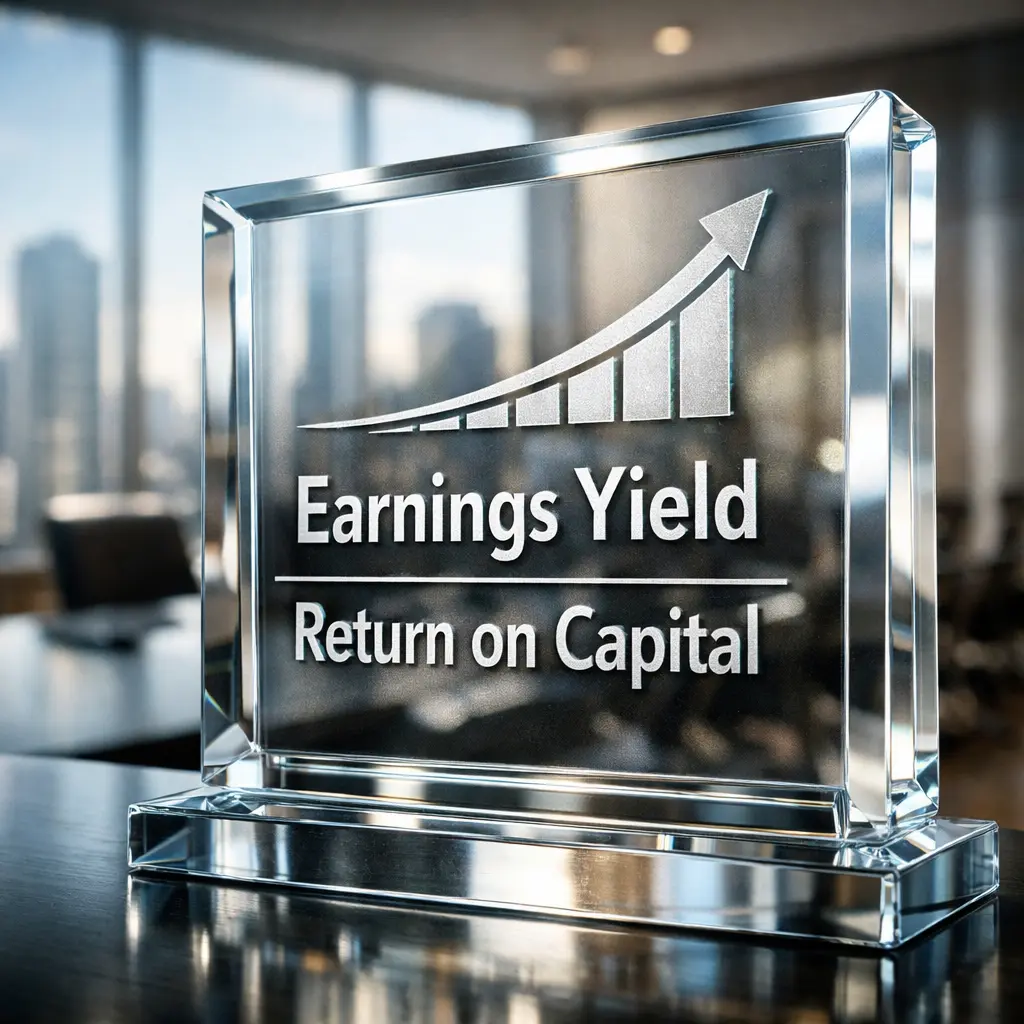
In the complex ecosystem of global equity markets, identifying sustainable value can often feel overwhelming. Investors are constantly bombarded with macroeconomic noise, speculative trends, and shifting market sentiment. To cut through this volatility, rigorous quantitative frameworks have been developed by leading institutional investors. One of the most renowned is Joel Greenblatt’s Magic Formula—a systematic strategy that ranks stocks by high earnings yield and high return on capital, then buys a basket of the top-ranked stocks.
Developed by the founder of Gotham Capital, it is a quantitative value approach designed to find good quality businesses at good prices. By relying strictly on financial mathematics rather than human emotion, the strategy provides a disciplined roadmap for capital allocation.
What Is Joel Greenblatt’s Magic Formula Strategy?
The Magic Formula is a strictly rules-based value investing framework popularized by hedge fund manager Joel Greenblatt. At its core, the strategy attempts to mathematically codify the legendary investment philosophy of Warren Buffett: buying wonderful companies at fair prices.
Instead of relying on subjective forecasts or qualitative business analysis, the formula strips away human bias by focusing entirely on historical financial data. It screens a broad universe of publicly traded companies and ranks them based on two distinct factors: the “cheapness” of the stock (Earnings Yield) and the “quality” of the underlying business (Return on Capital). By combining these two rankings, the strategy identifies a condensed list of companies that offer the optimal intersection of low valuation and high operational efficiency.
Before applying advanced quantitative methods to your portfolio, it is imperative to have a solid introduction to stock markets and an understanding of how deliverable equities function within a global framework. The Magic Formula assumes the investor has the capacity to directly purchase and hold actual shares, allowing the underlying business fundamentals to reflect in the stock price over time.
How Does the Magic Formula Rank Stocks?
The mechanical execution of the strategy is what makes it “systematic.” The ranking process follows a strict, repeatable methodology:
- Establish a Market Cap Threshold: The strategy begins by defining a universe of investable stocks, typically excluding micro-caps by setting a minimum market capitalization (e.g., $100 million or higher) to ensure adequate market liquidity.
- Exclude Specific Sectors: Financial institutions (banks, insurance companies) and utility companies are removed from the screening process. Their unique capital structures and heavy regulatory environments make the standard formula metrics less relevant.
- Calculate Earnings Yield: Every remaining company is ranked by its Earnings Yield, from highest (cheapest) to lowest (most expensive).
- Calculate Return on Capital: The same companies are then ranked by their Return on Capital (ROC), from highest (most efficient) to lowest (least efficient).
- Combine the Rankings: The two rank numbers for each company are added together. A company that ranks 15th in Earnings Yield and 10th in ROC would have a combined score of 25.
- Construct the Basket: The strategy buys a diversified basket of the 20 to 30 companies with the lowest combined scores. These positions are typically held for one year before the portfolio is completely re-evaluated and rebalanced.
Access Global Markets with Deliverable Equities
Execute value strategies confidently with direct access to US markets.
Why Are Earnings Yield and Return on Capital the Key Metrics?
To understand the power of the strategy, investors must look closely at the specific formulas Greenblatt utilizes, which differ slightly from conventional Wall Street metrics.
Earnings Yield (EBIT / Enterprise Value): Traditional investors often use the Price-to-Earnings (P/E) ratio to gauge value. The Magic Formula improves upon this by using Earnings Before Interest and Taxes (EBIT) divided by Enterprise Value (EV). Enterprise Value is a more accurate representation of a company’s price tag because it factors in both the company’s debt and its cash reserves. By using EBIT, the formula evaluates the raw operating profitability of the business before the distortions of varying corporate tax rates and debt interest levels. In short, this metric answers the question: How much operating profit am I getting for the total price of buying the entire business?
Return on Capital (EBIT / Net Working Capital + Net Fixed Assets): While traditional Return on Equity (ROE) can be artificially inflated by excessive debt, Greenblatt’s Return on Capital (ROC) measures how effectively a company utilizes its tangible operational assets to generate profit. By dividing EBIT by the sum of net working capital and net fixed assets, the formula isolates the core economic engine of the company. A high ROC indicates a company with a strong competitive advantage, capable of growing its operations without requiring massive external capital injections.
Relying solely on surface-level ratios can sometimes lead to poor allocation; therefore, confirming these quantitative signals with a thorough intrinsic value calculation ensures you are deeply analyzing the cash flow generation behind the metrics.
What Are the Advantages of This Quantitative Value Approach?
The primary advantage of the Magic Formula is its elimination of behavioral finance errors. Human investors are notoriously prone to panic during market corrections and greed during euphoric rallies. By adhering to a systematic, mechanical ranking system, investors are forced to buy out-of-favor companies that possess fundamentally sound operations.
Additionally, the strategy enforces portfolio diversification by requiring the purchase of a basket of 20 to 30 stocks. This mitigates single-stock risk, ensuring that a single corporate failure does not devastate the overall capital base. The strategy is also time-efficient; rather than spending hundreds of hours reading subjective analyst reports, the data-driven screen provides a targeted list of high-probability investment candidates.
Are There Any Limitations or Risks to the Magic Formula?
No quantitative strategy is flawless, and the Magic Formula has distinct challenges. The most prominent risk is the “Value Trap”—a company that appears mathematically cheap but is experiencing a permanent structural decline in its industry. Because the formula relies on trailing or projected financial data, it cannot account for sudden technological disruptions or unforeseen management crises.
Furthermore, the strategy requires immense psychological discipline. Value investing often underperforms broad market indices during aggressive, growth-driven bull markets. An investor using this system must be prepared to endure periods of relative underperformance, trusting the mathematical probabilities over a multi-year horizon. It is vital to evaluate whether the patience required for this approach aligns with your personal risk and return profile before deploying significant capital.
Finally, the mechanical requirement to turn over the portfolio annually can result in transaction costs and tax implications, making efficient brokerage execution paramount to preserving yield.
Elevate Your Family Office Portfolio
Leverage advanced institutional brokerage services for sophisticated quantitative strategies
Conclusion
Joel Greenblatt’s Magic Formula stands as a testament to the power of disciplined, quantitative value investing. By systematically seeking out companies that generate exceptional returns on capital and trading at highly attractive earnings yields, the strategy cuts through market noise to find true economic quality. While it requires the psychological fortitude to buy unloved stocks and the patience to weather cyclical underperformance, its logical foundation makes it a compelling framework for long-term wealth preservation and growth. For global investors and professionals in the UAE, adapting such institutional-grade logic is a crucial step toward building a resilient and fundamentally sound equity portfolio.
Frequently Asked Questions (FAQs)
Does Joel Greenblatt’s Magic Formula still work today?
While the strategy delivered massive outperformance during Greenblatt’s original testing period, modern investors often experience cyclical periods of underperformance, particularly during long, growth-dominated bull markets. However, the fundamental premise—buying highly profitable businesses at discount valuations—remains a mathematically sound approach for long-term investors (typically requiring a 5 to 10-year commitment) who can maintain strict discipline during market downturns.
Why does the strategy exclude financial and utility stocks?
The formula excludes financial institutions (like banks and insurance companies) and utilities because their capital structures distort the screening metrics. Financials carry unique, operation-critical debt, and utilities operate under heavy regulatory constraints with massive fixed-asset bases. Applying standard Return on Capital (ROC) and Earnings Yield calculations to these sectors would yield inaccurate comparisons against standard corporations.
How often should a Magic Formula portfolio be rebalanced?
The strategy dictates a strict annual rebalancing schedule. You are instructed to hold the basket of stocks for exactly one year. After 12 months, you sell the positions and re-run the screener to construct a new portfolio of the currently highest-ranked stocks. This mechanical turnover removes emotional attachment and ensures the portfolio consistently reflects the optimal balance of cheap valuation and high quality.
Can I just buy the top 3 or 4 stocks instead of 20 to 30?
Concentrating your capital into just a handful of the top-ranked names is highly discouraged. The Magic Formula relies on statistical probabilities playing out over a diversified group. Because a purely mathematical screen cannot identify “value traps” (companies facing sudden technological obsolescence or structural decline), holding 20 to 30 stocks is necessary to absorb individual corporate failures while allowing the broader mathematical edge to succeed.
Disclaimer:
Trading foreign exchange and/or contracts for difference on margin carries a high level of risk, and may not be suitable for all investors as you could sustain losses in excess of deposits. The products are intended for retail, professional and eligible counterparty clients. Before deciding to trade any products offered by PhillipCapital (DIFC) Private Limited you should carefully consider your objectives, financial situation, needs and level of experience. You should be aware of all the risks associated with trading on margin. The content of the Website must not be construed as personal advice. For retail, professional and eligible counterparty clients. Before deciding to trade any products offered by PhillipCapital (DIFC) Private Limited you should carefully consider your objectives, financial situation, needs and level of experience. You should be aware of all the risks associated with trading on margin.
Rolling Spot Contracts and CFDs are complex instruments and come with a high risk of losing money rapidly due to leverage. 78% of our retail client accounts lose money while trading with us. You should consider whether you understand how Rolling Spot Contracts and CFDs work, and whether you can afford to take the high risk of losing your money.

Magic Formula (Greenblatt’s Strategy)
Magic Formula Investing A Guide to Greenblatt’s Systematic Strategy Introduction...
Read More
Rebalancing Strategy
Rebalancing Strategy Mastering Portfolio Rebalancing: A Strategic Approach to Risk...
Read More
Contrarian Investing /Dip Buying
Contrarian Investing / Dip buying Mastering the Art of Contrarian...
Read More
Growth at Reasonable Price (GARP)
Growth at Reasonable Price (GARP) Mastering Growth at Reasonable Price...
Read More
Sector Rotation Strategy
Sector Rotation A Strategic Guide to Investing Through Economic Cycles...
Read More
Dividend Growth Investing
Dividend Growth Investing Mastering Dividend Growth Investing: The Strategy for...
Read More
Growth Investing
Growth Investing The High-Risk, High-Reward Strategy for UAE Investors Growth...
Read More

Buy and Hold vs. Active Trading
Buy and Hold vs. Trading Understanding the difference in mindset...
Read More