Spot Price vs Futures Price

Spot Price vs Futures Price: A Comprehensive Guide for Global Investors

In the sophisticated world of global capital markets, understanding how assets are priced is the cornerstone of any successful investment strategy. Whether you are looking at the price of Gold on the Dubai Gold and Commodities Exchange (DGCX) or monitoring the volatility of Crude Oil, you will inevitably encounter two distinct pricing models: the spot price and the futures price.

For a professional investor or a corporate treasurer, the choice between these two isn’t just about “when” the trade happens, but “how” it impacts the bottom line, risk exposure, and capital efficiency. This guide provides a deep dive into the mechanics of these pricing structures to help you navigate the markets with confidence.

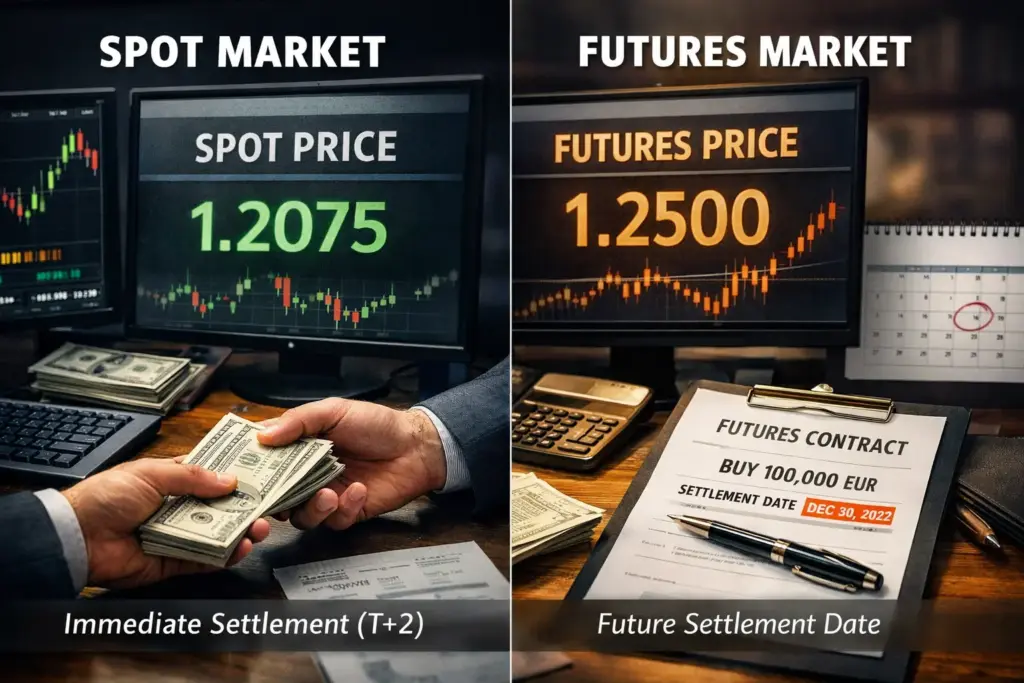
Hyper-realistic comparison of spot price vs futures price showing immediate settlement in spot market and future contract settlement with trading screens and financial documents.

What is the fundamental difference between spot price and futures price?

The primary distinction lies in the timing of the transaction and the delivery of the underlying asset. The spot price is the current market price for the immediate purchase or sale of an asset. When you trade in the spot market—such as trading Spot FX—the exchange of cash for the asset happens “on the spot,” usually settling within two business days (T+2).

In contrast, the futures price is the price agreed upon today for an asset that will be delivered or cash-settled on a specific date in the future. A futures contract is a legally binding agreement to buy or sell a standardized quantity and quality of an asset at this predetermined price. While the spot market focuses on the immediate supply and demand of today, the futures market is forward-looking, reflecting what market participants believe the asset will be worth at the time of expiration.

How is the spot price determined in real-time?

Spot prices are the purest reflection of current market sentiment. They are driven by the immediate interaction of buyers and sellers in the global marketplace. In the Forex market, for example, the spot price of a currency pair like EUR/USD is determined by interbank liquidity, central bank policies, and real-time economic data releases.

Because spot trading involves immediate delivery, it is highly sensitive to sudden supply shocks. For instance, if a major oil refinery faces an unexpected shutdown, the spot price of Crude Oil may spike instantly as refineries scramble for immediate physical supply. This makes the spot market the preferred venue for day traders and those needing the physical asset for immediate use.

What factors influence the pricing of a futures contract?

A common misconception is that the futures price is simply a “guess” of the future spot price. In reality, the pricing of a futures contract is a mathematical calculation based on the spot price plus the cost of carry.

The cost of carry includes:

  1. Storage Costs: The expense of physically holding a commodity (like Gold or Wheat) in a warehouse until the delivery date.
  2. Insurance: Protecting the physical asset during the holding period.
  3. Interest Rates: The opportunity cost of the capital tied up in the asset. If you buy a future instead of the physical asset, you can keep your cash in an interest-bearing account until the contract expires.

The formula is generally: Futures Price = Spot Price + (Storage + Insurance + Interest) – (Income/Dividends).

Ready to trade Global Futures?

Access regulated exchanges and institutional-grade tools with PhillipCapital DIFC.

Comparison: Spot Market vs. Futures Market at a Glance

Feature Spot Market Futures Market
DeliveryImmediate (usually T+0 to T+2)On a specified future date
Pricing BasisReal-time supply & demandSpot price + Cost of Carry
OwnershipDirect ownership of the assetAgreement to trade in the future
LeverageGenerally lower or noneHigh (Margin-based)
ExpirationNo expiration dateFixed expiration dates
Primary UseImmediate use / Short-term tradingHedging / Speculation

Why do futures prices often differ from spot prices?

The relationship between the spot and futures price creates what is known as the “forward curve.” There are two main states this curve can take:

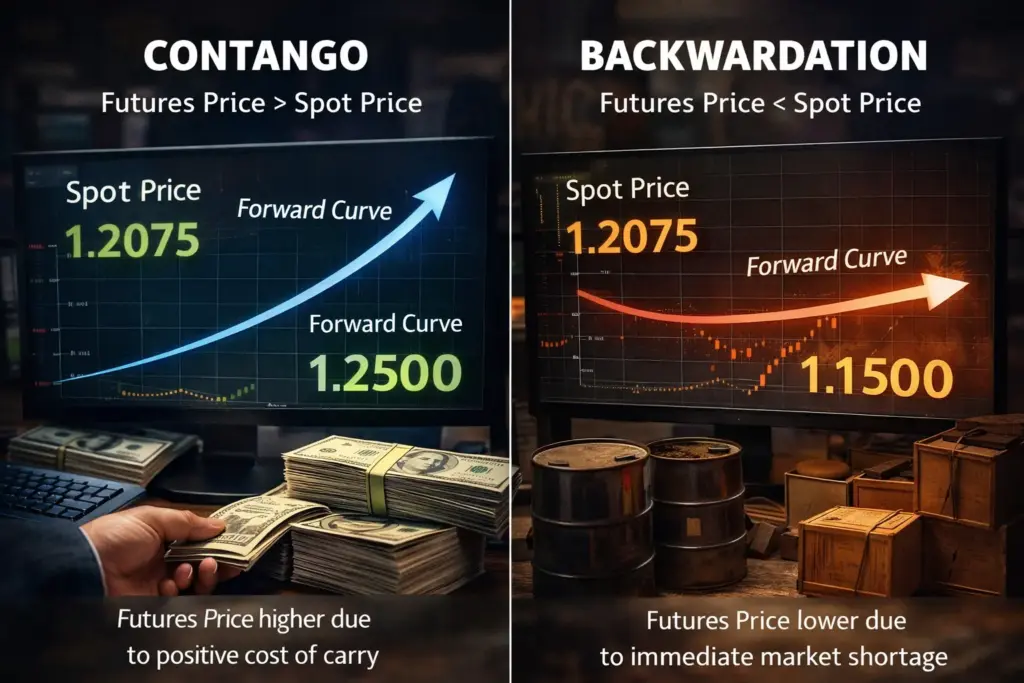
  • Contango: This is the most common state, where the futures price is higher than the spot price. This occurs when the cost of carry (storage, interest) is positive. Investors are willing to pay a premium to avoid the costs and logistics of holding the physical asset today.
  • Backwardation: This occurs when the futures price is lower than the spot price. This usually signals an immediate shortage in the market, where buyers are willing to pay a significant premium for “immediate” delivery in the spot market rather than waiting for the future.
Hyper-realistic illustration of contango and backwardation showing forward curve comparison where futures price is higher or lower than spot price in financial markets.

When should an investor choose spot trading over futures?

The choice depends on your objective. If you are a retail trader looking to capitalize on a two-hour price movement in major or exotic currency pairs, the spot market offers the liquidity and simplicity you need. You gain immediate exposure without worrying about contract expiration or rollover.

However, if you are looking to control a large position with a smaller capital outlay, the leverage inherent in derivatives makes the futures market more attractive. For instance, instead of paying the full price for 100 ounces of Gold in the spot market, you can post a “margin” (a fraction of the total value) to control a Gold futures contract.

How do professional traders use futures for hedging?

Hedging is perhaps the most critical application of the futures price. Imagine a UAE-based jewelry manufacturer who needs to buy 1,000 ounces of gold in six months. They are worried that the price will rise. By “locking in” a price today using a futures contract, they eliminate the risk of price volatility. If the spot price rises by the delivery date, their futures contract profit offsets the higher cost of the physical gold.

This ability to manage long vs short positions is what allows businesses to forecast costs with certainty, regardless of how the spot market fluctuates.

Need Personalized Investment Advice?

peak with our DIFC-based advisors to tailor your multi-asset portfolio.

What are the risks associated with both pricing models?

While the spot market is susceptible to “slippage” during high volatility, the futures market carries the significant risk of leverage. Because you are trading on margin, a small move in the spot price can lead to large gains or losses in your futures position. Professional investors must use robust risk management tools, such as stop-loss orders, to protect their capital from adverse movements in the underlying asset.

Conclusion

Mastering the dynamics of spot price vs futures price is essential for anyone looking to navigate the global financial landscape. The spot market provides the pulse of the “here and now,” offering immediate liquidity and simplicity. The futures market, governed by the cost of carry and market expectations, provides a powerful venue for leverage, speculation, and essential risk management.

At PhillipCapital DIFC, we provide the platform and expertise to access both worlds—from Spot FX and CFDs to exchange-traded futures on global markets. By understanding the relationship between these two prices, you can build a more resilient and versatile investment portfolio.

Frequently Asked Questions (FAQs)

Why is the futures price usually higher than the spot price?

The futures price is typically higher because it includes the “cost of carry.” This covers expenses that a seller incurs to hold the asset until the future delivery date, such as storage fees, insurance, and interest rates. When the market is in this standard state, it is known as Contango.

Can the spot price ever be higher than the futures price?

 Yes. This occurs during a market state called Backwardation. It usually happens when there is an immediate, urgent demand for the physical asset or a sudden supply shortage. In these cases, investors are willing to pay a premium to get the asset “on the spot” rather than waiting for a future delivery.

Do futures and spot prices ever meet?

 Yes, they converge. As a futures contract approaches its expiration date, the “time value” and storage costs decrease to zero. On the final day of the contract, the futures price and the spot price must be identical because the “future” has officially become the “now.”

Is it better to trade in the spot or futures market?

 It depends on your goal. Spot trading is better for beginners or long-term investors who want to own the asset immediately without worrying about expiration dates. Futures trading is preferred by professional traders for hedging or using leverage to control large positions with less upfront capital.

Can the futures price be used to predict the future spot price?

While it reflects market expectations, it is not a perfect predictor. It is primarily determined by the current spot price plus the cost of carrying the asset over time.

What happens if I hold a futures contract until expiration?

Depending on the contract, it will either be cash-settled (the difference in price is credited/debited to your account) or require physical delivery of the asset. Most financial futures are cash-settled

Is spot trading safer than futures trading?

Not necessarily. Spot trading involves the risk of the asset’s price falling to zero. Futures trading involves leverage, which can amplify both profits and losses, making it more complex for beginners.

Disclaimer:

Trading foreign exchange and/or contracts for difference on margin carries a high level of risk, and may not be suitable for all investors as you could sustain losses in excess of deposits. The products are intended for retail, professional and eligible counterparty clients. Before deciding to trade any products offered by PhillipCapital (DIFC) Private Limited you should carefully consider your objectives, financial situation, needs and level of experience. You should be aware of all the risks associated with trading on margin. The content of the Website must not be construed as personal advice. For retail, professional and eligible counterparty clients. Before deciding to trade any products offered by PhillipCapital (DIFC) Private Limited you should carefully consider your objectives, financial situation, needs and level of experience. You should be aware of all the risks associated with trading on margin.

Rolling Spot Contracts and CFDs are complex instruments and come with a high risk of losing money rapidly due to leverage. 78% of our retail client accounts lose money while trading with us. You should consider whether you understand how Rolling Spot Contracts and CFDs work, and whether you can afford to take the high risk of losing your money.