Statement of Changes in Equity

Professional investor in a modern Dubai office analyzing financial charts and equity reports on a large screen with warm ambient lighting

Introduction

When evaluating a company’s stock, most investors jump straight to revenue figures or earnings per share. But seasoned analysts know that the Statement of Changes in Equity often tells the deeper story — one about how a company manages its own financial foundation over time.

This statement sits alongside the income statement, balance sheet, and cash flow statement as part of a company’s full financial report. Understanding it is a key part of fundamental analysis of deliverable equities, helping investors cut through surface-level numbers and assess the true health of a business.

What Is the Statement of Changes in Equity?

In plain terms, what does this financial statement actually show?

The Statement of Changes in Equity is a formal financial document that tracks every movement in a company’s equity — or “net worth” — over a specific accounting period, usually one financial year.

Think of it this way: if a company’s total equity was $500 million at the start of the year and $540 million at the end, this statement explains exactly why and how that $40 million change happened. Was it because the company earned profits? Did it issue new shares? Did it pay dividends or buy back stock?

Every action that increases or decreases shareholder wealth is captured here — making it one of the most transparent financial documents available to equity investors.

What Components Does It Include?

What line items will I typically see in this statement?

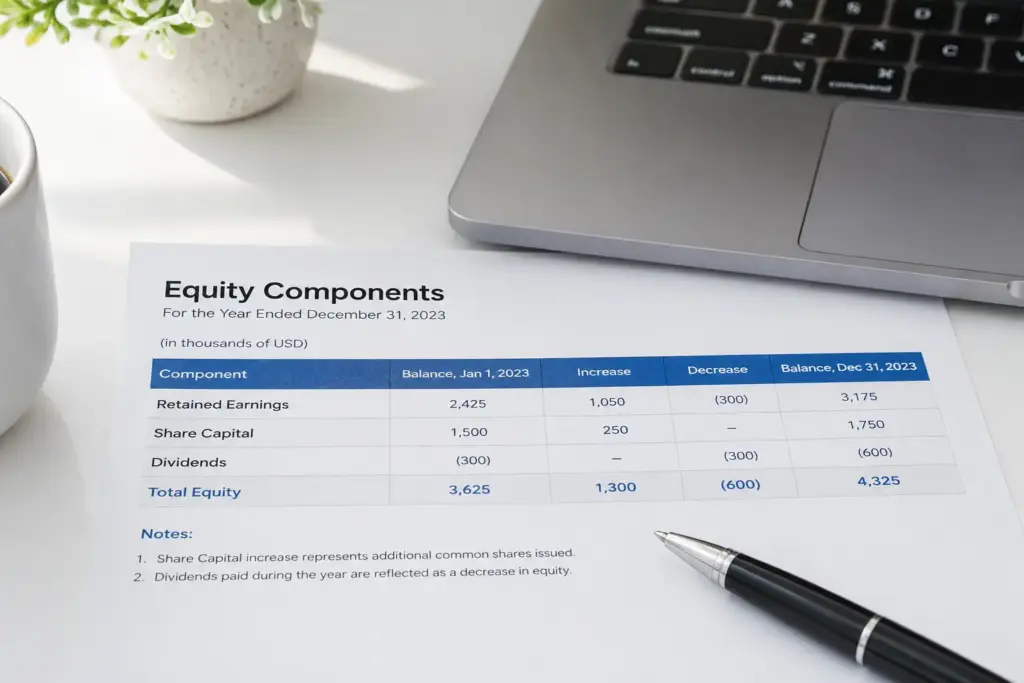
The statement is usually presented as a table, with different equity categories listed in columns and time periods in rows. The main components you’ll encounter include:

Share Capital — The value of shares issued by the company to investors. Any new share issuances or buybacks appear here.

Share Premium / Additional Paid-In Capital — The amount received above the nominal (face) value when shares are sold to the public. Relevant during IPOs or secondary offerings.

Close-up of financial spreadsheet showing equity components including retained earnings, share capital, and dividends on a white desk with laptop and pen in natural daylight

Retained Earnings — This is the cumulative profit the company has kept over the years rather than paying out as dividends. It grows when profits are high and shrinks when dividends are paid or losses are recorded. Investors tracking stock valuations often monitor this closely, as sustained growth in retained earnings signals a company reinvesting in itself.

Other Comprehensive Income (OCI) — Gains or losses not yet realized — for example, from foreign currency translations or changes in the value of certain investments. OCI items don’t pass through the income statement but directly affect equity.

Treasury Shares — If a company buys back its own shares, these are recorded here as a deduction. Share buybacks reduce the total equity figure.

How Do Dividends Affect This Statement?

I know dividends are paid to shareholders — but how do they show up here?

Dividends are one of the most visible items in this statement. When a company declares a dividend, it reduces retained earnings — because cash that could have stayed in the business is being returned to shareholders instead.

For investors holding deliverable equity — US stocks, ETFs, and ADRs or GCC stocks, dividend trends visible in this statement can inform expectations about future income and management’s capital allocation priorities.

A company that consistently grows retained earnings while also paying dividends is typically generating strong, sustainable profits — a positive signal for long-term investors.

Ready to invest in dividend-paying global stocks?

Gain access to US, global, and GCC equities through a regulated broker trusted since 1975

Why Does This Statement Matter for Stock Investors?

Why should I bother reading this when I already look at profit and EPS?

The income statement shows whether a company made money. But the Statement of Changes in Equity shows what the company did with that money — and that distinction is everything.

A company might report strong profits but quietly erode equity through excessive share buybacks, large dividend payouts, or hidden losses sitting in OCI. On the flip side, a company with modest profits but steadily growing equity could be building long-term shareholder value responsibly.

Reading this alongside stock market basics and core valuation methods gives investors a far more complete picture before making any buy or sell decision.

It is especially useful when comparing two companies in the same sector — the one with more disciplined equity management tends to outperform over market cycles.

How to Use It in Fundamental Analysis?

How do I practically apply this statement when analyzing a stock?

Here’s a practical approach used by experienced equity analysts:

Step 1 — Track retained earnings over 3–5 years. If retained earnings are consistently growing, the company generates more than it distributes — a good sign of financial strength.

Step 2 — Watch for sudden equity drops. A sharp decline in equity can mean large losses, aggressive buybacks, or heavy dividend payouts relative to earnings. Investigate why before assuming it’s a red flag or a positive.

Step 3 — Check the OCI section. Large, unexplained swings in OCI can indicate exposure to currency risk or volatile investments — relevant if you’re evaluating a multinational. Investors interested in global equity trading in Dubai should be particularly aware of currency-driven equity movements.

Step 4 — Compare equity growth to net profit. If profits are high but equity isn’t growing, find out where the value is going. This tells you about management’s reinvestment strategy.

Have questions about equity analysis?

Our team is here to guide you through the fundamentals.

Conclusion & Key Takeaways

The Statement of Changes in Equity is not just accounting paperwork — it’s a window into how a company’s leadership creates (or destroys) shareholder value over time. For investors serious about fundamental analysis of deliverable equities, reading this statement alongside the income statement and balance sheet is non-negotiable.

Key Takeaways:

  • The statement tracks all movements in a company’s equity during a reporting period — from profits and losses to dividends and share issuances.
  • Retained earnings growth signals financial strength and disciplined capital allocation.
  • Dividends, share buybacks, and OCI movements all reduce or reshape equity — each with different investment implications.
  • Used in combination with income and cash flow data, this statement strengthens your ability to evaluate a stock’s true long-term value.
  • It is particularly valuable when comparing companies in the same industry or tracking a company’s financial discipline over multiple years.

PhillipCapital DIFC — Serving Investors Since 1975

Access global equities, research tools, and expert support — all from a DFSA-regulated platform in Dubai.

trading account opening uae banner

Frequently Asked Questions (FAQs)

Is the Statement of Changes in Equity the same as the balance sheet?

No. The balance sheet shows equity at a single point in time — a snapshot. The Statement of Changes in Equity explains how that figure moved during the year. Think of the balance sheet as the destination and this statement as the journey.

Can a profitable company still show a decrease in equity?

Absolutely — and this surprises many investors. If a company pays out large dividends or buys back significant shares, equity can fall even when profits are strong. This is why reading just the income statement isn’t enough for complete stock analysis.

How often is this statement published?

Typically quarterly and annually, alongside the full financial report. Most listed companies on major exchanges publish audited annual statements and unaudited quarterly updates — making it accessible for any investor doing regular portfolio reviews.

Does a growing equity figure always mean the stock is a good buy?

Not necessarily. Growing equity is a positive signal, but it must be read in context. A company could be retaining earnings simply because it has no better use for the cash — which may indicate limited growth opportunities. Always combine this with valuation metrics for a fuller picture.

Disclaimer:

Trading foreign exchange and/or contracts for difference on margin carries a high level of risk, and may not be suitable for all investors as you could sustain losses in excess of deposits. The products are intended for retail, professional and eligible counterparty clients. Before deciding to trade any products offered by PhillipCapital (DIFC) Private Limited you should carefully consider your objectives, financial situation, needs and level of experience. You should be aware of all the risks associated with trading on margin. The content of the Website must not be construed as personal advice. For retail, professional and eligible counterparty clients. Before deciding to trade any products offered by PhillipCapital (DIFC) Private Limited you should carefully consider your objectives, financial situation, needs and level of experience. You should be aware of all the risks associated with trading on margin.

Rolling Spot Contracts and CFDs are complex instruments and come with a high risk of losing money rapidly due to leverage. 78% of our retail client accounts lose money while trading with us. You should consider whether you understand how Rolling Spot Contracts and CFDs work, and whether you can afford to take the high risk of losing your money.

peg ratio thumbnail

PEG ratio

PEG Ratio The Advanced Metric for Finding Growth at a...

Read More