Return on Assets (ROA) Introduction When you look at a...
Read MoreEarnings Per Share (EPS)
A Complete Guide for Equity Investors

Introduction
When evaluating whether a stock is worth buying, one number comes up again and again — Earnings Per Share, or EPS. It is one of the most widely used metrics in fundamental analysis, appearing in every earnings report, analyst note, and investment research piece. Yet for many investors, especially those new to equity markets, EPS can feel like just another figure buried in a financial statement.
This guide breaks EPS down in plain language — what it means, how to calculate it, how to interpret it, and how to use it alongside other tools when analysing deliverable equities. Whether you are investing in US stocks, global equities, or GCC-listed companies, understanding EPS is a foundational step toward making more informed investment decisions.
What Is Earnings Per Share (EPS)?
EPS tells you how much profit a company earned for each share of its stock.
Think of it this way: if a company earns $10 million in net profit and has 10 million shares outstanding, each share is entitled to $1 of that profit. That $1 is the EPS.
EPS is reported quarterly and annually by publicly listed companies. It gives investors a standardised way to compare profitability — not just in absolute terms, but on a per-share basis, making it far easier to compare companies of different sizes.
It is important to understand that EPS reflects profit, not cash in hand. A company can report strong earnings and still have cash flow challenges, which is why EPS should never be looked at in isolation. It is one piece of a broader picture that includes revenue growth, debt levels, and cash flow metrics — all of which fall under fundamental analysis.
How Is EPS Calculated?
The basic EPS formula is straightforward:
EPS = (Net Income – Preferred Dividends) ÷ Weighted Average Shares Outstanding
Here is what each component means:
- Net Income is the company’s total profit after all expenses, interest, and taxes have been deducted.
- Preferred Dividends are subtracted because preferred shareholders are paid before common shareholders. EPS is calculated for common shareholders only.
- Weighted Average Shares Outstanding accounts for any shares issued or repurchased during the period, rather than simply using the number of shares at year-end.
Example: A company reports $50 million in net income, pays $5 million in preferred dividends, and has 45 million weighted average shares outstanding.
EPS = ($50M – $5M) ÷ 45M = $1.00 per share
This number then becomes the basis for a range of valuation decisions — and forms a key input into metrics like the Price-to-Earnings (P/E) ratio.
What Is the Difference Between Basic EPS and Diluted EPS?
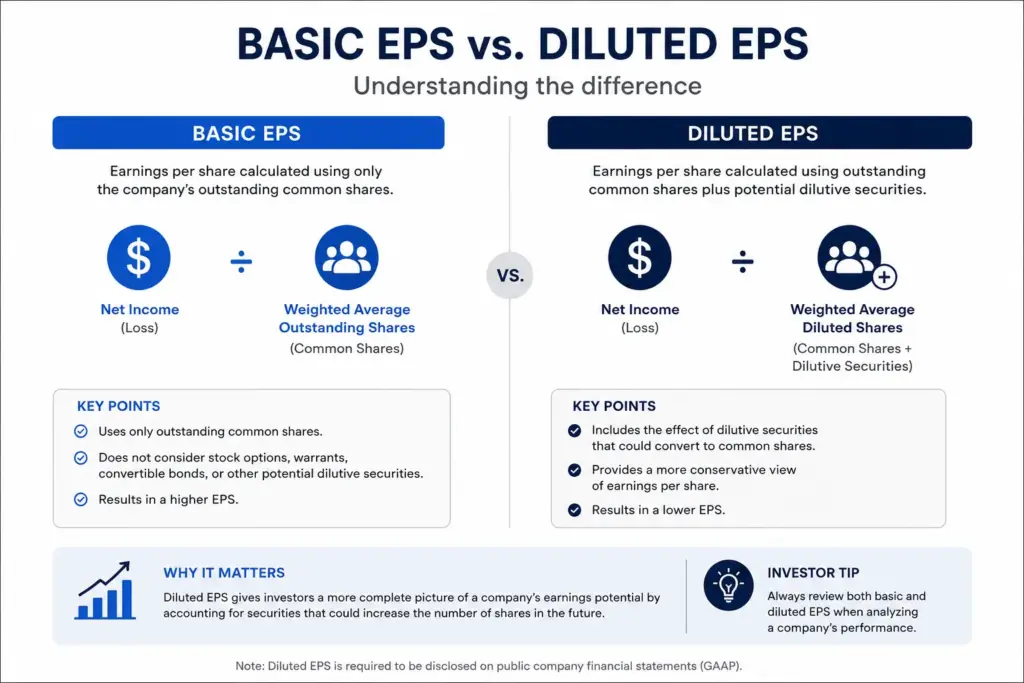
Diluted EPS is generally the more conservative and realistic figure to use.
Basic EPS uses only the actual shares currently outstanding. Diluted EPS goes a step further — it factors in all securities that could potentially be converted into shares in the future. This includes stock options held by employees, convertible bonds, and warrants.
Why does this matter? Because if all those potential shares were issued tomorrow, each existing share would represent a smaller portion of the company’s profit. Diluted EPS captures that risk.

For instance, a company might report a basic EPS of $2.50, but once convertible instruments are included, the diluted EPS drops to $2.10. The gap between the two is worth paying attention to — a large difference signals that future share dilution is a real possibility, which can weigh on stock prices.
Most professional analysts and institutions focus on diluted EPS precisely because it gives a more complete picture of what shareholders might actually receive. If you are analysing global stocks, always check which EPS figure is being quoted.
What Does a High or Low EPS Tell You?
A higher EPS generally means a more profitable company — but context is everything.
A rising EPS over several quarters suggests that a company is growing its profitability. This is typically viewed positively by the market and can support a rising share price. However, there are important nuances:
A high EPS is not always a sign of quality. A company can boost its EPS by buying back shares (reducing the denominator), even if its actual profits have not changed. This is a legitimate strategy, but investors should check whether the EPS improvement came from genuine earnings growth or from share buybacks.
A declining EPS needs investigation. It could reflect a genuinely struggling business, or it could be a one-off event — a large one-time write-off or restructuring charge — that does not reflect ongoing performance. Analysts often look at “adjusted” or “normalised” EPS to strip out these one-time items.
Comparing EPS across industries requires care. Capital-intensive industries like utilities or airlines naturally operate with different EPS profiles compared to technology or pharmaceutical companies. EPS is most meaningful when compared within the same sector and against the company’s own historical trend.
Understanding this context is core to stock valuation — knowing not just what the number is, but what it means in the broader business environment.
Ready to Trade Global Equities?
Access US stocks, global shares, and GCC-listed equities with a trusted DIFC-regulated broker.
How Does EPS Relate to the P/E Ratio?
EPS is the foundation of one of the most commonly used valuation tools — the Price-to-Earnings ratio.
The P/E ratio is calculated as:
P/E Ratio = Share Price ÷ EPS
If a stock trades at $50 and has an EPS of $5, its P/E ratio is 10. This means investors are paying $10 for every $1 of earnings. A higher P/E suggests investors expect strong future growth; a lower P/E may indicate the stock is undervalued — or that the market has concerns about the company’s outlook.
EPS is therefore not just a historical data point — it directly shapes how a stock is priced in the market. Analysts also use forward EPS, which is based on projected future earnings rather than historical ones. Forward EPS is particularly useful when evaluating high-growth companies whose current earnings may not yet reflect their full potential.
For investors looking at a broad portfolio of US stocks, ETFs, and ADRs, P/E ratios powered by EPS are often the first filter applied during the stock screening process.
Can EPS Be Manipulated?
Yes — and informed investors need to know how.
Companies have some flexibility in how they report earnings, and this can affect EPS in ways that do not always reflect business reality. Common techniques include:
- Aggressive revenue recognition — booking revenue earlier than appropriate to inflate current period earnings.
- Share buybacks — reducing share count to boost EPS without improving profits.
- One-time gain inclusion — including non-recurring gains in reported net income without separately disclosing them.
- Capitalising expenses — treating costs as long-term assets rather than current expenses, which reduces costs and boosts earnings.
This is why analysing EPS alongside free cash flow is so important. If a company consistently reports strong EPS but generates little or no cash, it warrants deeper scrutiny. Learning to read financial statements critically is a core skill explored in our stock market basics content.

How Should Investors Use EPS in Practice?
EPS is a starting point, not a conclusion.
Here is how experienced investors incorporate EPS into their analysis:
- Track EPS trends over time. A company that has grown EPS consistently over five years is demonstrating real earnings power. Erratic or declining EPS over the same period is a warning signal worth investigating further.
- Compare against analyst expectations. Markets often react not to the absolute EPS figure, but to whether it beat or missed the consensus forecast. A company that earns $1.50 per share when analysts expected $1.20 is likely to see its stock rise, even if the number seems modest.
- Look at EPS alongside revenue and margins. If EPS is growing but revenue is flat, the company may be cutting costs aggressively — which has limits. Sustainable EPS growth typically comes from revenue growth combined with improving margins.
- Use diluted EPS for a conservative read. As discussed, diluted EPS accounts for potential share issuance and gives a more cautious but realistic picture.
- Combine EPS with other valuation metrics. Price-to-Book, Debt-to-Equity, Return on Equity, and dividend yield all complement EPS to give a fuller picture of a company’s financial health. These are all explored within our fundamental analysis resources.
For investors accessing markets across different regions, including GCC-listed stocks, these principles apply universally — EPS remains one of the most reliable cross-market indicators of corporate profitability.
Open a Trading Account Today
Start investing in global equities with a DFSA-regulated broker trusted since 1975.
Conclusion & Key Takeaways
Earnings Per Share is one of the simplest yet most powerful metrics available to equity investors. It distils a company’s profitability into a single, comparable figure — and when used correctly, it can sharpen your investment analysis significantly.
Here are the key takeaways from this guide:
- EPS = (Net Income – Preferred Dividends) ÷ Weighted Average Shares Outstanding. A straightforward formula with meaningful output.
- Diluted EPS is more conservative and accounts for potential future share issuance — always check which figure you are looking at.
- A rising EPS is generally positive, but verify whether growth comes from real earnings improvement or share buybacks.
- EPS powers the P/E ratio, the most widely used stock valuation metric globally.
- EPS can be managed — always cross-check with cash flow and read earnings reports critically.
- EPS is a starting point. Combine it with other financial metrics and qualitative analysis for a complete investment view.
Whether you are building a long-term portfolio, evaluating individual stocks, or exploring opportunities across global markets, understanding EPS gives you a stronger foundation to make confident, well-informed decisions.
Frequently Asked Questions (FAQs)
Not necessarily. A high EPS tells you the company is profitable on a per-share basis, but it says nothing about whether the stock is fairly priced. A company could have strong EPS and still be overvalued if its share price has risen far beyond what the earnings justify. That is where the P/E ratio comes in — it puts EPS in the context of price. Always look at EPS alongside valuation metrics and the company’s growth trajectory before making any investment decision.
A negative EPS means the company is spending more than it earns — it is running at a loss. However, this does not automatically make a stock a bad investment. Many high-growth companies, particularly in technology or early-stage sectors, report negative EPS for years while building their business. The key question is whether losses are shrinking over time and whether the company has a credible path to profitability. Context and trend matter far more than a single negative number.
Because the absolute EPS figure, taken alone, is hard to interpret. What matters to the market is direction — is the company becoming more profitable over time? Consistent EPS growth quarter after quarter signals strong underlying business momentum. A company with an EPS of $0.50 growing at 25% annually can be far more compelling than one with an EPS of $3.00 that has been flat for three years. Growth is what tends to drive share prices higher over the long run.
Yes — and it happens frequently. When a company buys back its own shares, the total share count falls. Since EPS is net income divided by shares outstanding, fewer shares means a higher EPS even if profits are unchanged. Share buybacks are not inherently bad, but investors should check whether EPS growth is coming from genuine earnings improvement or simply from a shrinking denominator. One quick way to verify: compare EPS growth with revenue growth. If revenue is flat but EPS is climbing, buybacks are likely at play.
Disclaimer:
Trading foreign exchange and/or contracts for difference on margin carries a high level of risk, and may not be suitable for all investors as you could sustain losses in excess of deposits. The products are intended for retail, professional and eligible counterparty clients. Before deciding to trade any products offered by PhillipCapital (DIFC) Private Limited you should carefully consider your objectives, financial situation, needs and level of experience. You should be aware of all the risks associated with trading on margin. The content of the Website must not be construed as personal advice. For retail, professional and eligible counterparty clients. Before deciding to trade any products offered by PhillipCapital (DIFC) Private Limited you should carefully consider your objectives, financial situation, needs and level of experience. You should be aware of all the risks associated with trading on margin.
Rolling Spot Contracts and CFDs are complex instruments and come with a high risk of losing money rapidly due to leverage. 78% of our retail client accounts lose money while trading with us. You should consider whether you understand how Rolling Spot Contracts and CFDs work, and whether you can afford to take the high risk of losing your money.
Profit Margins & Profitability
Profit Margins and Profitability Introduction When you look at a...
Read MoreRevenue Growth Analysis
Revenue Growth Analysis Table of Contents Introduction What Is Revenue...
Read MoreStatement of Changes in Equity
Statement of Changes in Equity Table of Contents Introduction What...
Read MoreCash Flow Statement Analysis

Cash Flow Statement Analysis Table of Contents Introduction What Is...
Read MoreUnderstanding Balance Sheets

Understanding Balance Sheets Understanding Balance Sheets: A Complete Guide for...
Read MoreFundamental Analysis for Stocks

Fundamental Analysis for Stocks Mastering Fundamental Analysis for Stocks: A...
Read MoreDiscounted Cash Flow (DCF) Model

Discounted Cash Flow (DCF) Model Understanding the Discounted Cash Flow...
Read MoreIntrinsic Value Calculation

Intrinsic Value Calculation Guide to Stock Valuations Intrinsic Value Calculation:...
Read Moreunderstanding dividend yield investment guide

Dividend Yield The Strategic Guide to Dividend Yield: Maximizing Passive...
Read MoreEnterprise Value And Ev/Ebitda

Enterprise Value And EV/EBITDA Enterprise Value and EV/EBITDA: A Comprehensive...
Read MorePrice-to-Sales Ratio (P/S)

Price-to-Sales Ratio (P/S) Understanding the Price-to-Sales Ratio (P/S) in Modern...
Read MorePrice-to-Book Ratio

Price-to-Book Ratio (P/B) The Essential Guide for Identifying Undervalued Stocks...
Read MorePrice-to-Earnings Ratio (P/E)

Price-to-Earnings Ratio (P/E) Table of Contents What is the Price-to-Earnings...
Read MoreStock Valuation Methods

Stock Valuation Methods A Comprehensive Guide to Estimating Fair Value...
Read MoreStock Market Hours and Session Trading

Stock Market Hours and Session Trading A Global Guide for...
Read MoreInitial Public Offering Process guide
IPO (Initial Public Offering) Process From Private to Public In...
Read MoreWhat Are Equities and Shares
Demystifying the Market What Are Equities and Shares? The world...
Read MoreIntroduction to Stock Markets
Introduction to Stock Markets &Deliverable Equities Introduction: The Engine of...
Read More