Return on Equity (ROE)

Introduction

When you invest in a stock, you are essentially trusting a company’s management to put your money to productive use. But how do you measure whether they are actually doing that well? One of the clearest answers lies in a single ratio: Return on Equity (ROE).

ROE is a cornerstone of fundamental analysis and one of the most widely referenced metrics by professional fund managers, institutional investors, and seasoned retail traders alike. It tells you, in simple terms, how efficiently a company is using the money that shareholders have invested to generate profit.

Whether you are evaluating US blue-chip stocks or exploring GCC-listed equities, understanding ROE gives you a significant analytical edge when choosing where to allocate your capital.

Professional male investor in a modern Dubai office analysing stock charts and financial ratios on dual monitors with the Dubai skyline visible through floor-to-ceiling windows.

What Is Return on Equity (ROE)?

ROE measures how much net profit a company generates for every dollar (or dirham) of shareholders’ equity. In plain language, it answers this question: “For every $100 a shareholder has invested in this company, how much profit did the company earn?”

Shareholders’ equity is what remains when you subtract a company’s total liabilities from its total assets — it represents the owners’ stake in the business. When a company earns strong profits relative to this equity base, it demonstrates that management is deploying capital wisely and creating real value for investors.

ROE is particularly powerful for evaluating deliverable equity investments because you are taking an ownership position in the business itself — not just speculating on price movements.

How Is ROE Calculated?

The formula is refreshingly straightforward:

ROE = Net Income ÷ Shareholders’ Equity × 100

For example, if a company reports a net income of $500 million and its shareholders’ equity stands at $2.5 billion, its ROE is 20%. That means for every $100 of equity, the company generated $20 in profit.

Where Do You Find These Numbers?

  • Net Income is found on the company’s income statement (profit & loss statement).
  • Shareholders’ Equity is found on the balance sheet.

A common refinement used by analysts is to calculate ROE using average shareholders’ equity — the average of the beginning and end-of-year equity figures — to smooth out any large one-time changes in equity during the year. This provides a more accurate picture of ongoing operational performance.

When exploring stock valuations, running this calculation across several years gives you a trend view, which is far more meaningful than a single-year snapshot.

What Does a Good ROE Look Like?

There is no universal “perfect” ROE figure that applies to every company or sector. Context matters enormously.

Industry Benchmarks Matter

Capital-light industries — such as technology, software, and financial services — naturally tend to have higher ROEs because they require less physical capital to generate revenue. Manufacturing, utilities, and infrastructure companies typically operate with lower ROEs due to their high asset bases, yet they can still be excellent investments.

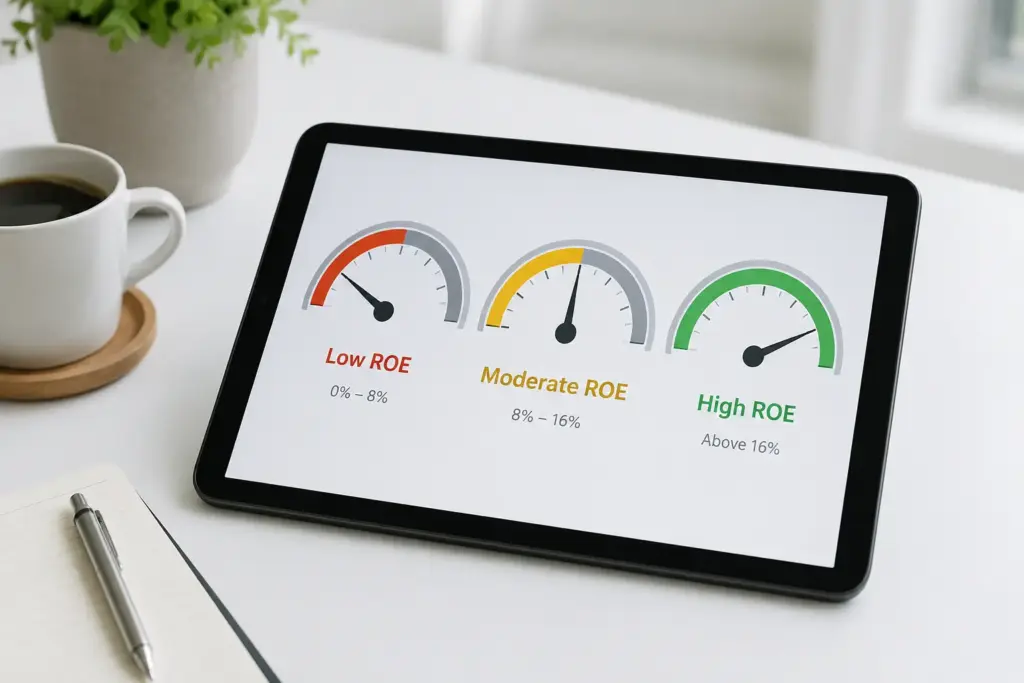
Ultra-realistic infographic on a digital tablet showing Low ROE, Moderate ROE, and High ROE gauge meters on a minimalist white office desk with coffee and soft natural lighting.

As a general guide used by many analysts:

  • Below 10% — Often considered weak; the company may not be generating sufficient returns for shareholders.
  • 10%–15% — Reasonable; acceptable for most stable, mature industries.
  • 15%–20% — Strong; the company is generating solid shareholder value.
  • Above 20% — Exceptional; a hallmark of high-quality businesses with sustainable competitive advantages.

Consistency Over Time

A company posting a 25% ROE for one year might be impressive. A company posting above 20% ROE consistently for 10 years is genuinely exceptional — it typically signals durable competitive strengths, pricing power, and superior management. This is precisely the kind of quality that long-term, fundamentals-driven investors seek when building equity portfolios across global markets.

Access Global Stocks with PhillipCapital DIFC

Trade US stocks, global equities, and GCC-listed shares through a regulated, award-winning broker in Dubai.

Why Does ROE Matter in Fundamental Analysis?

ROE is not just a number on a financial statement — it is a window into the quality of a business.

It Reveals Management Efficiency

A consistently high ROE signals that the company’s leadership is making smart decisions about where and how to deploy capital. Poor or declining ROE, especially when peers are performing better, can be a red flag that management is struggling to generate value — even if revenues look healthy on the surface.

It Connects to Long-Term Shareholder Value

Companies with high, sustained ROE tend to compound shareholder wealth over time. This is because high-ROE businesses can reinvest their earnings at attractive rates, which accelerates growth without the need for constant external fundraising. When you factor ROE into your fundamental analysis process alongside earnings growth and valuation, you gain a far clearer picture of whether a stock deserves a premium price.

It Helps You Compare Companies Within a Sector

ROE becomes especially useful when comparing two competitors in the same industry. If Company A has an ROE of 22% and Company B has an ROE of 9%, Company A is clearly generating far better returns on the same pool of shareholder capital — a critical distinction for investors.

Close-up of a financial analyst reviewing a printed balance sheet beside a laptop displaying stock analysis dashboard metrics for debt and equity in a professional office environment.

What Are the Limitations of ROE?

ROE is a powerful metric, but it has blind spots. Relying on it without context can lead to flawed investment decisions.

High Debt Can Artificially Inflate ROE

This is the most important limitation to understand. When a company borrows heavily, its equity base shrinks relative to its assets. A smaller equity denominator means the ROE ratio rises — even if the business is not fundamentally improving. Two companies can have the same ROE, but one might be debt-free while the other is heavily leveraged. The debt-laden company carries significantly more financial risk.

Always pair ROE analysis with a check on the company’s debt-to-equity ratio to separate genuine efficiency from financial engineering.

One-Off Events Can Distort the Ratio

Large write-offs, asset sales, share buybacks, or extraordinary gains can all cause significant swings in net income or equity in a single year, pushing ROE temporarily higher or lower. Always look at multi-year trends rather than isolated figures.

ROE Varies Significantly Across Sectors

Comparing the ROE of a bank to a mining company makes little sense. Always benchmark within the same industry.

How Do Investors Use ROE Alongside Other Metrics?

The most effective investors use ROE as one piece of a larger analytical picture. Here are the metrics most commonly paired with it:

ROE + Price-to-Earnings (P/E) Ratio

A company with a high ROE and a reasonable P/E ratio can be a compelling opportunity — strong returns at a fair price. A high ROE with an extremely high P/E may mean the market has already priced in the quality, leaving little upside.

ROE + Return on Assets (ROA)

If ROE is high but ROA is low, it typically suggests the company is using significant debt to boost its equity returns — a risk worth noting. If both are high, it reflects genuine operational excellence.

ROE + Earnings Per Share (EPS) Growth

Sustained earnings-per-share growth supported by consistently high ROE is one of the strongest signals of a compounding business. This combination is a core part of stock market analysis and long-term portfolio construction.

Using these metrics together gives you a much more complete, reliable view of a company’s investment quality — which is why thorough fundamental analysis is never built on a single ratio alone.

Invest Across Global Equity Markets

From US stocks and ETFs to GCC equities — access diversified equity markets through one regulated platform.

Conclusion & Key Takeaways

Return on Equity is one of the most important metrics in the fundamental analysis toolkit for equity investors. It cuts through financial noise and answers a fundamental question: is this company creating real value from the capital shareholders have entrusted to it?

Here are the core points to remember:

  • ROE = Net Income ÷ Shareholders’ Equity × 100 — a simple formula with profound implications.
  • A ROE consistently above 15–20% often indicates a high-quality business with strong management.
  • Trends matter more than single-year figures — always evaluate ROE over multiple years.
  • High ROE driven by high debt is a warning sign, not a strength — always check the balance sheet.
  • ROE is most powerful when used alongside other ratios like ROA, P/E, and EPS growth.
  • Sector context is essential — always benchmark against industry peers, not the broad market.

As an investor exploring deliverable equities across global and regional markets, building ROE analysis into your stock screening process can meaningfully improve the quality of companies you select — and ultimately, the long-term performance of your portfolio.

Frequently Asked Questions (FAQs)

Is a higher ROE always better?

Not necessarily. A very high ROE can sometimes be misleading. If a company has taken on significant debt, that reduces its equity base and inflates the ROE figure — making performance look better than it actually is. Always check whether a high ROE is backed by genuine profitability or driven by leverage. A moderately high, consistent ROE is far more trustworthy than a one-year spike.

What is a "good" ROE for a stock?

Most analysts consider 15% or above a solid benchmark for most industries. Above 20% consistently is generally seen as exceptional. That said, what counts as “good” depends heavily on the sector — technology companies often post higher ROEs than utilities or manufacturers simply due to the nature of their business models. Always compare ROE within the same industry.

Can ROE be negative? What does that mean?

Yes, ROE can be negative — and it’s a red flag. This happens when a company reports a net loss (negative net income), meaning it’s spending more than it earns. It can also turn negative when shareholders’ equity itself turns negative due to accumulated losses or heavy borrowing. Either way, a negative ROE signals that the company is destroying shareholder value rather than creating it.

How is ROE different from ROA?

ROE measures profit relative to shareholders’ equity, while ROA (Return on Assets) measures profit relative to total assets — which includes both equity and debt. If a company’s ROE is high but its ROA is low, it’s a sign the company is relying heavily on debt to generate returns. When both ROE and ROA are strong together, it reflects genuine operational efficiency without excessive financial risk.

Disclaimer:

Trading foreign exchange and/or contracts for difference on margin carries a high level of risk, and may not be suitable for all investors as you could sustain losses in excess of deposits. The products are intended for retail, professional and eligible counterparty clients. Before deciding to trade any products offered by PhillipCapital (DIFC) Private Limited you should carefully consider your objectives, financial situation, needs and level of experience. You should be aware of all the risks associated with trading on margin. The content of the Website must not be construed as personal advice. For retail, professional and eligible counterparty clients. Before deciding to trade any products offered by PhillipCapital (DIFC) Private Limited you should carefully consider your objectives, financial situation, needs and level of experience. You should be aware of all the risks associated with trading on margin.

Rolling Spot Contracts and CFDs are complex instruments and come with a high risk of losing money rapidly due to leverage. 78% of our retail client accounts lose money while trading with us. You should consider whether you understand how Rolling Spot Contracts and CFDs work, and whether you can afford to take the high risk of losing your money.

peg ratio thumbnail

PEG ratio

PEG Ratio The Advanced Metric for Finding Growth at a...

Read More