Fixed Income

Bond Valuation Methods and Formulas

Bond Valuation Methods Mastering Bond Valuation Methods and Formulas: A Comprehensive Guide for Investors In the sophisticated landscape of global finance, bonds are often perceived as the “steady hand” that balances a volatile portfolio. However, the true value of a bond is not found in its face value alone, but through rigorous mathematical assessment. For investors navigating the markets via PhillipCapital DIFC, understanding bond valuation methods is the difference between speculative trading and strategic wealth preservation. This guide delves into the core formulas and methodologies used by institutional analysts to determine the intrinsic value of debt securities. Table of Contents The Fundamental Concept of Bond Valuation The Time Value of Money in Pricing The Standard Bond Valuation Formula Valuing Zero-Coupon Bonds Understanding Yield to Maturity (YTM) Interest Rates and Price Sensitivity Advanced Valuation Adjustments Conclusion What is the Fundamental Concept of Bond Valuation? Bond valuation is the technical process of determining the fair market value of a debt security. It is based on the principle that a bond’s price today should equal the sum of the present value of all future cash flows it is expected to generate. These cash flows include periodic coupon rates and the return of the principal (par value) at the end of the bond’s term. When you engage in investment advisory services, valuation acts as your primary filter. If a bond’s calculated intrinsic value is higher than its current market price, it is considered undervalued (trading at a discount). Conversely, if the market price exceeds the intrinsic value, the bond is overvalued (trading at a premium). How Does the Time Value of Money Apply to Bond Pricing? The “Time Value of Money” (TVM) is the bedrock of bond pricing. It dictates that a dollar received today is worth more than a dollar received in the future due to its potential earning capacity. To value a bond, we must “discount” future cash flows back to their present value using a specific discount rate, which typically reflects current market interest rates and the issuer’s credit risk. In professional wealth management, this discounting process ensures that investors are compensated for the opportunity cost of locking away their capital. The Essential Bond Valuation Formula: Step-by-Step Breakdown Formula: To calculate the price of a standard coupon-paying bond, analysts use the following formula: Where: P = Current price of the bond. C = Periodic coupon payment (Coupon Rate × Face Value). r = Required rate of return or market yield (discount rate). t = The specific time period. n = Number of periods until maturity. F = Face value (Par value) of the bond. This formula combines an annuity (the coupons) with a single future sum (the face value). By calculating each component, you can determine if a fixed income security is priced fairly relative to its risk. Optimize Your Fixed-Income Strategy Leverage our expertise to build a robust portfolio with over 1,000+ global bond instruments. Explore Global Bonds How Do You Value Zero-Coupon Bonds? Zero-coupon bonds do not provide periodic interest. Instead, they are issued at a significant discount to their face value. The investor’s return is the difference between the purchase price and the amount received at maturity. The Zero-Coupon Formula: Because there are no intermediate cash flows, zero-coupon bonds are highly sensitive to changes in the bond yield vs interest rates environment. They are often used by institutional investors for long-term liability matching. What is Yield to Maturity (YTM) and Why is it the Gold Standard? Yield to Maturity (YTM) is the most comprehensive measure of a bond’s return. It is the internal rate of return (IRR) an investor will earn if the bond is held until the end of its term and all payments are reinvested at the same rate. While the coupon rate is static, the YTM is dynamic. It accounts for the bond’s current market price, par value, coupon interest, and time to maturity. For clients utilizing institutional services, comparing YTM across different debt instruments is essential for identifying the best risk-adjusted returns. How Do Interest Rate Fluctuations Influence Valuation? The relationship between bond prices and interest rates is strictly inverse. When market interest rates rise, newly issued bonds offer higher coupons, making existing bonds with lower rates less valuable. To attract buyers, the price of these older bonds must fall until their yield matches the new market rate. Understanding this sensitivity is a core part of risk and return profile management. Long-term bonds generally have higher “duration,” meaning their prices fluctuate more significantly when rates move. Secure Your Financial Future Get expert guidance on global bond markets and fixed income. Contact Our Desk Advanced Valuation: Dealing with Semi-Annual Coupons and Accrued Interest In the real world, most bonds pay interest semi-annually. To value these accurately, the standard formula must be adjusted: Divide the annual coupon (C) by 2. Divide the annual discount rate (r) by 2. Multiply the number of years to maturity (n) by 2. Additionally, if you buy a bond between coupon dates, you must account for accrued interest—the interest earned since the last payment. This leads to the “Dirty Price” (actual price paid) versus the “Clean Price” (quoted price). Our trading platforms provide real-time calculations for these technical nuances, ensuring transparency in every transaction. Conclusion: Integrating Valuation into Your Investment Strategy Mastering bond valuation methods and formulas is not just for mathematicians; it is a prerequisite for successful long-term investing. By understanding how to discount cash flows and calculate YTM, you move beyond surface-level metrics and gain a deeper understanding of market value. At PhillipCapital DIFC, we empower our clients with the tools and research necessary to apply these principles, ensuring that every bond in their portfolio serves its purpose of providing stability, income, and growth. Frequently Asked Questions (FAQs) Why is bond valuation important for retail investors? It helps determine if a bond is a good deal compared to other investments like stocks or savings accounts, ensuring you don’t overpay for a fixed stream of income. What is the
Bond Valuation Methods and Formulas Read More »

The Inverse Relationship Between Bond Prices and Yields

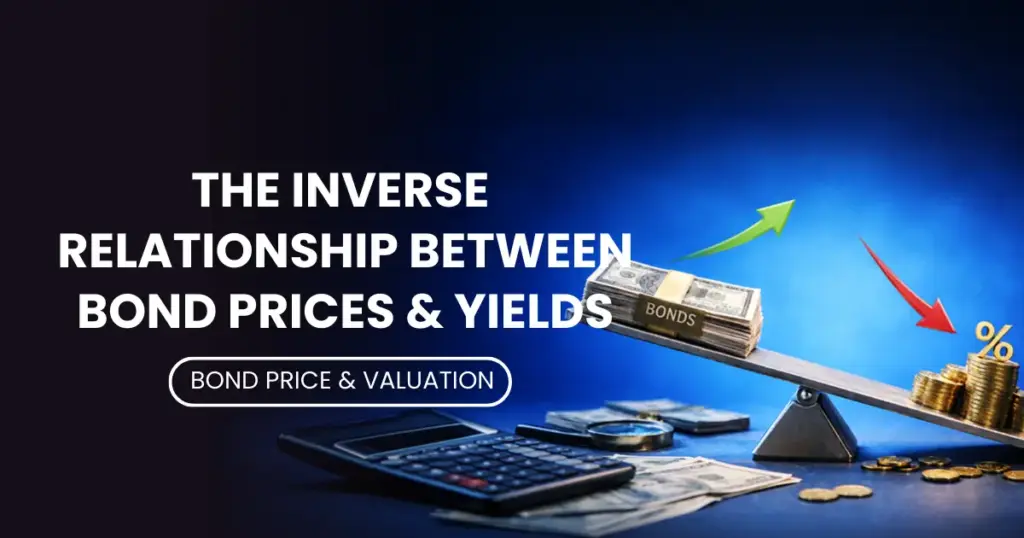
The Inverse Relationship Between Bond Prices and Yields Table of Contents Understanding the Fundamentals of Fixed Income Why Do Bond Prices and Yields Move in Opposite Directions? The Role of Central Banks and Interest Rates Duration and Convexity: Measuring Sensitivity Strategic Implications for Investors Conclusion Understanding the Fundamentals of Fixed Income What is the core definition of a bond yield compared to its price? To navigate the fixed-income markets effectively, investors must first distinguish between the face value of a bond and its market price. When you purchase a bond, you are essentially lending capital to an issuer—whether a government or a corporation. The price is the amount you pay for that bond today, which can fluctuate based on market demand. The yield, specifically the Yield to Maturity (YTM), is the total return anticipated on a bond if the bond is held until it matures. It is expressed as an annual percentage. While the coupon rate (the interest paid) typically remains fixed, the yield fluctuates dynamically. This distinction is critical because, in the secondary market, bonds rarely trade at their exact face value (par). They trade at a premium or a discount, and this price variance directly dictates the yield an investor effectively locks in. For a deeper dive into the mechanics of these instruments, you can explore our detailed guide on what a bond is and how it works, which breaks down the terminology of coupons, principal, and maturity dates for new investors. Why Do Bond Prices and Yields Move in Opposite Directions? What is the mathematical and logical reasoning behind the “Seesaw Effect”? The inverse relationship between bond prices and yields is often described as a “seesaw.” When prices go up, yields go down, and vice versa. This is not merely a market anomaly; it is a mathematical certainty required to keep the bond competitive with newer issues. Imagine a scenario where you hold a bond issued five years ago with a fixed coupon of 5%. If prevailing interest rates in the economy rise to 6%, no rational investor would pay full price for your 5% bond when they can buy a new one paying 6%. To sell your existing bond, you must lower its price (sell it at a discount) until its effective yield matches the new 6% market rate. Conversely, if market rates fall to 4%, your 5% bond becomes highly valuable. Investors will bid up its price (trading at a premium) until the yield compresses down to match the 4% environment. This dynamic ensures that older bonds remain liquid and tradable against new government and corporate bond issues, maintaining equilibrium in the global capital markets. Master the Fixed Income Market Access Global Bonds & Debentures with PhillipCapital DIFC Explore Bond Trading Products The Role of Central Banks and Interest Rates How do Federal Reserve and Central Bank policies impact this relationship? Central banks, such as the Federal Reserve or the ECB, exert a gravitational pull on bond markets. When a central bank raises its benchmark interest rate to combat inflation, the immediate effect is a reset in the cost of borrowing. New bonds are issued with higher coupons to reflect this higher base rate. As a result, the prices of existing bonds—which carry lower, older coupon rates—must fall significantly to align with the new, higher-yield environment. This period is often characterized by capital depreciation for holders of long-term debt. Conversely, when central banks cut rates to stimulate the economy, existing bonds with higher coupons become prized assets, seeing their prices appreciate. Investors monitoring these macroeconomic shifts often look at Investment Grade vs. Non-Investment Grade bonds to decide where to position their capital, as different credit ratings react with varying volatility to interest rate announcements. Duration and Convexity: Measuring Sensitivity Why does the maturity of a bond amplify price volatility? Not all bonds react to yield changes with the same intensity. This sensitivity is measured by a concept called Duration. In simple terms, duration estimates how much a bond’s price will change for a 1% change in interest rates. Long-term bonds generally have a higher duration than short-term bonds. For instance, a 30-year Treasury bond will see a much sharper price decline than a 2-year Treasury note if interest rates rise by the same amount. This is because the cash flows (coupons) of the long-term bond are further in the future, making them more vulnerable to the eroding effects of inflation and opportunity cost. For professional investors managing complex portfolios, understanding duration (and the curvature of this relationship, known as Convexity) is essential for hedging risk, especially when trading derivatives and futures alongside cash bonds. Strategic Implications for Investors How can investors turn this inverse relationship into an opportunity? Understanding that prices and yields move inversely allows investors to employ specific strategies based on their economic outlook: Riding the Yield Curve: In a stable interest rate environment, investors might buy longer-term bonds to capture higher yields, profiting as the bond rolls down the yield curve closer to maturity. Defensive Positioning: If an investor anticipates a rate hike (which hurts bond prices), they may shorten the duration of their portfolio. This involves shifting capital into short-term bills or notes that are less sensitive to price drops. Capital Appreciation: If an economic slowdown is forecast and rate cuts are expected, investors might lock in long-term bonds. As rates fall, the prices of these bonds will rise, offering significant capital gains on top of the coupon income. Diversification is key here. Integrating fixed income alongside global equities and ETFs ensures that a portfolio can withstand volatility in any single asset class. Expert Guidance for Your Portfolio Speak to our desk for personalized market insights Contact Now Conclusion The inverse relationship between bond prices and yields is the foundational gravity of the fixed-income universe. Whether you are a retail investor seeking stable coupons or a professional trader managing duration risk, acknowledging that higher yields equate to lower prices (and vice versa) is the first step toward clearer market analysis.

The Inverse Relationship Between Bond Prices and Yields Read More »

Bond Yield Vs Interest Rates

Bond Yield Vs Interest Rates Understanding the Relationship Between Bond Yields and Interest Rates As a cornerstone of the global financial system, the interplay between bond yields and interest rates dictates the flow of capital, influences corporate borrowing, and shapes investor portfolios. For investors navigating the diverse investment services offered in the UAE and international markets, mastering this inverse relationship is essential for effective risk management and capital preservation. Table of Contents How Do Interest Rates Influence Bond Prices and Yields? What Is the Difference Between a Bond’s Coupon Rate and Its Yield? Why Do Bond Yields Move Inversely to Interest Rates? How Does Inflation Impact the Bond Yield-Interest Rate Dynamic? What Should Investors Consider When Rates Are Rising? Conclusion: Strategic Fixed-Income Positioning How Do Interest Rates Influence Bond Prices and Yields? The relationship between interest rates and bond prices is fundamentally inverse. When central banks—such as the Federal Reserve or the Central Bank of the UAE—adjust benchmark interest rates, they effectively reset the “cost of money” for the entire economy. When interest rates rise, newly issued bonds enter the market offering higher coupon payments to attract investors. Consequently, existing bonds with lower fixed coupons become less attractive. To entice buyers, the market price of these older bonds must drop. Conversely, when interest rates fall, existing bonds with higher fixed coupons become highly sought after, driving their market prices upward. Yield, in its simplest form, represents the return an investor realizes on a bond. As the price of a bond falls, its yield rises (because the fixed interest payment now represents a larger percentage of the discounted purchase price). Understanding this mechanism is vital when reviewing your multi-asset portfolio performance, as it explains why fixed-income valuations may fluctuate despite stable interest payments. What Is the Difference Between a Bond’s Coupon Rate and Its Yield? It is a common misconception among retail investors that a bond’s coupon and its yield are the same. The coupon rate is the fixed annual interest payment established when the bond is issued, expressed as a percentage of the face value. The bond yield, specifically the “Yield to Maturity” (YTM), is a more dynamic metric. It accounts for the coupon rate, the current market price, and the time remaining until maturity. If you purchase a bond at a “premium” (above face value), your yield will be lower than the coupon rate. If purchased at a “discount” (below face value), your yield will be higher. For those engaging in global wealth management, distinguishing between these two is critical. The coupon provides the cash flow, but the yield tells the true story of the investment’s total return potential in the current economic climate. Enhance Your Fixed-Income Strategy Access institutional-grade bond market insights today. Access Global Bond Market Why Do Bond Yields Move Inversely to Interest Rates? The inverse movement is driven by the concept of “Opportunity Cost.” Imagine you hold a bond paying 3% interest. If the central bank raises interest rates, new bonds might start paying 5%. No rational investor would buy your 3% bond at face value when they can get 5% elsewhere. To sell your 3% bond, you must lower the price until the total return (the 3% coupon plus the capital gain when the bond matures at full face value) equals the current market rate of 5%. This “price adjustment” is what causes the yield to climb as rates rise. This phenomenon is a primary driver of volatility in fixed income trading, requiring active duration management to protect against interest rate shocks. How Does Inflation Impact the Bond Yield-Interest Rate Dynamic? Inflation is the silent predator of fixed-income returns. When inflation rises, the purchasing power of a bond’s fixed future payments diminishes. To compensate for this loss of value, investors demand higher yields, which exerts upward pressure on interest rates. Central banks typically respond to high inflation by raising interest rates to cool the economy. This creates a “double-whammy” for bondholders: prices fall due to rising rates, and the real value of the coupons falls due to inflation. Professional investors often look toward diversified investment funds that include inflation-protected securities or shorter-duration assets to mitigate these specific risks during inflationary cycles. What Should Investors Consider When Rates Are Rising? In a rising rate environment, “duration” becomes the most important metric. Duration measures a bond’s sensitivity to interest rate changes. Bonds with longer maturities generally have higher duration, meaning their prices will fall more sharply when rates rise. Investors should consider a “laddering” strategy—staggering the maturities of their bond holdings. As shorter-term bonds mature, the principal can be reinvested into new bonds at higher current interest rates. This proactive approach to asset management ensures that the portfolio is not locked into low yields for an extended period, allowing the investor to benefit from the changing interest rate landscape. Optimize Your Global Portfolio Tailored capital market solutions for professional investors. Contact Now Conclusion: Strategic Fixed-Income Positioning The relationship between bond yields and interest rates is a fundamental pillar of finance that every serious investor must respect. While the inverse correlation between price and yield can introduce volatility, it also creates opportunities for those who understand market cycles. By distinguishing between coupon rates and yields, monitoring inflationary trends, and managing portfolio duration, investors can navigate fluctuating rate environments with confidence. At PhillipCapital DIFC, we provide the expertise and financial brokerage services necessary to help you interpret these market signals and align your fixed-income strategy with your long-term capital goals. Frequently Asked Questions (FAQs) Why do bond prices fall when interest rates go up? When market interest rates rise, new bonds are issued with higher coupons. This makes existing bonds with lower rates less attractive. To sell these older bonds, owners must lower their price until the total return matches the current market rates. Is a higher bond yield always better for an investor? Not necessarily. While a higher yield means more potential return, it often signals higher risk—such as the issuer’s creditworthiness or rising inflation. Additionally,

Bond Yield Vs Interest Rates Read More »

Bond Yield to Maturity (YTM)

Bond Yield to Maturity (YTM) Understanding Bond Yield to Maturity (YTM): A Comprehensive Guide for Investors As the global fixed-income landscape evolves, sophisticated investors look beyond simple coupon rates to assess the true value of a debt instrument. Yield to Maturity (YTM) stands as the most critical metric in this assessment, offering a holistic view of a bond’s projected return. For clients engaging in global wealth management, mastering YTM is essential for constructing a resilient, income-generating portfolio. Table of Contents What is Yield to Maturity (YTM) and why does it matter? How is YTM different from Coupon Rate and Current Yield? What are the core components used to calculate YTM? How do interest rate fluctuations impact a bond’s YTM? What are the limitations of relying solely on YTM? How can professional investors use YTM for portfolio optimization? Conclusion: Integrating YTM into Your Investment Strategy What is Yield to Maturity (YTM) and why does it matter? Yield to Maturity (YTM) is the total estimated return an investor can expect to receive if a bond is held until its scheduled expiration date. Unlike nominal yield, which only accounts for interest payments, YTM is a complex internal rate of return (IRR). It assumes that all coupon payments are reinvested at the same rate as the current yield and accounts for the difference between the bond’s current market price and its par value at maturity. For investors navigating fixed income markets, YTM serves as the “gold standard” for comparing bonds with different maturities and coupon rates. It allows for an apples-to-apples comparison, helping you determine whether a discount bond or a premium bond offers a better long-term trajectory for your capital. How is YTM different from Coupon Rate and Current Yield? Understanding the distinction between these three terms is vital for accurate investment advisory services. Coupon Rate: This is the fixed annual interest rate established when the bond is issued. It never changes. Current Yield: This is a simpler calculation (Annual Interest / Current Market Price). It provides a snapshot of the return based on today’s price but ignores the “pull to par”—the gain or loss realized when the bond eventually matures. YTM: This is the comprehensive figure. If you buy a bond at a discount (below its $1,000 face value), your YTM will be higher than the coupon rate because you gain capital appreciation at maturity. Conversely, if bought at a premium, the YTM will be lower than the coupon rate. Explore Fixed Income Opportunities Achieve steady growth with professional bond trading. View Our Services What are the core components used to calculate YTM? Calculating YTM requires a deep dive into the bond’s structure. The formula considers the present value of all future cash flows, equated to the current market price. The key inputs include: Market Price: What you pay for the bond today. Par (Face) Value: The amount the issuer pays back at maturity. Coupon Interest Rate: The periodic payments made to the holder. Time to Maturity: The remaining years until the principal is repaid. Because the YTM formula is an iterative process of trial and error (solving for ‘r’), most investors use financial calculators or professional trading platforms to derive this figure instantly. How do interest rate fluctuations impact a bond’s YTM? There is an inverse relationship between interest rates and bond prices, which directly dictates YTM. When central banks raise interest rates, new bonds are issued with higher coupons. To remain competitive, existing bonds with lower coupons must drop in price. As the market price falls, the YTM rises to meet the prevailing market rates. This volatility is a primary reason why investors utilize multi-asset brokerage services to hedge their positions. Understanding this mechanic helps investors anticipate how their bond portfolio’s total return will shift in a changing macroeconomic environment. What are the limitations of relying solely on YTM? While YTM is powerful, it operates on two major assumptions that may not always hold true: Reinvestment Risk: It assumes every coupon payment is reinvested at the exact same YTM rate. In a falling-rate environment, this may be impossible, leading to a realized return lower than the YTM. Credit Risk: YTM assumes the issuer will make all payments on time. It does not account for the possibility of default. To mitigate these risks, professional investors often look at “Yield to Call” (if the bond is callable) or “Yield to Worst” to prepare for the most conservative outcome. Diversifying into equities and derivatives can also help balance the specific risks associated with fixed-income reinvestment. Consult a Financial Specialist Get personalised insights for your fixed-income portfolio Contact PhillipCapital How can professional investors use YTM for portfolio optimization? Professional investors use YTM as a benchmarking tool for “Yield Curve” strategies. By comparing the YTMs of short-term vs. long-term bonds, one can determine if they are being sufficiently compensated for the risk of time (duration). Furthermore, YTM helps in identifying “undervalued” bonds. If a bond’s YTM is significantly higher than peers with similar credit ratings, it may indicate a buying opportunity—provided the credit fundamentals remain strong. Integrating these insights into your broader capital markets strategy ensures that every dollar is optimized for the highest possible risk-adjusted return. Conclusion: Integrating YTM into Your Investment Strategy Yield to Maturity is more than just a percentage; it is a comprehensive lens through which the value of a debt instrument is revealed. By accounting for the time value of money, reinvestment assumptions, and capital gains/losses, YTM provides the clarity needed to make informed decisions in the complex world of fixed income. Whether you are looking to secure a steady income stream or seeking capital preservation, understanding the nuances of YTM allows you to move beyond basic interest rates and grasp the true earning potential of your investments. Partnering with a sophisticated institution for institutional services can provide the tools and expertise necessary to navigate these calculations and build a world-class portfolio. Frequently Asked Questions (FAQs) Is Yield to Maturity (YTM) the same as the annual interest I will

Bond Yield to Maturity (YTM) Read More »

Calculating Bond Price And Yield

Calculating Bond Price And Yield Understanding Bond Valuation: A Comprehensive Guide to Calculating Price and Yield As global fixed-income markets evolve, understanding the mechanics of bond valuation is essential for building a resilient investment portfolio. Whether you are a retail investor or a professional managing institutional capital, the relationship between interest rates, bond prices, and yields forms the bedrock of debt market strategy. This guide provides an in-depth exploration of how to calculate bond prices and yields, offering the clarity needed to navigate the complexities of the DIFC and international financial markets. Table of Contents How is the Price of a Bond Determined? What is the Relationship Between Bond Prices and Interest Rates? How Do You Calculate the Yield to Maturity (YTM)? What Factors Influence Bond Yield Spreads? Understanding the Difference Between Current Yield and Coupon Rate Conclusion: Mastering Fixed-Income Metrics How is the Price of a Bond Determined? The theoretical price of a bond is the present value of all its future cash flows. These cash flows consist of periodic interest payments, known as coupons, and the return of the bond’s face value (par value) at maturity. To determine the fair market value, investors must discount these future payments back to the present using a specific discount rate, often referred to as the “required rate of return.” The formula involves the summation of the present value of each coupon payment plus the present value of the par value. If the market’s required yield is higher than the bond’s coupon rate, the bond will trade at a discount. Conversely, if the required yield is lower, the bond trades at a premium. For those looking to diversify, exploring global debt markets requires a firm grasp of these mathematical foundations to identify undervalued opportunities. What is the Relationship Between Bond Prices and Interest Rates? The relationship between bond prices and interest rates is inverse. When central banks, such as the Federal Reserve, raise interest rates, newly issued bonds offer higher yields. This makes existing bonds with lower coupon rates less attractive, causing their market prices to fall until their effective yield matches the new market environment. This sensitivity to interest rate changes is measured by duration. A bond with a longer maturity typically exhibits higher duration, meaning its price will fluctuate more significantly in response to rate shifts. Sophisticated investors often utilize professional wealth management services to calibrate their portfolio duration, ensuring they are positioned correctly for the prevailing economic cycle. Optimize Your Fixed Income Strategy Expert Portfolio Management Navigate interest rate volatility with our bespoke investment solutions. Contact Our Desk How Do You Calculate the Yield to Maturity (YTM)? Yield to Maturity (YTM) is considered the most comprehensive measure of a bond’s profitability. Unlike the nominal yield, YTM accounts for the bond’s current market price, its par value, the coupon interest rate, and the time remaining until maturity. It assumes that all coupon payments are reinvested at the same rate as the current YTM. Calculating YTM manually is complex and often requires a trial-and-error method or a financial calculator. The formula equates the bond’s current price to the sum of the present value of all remaining cash flows. For investors accessing specialized trading platforms, these calculations are often automated, allowing for real-time comparison of various fixed-income instruments. What Factors Influence Bond Yield Spreads? A yield spread is the difference between the yields of two different debt instruments, usually a corporate bond and a risk-free government benchmark. This spread reflects the “risk premium” that investors demand for taking on additional credit risk. Several factors influence these spreads, including: Credit Quality: The perceived ability of the issuer to meet its obligations. Liquidity Risk: How easily the bond can be sold in the secondary market without affecting its price. Economic Outlook: During periods of uncertainty, spreads tend to widen as investors flock to “safe-haven” assets. Understanding these nuances is vital when investing in emerging markets, where yield spreads can offer significant returns for those who accurately assess the underlying credit risk. Access Global Capital Markets Direct Market Access Trade international bonds and equities through our secure DIFC-based platform. Open an account Understanding the Difference Between Current Yield and Coupon Rate It is a common mistake to use the terms “coupon rate” and “yield” interchangeably. The coupon rate is the fixed annual interest payment set at the time of issuance, expressed as a percentage of the par value. The current yield, however, is a dynamic figure. It is calculated by dividing the annual coupon payment by the bond’s current market price. If you purchase a bond at a discount, your current yield will be higher than the coupon rate. This distinction is critical for investors focused on generating consistent cash flow from their investments, as it reflects the actual return on the capital deployed today Conclusion: Mastering Fixed-Income Metrics Calculating bond prices and yields is more than a mathematical exercise; it is a fundamental skill for interpreting market sentiment and valuing risk. By understanding the inverse relationship between prices and rates, and the comprehensive nature of Yield to Maturity, investors can make more informed decisions in a fluctuating interest rate environment. Success in fixed-income investing requires a combination of technical knowledge and access to the right markets. Whether you are hedging against equity volatility or seeking long-term capital preservation, a disciplined approach to bond valuation will remain your most valuable tool. Frequently Asked Questions (FAQs) Why do bond prices fall when market interest rates rise? This inverse relationship exists because a bond’s coupon rate is fixed at issuance. If new bonds are issued with higher interest rates, your existing bond becomes less valuable to investors. To make your bond competitive, its market price must drop until its effective yield matches the new, higher market rates. Is it better to look at the Coupon Rate or the Yield to Maturity (YTM)? The coupon rate only tells you the annual interest payment based on the face value. YTM is a far more accurate metric for total

Calculating Bond Price And Yield Read More »

Bond Pricing Fundamentals

Bond Pricing Fundamentals A Guide for Investors Table of Contents What Determines the Price of a Bond? Why Do Bond Prices Move Inversely to Interest Rates? How Do Yield to Maturity and Coupon Rates Interact? How Is a Bond’s Fair Value Calculated? What Role Does Duration Play in Bond Pricing? Conclusion Understanding the mechanics of fixed-income securities is essential for constructing a resilient portfolio. While equities often dominate financial headlines, the bond market represents a significantly larger portion of global capital markets. For investors navigating the complexities of global market access, grasping bond pricing fundamentals is not merely academic—it is a critical skill for risk management and capital preservation. Below, we explore the core components of bond valuation, dissecting how market forces, interest rates, and mathematical formulas converge to determine the fair value of a fixed-income asset. What Determines the Price of a Bond? At its core, a bond’s price is the present value of its future cash flows. When you purchase a bond, you are essentially buying a stream of future payments, which includes periodic interest payments (coupons) and the return of the principal amount (face value) at maturity. Several intrinsic and extrinsic factors dictate this price: Face Value (Par Value): The amount paid to the bondholder at maturity. Coupon Rate: The annual interest rate paid on the bond’s face value. Maturity Date: The date on which the principal is repaid. Credit Quality: The issuer’s ability to repay, often rated by agencies like Moody’s or S&P. Market Interest Rates: The prevailing rates for new bonds of similar risk and maturity. The interplay between these factors determines whether a bond trades at par (face value), at a premium (above face value), or at a discount (below face value). Investors utilizing our electronic trading platforms will often see live pricing fluctuate based on real-time shifts in these variables. Why Do Bond Prices Move Inversely to Interest Rates? The inverse relationship between bond prices and interest rates is perhaps the most fundamental rule of fixed-income investing. Simply put: when market interest rates rise, existing bond prices fall, and conversely, when rates fall, bond prices rise. This occurs due to the opportunity cost of capital. If an investor holds a bond paying a 3% coupon and the central bank raises rates, causing new bonds to be issued with a 5% coupon, the older 3% bond becomes less attractive. To compete with the new, higher-yielding issues, the price of the older bond must drop until its effective yield matches the new market rate. Conversely, if market rates decline to 2%, the older 3% bond becomes highly desirable. Investors will pay a premium for that higher income stream, driving the price up. Navigating this interest rate risk is a primary reason why sophisticated investors rely on professional brokerage services to time their entry and exit points in the fixed-income market. How Do Yield to Maturity and Coupon Rates Interact? To accurately value a bond, one must distinguish between the coupon rate (the fixed payment) and the Yield to Maturity (YTM). The YTM is the total anticipated return on a bond if the bond is held until it matures. It is essentially the internal rate of return (IRR) of the bond. The relationship between the coupon rate, YTM, and price is consistent: Par Value: If the Coupon Rate equals the YTM, the bond trades at Par ($100). Discount: If the Coupon Rate is lower than the YTM, the bond trades at a Discount (<$100). Premium: If the Coupon Rate is higher than the YTM, the bond trades at a Premium (>$100). For example, purchasing a bond at a discount implies that the investor will receive a capital gain at maturity (the difference between the purchase price and the face value) in addition to the coupon payments. This total return profile is what smart capital allocation strategies aim to optimize. Ready to Diversify Your Portfolio? Access global fixed-income markets with a trusted partner. Open an account Contact us How Is a Bond’s Fair Value Calculated? The mathematical valuation of a bond is derived by discounting its expected future cash flows back to the present day. This “Discounted Cash Flow” (DCF) method ensures that the time value of money is accounted for—acknowledging that a dollar received today is worth more than a dollar received five years from now. The formula for calculating the price of a standard coupon bond is  P  = Current price of the bond C  = Coupon payment per period r = Yield to maturity (market interest rate) per period n = Total number of payment periods F = Face value (par value) of the bond This calculation highlights why longer-maturity bonds are more sensitive to rate changes. The further out the cash flows (n  becomes larger), the more they are impacted by changes in the discount rate (r). Investors looking to execute such precise valuations often utilize the advanced analytical tools available through our proprietary trading solutions. What Role Does Duration Play in Bond Pricing? While YTM provides a snapshot of return, Duration measures the sensitivity of a bond’s price to changes in interest rates. It is a vital risk metric for portfolio managers. Macaulay Duration: The weighted average time until a bond’s cash flows are received. Modified Duration: An adjustment of Macaulay duration that estimates the percentage change in price for a 1% change in yield. Higher duration implies higher volatility. For instance, a bond with a duration of 10 years will theoretically lose approximately 10% of its value if interest rates rise by 1%. Understanding duration allows investors to hedge their portfolios effectively, especially in volatile economic climates where central bank policies are shifting. Guidance for Complex Markets Consult with our desk for institutional-grade bond market insights. Contact Our Team Conclusion Bond pricing is a sophisticated blend of mathematics and market psychology. By mastering the relationships between par value, coupon rates, yield to maturity, and duration, investors can look beyond the surface level of “fixed income” and uncover deep value opportunities.

Bond Pricing Fundamentals Read More »

Jan 12 – Daily Market Update

12 Jan 26 – Daily Market Updates Markets Daily Your broad market briefing for the trading day Market at a glance Equities: US index futures softer; European benchmarks slightly lower after an uneven open; Asia mixed with Japan closed for a holiday. Rates: Long-dated US Treasury yields edging higher; global curves exhibiting a mild steepening bias. FX: The US dollar pulls back against major peers as investors reassess policy and growth trajectories. Commodities: Gold and silver extend gains on safe-haven demand; oil trades in a tight range amid crosscurrents in supply and demand. What’s moving markets Policy uncertainty and central bank signaling are back in focus. Markets are weighing the implications of potential shifts in the path of interest rates and the broader debate around monetary policy independence, keeping volatility elevated in rates, FX, and precious metals. Positioning and concentration risk remain key themes in equities. With leadership narrowing at times over recent months, investors are paying closer attention to earnings breadth, guidance quality, and cash flow durability rather than headline growth alone. Safe-haven flows are noticeable. A softer dollar alongside strength in bullion suggests some preference for diversification, particularly as investors hedge against inflation and policy surprises. Credit and consumer finance sentiment is cautious. Headlines and regulatory discussions around consumer lending and pricing are creating short-term pressure across select financials, while the broader credit market remains orderly. Equities US: Futures point to a weaker start as investors brace for a dense macro and earnings calendar. Dispersion within large-cap tech persists; stock selection remains critical as spending on new technologies meets more rigorous profitability scrutiny. Europe: Regional indices are modestly lower, with defensives and commodity-linked names outperforming cyclical pockets. M&A interest and corporate restructuring remain supportive for select sectors. Asia: Performance was mixed in a thin session. Mainland China and parts of North Asia are digesting fresh trade and price data later this week; liquidity conditions and policy communication remain near-term catalysts. Fixed income Treasuries: The curve is tilting steeper as markets weigh near-term easing expectations against longer-run term premium and fiscal dynamics. Duration has been choppy; many are favoring barbell or laddered approaches to manage reinvestment and volatility risk. Global rates: Core European yields are little changed to slightly higher; UK gilts underperform on supply and wage/inflation sensitivity. In credit, primary issuance remains active with mostly stable spreads, though lower-quality tiers could see more differentiation into earnings. Currencies The dollar index softens as rate differentials narrow at the margin. Pro-cyclical pairs are mixed; haven FX is steady. Investors continue to explore diversification across G10 and select EM currencies, balancing carry with liquidity and policy credibility. Commodities Precious metals: Gold and silver advance on a combination of real-yield moves, dollar softness, and hedging demand. Positioning is elevated; pullbacks may be tactical in nature given ongoing macro uncertainty. Energy: Crude trades sideways as supply risks are balanced by uneven demand indicators. Time spreads remain range-bound; refinery margins and inventory data later in the week are in focus. Industrials: Base metals are mixed, with growth-sensitive contracts awaiting clearer signals from global manufacturing and construction data. The week ahead: what to watch US: Inflation (CPI/PPI), retail sales, housing activity, and the Fed’s Beige Book. A full slate of public remarks from policymakers may shed light on the reaction function and outlook for rates. Big banks and bellwethers kick off a heavy earnings stretch; investors will watch net interest income trends, credit provisioning, trading revenues, and forward guidance. Europe/UK: Industrial production, trade balances, and central bank commentary. Bank earnings and corporate updates will help gauge demand, cost pressures, and pricing power into the first quarter. Asia: China trade data and regional labor/price prints; a key policy rate decision in North Asia. Semiconductor and technology supply-chain updates remain a driver for sentiment. Canada: Housing indicators and existing home sales; Bank commentary on growth and inflation mix. Strategy snapshots Equities: Expect higher dispersion. Emphasize quality balance sheets, consistent free cash flow, and pricing power. Within tech, differentiate between long-duration R&D stories and firms showing near-term monetization. Consider global diversification as non-US markets screen more attractively on relative valuation and earnings revision trends. Rates: Curve risk is back. Investors concerned about steepening may look at intermediate tenors and add hedges where appropriate. For income, maintain flexibility to add duration on weakness; consider credit selection over beta in tighter-spread areas. FX: With the dollar softer, selectively add to non-USD exposures where policy credibility is firm and growth is stable. Maintain liquidity and avoid crowded carry where volatility could force quick reversals. Commodities: For hedgers, staggered entries in precious metals may help manage momentum-driven swings. In energy, focus on balance sheets of producers with disciplined capex and robust cash returns. Risk management checklist Track real yields and breakevens for clues on inflation psychology. Watch credit conditions and bank earnings for early reads on the consumer and corporate funding costs. Use scenario analysis around key data releases; adjust stops and position sizes to account for event risk. Maintain diversification across regions, styles, and factors to mitigate concentration risk. Housekeeping and disclosures This material is a general market commentary prepared for informational purposes only. It does not constitute investment advice or a recommendation to buy or sell any security or strategy. Markets are volatile; past performance is not indicative of future results. Consider your objectives, risk tolerance, and consult a qualified advisor before making investment decisions. Disclaimer: Trading foreign exchange and/or contracts for difference on margin carries a high level of risk, and may not be suitable for all investors as you could sustain losses in excess of deposits. The products are intended for retail, professional and eligible counterparty clients. Before deciding to trade any products offered by PhillipCapital (DIFC) Private Limited you should carefully consider your objectives, financial situation, needs and level of experience. You should be aware of all the risks associated with trading on margin. The content of the Website must not be construed as personal advice. For retail, professional and eligible counterparty clients. Before deciding to

Jan 12 – Daily Market Update Read More »

Dec 30 – Daily Market Update

Dec 30 – Daily Market Updates Markets Daily — Morning Briefing At a glance Equities: US stock futures were little changed in early trade, Europe opened modestly higher, and most Asian benchmarks advanced with Hong Kong outperforming. Bonds: The US 10-year yield held near the low 4% area, steady on light year-end volumes. Commodities: Precious metals firmed after recent volatility, while industrial metals extended gains on supply concerns. Energy prices were mixed. FX: The US dollar was broadly range-bound against major peers, with select Asian currencies edging higher. Market overview Global markets are navigating the final stretch of the year with subdued volatility and thin liquidity. With few fresh catalysts on the docket, price action is being driven largely by rebalancing, positioning clean-up, and year-end window-dressing. Equities are consolidating near recent highs, sovereign yields are stable, and commodities are finding support as investors reassess the growth and policy backdrop heading into the new year. Equities US: Futures indicate a flat open as investors balance resilient earnings expectations against lingering macro and geopolitical uncertainties. Leadership remains concentrated but breadth has been improving, with a gradual rotation into cyclicals and select defensives. Europe: Stocks edged higher, supported by financials and industrials. The region continues to benefit from cooling inflation trends and the prospect of easier policy later in the cycle, though growth differentials versus the US remain in focus. Asia: Markets were mixed to higher, with Hong Kong leading on strength in technology and health care. Mainland China sentiment is cautious but stabilizing; elsewhere in the region, export-oriented markets benefited from firmer semiconductor and AI-related demand. Fixed income Treasuries: The curve was little changed, with the 10-year yield hovering just above 4%. Rate volatility has eased notably compared with earlier in the year as investors coalesce around a gradual policy-easing narrative, though the timing and pace remain data-dependent. Global rates: Core European yields drifted lower, while UK gilts were steady. In credit, spreads are tight versus historical averages, reflecting improved risk appetite and limited new issuance late in the year. Currencies The dollar traded in narrow ranges. High-beta FX was mixed, while select Asian currencies ticked higher on improved risk sentiment. Markets continue to weigh the path of US policy easing versus divergent central bank stances elsewhere. Commodities Precious metals: Gold recovered after a recent pullback as real yields steadied and safe-haven demand persisted into year-end. Silver tracked the move higher. Industrial metals: Copper extended a multi-week advance amid ongoing supply concerns and resilient end-demand linked to electrical infrastructure and data center build-outs. Energy: Crude prices were range-bound, with participants monitoring inventories, OPEC+ discipline, and any year-end shipping or geopolitical disruptions. Macro and policy watch Growth and inflation: The US economy continues to slow from a strong pace while maintaining signs of underlying resilience. Disinflation progress has allowed markets to pencil in policy easing next year, but central banks have kept a data-dependent tone. Geopolitics: Headlines remain a swing factor for risk sentiment, particularly around Eastern Europe and the Middle East. Energy and shipping lanes are key watchpoints. Policy outlook: Markets are pricing a cautious shift toward lower policy rates over the coming quarters. Communication from major central banks will be scrutinized for any pushback against the pace of cuts implied by futures. Positioning and flows With liquidity thin, intraday moves can be exaggerated. Rebalancing from balanced and target-date funds, as well as tax-loss harvesting and performance-chasing into year-end winners, may influence closing prints this week. Investor tone remains moderately risk-on, supported by expectations for earnings growth and lower rates, but hedging activity has increased around key index levels. The day ahead Data: A light calendar into the holiday period; any surprises in labor, housing, or sentiment indicators could move rates and beta. Corporate news: The pipeline is quiet, though AI- and semiconductor-related updates continue to draw attention. Technicals: Major US indices are consolidating just below recent highs; dips have been shallow, with buyers stepping in near short-term moving averages. What we’re watching into the new year Earnings breadth: Whether profit growth broadens beyond mega-cap technology remains central to the durability of the rally. Policy timing: The start, speed, and magnitude of global rate cuts will shape cross-asset performance and sector rotation. Supply chains: Any renewed bottlenecks could support industrial metals and rekindle goods-price pressures. Credit conditions: Funding costs, default trends in high yield, and issuance windows are important late-cycle signals. Markets are ending the year in a constructive but cautious stance. Equities are holding gains, yields are stable, and commodities are firmer. With catalysts scarce in the final sessions, positioning and liquidity will likely dictate near-term moves. Looking ahead, the interplay of earnings, disinflation, and measured policy easing remains the core driver of cross-asset returns. Note: This publication is for information purposes only and does not constitute investment advice or a recommendation to buy or sell any security. Investing involves risk, including the possible loss of principal. Disclaimer: Trading foreign exchange and/or contracts for difference on margin carries a high level of risk, and may not be suitable for all investors as you could sustain losses in excess of deposits. The products are intended for retail, professional and eligible counterparty clients. Before deciding to trade any products offered by PhillipCapital (DIFC) Private Limited you should carefully consider your objectives, financial situation, needs and level of experience. You should be aware of all the risks associated with trading on margin. The content of the Website must not be construed as personal advice. For retail, professional and eligible counterparty clients. Before deciding to trade any products offered by PhillipCapital (DIFC) Private Limited you should carefully consider your objectives, financial situation, needs and level of experience. You should be aware of all the risks associated with trading on margin. Rolling Spot Contracts and CFDs are complex instruments and come with a high risk of losing money rapidly due to leverage. 78% of our retail client accounts lose money while trading with us. You should consider whether you understand how Rolling Spot Contracts and

Dec 30 – Daily Market Update Read More »

Weekly Global Market News – Dec 30

Weekly Global Market News – Dec 30 Weekly Markets Brief – Year-End Edition Overview Markets wrapped up the holiday-shortened week with a cautious tone as investors balanced resilient growth signals against the prospect of slower, but still positive, disinflation. Liquidity remained thin into year-end, amplifying intraday swings across equities, bonds, and commodities. While headline indices hovered near recent ranges, leadership continued to rotate beneath the surface—benefiting quality balance sheets and companies with clear cash flow visibility, while more speculative pockets saw mixed participation. Quick take Macro: Disinflation continues to trend gradually lower in major economies, while labor markets show signs of cooling without a sharp deterioration. Policy: Central banks remain data-dependent; markets are still calibrating the timing and pace of eventual rate cuts rather than debating further hikes. Equities: Breadth is improving but uneven; quality growth, selected cyclicals, and capital-light business models retain a premium. Fixed income: Front-end yields are sensitive to each macro print; curve shape remains a focal point for duration decisions. Credit: Investment-grade spreads remain resilient; high yield and loans are more idiosyncratic as refinancing calendars pick up. Commodities: Energy trades the push-pull of supply discipline versus growth expectations; precious metals track real yields. Currencies: Dollar direction is tied to relative rate expectations; yen remains sensitive to any normalization cues from the BoJ. Risks: Policy missteps, sticky services inflation, and geopolitical headlines are the key swing factors as we turn the calendar. Equities Global stocks were range-bound into the holiday period, with thin volumes masking notable factor rotation. Investors favored: Quality earnings and free cash flow over high beta. Businesses with pricing power as input costs normalize but wage trends remain steady. Select cyclicals tied to infrastructure, AI-related capex, and industrial automation. Healthcare and staples for defensiveness where valuations remain reasonable. Technology leadership broadened beyond megacaps in places, with semiconductors and software tied to AI infrastructure continuing to draw capital. That said, valuation discipline mattered: companies pairing growth with improving margins saw the most durable follow-through. Small and mid-caps showed intermittent strength as rate expectations eased, but dispersion within those cohorts stayed elevated. Fixed income Rate markets spent the week consolidating prior moves. The front end remains anchored to incoming inflation and employment data, while the long end is responding to growth expectations and term premia. Duration: With policy rates near a peak in many jurisdictions, selectively extending duration remains a live debate, particularly for investors underweight high-quality core bonds. Credit: Investment-grade corporate bonds continue to benefit from balance sheet conservatism and terming-out of debt. High yield is more bifurcated; credits with near-term maturities and weaker cash generation face a tougher refinancing backdrop even if all-in yields remain attractive. Municipals: Seasonals can be supportive into year-end, though individual credit fundamentals and tax positioning remain key. Commodities Crude oil: Prices are oscillating as production discipline and inventory draws square off against moderate demand growth and an uncertain global growth outlook. Geopolitical risk premia can spike quickly in thin markets. Gold: Supported by a softer trajectory in real yields and ongoing central bank demand; pullbacks have found buyers on dips. Industrial metals: Copper and related metals are tracking China’s policy impulses and global manufacturing momentum. Any pickup in capex and grid investment is a medium-term tailwind. Currencies US dollar: The path is driven by relative rate differentials and growth surprises. A measured glide path lower in US inflation relative to peers typically weighs on the dollar, but any growth outperformance can offset. Euro: Sensitive to Eurozone inflation prints and growth downgrades; the policy narrative is balanced between caution and flexibility. Yen: Markets remain alert to signs of policy normalization; small shifts in guidance can result in outsized FX moves. EM FX: Country-specific fundamentals dominate. External balances, commodity exposure, and credible policy frameworks are differentiators. Corporate earnings The upcoming reporting season will refocus attention on: Margins: Relief from input costs versus sticky wage bills and opex normalization. Guidance: Demand visibility, backlog quality, and pricing power in 2025. Capex: Ongoing spend on AI infrastructure, supply-chain resiliency, and energy transition projects. Buybacks and dividends: Capital return remains a support, but management teams are increasingly selective. Policy and macro Inflation: Goods disinflation is largely advanced; the focus is on services categories tied to wages and shelter. The trajectory still points lower, but month-to-month noise remains. Growth: Soft landing remains the base case for many, with risks skewed by credit conditions and consumer excess savings that have normalized. Central banks: Messaging emphasizes flexibility. Markets are calibrating the timing of any policy easing, likely gradual and dependent on data. The week ahead: what matters Inflation gauges: National CPI/PPI prints and Eurozone flash estimates will set the tone for rate expectations. PMIs and ISM: Manufacturing and services surveys will help validate whether activity is stabilizing. Labor data: Payrolls, wage growth, and jobless claims will inform the “slow-cooling” narrative. Central bank minutes/speakers: Any hints on reaction functions, balance sheet plans, or tolerance for upside/downside surprises. China: Official and Caixin PMIs plus policy headlines around property and credit conditions. Corporate: Early preannouncements, buyback authorizations, and capital expenditure updates. Three things to watch Breadth and leadership: Can participation broaden beyond a handful of mega-caps on improving earnings visibility and easing financial conditions? Services inflation: Progress here is the swing factor for the timing of rate cuts in major economies. Credit conditions: Primary markets and refinancing activity will be a real-time stress test for lower-rated borrowers. Strategy corner (education only) Equities: Balance quality growth with selective cyclicals exposed to capex and infrastructure upgrades. Consider diversifying factor exposure to reduce reliance on a narrow leadership cohort. Fixed income: Reassess core duration after the past year’s moves; high-quality bonds have regained their hedging role. In credit, emphasize upgraded balance sheets and manageable maturity walls. Multi-asset: With cross-asset correlations falling from peak levels, a more balanced mix across equities, high-quality bonds, and select alternatives can improve risk-adjusted outcomes. Risk radar Policy error: Cutting too early or staying restrictive too long. Sticky services prices: Particularly shelter and labor-intensive categories. Geopolitics: Energy supply disruptions,

Weekly Global Market News – Dec 30 Read More »

Bond Issuers Government vs Corporate Bonds

Bond Issuers Government vs Corporate Bonds What UAE Investors Need to Know In the current economic landscape of late 2025, where interest rates are stabilizing and global markets offer new opportunities, fixed-income securities remain a cornerstone of a resilient portfolio. For investors in the UAE, the choice often boils down to two primary categories: Government Bonds and Corporate Bonds. While both serve the purpose of raising capital, their risk profiles, yield potentials, and roles in your portfolio differ significantly. At PhillipCapital DIFC, we believe that informed decisions are the most profitable ones. This guide breaks down the critical differences between these bond issuers and helps you decide which aligns best with your financial goals. What is the fundamental difference between Government and Corporate Bonds? The core difference lies in the issuer—the entity borrowing your money. Government Bonds (Sovereign Debt): These are issued by national governments. When you buy a US Treasury Bond or a UK Gilt, you are essentially lending money to that country’s government. These funds are typically used to finance public projects, infrastructure, or manage national debt. Because they are backed by the taxing power of a nation, major sovereign bonds are considered “risk-free” benchmarks. Corporate Bonds: These are issued by companies—ranging from global giants like Apple or Tesla to emerging market firms—to fund business expansions or M&A activities. Unlike stocks, where you own a piece of the company, bonds are simply a loan you provide to them. Expert Insight: For UAE investors, diversifying between high-grade US Treasuries (for safety) and Corporate Bonds (for yield) is a common strategy. How do the risk and return profiles compare? The “Risk-Reward Trade-off” is the golden rule of bond investing. Government Bonds: Generally offer lower yields because the risk of default is minimal. In times of economic uncertainty (like the volatility seen in early 2024), investors flock to government bonds as a “safe haven.” Corporate Bonds: To attract investors, companies must offer higher coupon rates (interest payments). Investment Grade: Issued by stable companies with good credit ratings (e.g., BBB and above). High-Yield (Junk) Bonds: Issued by companies with lower credit ratings. These offer significantly higher returns to compensate for the higher risk of default. Looking to trade with leverage? Explore our CFD options on Bond Indices to hedge your physical portfolio. Explore CFD Products What are the tax implications for UAE residents investing in global bonds? One of the most significant advantages for investors based in the UAE is the tax efficiency. Personal Income Tax: As of late 2025, UAE residents generally do not pay personal income tax on interest income or capital gains earned from investing in foreign bonds. This means the coupon payments you receive from a US Corporate Bond or a UK Gilt are typically yours to keep, tax-free, locally. Withholding Tax: It is important to note that the source country might withhold tax. However, the UAE has an extensive network of Double Taxation Avoidance Agreements (DTAA). Corporate Investors: For UAE corporations, the 9% Corporate Tax applies to net income exceeding AED 375,000. Bond interest is considered taxable income unless specific free zone exemptions apply. What are the tax implications for UAE residents investing in global bonds? Liquidity refers to how quickly you can convert your bond into cash without affecting its price. Government Bonds: The market for major sovereign debt (like US Treasuries) is the most liquid market in the world. You can buy or sell millions of dollars worth of these bonds in seconds with very tight spreads. Corporate Bonds: Liquidity varies. Bonds issued by massive blue-chip companies are highly liquid. However, bonds from smaller companies may trade less frequently. Why should I choose PhillipCapital DIFC for bond trading? Regulatory Trust: We are regulated by the DFSA (Dubai Financial Services Authority), ensuring your investments are handled with the highest standards of transparency and security. Global Access: We don’t just offer local regional bonds. Our platform connects you to global exchanges, allowing you to buy US Treasuries, European Sovereign debt, and Asian Corporate bonds all from one account in the DIFC. Institutional Pricing: Leveraging our global network (PhillipCapital Group has roots in Singapore since 1975), we provide retail investors with competitive pricing often reserved for institutional desks. Ready to build a balanced portfolio? Open your account today and access over 1,000+ global bond instruments. Open an account Contact us Which bond type is right for me in the current 2025/2026 market outlook? The “right” choice depends on your financial goals: Choose Government Bonds if: Your priority is capital preservation. If you are nearing retirement or need to park cash for a short period (1-3 years) with zero tolerance for loss, short-term US Treasuries or highly-rated sovereign debt are ideal. Choose Corporate Bonds if: You are in a growth phase and want to beat inflation. If you can tolerate some market fluctuation, Investment Grade corporate bonds currently offer attractive yields that outperform standard bank deposits. Stay updated with weekly insights for smarter bond timing Read Market Updates Disclaimer: Trading foreign exchange and/or contracts for difference on margin carries a high level of risk, and may not be suitable for all investors as you could sustain losses in excess of deposits. The products are intended for retail, professional and eligible counterparty clients. Before deciding to trade any products offered by PhillipCapital (DIFC) Private Limited you should carefully consider your objectives, financial situation, needs and level of experience. You should be aware of all the risks associated with trading on margin. The content of the Website must not be construed as personal advice. For retail, professional and eligible counterparty clients. Before deciding to trade any products offered by PhillipCapital (DIFC) Private Limited you should carefully consider your objectives, financial situation, needs and level of experience. You should be aware of all the risks associated with trading on margin. Rolling Spot Contracts and CFDs are complex instruments and come with a high risk of losing money rapidly due to leverage. 78% of our retail client accounts lose money while trading

Bond Issuers Government vs Corporate Bonds Read More »