PEG Ratio The Advanced Metric for Finding Growth at a...
Read MorePEG Ratio
The Advanced Metric for Finding Growth at a Reasonable Price
In the fast-paced world of global equities, relying solely on the Price-to-Earnings (P/E) ratio can sometimes lead investors into “value traps”—stocks that appear cheap but have poor growth prospects. For investors in the UAE and beyond, distinguishing between a genuine bargain and a stagnant company is critical. This is where the Price/Earnings-to-Growth (PEG) ratio becomes an essential tool. By factoring in expected earnings growth, the PEG ratio provides a more three-dimensional view of a company’s valuation, helping you identify opportunities that offer the perfect balance of value and potential, especially when analyzing volatile Global Stocks (Non-US) markets.
Table of Contents
- What is the PEG Ratio and how does it differ from the P/E Ratio?
- How do you calculate the PEG Ratio correctly?
- What is considered a “Good” PEG Ratio for investors?
- Why is the PEG Ratio critical for Growth at a Reasonable Price (GARP) strategies?
- What are the limitations of using the PEG Ratio?
- How does the PEG Ratio vary across different sectors?
- Conclusion

What is the PEG Ratio and how does it differ from the P/E Ratio?
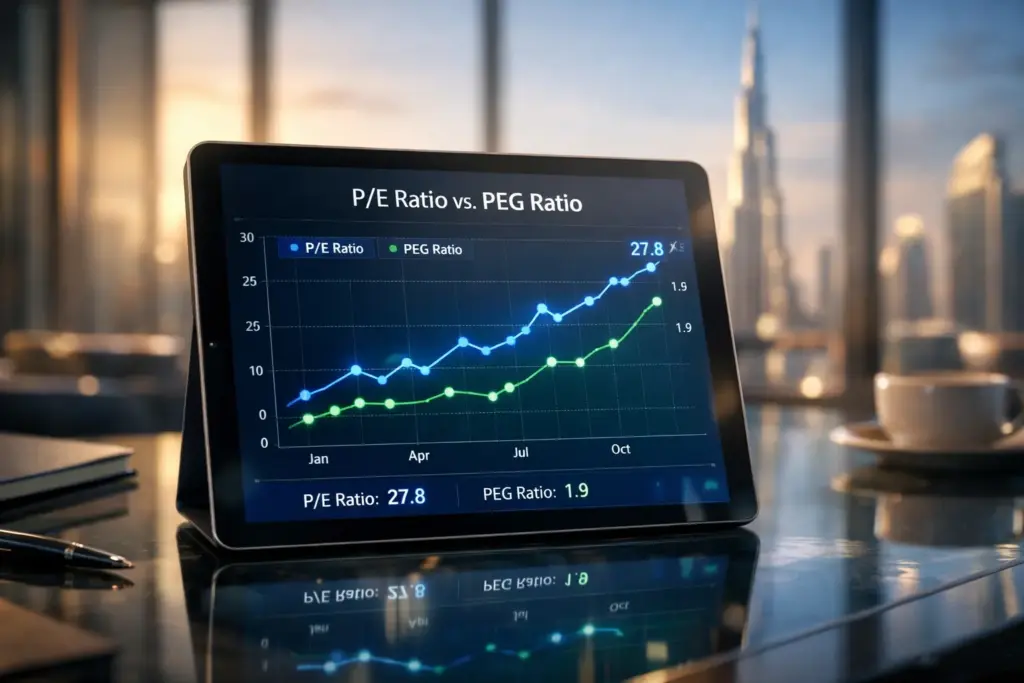
While the traditional P/E ratio tells you how much you are paying for current earnings, it fails to account for how fast those earnings are growing. The PEG ratio fixes this blind spot by dividing the P/E ratio by the company’s expected earnings growth rate.
Think of the P/E ratio as a snapshot of today’s price, whereas the PEG ratio is a roadmap of future potential. For example, a high-growth technology stock might have a high P/E of 30, which looks expensive. However, if that company is growing its earnings at 30% per year, its PEG ratio would be 1.0, suggesting it might actually be fairly valued. This nuance is why sophisticated traders often look beyond basic multiples when analyzing US Stocks & ETFs or high-flying tech giants.
How do you calculate the PEG Ratio correctly?
The formula for the PEG ratio is deceptively simple, but the quality of the input data matters immensely.
Formula: PEG Ratio = (P/E Ratio) / (Earnings Growth Rate)
To get an accurate figure, you first determine the P/E ratio by dividing the stock price by its Earnings Per Share (EPS). Then, you divide that result by the projected annual EPS growth rate.
Investors often face a choice: should they use trailing historical growth or forward-looking estimates? For markets that price in the future—like those accessible through our Deliverable Equity services—using the forward growth estimate (typically for the next 1-3 years) is often more effective. This forward-looking approach aligns better with dynamic market conditions than relying on past performance alone.
Unlock Global Market Access
Access over 25 global exchanges and apply your valuation strategies on top-tier US and Asian equities.

What is considered a "Good" PEG Ratio for investors?
Interpretation of the PEG ratio often follows a standard rule of thumb, famously popularized by legendary investor Peter Lynch:
- PEG = 1.0: The stock is considered fairly valued. The market is paying a multiple exactly in line with the growth rate.
- PEG < 1.0: The stock may be undervalued. This suggests you are paying less for future growth, which is often a “buy” signal for value-conscious investors.
- PEG > 1.0: The stock may be overvalued. The price is outpacing the company’s expected growth.

However, context is vital. In today’s premium valuation environment, especially within the Wealth Management space, high-quality companies with deep “moats” often trade at PEG ratios between 1.5 and 2.0. Blindly rejecting anything over 1.0 could mean missing out on industry leaders that compound wealth over decades.
Why is the PEG Ratio critical for Growth at a Reasonable Price (GARP) strategies?
The PEG ratio is the heartbeat of the Growth at a Reasonable Price (GARP) strategy. GARP investors seek the “sweet spot” between pure value investing (which often targets slow-growth firms) and pure growth investing (which can be risky and expensive).
By using the PEG ratio as a filter, you can identify companies that have robust growth engines but haven’t yet been bid up to astronomical levels by the hype cycle. This disciplined approach is particularly useful when constructing a diversified portfolio, ensuring you aren’t overpaying for the promise of future returns.
What are the limitations of using the PEG Ratio?
No single metric is a magic bullet. The PEG ratio has specific limitations that every prudent investor should acknowledge:
- Reliance on Estimates: The “G” (Growth) component relies on analyst forecasts. If these estimates are overly optimistic, the stock might appear cheaper than it really is.
- Dividend Neglect: The standard PEG calculation often ignores dividend income. For Bond and Debentures or high-yield utility stocks, the PEG ratio might unfairly penalize the company because a significant portion of the return comes from cash payouts, not just share price growth.
- Mature Companies: It is less effective for evaluating mature, low-growth companies (like established banks or utilities) where stability and dividends are more important than rapid earnings expansion.
Diversify Your Portfolio
Go Beyond Equities Hedge your equity risks and explore opportunities in commodities and currencies with our advanced derivatives platforms.

How does the PEG Ratio vary across different sectors?
Comparing the PEG ratio of a software company to an oil producer is like comparing apples to oranges. Different sectors have different capital requirements and growth profiles.
- Technology & Biotech: These sectors typically command higher PEG ratios because investors are willing to pay a premium for innovation and scalability. A PEG of 1.5 might be considered “cheap” for a high-flying tech stock.
- Cyclicals & Industrials: Sectors like energy or manufacturing often trade at lower PEG ratios. Here, investors should be cautious; a very low PEG might signal that the market expects earnings to collapse in the next cycle, known as a “value trap.”
- Financials: When analyzing banks or insurance firms using our daily Market Updates , remember that these institutions often grow in line with the broader economy. A PEG near 1.0 is a solid benchmark here.
Conclusion
The PEG ratio acts as a powerful equalizer in stock valuation, helping investors look past the sticker shock of a high P/E ratio to see the underlying growth story. Whether you are building a long-term portfolio of US blue chips or trading volatile global markets, incorporating the PEG ratio into your analysis ensures you are not just buying growth, but buying it at a sensible price. However, it should never be used in isolation. Combining it with other metrics like the Price-to-Sales (P/S) ratio and fundamental analysis will provide the robust framework needed to navigate today’s complex financial landscape.
Frequently Asked Questions (FAQs)
Not necessarily. While a PEG below 1.0 suggests undervaluation, it can sometimes signal a “value trap.” The market may have driven the price down due to fundamental problems, regulatory risks, or declining competitive advantage that analyst growth forecasts haven’t yet fully accounted for. Always pair the PEG ratio with a review of the company’s debt and cash flow.
A negative PEG ratio typically means one of two things: the company is losing money (negative earnings), or its future earnings are expected to shrink (negative growth). In either case, the PEG ratio becomes ineffective for valuation. Investors dealing with these scenarios often switch to other metrics like Price-to-Sales (P/S)
High-quality technology leaders often trade at PEG ratios significantly higher than 1.0 (sometimes 2.0 or more) because investors are willing to pay a premium for “moats”—such as brand dominance, network effects, or massive cash reserves—that don’t show up in simple earnings growth projections. For these market leaders, a higher PEG is often the “price of admission” for lower risk and higher stability.
No, the standard PEG ratio calculates value based purely on price and earnings growth, ignoring the return generated by dividends. This makes it less useful for valuing high-yield sectors like utilities or real estate. For dividend-heavy portfolios, investors often use the PEGY ratio (Price/Earnings-to-Growth-and-Dividend-Yield), which adds the dividend yield to the growth rate for a more complete picture.
Disclaimer:
Trading foreign exchange and/or contracts for difference on margin carries a high level of risk, and may not be suitable for all investors as you could sustain losses in excess of deposits. The products are intended for retail, professional and eligible counterparty clients. Before deciding to trade any products offered by PhillipCapital (DIFC) Private Limited you should carefully consider your objectives, financial situation, needs and level of experience. You should be aware of all the risks associated with trading on margin. The content of the Website must not be construed as personal advice. For retail, professional and eligible counterparty clients. Before deciding to trade any products offered by PhillipCapital (DIFC) Private Limited you should carefully consider your objectives, financial situation, needs and level of experience. You should be aware of all the risks associated with trading on margin.
Rolling Spot Contracts and CFDs are complex instruments and come with a high risk of losing money rapidly due to leverage. 78% of our retail client accounts lose money while trading with us. You should consider whether you understand how Rolling Spot Contracts and CFDs work, and whether you can afford to take the high risk of losing your money.
understanding dividend yield investment guide
Dividend Yield The Strategic Guide to Dividend Yield: Maximizing Passive...
Read MoreEnterprise Value And Ev/Ebitda

Enterprise Value And EV/EBITDA Enterprise Value and EV/EBITDA: A Comprehensive...
Read MorePrice-to-Sales Ratio (P/S)

Price-to-Sales Ratio (P/S) Understanding the Price-to-Sales Ratio (P/S) in Modern...
Read MorePrice-to-Book Ratio

Price-to-Book Ratio (P/B) The Essential Guide for Identifying Undervalued Stocks...
Read MorePrice-to-Earnings Ratio (P/E)

Price-to-Earnings Ratio (P/E) Table of Contents What is the Price-to-Earnings...
Read MoreStock Valuation Methods

Stock Valuation Methods A Comprehensive Guide to Estimating Fair Value...
Read MoreStock Market Hours and Session Trading

Stock Market Hours and Session Trading A Global Guide for...
Read MoreInitial Public Offering Process guide
IPO (Initial Public Offering) Process From Private to Public In...
Read MoreWhat Are Equities and Shares
Demystifying the Market What Are Equities and Shares? The world...
Read MoreIntroduction to Stock Markets
Master the Basics: An Introduction to Stock Markets and Deliverable...
Read More