Forex Currency Pairs Explained

The Ultimate Guide to Major & Best Pairs

The foreign exchange (Forex) market is the largest and most liquid financial market in the world, with trillions of dollars traded daily. For traders in the UAE and across the globe, understanding the foundation of this market—Major Currency Pairs—is the first step toward building a robust trading strategy.

At Phillip Capital DIFC, we combine over 45 years of global financial expertise with deep local knowledge to help you navigate these markets. Whether you are a beginner looking to place your first trade or an institutional client seeking deep liquidity, this guide answers the most critical questions about the world’s most traded currencies.

Quick Guide to Major Currency Pairs

Before diving into the details, here is a quick reference table of the seven major pairs you will likely trade most often. Understanding these nicknames and characteristics is essential for following market news.

Currency Pair Common Nickname Key Characteristic Primary Drivers
EUR/USD “Fiber” Highest Liquidity ECB vs Fed Interest Rates, Eurozone GDP
USD/JPY “Gopher” Asian Market Proxy Bank of Japan Policy, Risk Sentiment
GBP/USD “Cable” High Volatility UK Inflation, Bank of England Rate Decisions
USD/CHF “Swissie” Safe Haven Global Uncertainty, Swiss National Bank Policy
AUD/USD “Aussie” Commodity Linked Gold Prices, China’s Economic Health
USD/CAD “Loonie” Commodity Linked Crude Oil Prices (WTI/Brent)
NZD/USD Kiwi” Agricultural Link Crude Oil Prices (WTI/Brent)
A futuristic holographic globe surrounded by glowing currency symbols and financial data charts in a modern trading office.

What Are the Major Currency Pairs?

In the Forex market, currencies are always traded in pairs. You buy one currency while simultaneously selling another. “Major” currency pairs are defined by one key characteristic: they all include the US Dollar (USD) on one side of the trade, paired with another currency from a powerful, developed economy.

These pairs account for the vast majority of daily trading volume globally. Because they are so heavily traded, they typically offer the highest liquidity and the tightest spreads.

Why Should I Trade Major Currency Pairs Instead of Minors or Exotics?

For most traders, especially those starting out, major pairs offer significant advantages over minor (crosses) or exotic pairs.

  • Liquidity: Because millions of traders, banks, and corporations trade these pairs every second, you can enter and exit positions almost instantly without significant price slippage.
  • Lower Transaction Costs: High volume leads to competition among liquidity providers. This results in tighter spreads (the difference between the buy and sell price). At Phillip Capital DIFC, we offer competitive spreads on major pairs like EUR/USD and USD/JPY to help you maximize your potential returns.
  • Predictability: While no market is perfectly predictable, major pairs tend to respect technical analysis levels and respond logically to economic news more reliably than volatile exotic pairs.

Start Trading with Confidence

Looking to access deep liquidity and tight spreads on over 40 currency pairs?

Which Major Currency Pair is Best for Beginners?

This is one of the most common questions we receive at our Dubai office. While there is no “easy” pair to trade, EUR/USD is widely considered the best starting point for new traders.

Why EUR/USD?

  1. Stability: It is generally less volatile than pairs like GBP/USD, meaning price swings are often smoother and less erratic.
  2. Information Availability: Because it represents the US and Eurozone economies, news flow is constant and transparent. You will never struggle to find analysis or data on this pair.
  3. Cost Efficiency: It almost always has the lowest spread of any pair, meaning your cost to enter the trade is lower, which is crucial when you are learning and managing a smaller account.

However, if you prefer trading during the UAE morning hours (which overlaps with the Asian session), USD/JPY is also an excellent choice due to its clear trends and high liquidity during that time.

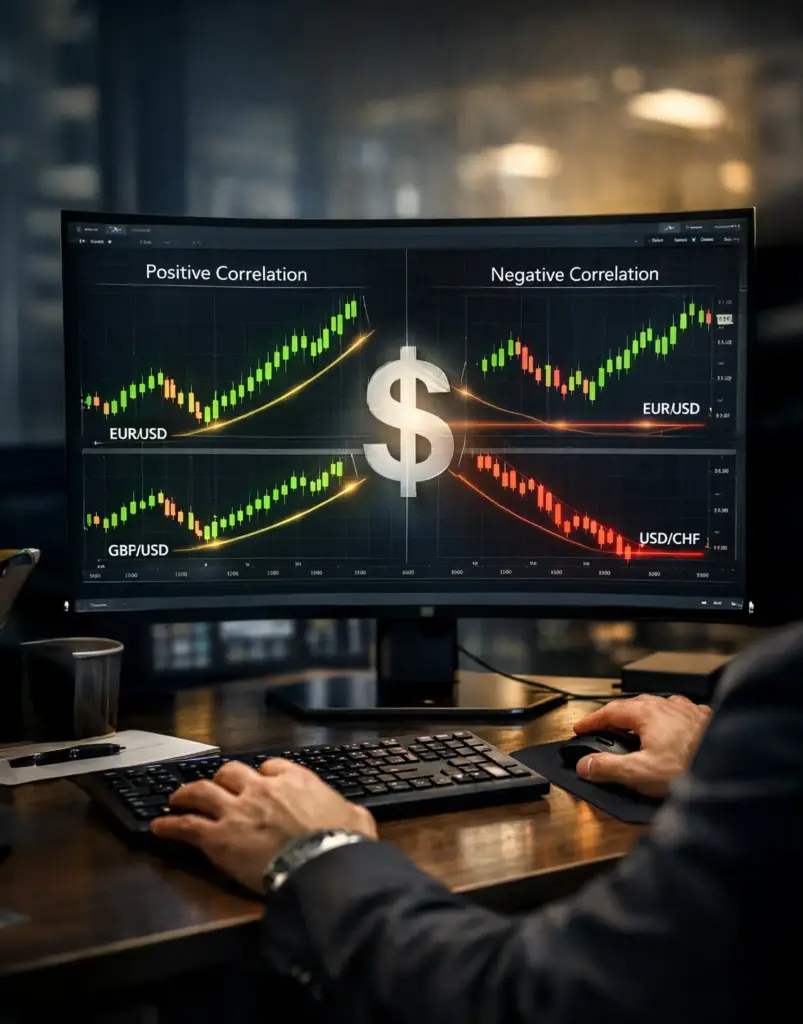
Professional trader analyzing positive and negative currency correlations on a trading screen with EUR/USD, GBP/USD, and USD/CHF charts.

How Do Currency Correlations Affect My Trading Risk?

Understanding correlations is what separates professional traders from amateurs. Currency pairs do not move in isolation; they often influence each other because they share a common currency (usually the USD).

Two Types of Correlation to Watch:

  • Positive Correlation (Moving Together): EUR/USD and GBP/USD often move in the same direction. If the US Dollar weakens, both the Euro and the Pound typically rise against it. If you buy both pairs simultaneously, you are essentially doubling your risk on the US Dollar.
  • Negative Correlation (Moving Opposite): EUR/USD and USD/CHF often have a strong inverse relationship. When EUR/USD goes up, USD/CHF usually goes down. Trading these in the same direction (e.g., buying both) can result in one trade canceling out the profit of the other.

Pro Tip: Always check the correlation before opening multiple positions. If you are already long on AUD/USD (which is linked to Gold), be cautious about opening a large position in Gold (XAU/USD) simultaneously, as you might be over-exposed to the same market drivers.

What Factors Influence the Price of Major Currency Pairs?

Currency prices are a reflection of the economic health of the countries they represent. To trade majors effectively, you need to understand the fundamental drivers behind them:

  1. Interest Rates: Central banks, such as the Federal Reserve (Fed) for the USD or the European Central Bank (ECB) for the Euro, set interest rates. Generally, higher interest rates attract foreign capital, strengthening the currency.
  2. Economic Data: Reports like Non-Farm Payrolls (US employment data), GDP growth, and inflation (CPI) figures can cause immediate spikes in volatility.
  3. Geopolitical Stability: Currencies like the Swiss Franc (CHF) and Japanese Yen (JPY) are often considered “safe havens.” During times of global uncertainty, investors may flock to these currencies, driving their value up against the USD.
  4. Commodity Prices: The Australian Dollar (AUD) and Canadian Dollar (CAD) are “commodity currencies.” If the price of Gold rises, AUD/USD often rises. If Oil prices surge, USD/CAD typically falls (meaning the CAD strengthens).

When Is the Best Time to Trade Major Currency Pairs?

The Forex market is open 24 hours a day, 5 days a week, but not every hour offers the same opportunity. The market is divided into three major sessions:

  • Asian Session (Tokyo): Best for trading USD/JPY and AUD/USD.
  • European Session (London): The most volatile session. Great for EUR/USD, GBP/USD, and USD/CHF.
  • North American Session (New York): High volume, especially when it overlaps with the London session (typically 4:00 PM to 8:00 PM Dubai time).

For traders in the UAE, the time zone is advantageous. The London session begins in the late morning, and the New York session overlap happens in the evening, allowing you to trade the most liquid hours without disrupting your entire day.

How Can I Manage Risk When Trading Forex?

Trading on margin (leverage) allows you to control a large position with a smaller amount of capital, but it also increases risk. A solid risk management strategy is non-negotiable.

  • Use Stop-Loss Orders: Always define your exit point before you enter a trade.
  • Understand Leverage: Phillip Capital DIFC offers flexible leverage options (up to 1:20 for retail and 1:100 for professional clients). Higher leverage can magnify both profits and losses.
  • Educate Yourself: Utilize our research reports and daily market updates to stay ahead of market movements.

Need Personalized Advice?

Our experts help you navigate our platforms and risk management tools.

How Do I Start Trading Major Pairs with Phillip Capital DIFC?

Getting started is straightforward. We provide a secure, regulated environment (DFSA regulated) for you to access the global markets.

  1. Open an Account: You can apply for a retail or professional account depending on your experience and capital.
  2. Choose Your Platform: We offer the award-winning MetaTrader 5 (MT5) platform, which is perfect for analyzing major currency pairs with advanced charting tools and automated trading capabilities.
  3. Fund Your Account: We offer secure funding methods to get you ready to trade.
  4. Start Trading: Access over 40 FX pairs, including all the majors discussed above, alongside Gold, Silver, and Indices.
Macro shot of a futuristic, glowing glass interface displaying the Dollar ($), Euro (€), and Pound Sterling (£) currency symbols overlaid on vibrant red and green stock chart candles. The background is a blurred, dramatic dusk view of the Dubai skyline, including the Burj Khalifa, with the PhillipCapital DIFC logo visible.

Ready to Enter the Global Markets?

Join thousands of traders who trust Phillip Capital’s 50+ year legacy.

Frequently Asked Questions (FAQs)

Is EUR/USD always the "safest" pair for beginners to trade?

Not always. while EUR/USD is the most liquid and typically has the lowest spread (cheapest to trade), it can be deceptively choppy. Because it is the most heavily traded pair, it reacts instantly to both US and European news, often causing "whipsaws" (sharp movements in both directions). Many beginners find USD/JPY slightly easier to identify clear trends on, especially during the Asian session.

Why do spreads on major pairs suddenly increase at 1:00 AM (Dubai Time)?

This is known as "Rollover" or the "Bank Reset." Even though the Forex market is open 24 hours, the banking day officially closes at 5:00 PM New York time (roughly 1:00 AM in Dubai). For a few minutes, liquidity from major banks dries up as they settle accounts for the day. This lack of liquidity causes spreads to widen temporarily, even on major pairs like EUR/USD.

Which major pair moves the most (has the highest volatility)?

If you are looking for price movement, GBP/USD (The Cable) is historically more volatile than EUR/USD. It tends to have wider daily ranges, offering higher profit potential for day traders, but it also carries higher risk. If you prefer a calmer, slow-moving pair, AUD/USD often moves more gradually than the Pound

Disclaimer:

Trading foreign exchange and/or contracts for difference on margin carries a high level of risk, and may not be suitable for all investors as you could sustain losses in excess of deposits. The products are intended for retail, professional and eligible counterparty clients. Before deciding to trade any products offered by PhillipCapital (DIFC) Private Limited you should carefully consider your objectives, financial situation, needs and level of experience. You should be aware of all the risks associated with trading on margin. The content of the Website must not be construed as personal advice. For retail, professional and eligible counterparty clients. Before deciding to trade any products offered by PhillipCapital (DIFC) Private Limited you should carefully consider your objectives, financial situation, needs and level of experience. You should be aware of all the risks associated with trading on margin.

Rolling Spot Contracts and CFDs are complex instruments and come with a high risk of losing money rapidly due to leverage. 78% of our retail client accounts lose money while trading with us. You should consider whether you understand how Rolling Spot Contracts and CFDs work, and whether you can afford to take the high risk of losing your money.