Stock Market Hours and Session Trading

A Global Guide for UAE Traders

Success in the financial markets isn’t just about what you trade; it’s about when you trade. For investors based in the UAE, the geographical advantage of being positioned between East and West offers unique access to the world’s most liquid trading sessions. However, navigating the shifting time zones of the New York, London, and Tokyo exchanges can be complex.

Whether you are trading deliverable US equities, engaging in CFD trading, or hedging with Spot FX, understanding market hours is critical for managing liquidity and volatility. In this guide, we answer the most pressing questions about stock market hours and session trading, specifically tailored for the UAE time zone.

A high-tech trading workstation monitor displaying a world map visualizing the three major global stock market trading sessions—Asia, Europe, and North America—with glowing data lines and digital clocks for JST, GMT, and EST time zones.

What are the Major Global Stock Market Trading Sessions?

The global stock market is generally divided into three major trading sessions. These sessions correspond to the operating hours of the largest financial centers in the world.

  • The Asian Session: Dominated by the Tokyo Stock Exchange (Japan), but also includes Hong Kong and Singapore. This is often the first session to react to news from the weekend or overnight developments.
  • The European Session: Centered around London (LSE), but also includes major hubs like Frankfurt and Paris. This session is known for high liquidity and volatility, especially when it overlaps with the Asian or US sessions.
  • The North American (US) Session: The powerhouse of the global economy, dominated by the New York Stock Exchange (NYSE) and Nasdaq. This session typically generates the highest trading volume globally.

What Are the US Stock Market Hours in UAE Time?

This is the most common question for traders in Dubai, as the US market offers massive opportunities through instruments like US Stocks, ETFs, and ADRs.

Since the UAE does not observe Daylight Saving Time, but the US does, the trading hours shift twice a year.

  1. Winter Timing (Standard Time – Approx. Nov to March):
  • US Market Open: 6:30 PM (UAE Time)
  • US Market Close: 1:00 AM (Next Day UAE Time)
  1. Summer Timing (Daylight Saving – Approx. March to Nov):
  • US Market Open: 5:30 PM (UAE Time)
  • US Market Close: 12:00 AM (Midnight UAE Time)

Note: Pre-market and post-market trading sessions extend beyond these core hours, offering additional opportunities but with different liquidity profiles.

Ready to trade global giants like Apple and Tesla?

Access top US stocks and seize global opportunities.

When Do the European and Asian Markets Open in Dubai?

For traders looking to diversify beyond the US, the European and Asian markets provide excellent volatility.

European Session (London Stock Exchange):

  • Opens: 12:00 PM (UAE Winter) / 11:00 AM (UAE Summer)
  • Closes: 8:30 PM (UAE Winter) / 7:30 PM (UAE Summer)

Asian Session (Tokyo Stock Exchange):

  • Opens: 4:00 AM (UAE Time)
  • Closes: 10:00 AM (UAE Time)
  • (Note: Japan does not observe Daylight Saving Time, so this remains relatively constant).

What Are the Trading Hours for Local UAE Markets (DFM & ADX)?

If you are trading local equities, it is essential to follow the specific hours of the Dubai Financial Market (DFM) and the Abu Dhabi Securities Exchange (ADX).

  • Trading Days: Monday to Friday
  • Opening Session: 10:00 AM (Gulf Standard Time)
  • Closing Session: 3:00 PM (Gulf Standard Time)

Trading local markets allows you to invest in the region’s growth while operating entirely within your daytime business hours.

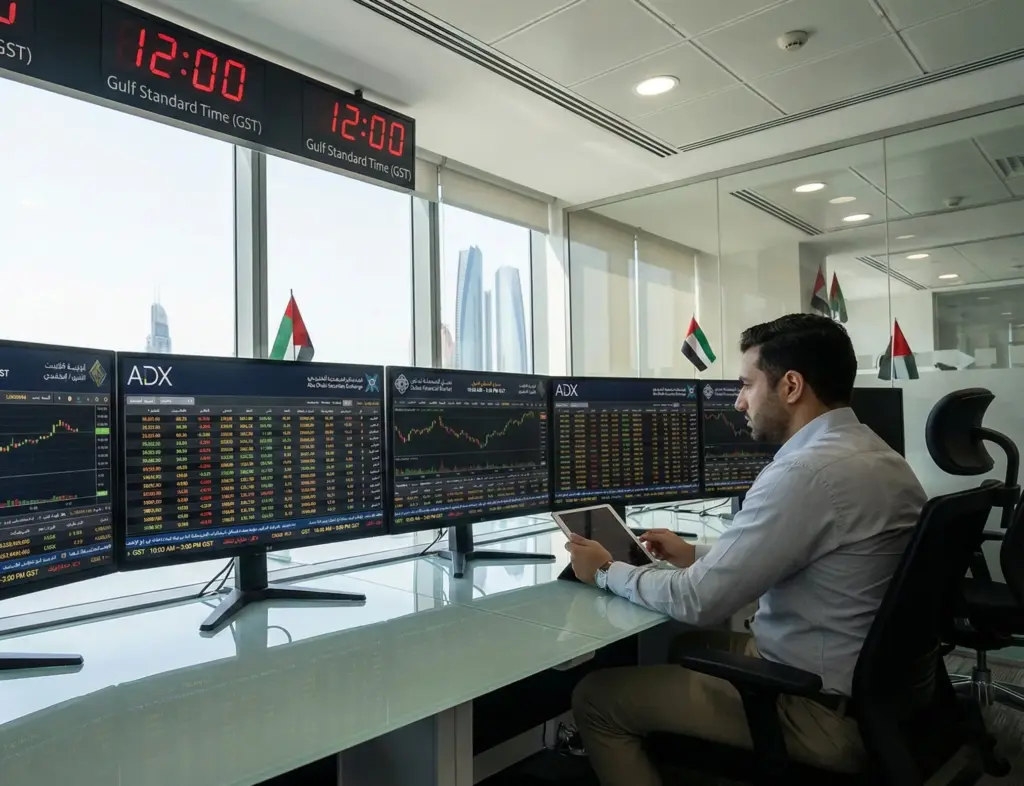
A professional trader in a Dubai office with a view of the Burj Khalifa, monitoring multiple screens displaying real-time financial data and charts for the Dubai Financial Market (DFM) and Abu Dhabi Securities Exchange (ADX) during active trading hours.

Can I Trade After the Market Closes? (Pre-Market and Post-Market)

Yes, trading outside of regular hours is possible, primarily in the US markets. This is known as Extended Hours Trading.

  • Pre-Market: Occurs before the opening bell. It allows traders to react to earnings reports or economic data released early in the morning.
  • Post-Market: Occurs after the closing bell.

Is it risky? Yes. Liquidity is generally lower (fewer buyers and sellers), which leads to wider spreads (the difference between the buy and sell price) and higher volatility. At Phillip Capital DIFC, we ensure our clients have access to robust platforms that handle these conditions transparently.

Want to access markets around the clock?

Explore our CFD Trading Platforms for flexible access to global indices and commodities.

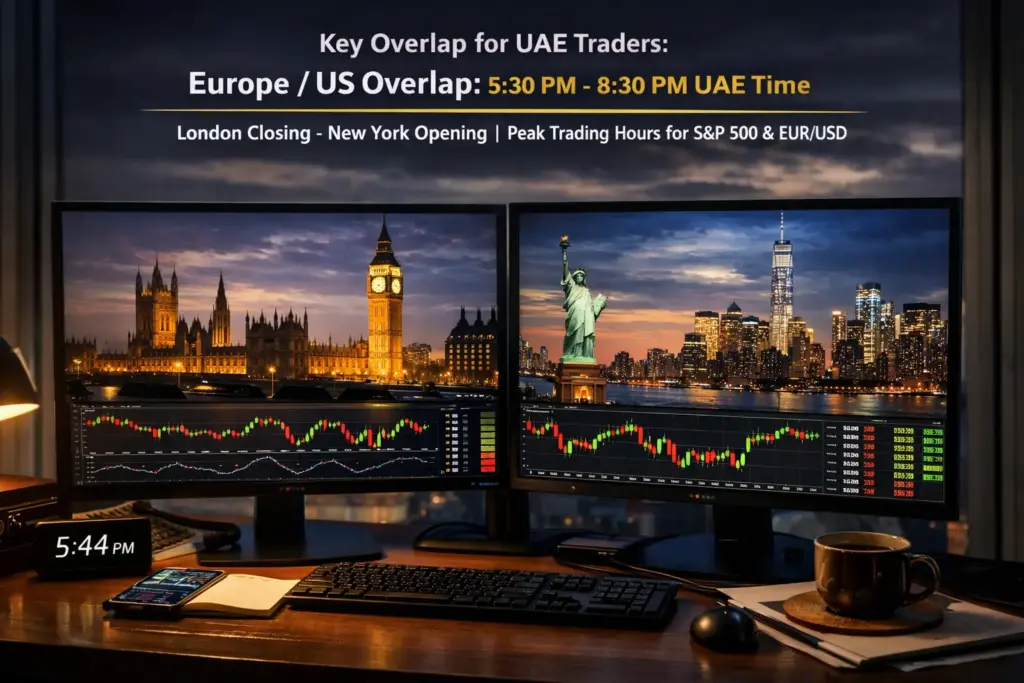
Photorealistic dual-monitor trading setup showing London and New York markets during the Europe-US overlap trading session for UAE traders.

What Is the "Market Overlap" and Why Is It Important?

The “Overlap” is the golden window for day traders. This is when two major markets are open simultaneously, resulting in peak volume and liquidity.

The Key Overlap for UAE Traders:

  • Europe / US Overlap: Occurs roughly between 5:30 PM and 8:30 PM (UAE Time).
  • During this window, the London market is closing while the New York market is opening. This creates significant price movement, making it an ideal time for day trading strategies, particularly in Indices (like the S&P 500) and Forex pairs (like EUR/USD).

How Does Daylight Saving Time (DST) Affect My Trading Schedule?

Since the UAE stays on Gulf Standard Time (GST) year-round, you must adjust your schedule when other countries change theirs.

  • US Clocks Move Forward (March): The US market opens 1 hour earlier for you (5:30 PM UAE).
  • US Clocks Fall Back (November): The US market opens 1 hour later for you (6:30 PM UAE).

Missing this shift is a common mistake for new traders. We recommend adding a “World Clock” widget to your trading dashboard to stay synchronized.

Why Choose a Broker in the DIFC for Global Session Trading?

Trading global hours requires a broker that operates with the same global mindset. Phillip Capital DIFC is regulated by the DFSA (Dubai Financial Services Authority), offering:

  1. Safety: Top-tier regulatory oversight.
  2. Access: From local UAE stocks to US Equities and Asian Futures.

Frequently Asked Questions (FAQs)

Is Pre-Market trading risky for beginners?

Yes, it is generally considered riskier than standard session trading. While it allows you to react to earnings released before the bell, the “Pre-Market” suffers from significantly lower liquidity. This means there are fewer buyers and sellers, which leads to “wider spreads” (a larger gap between the bid and ask price). A stock might look stable, but a small order can cause a sudden price jump or drop that wouldn’t happen during regular hours.

Is it dangerous to hold my day trades overnight?

It carries “Gap Risk.” If major news breaks while the market is closed, the stock price could “gap” up or down the next morning, opening at a price far away from your closing point. This can bypass your Stop Loss order, leading to larger-than-expected losses. Day traders typically close all positions before the bell to avoid this uncertainty.

Which day of the week is usually the best for trading?

While opportunities exist daily, Tuesday, Wednesday, and Thursday are widely considered the most stable for trend trading. Mondays can be sluggish as the market finds direction after the weekend, and Fridays are often erratic as traders rush to close positions to avoid holding risk over the weekend. However, volatility always peaks on days when major economic data (like CPI or Jobs Reports) is released.

Conclusion

Understanding stock market hours and session trading is the foundation of a disciplined trading strategy. By aligning your trading activity with high-liquidity sessions—such as the Europe/US overlap—you can potentially improve your execution quality and capitalize on market movements. Whether you are an early riser trading Tokyo or an evening trader focused on New York, Phillip Capital DIFC provides the gateway to these global opportunities.

Start Your Trading Journey Today

Contact us today to connect with a relationship manager and begin your account opening process.

Disclaimer:

Trading foreign exchange and/or contracts for difference on margin carries a high level of risk, and may not be suitable for all investors as you could sustain losses in excess of deposits. The products are intended for retail, professional and eligible counterparty clients. Before deciding to trade any products offered by PhillipCapital (DIFC) Private Limited you should carefully consider your objectives, financial situation, needs and level of experience. You should be aware of all the risks associated with trading on margin. The content of the Website must not be construed as personal advice. For retail, professional and eligible counterparty clients. Before deciding to trade any products offered by PhillipCapital (DIFC) Private Limited you should carefully consider your objectives, financial situation, needs and level of experience. You should be aware of all the risks associated with trading on margin.

Rolling Spot Contracts and CFDs are complex instruments and come with a high risk of losing money rapidly due to leverage. 78% of our retail client accounts lose money while trading with us. You should consider whether you understand how Rolling Spot Contracts and CFDs work, and whether you can afford to take the high risk of losing your money.