Long vs Short Positions in Derivatives

A Complete Guide for UAE Investors

In the dynamic landscape of global finance, market volatility is the only constant. For traditional investors, a market downturn often signals a period of waiting or potential loss. However, for sophisticated traders using derivatives, market movement in any direction—whether up or down—presents an opportunity.

Understanding the mechanics of Long vs Short positions is the watershed moment for many investors in the UAE. It transforms a one-dimensional investment approach into a versatile strategy capable of navigating complex economic cycles. Whether you are trading on the Dubai Gold and Commodities Exchange (DGCX) or exploring global Forex markets, mastering these positions allows you to hedge risks and capitalize on trends that others might fear.

At Phillip Capital DIFC, we believe that educated traders are successful traders. This guide breaks down the technicalities of going long and short into clear, actionable insights, helping you utilize derivatives to their full potential.

What is the fundamental difference between "Going Long" and "Going Short"?

In the world of financial markets, the concepts of “long” and “short” are the two sides of the trading coin. At its simplest, going long reflects the traditional investing mindset: you buy an asset today with the expectation that its price will rise in the future. For example, if you purchase Equities or Shares in a blue-chip company listed on the DFM (Dubai Financial Market), you are taking a long position. You profit if the price goes up.

Going short, or “short selling,” is the inverse. It is a strategy used when you anticipate that the price of an asset will fall. In derivatives trading—such as Futures and Options or CFDs (Contracts for Difference)—you can sell an asset you do not technically own (or sell a contract) with the intent to buy it back later at a lower price. The difference between the higher selling price and the lower buying price becomes your profit. This ability to profit from falling markets is what makes derivatives a powerful tool for sophisticated traders in the DIFC and beyond.

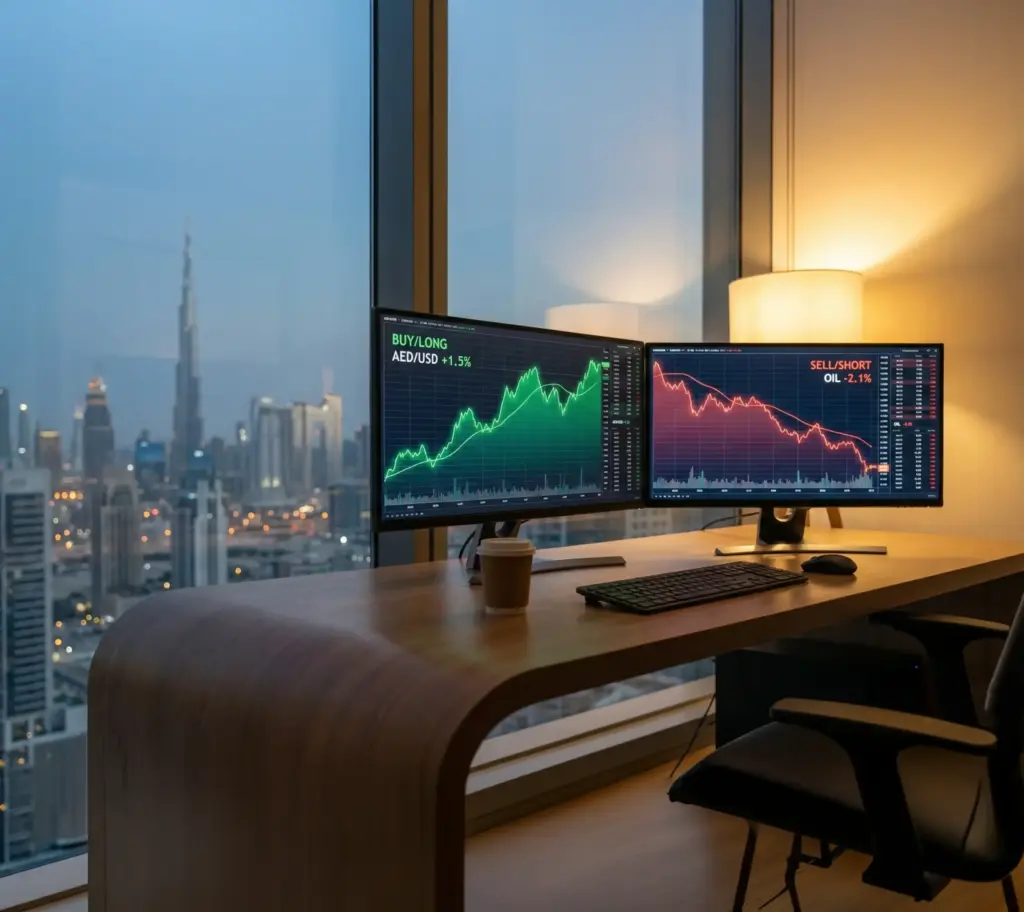
Modern trading desk in a Dubai high-rise office at dusk, featuring dual monitors displaying a green 'BUY/LONG AED/USD' chart and a red 'SELL/SHORT OIL' chart, with a view of the Burj Khalifa and city skyline.

How does a Long Position work specifically within Derivatives?

While a long position in physical stocks involves ownership, a long position in derivatives is about exposure to the price movement without necessarily owning the underlying asset.

When you go long on a derivative contract, such as a DGCX Gold Future, you are agreeing to buy the asset at a specific price on a future date. If the market price of gold rises above your agreed price by the time the contract expires (or when you choose to close the trade), your position gains value.

This is particularly popular in Spot FX trading. If you go long on the EUR/USD pair, you are buying Euros and selling US Dollars, expecting the Euro to strengthen. The key advantage here is leverage; you can control a large position with a relatively small initial margin, amplifying potential returns (though also amplifying risks).

Ready to Capitalize on Market Rises?

Access global markets with competitive spreads and advanced trading tools.

3D illustration of a golden bull pushing a green upward market line and a metallic bear pulling a red downward line on a financial chart

What is the mechanism behind a Short Position?

Short positions in derivatives are often misunderstood. You aren’t “losing” an asset; you are entering a contract to sell.

In an Exchange-Traded Derivative (ETD) like a future, “going short” simply means you are the seller of the contract. You agree to sell the asset at today’s price in the future. If the market price drops, the value of your contract increases because you have secured a selling price that is higher than the current market rate.

In OTC (Over-the-Counter) markets like CFDs, shorting is even more seamless. You simply click “Sell” on your platform. The broker effectively lends you the asset to sell at the current high price. When you close the position, you “buy” it back. If the price has dropped, you keep the difference. This is widely used by traders to hedge portfolios—for instance, if you own physical stocks but fear a short-term market dip, you might short a stock index to offset potential losses in your physical holdings.

What are the risks associated with Long vs Short positions?

This is the most critical aspect for any trader to understand.

  • Risk in Long Positions: The risk is generally capped. If you buy a crude oil contract at $80, the worst-case scenario (theoretically) is that the price falls to zero. You cannot lose more than the value of the asset (assuming no leverage).
  • Risk in Short Positions: The risk is theoretically unlimited. If you short a stock at $100, expecting it to drop to $80, but a sudden positive news event pushes the price to $200, $300, or higher, you are responsible for covering that difference. Since there is no ceiling on how high a price can rise, losses on a short position can exceed your initial investment if not managed with strict Stop-Loss orders.

At Phillip Capital DIFC, we emphasize risk management. Whether you are long or short, utilizing tools like stop-losses and understanding margin requirements is non-negotiable for sustainable trading.

Master Your Risk Management

Learn how to protect your capital with our expert educational resources.

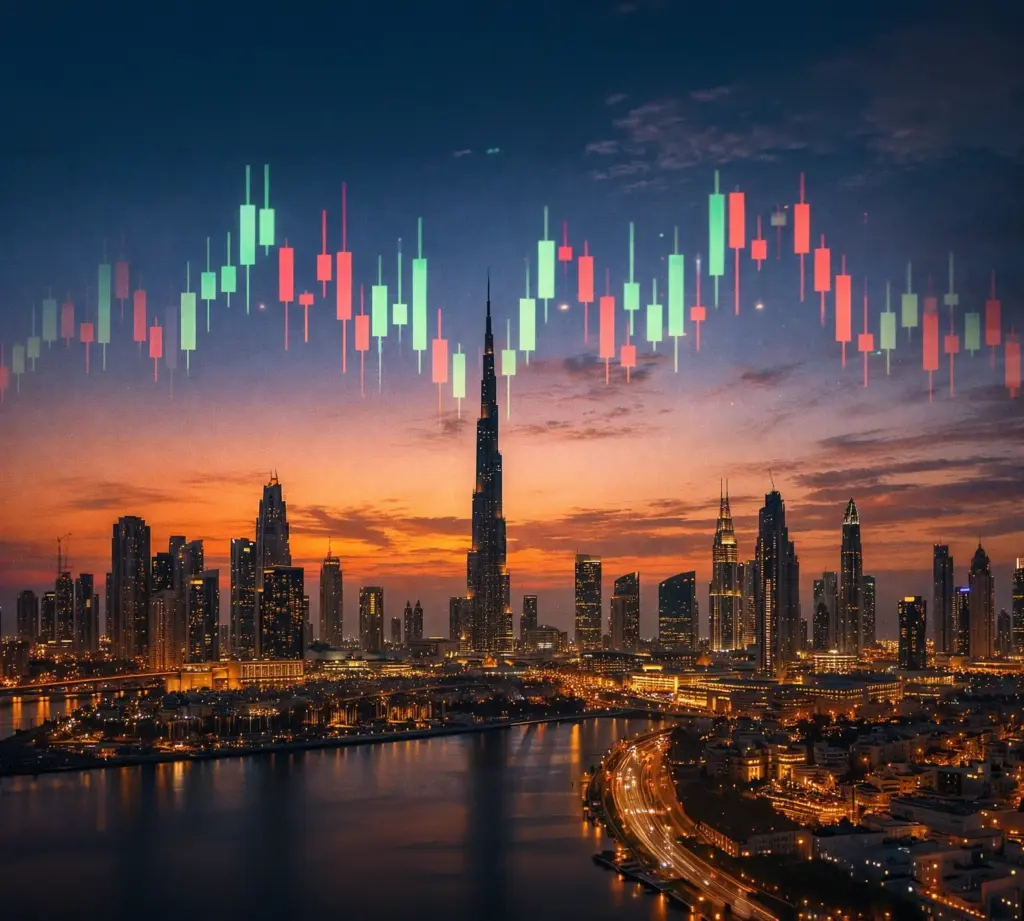
Photorealistic twilight view of the Dubai skyline with floating green and red financial candlestick charts above the city

When should I choose a Long Strategy versus a Short Strategy?

The decision depends entirely on your market outlook and your broader financial goals.

  • Choose Long When: You identify strong fundamentals, positive economic data, or a “bullish” technical trend. It is also the primary strategy for long-term wealth accumulation in assets like equities or gold.
  • Choose Short When: You believe an asset is overvalued (a bubble), the economic outlook is “bearish,” or you need to hedge an existing investment. For example, if you hold physical Indian Rupees but worry about currency depreciation, you might take a short position in INR futures to protect your value.

Successful traders do not favor one over the other; they remain flexible, adapting their position to the current market cycle.

Conclusion

In the fast-paced world of derivatives trading, flexibility is your greatest asset. By mastering the distinction between Long and Short positions, you are no longer limited to profiting only when markets rise. Instead, you gain the ability to navigate bear markets, hedge your physical investments, and seize opportunities across diverse asset classes—from commodities to currencies.

While the potential for profit is significant, the risks, particularly with short selling and leverage, demand respect and discipline. A balanced strategy that combines thorough market analysis with robust risk management tools is essential for long-term success.

At Phillip Capital DIFC, we are committed to empowering you with the technology and insights needed to trade with confidence. Whether you are looking to go long on the future of the UAE economy or short to hedge against global volatility, our platform provides the stability and access you need.

Frequently Asked Questions (FAQs)

How is it possible to "sell" an asset I don't actually own?

This is a common point of confusion. In derivatives trading, you aren’t physically handing over an asset. Instead, you are entering a contract based on the asset’s price.

  • In Futures/CFDs: Your broker effectively “lends” you the asset to sell at the current market price. You are then obligated to “buy” it back later to close the position. If you buy it back cheaper than you sold it, you keep the difference as profit. If the price rises, you pay the difference.

Is Short Selling significantly riskier than Going Long?

Yes, generally speaking, short selling carries higher theoretical risk.

  • Long Risk is Capped: If you buy an asset, the price can only fall to zero. Your maximum loss is limited to your initial investment.

  • Short Risk is Unlimited: If you short an asset, there is no “ceiling” on how high the price can rise. If a market moves violently against you, your losses can theoretically exceed your initial investment. This makes the use of Stop-Loss orders absolutely essential when shorting.

Can I hold a Long and a Short position on the same asset simultaneously?

Yes, this strategy is known as “Hedging.” Traders often use this to protect a long-term investment from short-term volatility. For instance, if you hold a long-term Long position in Gold but expect a temporary price drop this week, you might open a short position on Gold Futures for a few days. The profit from the short trade helps offset the temporary paper loss on your long-term holding.

Disclaimer:

Trading foreign exchange and/or contracts for difference on margin carries a high level of risk, and may not be suitable for all investors as you could sustain losses in excess of deposits. The products are intended for retail, professional and eligible counterparty clients. Before deciding to trade any products offered by PhillipCapital (DIFC) Private Limited you should carefully consider your objectives, financial situation, needs and level of experience. You should be aware of all the risks associated with trading on margin. The content of the Website must not be construed as personal advice. For retail, professional and eligible counterparty clients. Before deciding to trade any products offered by PhillipCapital (DIFC) Private Limited you should carefully consider your objectives, financial situation, needs and level of experience. You should be aware of all the risks associated with trading on margin.

Rolling Spot Contracts and CFDs are complex instruments and come with a high risk of losing money rapidly due to leverage. 78% of our retail client accounts lose money while trading with us. You should consider whether you understand how Rolling Spot Contracts and CFDs work, and whether you can afford to take the high risk of losing your money.

Open Your Account Today

Ready to build a more stable financial future?