Futures Fundamentals A Strategic Guide to Capital Markets Table of...
Read More

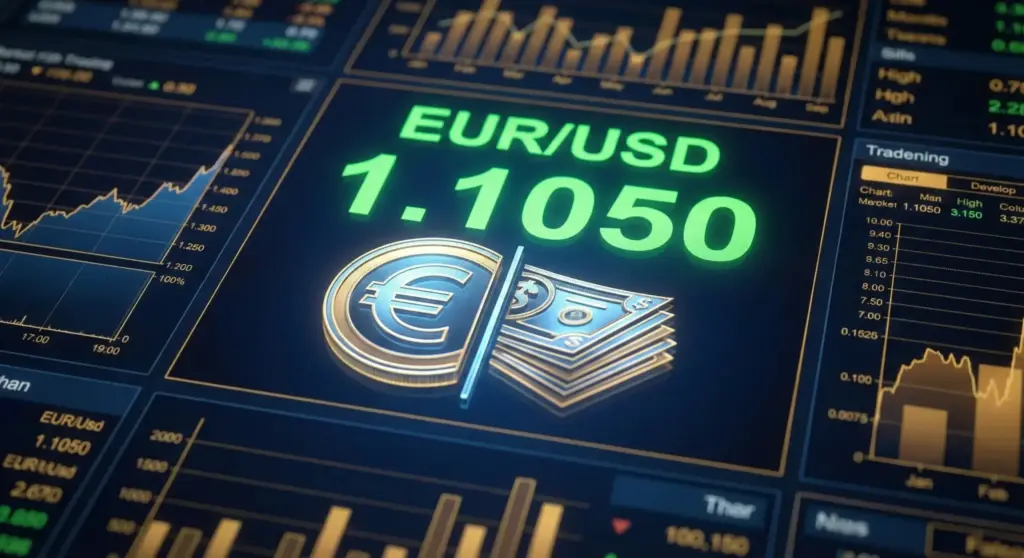
In the global foreign exchange markets, currencies are never traded in isolation; they are always traded in pairs. This structure allows investors to measure the value of one currency relative to another.
The Base Currency is the first currency listed in the pair. It serves as the reference point for the transaction and always has a notional value of 1. Whether you are buying or selling a currency pair, you are essentially performing that action on the base currency.
The Quote Currency (often called the counter currency) is the second currency listed. It represents the amount required to purchase one unit of the base currency.
For example, in the EUR/USD pair:
If you decide to execute a trade, the direction of your position depends on your view of the base currency. A “long” (buy) position indicates you expect the base currency to appreciate against the quote currency. Conversely, a “short” (sell) position implies you anticipate the base currency will depreciate relative to the counter currency. This dual mechanism is the foundation of Spot FX trading, allowing investors to capitalize on both rising and falling markets.
The exchange rate you see on your trading platform is strictly a reflection of the quote currency’s value per single unit of the base currency.
Let’s look at a practical example using a major pair. If the GBP/USD is trading at 1.2500:
This price tells you that to acquire 1 GBP, you must sell 1.25 USD.
If the exchange rate rises to 1.2600, it means the base currency (GBP) has strengthened—it now “costs” more US dollars to buy the same pound. If the rate falls to 1.2400, the base currency has weakened.
For investors trading on global markets via platforms like MetaTrader 5, understanding this relationship is critical for reading charts. A chart moving upward always signifies strength in the base currency, while a downward trend signifies strength in the quote currency. This inverse relationship is vital when analyzing economic data; for instance, positive US economic news typically strengthens the USD. If the USD is the quote currency (e.g., EUR/USD), the chart will likely move down.
Discover why the EUR/USD and other major pairs offer the best liquidity for beginners
In the interbank market, the order of currencies is established by global convention and cannot be changed by the trader. This standardization ensures that liquidity providers, banks, and brokers—including those in the DIFC financial hub—are all speaking the same “language.”
The hierarchy generally places the currency with the higher historical value or dominance as the base currency. The typical priority order for major currencies is:

This is why you will see EUR/USD (Euro is priority 1) but USD/JPY (USD is priority 5, higher than JPY).
There are rare exceptions in some exotic crosses, but adhering to this hierarchy is standard practice. Understanding this hierarchy helps investors quickly identify which asset they are technically buying or selling, which is particularly important when diversifying into major and exotic currency pairs.
A crucial but often overlooked detail is that your Profit and Loss (P&L) is always valued in the Quote Currency.
If you are trading USD/JPY, the quote currency is the Japanese Yen. Therefore, your pip value and initial profit calculation will be in Yen. To reflect this in your trading account balance (assuming your account is denominated in USD), the platform automatically converts that Yen profit back into US Dollars at the current exchange rate.
Example:
However, if you trade USD/CHF (Quote currency is Swiss Franc):
For professional investors managing a diverse portfolio, keeping track of the quote currency is essential for accurate risk management and margin calculations. Sophisticated traders often utilize structured products or hedging strategies to mitigate the risk of currency fluctuations affecting their realized P&L.
When you open a trade, you will see two prices: the Bid (sell price) and the Ask (buy price). The difference between them is the Spread.
Liquidity plays a massive role here. Pairs involving major global currencies like the USD or EUR typically have high liquidity, resulting in tighter spreads. Conversely, pairs with less liquid quote currencies (such as the Turkish Lira or South African Rand) often have wider spreads.
Investors should be aware that the spread is effectively a transaction cost derived from the quote currency. During periods of high volatility—such as central bank announcements or geopolitical shifts—spreads can widen significantly. Utilizing a robust trading ecosystem, such as the one provided by Phillip Capital DIFC, ensures you have access to competitive spreads and reliable execution even during turbulent market conditions.

Understanding the distinction between base currency and quote currency is more than just learning terminology; it is the mechanics of how value is transferred in the global economy. The base currency indicates what you are trading, while the quote currency dictates the cost and the valuation of your trade.
Whether you are executing high-volume technical trades on the EUR/USD or hedging exposure with commodity futures, the dynamics remain the same. By mastering these fundamentals, you position yourself to make more calculated decisions, better manage your margin, and interpret market movements with the eye of a professional investor.
Your profit (or loss) is always generated in the Quote currency (the second currency in the pair). For example, if you trade the USD/JPY, your profit is earned in Japanese Yen. Your trading platform then automatically converts this amount into your account’s designated currency (e.g., USD) at the current exchange rate.
No, you cannot change the standardized order. The forex market follows a strict global hierarchy where specific currencies (like EUR and GBP) must always be listed as the Base currency. If you want to “buy” the USD against the Euro, you simply sell the standard EUR/USD pair.
In every forex transaction, you are performing the action on the Base currency. Selling the GBP/USD means you are selling British Pounds and simultaneously buying US Dollars. You would do this if you believe the British Pound will fall in value or the US Dollar will rise.
This happens when the USD is the Quote currency (e.g., EUR/USD or GBP/USD). Since the chart tracks the value of the Base currency, a stronger US Dollar makes the Base currency (Euro) look weaker by comparison, pushing the price chart downward. Conversely, for pairs where USD is the Base (like USD/JPY), positive dollar news pushes the chart upward.
Trading foreign exchange and/or contracts for difference on margin carries a high level of risk, and may not be suitable for all investors as you could sustain losses in excess of deposits. The products are intended for retail, professional and eligible counterparty clients. Before deciding to trade any products offered by PhillipCapital (DIFC) Private Limited you should carefully consider your objectives, financial situation, needs and level of experience. You should be aware of all the risks associated with trading on margin. The content of the Website must not be construed as personal advice. For retail, professional and eligible counterparty clients. Before deciding to trade any products offered by PhillipCapital (DIFC) Private Limited you should carefully consider your objectives, financial situation, needs and level of experience. You should be aware of all the risks associated with trading on margin.
Rolling Spot Contracts and CFDs are complex instruments and come with a high risk of losing money rapidly due to leverage. 78% of our retail client accounts lose money while trading with us. You should consider whether you understand how Rolling Spot Contracts and CFDs work, and whether you can afford to take the high risk of losing your money.
Bond Pricing Fundamentals A Guide for Investors Table of Contents...
Read MorePrice-to-Earnings Ratio (P/E) Table of Contents What is the Price-to-Earnings...
Read MoreBase Currency vs Quote Currency Table of Contents What is...
Read MoreBond Maturities Short-Term, Intermediate, and Long-Term Bonds Table of Contents...
Read MoreSector Rotation A Strategic Guide to Investing Through Economic Cycles...
Read MoreHow Structured Products Work A Complete Guide for Investors Table...
Read MoreStock Valuation Methods A Comprehensive Guide to Estimating Fair Value...
Read MoreMinor and Exotic Currency Pairs A Trader’s Guide to Global...
Read MoreLong vs Short Positions in Derivatives A Complete Guide for...
Read MoreInvestment Grade vs Non-Investment Grade Bonds A Guide for UAE...
Read MoreStock Market Hours and Session Trading A Global Guide for...
Read MoreOver-the-Counter (OTC) vs Exchange-Traded Derivatives A Complete Guide for UAE...
Read MoreBonds: Face Value, Par Value & Coupon Rate When venturing...
Read MoreGrowth Investing The High-Risk, High-Reward Strategy for UAE Investors Growth...
Read MoreComponents of Structured Products A Detailed Guide for UAE Investors...
Read MoreIPO (Initial Public Offering) Process From Private to Public In...
Read MoreForex Market Structure and Hours The Complete Guide for UAE...
Read MoreTypes of Derivatives Futures, Options, Swaps, and Forwards In the...
Read MoreBond Issuers Government vs Corporate Bonds What UAE Investors Need...
Read MoreDemystifying the Market What Are Equities and Shares? The world...
Read MoreDecoding the Market What is Spot FX Trading and How...
Read MoreWhat are Derivatives and Their Purpose The financial world is...
Read MoreMaster the Basics: An Introduction to Stock Markets and Deliverable...
Read MoreIntroduction to the Forex Market : Your Gateway to Global...
Read MorePhillipCapital DIFC is the best online trading broker in the UAE, offering secure and advanced solutions for global investors and traders.
You should carefully consider your objectives, financial situation, needs, and level of experience before engaging in trading activities. You should be aware of all the risks associated with trading on margin. Rolling Spot Contracts and CFDs are complex instruments and carry a high risk of losing money rapidly due to leverage.
PhillipCapital (DIFC) Private Limited (a member of the PhillipCapital Group) is incorporated in the Dubai International Financial Centre (“DIFC”) with its business address at 417, Liberty House, Financial Centre, Dubai, United Arab Emirates, and is regulated by the Dubai Financial Services Authority (“DFSA”) under reference No. F003474. Some of the products and services mentioned on this site may be offered through other PhillipCapital group offices and not directly by PhillipCapital (DIFC) Private Limited. All Rights Reserved.
PhillipCapital (DIFC) Private Limited does not offer its services to residents of the Democratic Republic of Korea, Iran, and the Russian Federation.
The information on this site is not directed at residents of the United States and is not intended for distribution to, or use by, any person in any jurisdiction where such distribution or use would be contrary to local law or regulation.