Bonds: Face Value, Par Value & Coupon Rate

When venturing into the world of fixed income trading, three terms appear constantly: Face Value, Par Value, and Coupon Rate. While they may sound technical, understanding the relationship between them is critical for calculating potential returns and assessing the risk of your portfolio. Whether you are an experienced trader in Dubai or an expat looking to diversify your savings, mastering these basics is the first step toward smart investing.

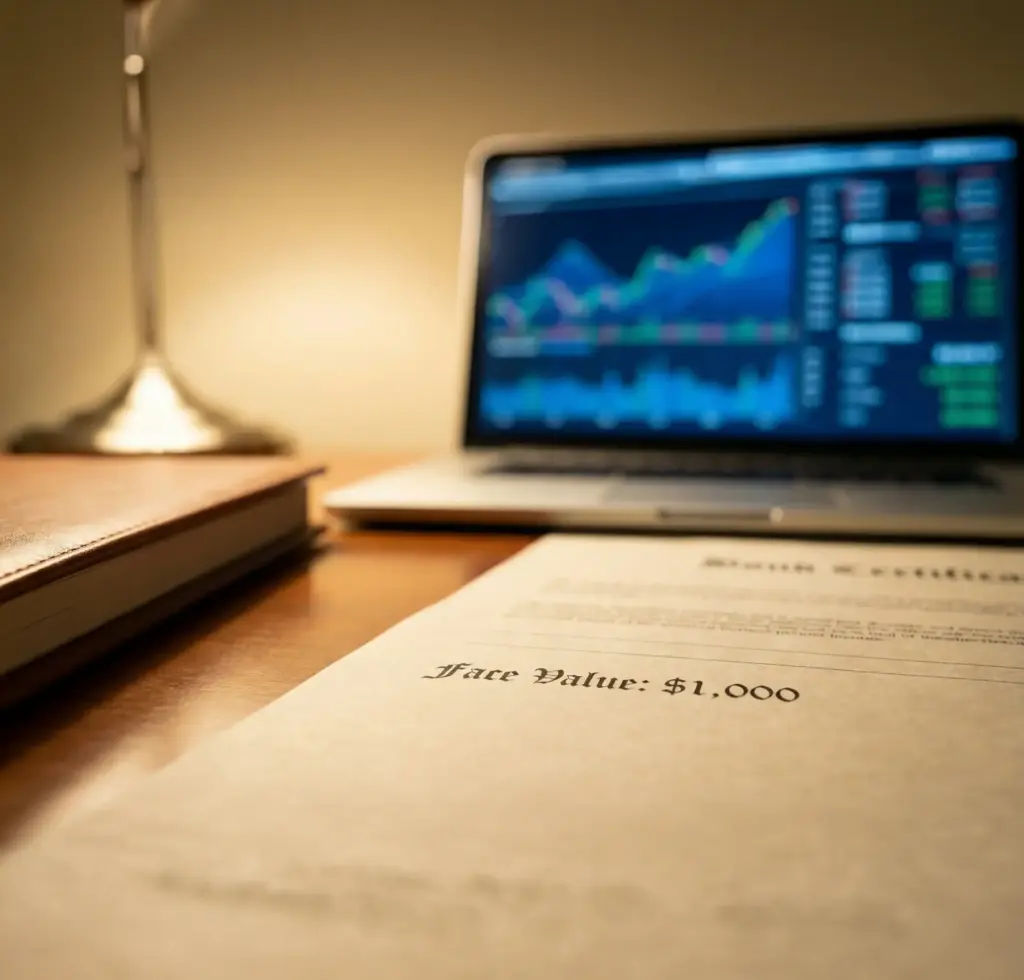
Close-up of a printed bond certificate on a mahogany desk focusing on the text "Face Value: $1,000," with a blurred laptop screen displaying financial trading charts in the background.

What is the difference between Bond Face Value and Par Value?

This is one of the most common sources of confusion for new investors. In the vast majority of financial contexts, Face Value and Par Value are effectively the same thing.

  • Both terms refer to the nominal value of the bond as stated by the issuing entity (whether it is a government or a corporation). This is the amount of money the issuer promises to repay the bondholder once the bond reaches its maturity date.
  • While the terms are interchangeable, “Face Value” is often the term used when discussing the physical certificate or the principal amount appearing on statements, whereas “Par Value” is frequently used when discussing price relative to the market (e.g., trading “at par,” “above par,” or “below par”).

    Why it matters to you: Regardless of what you pay for a bond today (the market price), the Face Value is what you will receive when the bond matures (assuming the issuer does not default).

What is a Bond Coupon Rate and how is it calculated?

The Coupon Rate is the annual interest rate paid on the bond’s face value. It determines the steady stream of income you receive while holding the bond.

  • The Calculation: If a bond has a Face Value of $1,000 and a Coupon Rate of 5%, the issuer will pay you $50 per year.
    • Formula: (Coupon Rate x Face Value) = Annual Interest Payment
  • Payment Frequency: Most bonds pay this interest semi-annually. In the example above, you would likely receive two payments of $25 each year.

    Crucial Note: The Coupon Rate is fixed at the time of issuance. Even if the market price of the bond changes daily on the exchange, your coupon payment amount generally stays the same (unless it is a floating-rate note).

Why do bonds trade at prices different from their Face Value?

You might ask, “If a bond is worth $1,000 at maturity, why would anyone buy or sell it for $950 or $1,050?” The answer lies in the relationship between the bond’s Coupon Rate and the current Market Interest Rates.

  1. Trading at a Discount (Below Par): If market interest rates rise higher than your bond’s coupon rate, your bond becomes less attractive because new bonds pay more. To sell your bond, you must lower the price below its face value.
  2. Trading at a Premium (Above Par): If market interest rates fall lower than your bond’s coupon rate, your bond is highly valuable because it pays better interest than new bonds. Investors will pay more than the face value to acquire it.
  3. Trading at Par: When the market interest rate equals the bond’s coupon rate, the bond typically trades at its face value.

    Investor Insight: buying a bond at a “discount” can be a strategic move. You pay less upfront but still receive the full face value at maturity, effectively increasing your total return (yield).

A golden balance scale on a desk inside a modern Dubai trading floor. The left pan holds a weight labeled "COUPON RATE," which is perfectly balanced with a stack of coins and a plaque labeled "MARKET PRICE" on the right pan. The Burj Khalifa and city skyline are visible through the background windows.

How does the Coupon Rate affect the Bond Yield?

This is where the “Expertise” in investing comes into play. The Coupon Rate and Yield are not the same.

  • Coupon Rate: The fixed percentage paid on the face value.
  • Yield (specifically Yield to Maturity – YTM): This is the total estimated return you earn if you hold the bond until it matures. It accounts for the coupon payments plus the profit or loss from the difference between what you paid (Market Price) and what you get back (Face Value).

Example: If you buy a $1,000 bond for $900 (at a discount), your Yield will be higher than the Coupon Rate because you are getting the interest payments plus a $100 capital gain at maturity.

Confused by Yield vs. Coupon?

Phillip Capital DIFC advisors help build portfolios aligned with your financial goals.

Can the Face Value of a bond ever change?

In most standard cases, the Face Value (Par Value) is fixed for the life of the bond. However, there are exceptions in sophisticated financial instruments:

  1. Inflation-Linked Bonds (e.g., TIPS): The face value of these bonds can adjust periodically based on inflation rates. If inflation goes up, the face value increases, which in turn increases the coupon payments.
  2. Amortizing Bonds: These bonds pay back a portion of the face value (principal) along with interest payments over time, meaning the outstanding face value decreases as the bond gets closer to maturity.

For the vast majority of corporate and government bonds traded by retail investors, the face value remains constant.

How do I choose the right bond for my portfolio?

Selecting the right bond requires balancing the Coupon Rate (income) with the Credit Quality (safety) of the issuer.

  • High Coupon, High Risk: Bonds with very high coupon rates often come from issuers with lower credit ratings (High Yield or “Junk” Bonds). They pay you more to compensate for the risk of default.
  • Low Coupon, High Stability: Government bonds or “Blue Chip” corporate bonds usually offer lower coupon rates but provide much higher security that your Face Value will be returned.

Strategy Tip: Don’t just chase the highest coupon rate. Look at the Yield to Maturity and the issuer’s credit rating to ensure the investment aligns with your risk tolerance.

A businessman holding a tablet displaying a portfolio diversification pie chart with a highlighted fixed income section, set against a blurred background of the Burj Khalifa and Dubai skyline.

Where can I trade bonds in the UAE?

Trading bonds requires a broker that offers access to international exchanges, as many lucrative opportunities exist in US, European, and Asian markets.

At Phillip Capital DIFC, we provide a gateway to the global bond market. Whether you are looking for Sovereign Bonds, Corporate Debentures, or Sukuk, our platform ensures you have the liquidity and transparency needed to trade with confidence.

Ready to start? Bonds are a powerful tool for preserving capital and generating steady cash flow. Don’t leave your cash idle—make it work for you.

Invest Smarter in Fixed Income

Open Your Account Today

Disclaimer:

Trading foreign exchange and/or contracts for difference on margin carries a high level of risk, and may not be suitable for all investors as you could sustain losses in excess of deposits. The products are intended for retail, professional and eligible counterparty clients. Before deciding to trade any products offered by PhillipCapital (DIFC) Private Limited you should carefully consider your objectives, financial situation, needs and level of experience. You should be aware of all the risks associated with trading on margin. The content of the Website must not be construed as personal advice. For retail, professional and eligible counterparty clients. Before deciding to trade any products offered by PhillipCapital (DIFC) Private Limited you should carefully consider your objectives, financial situation, needs and level of experience. You should be aware of all the risks associated with trading on margin.

Rolling Spot Contracts and CFDs are complex instruments and come with a high risk of losing money rapidly due to leverage. 78% of our retail client accounts lose money while trading with us. You should consider whether you understand how Rolling Spot Contracts and CFDs work, and whether you can afford to take the high risk of losing your money.