Calculating Bond Price And Yield

Understanding Bond Valuation: A Comprehensive Guide to Calculating Price and Yield

As global fixed-income markets evolve, understanding the mechanics of bond valuation is essential for building a resilient investment portfolio. Whether you are a retail investor or a professional managing institutional capital, the relationship between interest rates, bond prices, and yields forms the bedrock of debt market strategy.

This guide provides an in-depth exploration of how to calculate bond prices and yields, offering the clarity needed to navigate the complexities of the DIFC and international financial markets.

Ultra-realistic cinematic visualization of bond valuation showing present value formulas, yield curve, coupon payments, and global bond markets in a modern trading environment.

How is the Price of a Bond Determined?

The theoretical price of a bond is the present value of all its future cash flows. These cash flows consist of periodic interest payments, known as coupons, and the return of the bond’s face value (par value) at maturity. To determine the fair market value, investors must discount these future payments back to the present using a specific discount rate, often referred to as the “required rate of return.”

The formula involves the summation of the present value of each coupon payment plus the present value of the par value. If the market’s required yield is higher than the bond’s coupon rate, the bond will trade at a discount. Conversely, if the required yield is lower, the bond trades at a premium. For those looking to diversify, exploring global debt markets requires a firm grasp of these mathematical foundations to identify undervalued opportunities.

What is the Relationship Between Bond Prices and Interest Rates?

The relationship between bond prices and interest rates is inverse. When central banks, such as the Federal Reserve, raise interest rates, newly issued bonds offer higher yields. This makes existing bonds with lower coupon rates less attractive, causing their market prices to fall until their effective yield matches the new market environment.

This sensitivity to interest rate changes is measured by duration. A bond with a longer maturity typically exhibits higher duration, meaning its price will fluctuate more significantly in response to rate shifts. Sophisticated investors often utilize professional wealth management services to calibrate their portfolio duration, ensuring they are positioned correctly for the prevailing economic cycle.

Optimize Your Fixed Income Strategy

Expert Portfolio Management Navigate interest rate volatility with our bespoke investment solutions.

How Do You Calculate the Yield to Maturity (YTM)?

Yield to Maturity (YTM) is considered the most comprehensive measure of a bond’s profitability. Unlike the nominal yield, YTM accounts for the bond’s current market price, its par value, the coupon interest rate, and the time remaining until maturity. It assumes that all coupon payments are reinvested at the same rate as the current YTM.

Calculating YTM manually is complex and often requires a trial-and-error method or a financial calculator. The formula equates the bond’s current price to the sum of the present value of all remaining cash flows. For investors accessing specialized trading platforms, these calculations are often automated, allowing for real-time comparison of various fixed-income instruments.

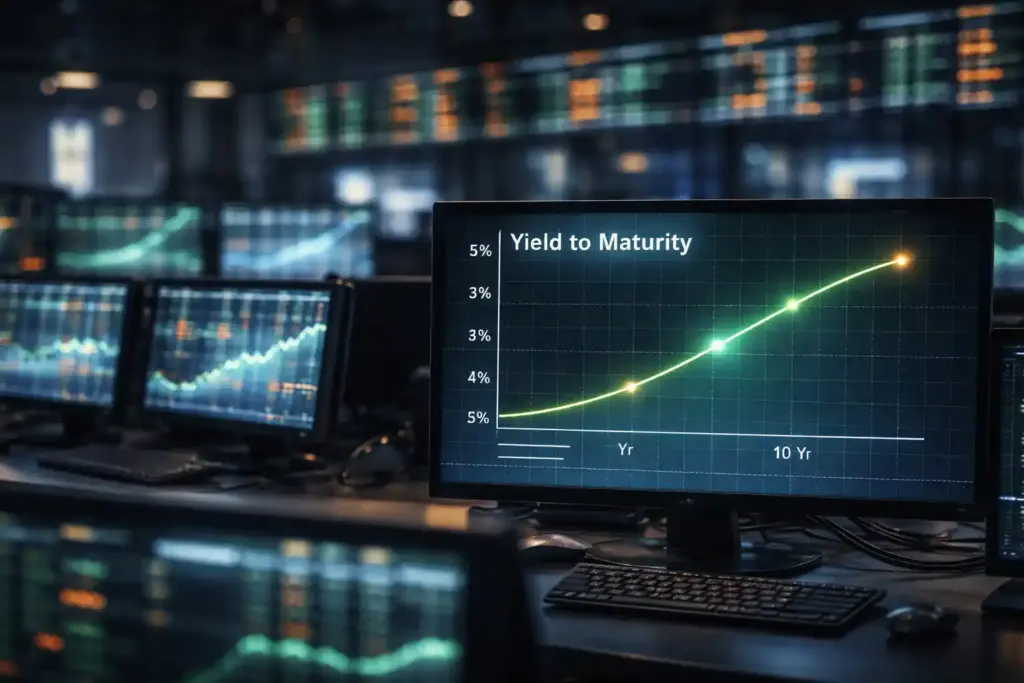
Photorealistic wide shot of a modern trading floor with glowing monitors displaying a green yield to maturity curve and real-time financial data.

What Factors Influence Bond Yield Spreads?

A yield spread is the difference between the yields of two different debt instruments, usually a corporate bond and a risk-free government benchmark. This spread reflects the “risk premium” that investors demand for taking on additional credit risk.

Several factors influence these spreads, including:

  • Credit Quality: The perceived ability of the issuer to meet its obligations.
  • Liquidity Risk: How easily the bond can be sold in the secondary market without affecting its price.
  • Economic Outlook: During periods of uncertainty, spreads tend to widen as investors flock to “safe-haven” assets.

Understanding these nuances is vital when investing in emerging markets, where yield spreads can offer significant returns for those who accurately assess the underlying credit risk.

Access Global Capital Markets

Direct Market Access Trade international bonds and equities through our secure DIFC-based platform.

Understanding the Difference Between Current Yield and Coupon Rate

It is a common mistake to use the terms “coupon rate” and “yield” interchangeably. The coupon rate is the fixed annual interest payment set at the time of issuance, expressed as a percentage of the par value.

The current yield, however, is a dynamic figure. It is calculated by dividing the annual coupon payment by the bond’s current market price. If you purchase a bond at a discount, your current yield will be higher than the coupon rate. This distinction is critical for investors focused on generating consistent cash flow from their investments, as it reflects the actual return on the capital deployed today

Conclusion: Mastering Fixed-Income Metrics

Calculating bond prices and yields is more than a mathematical exercise; it is a fundamental skill for interpreting market sentiment and valuing risk. By understanding the inverse relationship between prices and rates, and the comprehensive nature of Yield to Maturity, investors can make more informed decisions in a fluctuating interest rate environment.

Success in fixed-income investing requires a combination of technical knowledge and access to the right markets. Whether you are hedging against equity volatility or seeking long-term capital preservation, a disciplined approach to bond valuation will remain your most valuable tool.

Frequently Asked Questions (FAQs)

Why do bond prices fall when market interest rates rise?

This inverse relationship exists because a bond’s coupon rate is fixed at issuance. If new bonds are issued with higher interest rates, your existing bond becomes less valuable to investors. To make your bond competitive, its market price must drop until its effective yield matches the new, higher market rates.

Is it better to look at the Coupon Rate or the Yield to Maturity (YTM)?

The coupon rate only tells you the annual interest payment based on the face value. YTM is a far more accurate metric for total return because it accounts for the price you paid (premium or discount), the time remaining until maturity, and the assumption that all interest is reinvested.

What happens if I hold a bond until it matures?

If you hold a bond to maturity, market price fluctuations become irrelevant to your final return. Provided the issuer does not default, you will receive the full face value of the bond plus all scheduled interest payments, regardless of how much the bond’s market price changed during the holding period.

What is the difference between a bond's "Par," "Premium," and "Discount"?

These terms describe the bond’s price relative to its face value (usually $1,000). A bond trading at Par is priced exactly at its face value. A Premium bond costs more than its face value because its coupon is higher than current market rates. A Discount bond costs less, typically because its coupon is lower than what is currently available elsewhere.

Why is there an inverse relationship between bond prices and interest rates?

The inverse relationship exists because a bond’s fixed coupon rate becomes more or less attractive compared to the broader market. When interest rates rise, new bonds are issued with higher yields, making older bonds with lower rates less desirable. To attract buyers, the price of these older bonds must drop until their total return (yield) matches the current market environment.

Mathematically, a bond’s price is the present value of its future cash flows. When the market interest rate (the discount rate) increases, the present value of those fixed future payments decreases, resulting in a lower market price for the bond.

Disclaimer:

Trading foreign exchange and/or contracts for difference on margin carries a high level of risk, and may not be suitable for all investors as you could sustain losses in excess of deposits. The products are intended for retail, professional and eligible counterparty clients. Before deciding to trade any products offered by PhillipCapital (DIFC) Private Limited you should carefully consider your objectives, financial situation, needs and level of experience. You should be aware of all the risks associated with trading on margin. The content of the Website must not be construed as personal advice. For retail, professional and eligible counterparty clients. Before deciding to trade any products offered by PhillipCapital (DIFC) Private Limited you should carefully consider your objectives, financial situation, needs and level of experience. You should be aware of all the risks associated with trading on margin.

Rolling Spot Contracts and CFDs are complex instruments and come with a high risk of losing money rapidly due to leverage. 78% of our retail client accounts lose money while trading with us. You should consider whether you understand how Rolling Spot Contracts and CFDs work, and whether you can afford to take the high risk of losing your money.