

CFD Advantages and Disadvantages CFD Advantages and Disadvantages: What Investors...
Read MoreCFD Advantages and Disadvantages
CFD Advantages and Disadvantages: What Investors Should Weigh Before Trading
Contracts for Difference (CFDs) attract attention because they let investors trade price movements in shares, indices, commodities and currencies without owning the asset itself. That flexibility is the main appeal. It is also the main source of risk, which is why a balanced view matters more here than with most products.
Table of Contents
- What Is a CFD and How Does It Work?
- What Are the Advantages of Trading CFDs?
- What Are the Disadvantages and Risks of CFDs?
- How Do Leverage and Costs Affect a CFD Trade in Practice?
- How Do CFDs Compare With Owning Shares Directly?
- Which Investors and Markets Suit CFD Trading?
- What Risk Management Habits Help CFD Traders?
- Are CFDs Worth Considering?
- Frequently Asked Questions About CFDs
What Is a CFD and How Does It Work?
A Contract for Difference (CFD) is a derivative agreement between an investor and a broker to exchange the difference in an asset’s price between opening and closing a trade. The investor never owns the underlying asset, so profit or loss depends entirely on how the price moves and which direction the position was taken.
A derivative is simply a contract whose value comes from another asset, called the underlying asset. With a share CFD, for example, the investor is not buying the share. They are agreeing to settle the price change in cash. A long position profits if the price rises, and a short position profits if it falls.
Every CFD trade also involves a bid-ask spread, the gap between the price to buy and the price to sell, and a margin deposit. Margin is a fraction of the trade’s full value that the investor posts as collateral. Investors who want the fundamentals first can start with PhillipCapital DIFC’s CFD Basics learning hub or its broader derivatives basics guides. Because many CFDs track currency pairs, it also helps to understand how forex market structure and trading hours work.
What Are the Advantages of Trading CFDs?
The main advantages of CFDs are capital efficiency through leverage, the ability to profit from falling as well as rising prices, access to many markets from one account, and flexible position sizing. These features can suit active traders and hedgers, provided the risks in the next section are respected.
Leverage makes capital work harder
Leverage lets an investor control a larger position than their deposit would otherwise allow. Because only a fraction of the trade value is posted as margin, the remaining capital stays free for other uses. Leverage magnifies price moves in both directions, so the same feature that raises potential gains raises potential losses by the same proportion.
Short selling is straightforward
In a falling market, a CFD investor can open a short position as easily as a long one. Traditional share investing usually requires borrowing stock to sell short, which adds steps and conditions. With CFDs, direction is simply a choice at the order ticket.
One account can reach many markets
CFDs commonly cover shares, equity indices, commodities and currency pairs. An investor can therefore move between asset classes without opening separate accounts for each exchange, which supports diversification across the global equity, commodity and forex markets.
Hedging becomes more practical
An investor holding a portfolio of shares may open a short CFD position to offset temporary downside risk without selling the holdings. This is known as hedging. The hedge is only as good as the match between the CFD and the assets being protected, so it needs careful sizing.
Position sizes and order types are flexible
CFDs can often be traded in small increments, so position sizing can be matched closely to an investor’s risk budget. Stop-loss and limit orders, which close or open positions at preset prices, add further control over how a trade is managed.
Trade global markets with a DFSA-regulated broker
Explore how PhillipCapital DIFC structures its CFD offering for Dubai-based investors.
What Are the Disadvantages and Risks of CFDs?
The main disadvantages of CFDs are that leverage amplifies losses, margin calls can force positions closed, ongoing costs erode returns, prices can gap past stop orders, and investors gain no ownership rights in the underlying asset. CFDs are complex products that carry a high risk of rapid loss.
- Leverage amplifies losses as well as gains. A small adverse price move can wipe out a large share of the posted margin, and depending on account terms, losses can exceed the funds deposited.
- Margin calls can force the issue. If losses reduce the account’s equity below the maintenance requirement, the broker may ask for more funds or close positions. A margin call is that request for additional collateral.
- Costs accumulate quietly. Investors pay the bid-ask spread on entry, and positions held overnight typically incur a financing charge known as a swap rate. Over long holding periods, these charges can outweigh a modest price gain.
- Gaps can bypass stop-loss orders. When markets open sharply higher or lower after news, a trade may close at a worse price than the stop level that was set.
- There is no ownership. CFD holders do not own the share, so they have no voting rights and receive dividend-related cash adjustments rather than actual dividends.
- Overtrading is easy. The convenience of leverage and quick execution can tempt investors into taking more positions than their capital and attention can support.
How Do Leverage and Costs Affect a CFD Trade in Practice?
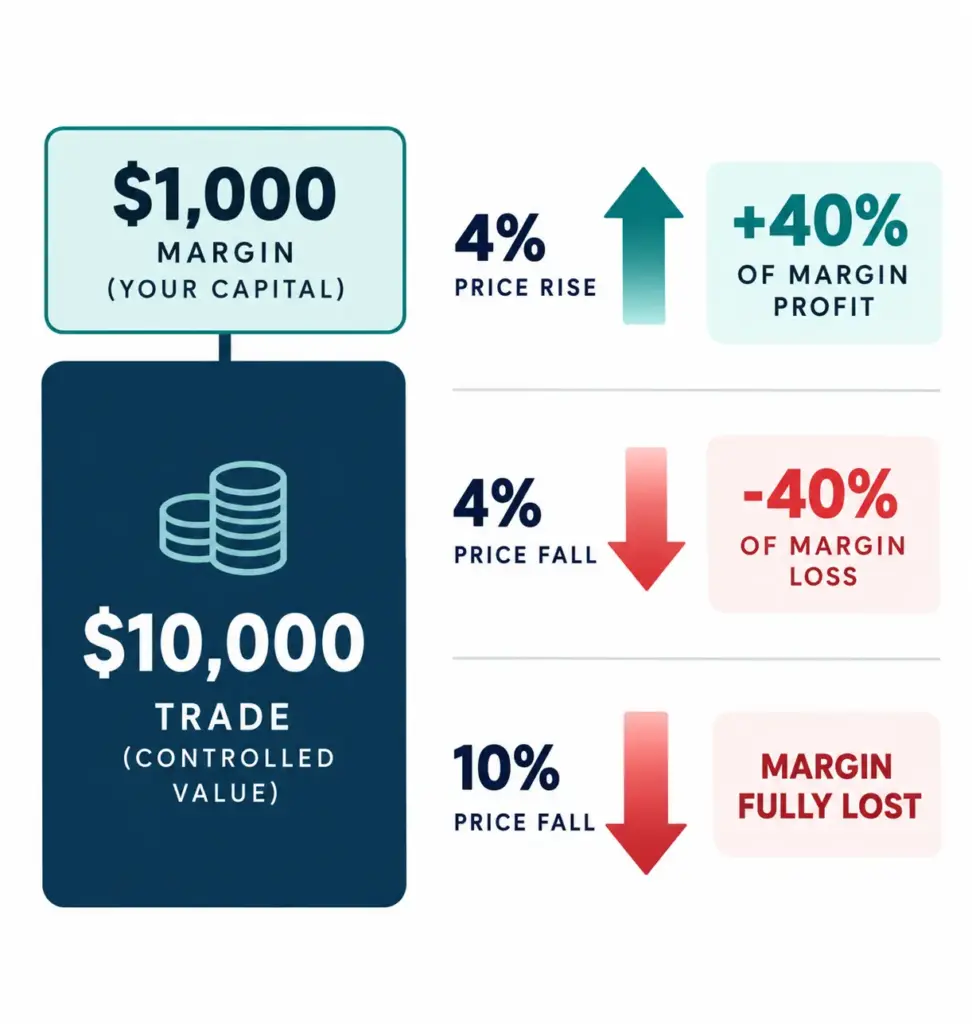
Leverage multiplies the percentage return on the margin posted, in both directions. In the illustrative example below, a 4% price move produces a 40% change in the investor’s margin, and a 10% adverse move removes it entirely. Spreads and financing charges then reduce every outcome.
Consider a hypothetical share priced at $50. An investor buys 200 share CFDs, giving a trade value of $10,000. Assume, for illustration only, a 10% margin requirement, so the investor posts $1,000. Actual margin rates vary by instrument and provider.
| Price move | Change in trade value | Result on $1,000 margin |
|---|---|---|
| Up 4% (to $52) | +$400 | +40% of margin |
| Down 4% (to $48) | -$400 | -40% of margin |
| Down 10% (to $45) | -$1,000 | Margin fully lost |
These figures exclude the spread and any overnight financing, both of which would make each result slightly worse. They also show why position size matters more than the headline margin. An investor who buys the same 200 shares outright would need $10,000 but would lose only 10% of capital in the same 10% fall.
How Do CFDs Compare With Owning Shares Directly?
Owning shares gives an investor real ownership, dividends and voting rights, with losses limited to the amount invested. CFDs require far less upfront capital and allow easy short selling, but they carry leverage risk, financing costs and no ownership. The better fit depends on the investor’s goals and time horizon.
CFDs vs Direct Share Ownership
| Feature | CFDs | Direct Shares |
|---|---|---|
| Ownership of the asset | None, only a contract on price | Full legal ownership |
| Upfront capital | A fraction of trade value as margin | Full purchase price |
| Direction of trade | Long or short with equal ease | Mainly long, short selling needs borrowing |
| Maximum loss | Can exceed the deposit, depending on account terms | Limited to the amount invested |
| Holding costs | Spread plus overnight financing | Brokerage and custody fees |
| Dividends and voting | Cash adjustments only, no votes | Actual dividends and voting rights |
| Typical use | Short-term trading and hedging | Longer-term investing |
Investors who prefer owning the underlying asset can look at PhillipCapital DIFC’s US stocks, ETFs and ADRs offering, which is a deliverable equity product rather than a derivative.
Which Investors and Markets Suit CFD Trading?
CFDs generally suit experienced, risk-aware investors who trade actively over shorter periods and can monitor positions closely. They are less suited to beginners without a risk plan or to investors who want to hold assets for years. Suitability depends on each person’s finances, knowledge and tolerance for loss.
PhillipCapital DIFC, a DFSA-regulated brokerage in Dubai, offers CFDs alongside Spot FX as part of its trading products. Investors should review the CFD trading product page for the instruments available, margin terms and charges, as these can change. Those weighing CFDs against other derivatives may also find it useful to read about futures and options trading, which are exchange-traded rather than contracts with a broker.
Investors should evaluate several practical questions before trading:
- Can the investor afford to lose the entire margin posted without affecting living expenses or other commitments?
- Does the investor understand how margin, financing and spreads apply to the specific instrument?
- Is there enough time to monitor positions, particularly during volatile sessions and major economic announcements?
Understand the product before you place a trade
Speak with PhillipCapital DIFC to learn how CFD margin and charges work on its platform.
What Risk Management Habits Help CFD Traders?
Sound CFD risk management starts with deciding the maximum acceptable loss before entering a trade, sizing the position to match, and using protective orders. Disciplined investors also keep spare margin in the account and avoid adding to losing positions, since these habits reduce the chance of forced closures.
Several practices are commonly followed by experienced traders:
- Size positions by risk, not by opportunity. Investors may consider risking only a small, fixed share of account equity on any single trade.
- Use stop-loss orders, and remember their limits. A stop defines the exit level in advance, though gaps can cause execution at a different price.
- Keep a margin buffer. Holding extra funds above the minimum requirement lowers the chance of a margin call during short-term volatility.
- Watch holding periods. Because overnight financing accrues daily, positions intended for long-term holding may be better suited to other products.
- Avoid stacking correlated trades. Several positions that all depend on the same market driver behave like one large position.
- Review trades regularly. Keeping a record of entries, exits and reasoning helps investors spot repeated errors, such as trading emotionally after a loss.
Are CFDs Worth Considering?
CFDs offer real benefits, including leverage, two-way trading and broad market access. Those benefits come with amplified losses, running costs and a lack of ownership. They are tools for informed, actively managed trading, not shortcuts to returns, and the right decision depends on the individual investor.
The strongest case for CFDs is a short-term, well-planned trade or a temporary hedge, backed by position sizing and a clear exit. The weakest case is a leveraged bet made without a plan. Investors who understand both sides of the ledger are better placed to use CFDs sensibly, or to decide they are not the right instrument.
Trade with clear terms and professional support
Get in touch with the PhillipCapital DIFC team to discuss account requirements and product details.
Frequently Asked Questions (FAQs)
Is CFD trading risky for beginners?
Yes, CFD trading carries a high level of risk, especially for beginners. Leverage can turn small price moves into large losses, and costs accrue while positions are open. Beginners may consider building knowledge through educational material and practising risk controls before committing capital.
Which is riskier, CFD trading or futures trading?
It depends on the account terms. Because leveraged losses are calculated on the full trade value, they can exceed the margin posted, and some accounts may leave the investor liable for the shortfall. Investors should read the provider’s terms and risk disclosures before trading.
Do CFDs have an expiry date?
Many CFDs have no fixed expiry and stay open until the investor closes them, while overnight financing accrues. Some CFDs track futures contracts and may be rolled to a new contract at a set point. Investors should check each instrument’s contract specifications.
Do CFD holders receive dividends?
CFD holders do not receive actual dividends because they do not own the shares. Instead, a long position may receive a cash adjustment when the underlying share pays a dividend, and a short position may be charged one. The treatment can vary, so the product terms should be checked.
Disclaimer:
Trading foreign exchange and/or contracts for difference on margin carries a high level of risk, and may not be suitable for all investors as you could sustain losses in excess of deposits. The products are intended for retail, professional and eligible counterparty clients. Before deciding to trade any products offered by PhillipCapital (DIFC) Private Limited you should carefully consider your objectives, financial situation, needs and level of experience. You should be aware of all the risks associated with trading on margin. The content of the Website must not be construed as personal advice. For retail, professional and eligible counterparty clients. Before deciding to trade any products offered by PhillipCapital (DIFC) Private Limited you should carefully consider your objectives, financial situation, needs and level of experience. You should be aware of all the risks associated with trading on margin.
Rolling Spot Contracts and CFDs are complex instruments and come with a high risk of losing money rapidly due to leverage. 78% of our retail client accounts lose money while trading with us. You should consider whether you understand how Rolling Spot Contracts and CFDs work, and whether you can afford to take the high risk of losing your money.



Real Effective Exchange Rates
Real Effective Exchange Rates Understanding Real Effective Exchange Rates (REER):...
Read More
Purchasing Power Parity (PPP)
Purchasing Power Parity (PPP) Introduction For investors navigating international markets...
Read More

Currency Carry Trade
Currency Carry Trade Unlocking Global Yields: The Definitive Guide to...
Read More
Cross Currency Pairs Explained
Cross Currency Pairs A Guide for Investors Introduction The foreign...
Read More
Direct and Indirect Quotes
Direct vs. Indirect Quotes Demystifying Direct and Indirect Quotes in...
Read More

Understanding Exchange Rates
Understanding Exchange Rates In an increasingly interconnected global economy, the...
Read More


Base Currency vs Quote Currency
Base Currency vs Quote Currency Table of Contents What is...
Read More
Minor and Exotic Currency Pairs
Minor and Exotic Currency Pairs A Trader’s Guide to Global...
Read More

Forex Market Structure and Hours
Forex Market Structure and Hours Introduction The foreign exchange market...
Read More
What is Spot FX Trading and How Does It Work?
Decoding the Market What is Spot FX Trading and How...
Read More
Introduction to the Forex Market
Introduction to the Forex Market Your Gateway to Global Currency...
Read More