
CFD vs Futures Contracts CFD vs Futures Contracts: What Every...
Read MoreCFD vs Futures Contracts
CFD vs Futures Contracts: What Every Investor Should Know Before Choosing
CFDs and futures contracts both let investors speculate on the price of an asset without owning it outright, and both use leverage to magnify exposure. Yet the two instruments are built very differently underneath, and that difference shapes everything from the cost of holding a position to the way a trade eventually closes. This guide compares CFDs and futures contracts side by side so you can see exactly where they overlap and where they part ways.
By the end of this article, you will understand how each instrument works mechanically, how margin and costs compare, which markets each one gives you access to, and how expiry and settlement rules differ. You will also see the type of investor each instrument tends to suit and the common mistakes that trip up first-time traders choosing between the two. This is educational content only and is not a recommendation to trade either instrument.
Table of Contents
- What Is a CFD and What Is a Futures Contract?
- How Does a CFD Actually Work?
- How Does a Futures Contract Actually Work?
- How Do Margin, Leverage, and Costs Compare Between CFDs and Futures?
- Which Markets and Assets Can You Trade With Each Instrument?
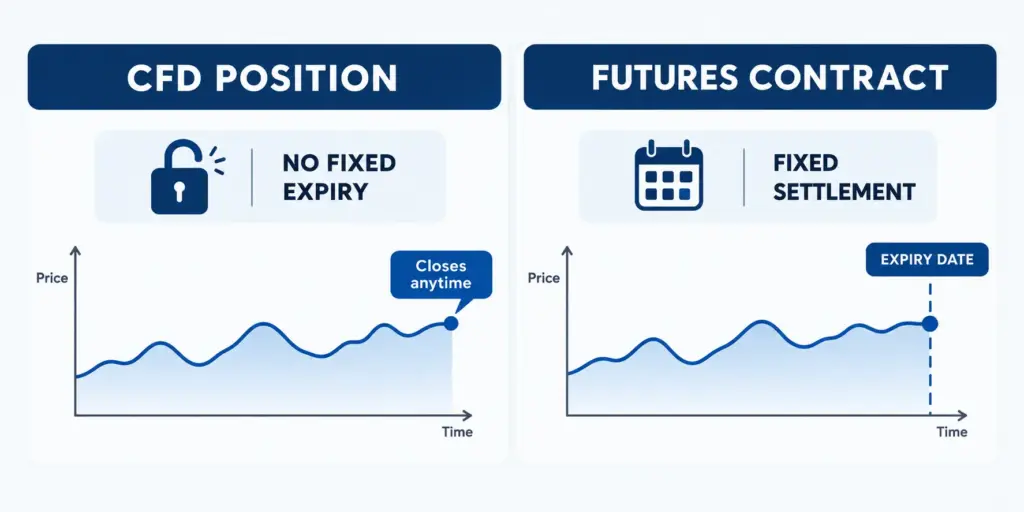
- How Do Expiry and Settlement Differ Between CFDs and Futures?
- Which Type of Investor Suits CFDs, and Which Suits Futures?
- What Are the Key Risks and Common Mistakes to Avoid?
- Conclusion: Choosing Between CFDs and Futures
- Frequently Asked Questions
What Is a CFD and What Is a Futures Contract?
A CFD (Contract for Difference) is an agreement with a broker to exchange the difference in an asset’s price between opening and closing a position, with no fixed expiry and no standardized contract size. A futures contract is a standardized agreement, traded on a regulated exchange, to buy or sell an underlying asset at a set price on a specific future date. Both are derivatives, meaning their value is derived from an underlying asset rather than the asset itself.
The word “derivative” simply means a financial contract whose price moves in relation to something else, such as a stock index, a currency pair, or a barrel of crude oil. Neither a CFD nor a futures contract typically results in the trader owning the underlying asset. Where they differ is in who sets the rules of the contract. A CFD’s terms are set by the broker offering it, while a futures contract’s terms, including contract size, tick value, and expiry, are standardized by the exchange that lists it.
This distinction matters more than it first appears. Because CFDs are not standardized, a broker can offer flexible position sizes and a broad menu of underlying markets from a single account. Because futures are standardized, they trade in known, comparable units across every participant on the exchange, which supports deep liquidity and transparent price discovery for institutional and retail investors alike.
How Does a CFD Actually Work?
A CFD position profits or loses money based purely on the difference between its opening and closing price, multiplied by position size, with no expiry forcing the trade to close. Because it is a leveraged product, both gains and losses are calculated against the margin deposited rather than the full notional value of the position. This is what allows CFDs to be traded on assets ranging from equities to commodities to currency pairs, often called spot FX when the underlying is a currency.
To illustrate the mechanics, consider a long position, which is one that profits when the price rises, and a short position, which profits when the price falls. If a trader opens a long CFD at a price of 72 and closes it once the price reaches 112, the gain is the difference between close and open, multiplied by the position size. A short position works in reverse: opening at 112 and closing at 32 produces the same size of gain, because the calculation is open minus close rather than close minus open.
Because a CFD has no fixed expiry, it can theoretically be held for as long as the trader wants, subject to margin requirements and any overnight financing charges. This flexibility is one of the main reasons CFDs appeal to investors who want exposure to a market without committing to a specific contract month. For a fuller walkthrough of CFD mechanics, including margin and leverage from first principles, see our detailed guide to what a CFD is and how it works.
How Does a Futures Contract Actually Work?
A futures contract obligates the buyer to purchase, and the seller to deliver or cash-settle, a standardized quantity of an underlying asset at an agreed price on a set future date. Profit or loss is measured against that agreed price as the market moves, and positions are marked to market daily, meaning gains and losses are credited or debited to the trading account at the end of each trading session rather than only when the position closes.
Every futures contract has a defined contract size, such as a set number of barrels of oil or units of a stock index, along with a specific expiry month. A trader who buys, or goes long, a futures contract at a current market price of 50 profits if the price rises above 50 by the contract’s expiry point, and loses if the price falls below 50 instead. Because the contract is standardized and exchange-traded, every participant is trading the exact same instrument, which keeps pricing transparent and liquidity concentrated.
This structure is why futures are often described as the more institutional of the two instruments, though retail investors can and do trade them through a regulated broker. Notional value, meaning the total value a contract controls, and open interest, meaning the number of contracts still open in the market, are two figures futures traders track closely to judge liquidity and market positioning. Our guide on the fundamentals of trading and hedging with futures contracts covers contract specifications in more depth.
Explore CFD Trading With PhillipCapital DIFC
Access equities, indices, commodities, and FX CFDs from a single regulated DIFC account.
How Do Margin, Leverage, and Costs Compare Between CFDs and Futures?
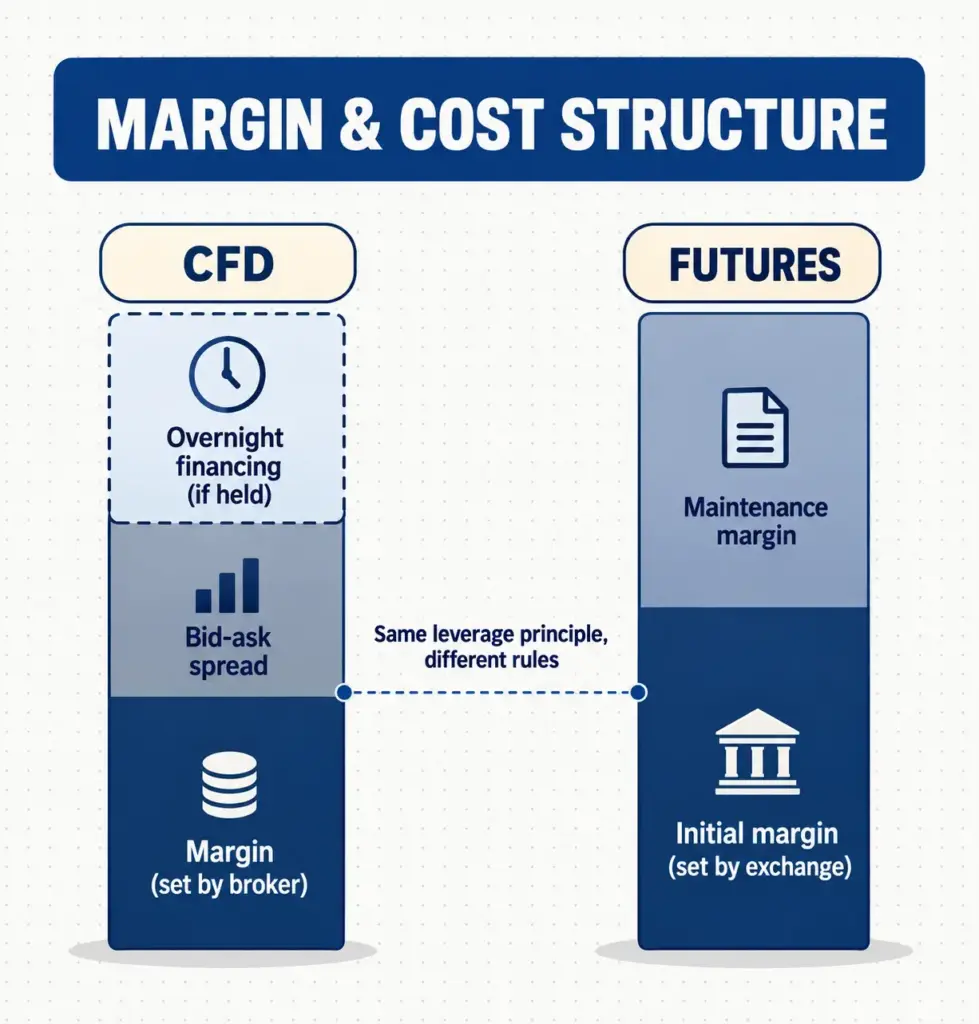
Both CFDs and futures are leveraged, meaning a trader deposits only a fraction of a position’s full value as margin, but the way margin is set and the way costs accumulate differ. CFD margin is typically set by the broker as a percentage of notional exposure, while futures margin is set by the exchange itself, split into an initial margin to open the position and a maintenance margin that must be preserved to keep it open.
Leverage magnifies both gains and losses in equal measure, which is why it is often described as a double-edged tool rather than a shortcut to profit. On a CFD, if a broker offers ten times leverage, a trader depositing a set amount of margin can control ten times that amount in market exposure. Futures leverage works on a similar principle, though the ratio is a function of the exchange-set margin requirement relative to the contract’s full notional value.
Cost structures diverge more visibly. CFD trading typically involves the bid-ask spread and, on positions held overnight, a financing charge sometimes called a swap rate, which reflects the cost of the leveraged exposure the broker is extending. Futures contracts are usually priced with costs built into the spread itself, with no separate overnight financing charge in most cases, since the price of carrying the position through to expiry is already embedded in the futures price relative to the spot price.
- Margin call risk applies to both instruments. If losses erode account equity below the maintenance level, the broker or exchange can require additional funds or reduce the position.
- Leverage ratios vary by asset class and client classification, so the exposure available on an index CFD will differ from that on a currency pair or an interest rate future.
- Position sizing should account for both margin and potential financing costs, particularly for CFD positions intended to be held for an extended period.
Investors should evaluate their own risk tolerance and cost sensitivity when weighing these structures, since neither leverage ratio nor cost structure is inherently better, only different in how the cost of exposure is charged over time.
Which Markets and Assets Can You Trade With Each Instrument?
CFDs generally offer broader single-account access across equities, indices, commodities, and currency pairs, while futures access is concentrated in standardized contracts on specific exchanges for commodities, indices, currencies, and interest rates. Both instruments allow a trader to go long or short, meaning the choice of market rather than the direction of the trade is usually what separates them.
The table below summarizes the core structural differences investors ask about most often when comparing the two instruments.
| Feature | CFDs | Futures Contracts |
|---|---|---|
| Contract structure | Non-standardized agreement between trader and broker | Standardized contract with fixed terms set by an exchange |
| Expiry | Typically no fixed expiry; positions can be held indefinitely | Fixed expiry date tied to a specific delivery or settlement month |
| Contract size | Flexible; brokers often allow fractional or custom position sizes | Standardized lot or contract size set by the exchange |
| Trading venue | Traded over-the-counter through a broker | Traded on a regulated futures exchange |
| Margin setting | Set by the broker as a percentage of notional exposure | Set by the exchange as initial and maintenance margin |
| Cost structure | Spread plus overnight financing charge on positions held past close | Usually built into the spread, with no separate financing charge in most cases |
| Settlement | Cash settled when the position is closed | Cash settled or physically delivered, depending on the contract |
| Market access | Broad range of asset classes from a single account | Access concentrated in standardized contracts by exchange and asset |
Retail investors exploring CFDs often start with major indices or currency pairs because of the tighter position sizing available, while futures traders, including institutional participants, gravitate toward standardized contracts where deep liquidity and transparent open interest data support larger positions. Neither market access model is superior in isolation; the right fit depends on the position size, holding period, and asset class an investor wants to trade.
Trade Futures Contracts Across Global Exchanges
Access standardized futures on indices, commodities, and interest rates through a single DIFC-regulated account.
How Do Expiry and Settlement Differ Between CFDs and Futures?
Futures contracts always carry a fixed expiry date and settle either through physical delivery of the underlying asset or in cash, while most CFDs have no expiry and simply settle in cash whenever the trader chooses to close the position. This single difference drives many of the practical decisions traders make about which instrument fits a given strategy.
Because a futures contract must expire, traders who want continued exposure past that date need to “roll” the position into the next contract month, which involves closing the expiring contract and opening a new one.
CFDs avoid this step entirely, since there is no contract month to roll out of, though the trade-off is the overnight financing charge that accumulates the longer a CFD position stays open. Our article on long and short positions in derivatives markets explains how direction and holding period interact across different derivative types.
Settlement style also differs by asset. A futures contract on a physical commodity may result in actual delivery if held to expiry, though most retail traders close out well before that point, while a futures contract on a stock index is typically cash-settled by design. CFDs, regardless of underlying asset, are structured to settle in cash only, since the trader never has a claim on the physical asset in the first place.
Which Type of Investor Suits CFDs, and Which Suits Futures?
CFDs tend to suit investors who want flexible position sizing, broad market access from one account, and no fixed contract expiry to manage, while futures tend to suit investors and institutions who value standardized contracts, deep exchange liquidity, and transparent daily mark-to-market settlement. Many active traders in the UAE use both instruments for different purposes within the same portfolio.
A retail investor exploring leveraged products for the first time may find the flexible sizing and single-account access of CFDs easier to start with, particularly across equities and currency pairs. A trader or institution running a specific hedging strategy, such as protecting a portfolio’s currency exposure or locking in a future commodity price, is more likely to reach for a standardized futures contract, since the fixed expiry and exchange-cleared structure suit longer-term risk management. Understanding initial and maintenance margin requirements is useful groundwork before trading either instrument, since both rely on the same underlying margin discipline.
Neither instrument is restricted to a single investor type in practice. Professional and institutional clients frequently use both CFDs and futures side by side, choosing whichever structure best matches the specific market, holding period, and cost profile of a given trade.
What Are the Key Risks and Common Mistakes to Avoid?
Both CFDs and futures are leveraged instruments, meaning losses can exceed initial expectations, and both carry margin call risk if a position moves against the trader without sufficient account equity. Beyond this shared leverage risk, each instrument carries a few risks specific to its structure that first-time traders frequently overlook.
- Underestimating overnight financing costs on CFDs. A position that looks profitable on price movement alone can be eroded by accumulated financing charges if held open for weeks rather than days.
- Forgetting to roll a futures position before expiry. Traders who intend to stay exposed past the contract’s expiry date need to actively manage the roll, or risk an unwanted settlement event.
- Misjudging position size relative to margin. Because leverage applies to both instruments, a position sized without regard to available margin can trigger a margin call sooner than expected.
- Assuming CFD and futures pricing on the same underlying will always match exactly. Futures prices reflect the cost of carrying a position to a future date, while CFD prices generally track the underlying market more directly, so small pricing differences are normal.
- Ignoring liquidity differences between contracts. Some futures contracts and CFD markets are far more liquid than others, and thinner liquidity can widen spreads and complicate exits during volatile periods.
Diversification, disciplined position sizing, and a clear understanding of each instrument’s cost structure remain the most effective ways investors manage these risks, regardless of which instrument they choose.
Ready to Start Trading With a Regulated DIFC Broker?
Speak with our team to find the account structure that fits your trading goals.
Conclusion: Choosing Between CFDs and Futures
CFDs and futures contracts both give investors leveraged exposure to price movements without owning the underlying asset, but they arrive at that exposure through very different structures. CFDs offer flexible sizing, broad market access, and no fixed expiry, in exchange for overnight financing costs on positions held open. Futures offer standardized, exchange-cleared contracts with deep liquidity and transparent daily settlement, in exchange for a fixed expiry that eventually requires the position to be closed or rolled.
Investors should evaluate their own holding period, preferred markets, and comfort with each cost structure before choosing between the two, and many experienced traders use both instruments for different parts of the same overall strategy. Understanding these mechanics thoroughly, rather than choosing based on leverage ratios alone, is the foundation of sound risk management in either market.
Frequently Asked Questions (FAQs)
Is a CFD the same as a futures contract?
No. A CFD is a non-standardized agreement with a broker that has no fixed expiry, while a futures contract is a standardized, exchange-traded agreement with a set expiry date. Both are derivatives and both use leverage, but their contract structures and settlement rules differ significantly.
Which is riskier, CFD trading or futures trading?
Both carry significant leverage risk, and neither is inherently riskier than the other in isolation. The relevant risks differ by structure, with CFDs carrying overnight financing cost risk and futures carrying expiry and roll risk, so the right comparison depends on the specific position and holding period.
Do CFDs have an expiry date like futures contracts do?
Most CFDs have no fixed expiry and can be held open indefinitely, subject to margin requirements and overnight financing charges. Futures contracts always have a fixed expiry date tied to a specific settlement month set by the exchange.
Can retail investors in the UAE trade futures contracts?
Yes, retail investors can trade futures contracts through a broker regulated by the Dubai Financial Services Authority, provided they meet the broker’s account and margin requirements. Retail clients should carefully review the specific contract specifications and margin rules before trading, since these vary by exchange and asset class.
Disclaimer:
Trading foreign exchange and/or contracts for difference on margin carries a high level of risk, and may not be suitable for all investors as you could sustain losses in excess of deposits. The products are intended for retail, professional and eligible counterparty clients. Before deciding to trade any products offered by PhillipCapital (DIFC) Private Limited you should carefully consider your objectives, financial situation, needs and level of experience. You should be aware of all the risks associated with trading on margin. The content of the Website must not be construed as personal advice. For retail, professional and eligible counterparty clients. Before deciding to trade any products offered by PhillipCapital (DIFC) Private Limited you should carefully consider your objectives, financial situation, needs and level of experience. You should be aware of all the risks associated with trading on margin.
Rolling Spot Contracts and CFDs are complex instruments and come with a high risk of losing money rapidly due to leverage. 78% of our retail client accounts lose money while trading with us. You should consider whether you understand how Rolling Spot Contracts and CFDs work, and whether you can afford to take the high risk of losing your money.


Real Effective Exchange Rates
Real Effective Exchange Rates Understanding Real Effective Exchange Rates (REER):...
Read More
Purchasing Power Parity (PPP)
Purchasing Power Parity (PPP) Introduction For investors navigating international markets...
Read More

Currency Carry Trade
Currency Carry Trade Unlocking Global Yields: The Definitive Guide to...
Read More
Cross Currency Pairs Explained
Cross Currency Pairs A Guide for Investors Introduction The foreign...
Read More
Direct and Indirect Quotes
Direct vs. Indirect Quotes Demystifying Direct and Indirect Quotes in...
Read More

Understanding Exchange Rates
Understanding Exchange Rates In an increasingly interconnected global economy, the...
Read More

Base Currency vs Quote Currency
Base Currency vs Quote Currency Table of Contents What is...
Read More
Minor and Exotic Currency Pairs
Minor and Exotic Currency Pairs A Trader’s Guide to Global...
Read More

Forex Market Structure and Hours
Forex Market Structure and Hours Introduction The foreign exchange market...
Read More
What is Spot FX Trading and How Does It Work?
Decoding the Market What is Spot FX Trading and How...
Read More
Introduction to the Forex Market
Introduction to the Forex Market Your Gateway to Global Currency...
Read More