Bonds: Face Value, Par Value & Coupon Rate When venturing...
Read MoreForex Market Structure and Hours
The Complete Guide for UAE Traders
The foreign exchange market is unique. Unlike the Dubai Financial Market (DFM) or the New York Stock Exchange (NYSE), it has no central physical location. It is a decentralized, global network that never truly sleeps during the working week. For traders in the UAE, understanding this structure and aligning your schedule with global liquidity centers is the first step toward disciplined trading.
In this guide, we break down the invisible architecture of the forex market and map out exactly when you should be watching the charts from your desk in Dubai.
How is the Forex Market Structured compared to the Stock Market?
The structure of the forex market is often described as “decentralized” or “Over-the-Counter” (OTC). In a traditional stock market, there is a centralized exchange (like the Nasdaq) that acts as the middleman for all transactions, ensuring a standardized price.
In Forex, the “exchange” is a tiered network of participants connected electronically.
- The Top Tier (Interbank Market): This consists of the world’s largest banks (like Citi, Deutsche Bank, Barclays) trading directly with each other. They determine the raw exchange rates.
- The Middle Tier: This includes hedge funds, commercial companies dealing in import/export, and retail market makers.
- The Retail Tier: This is where individual traders operate. You trade through a broker—like PhillipCapital DIFC—who provides you access to the interbank liquidity.
Because there is no central exchange, the market relies on this network to function 24 hours a day. Prices may vary slightly from broker to broker, which is why choosing a broker with deep liquidity providers is crucial for getting tight spreads.
Looking for institutional-grade access to this market structure?
Explore our Forex Trading Accounts and access global liquidity.


What are the Key Forex Trading Sessions in UAE Time?
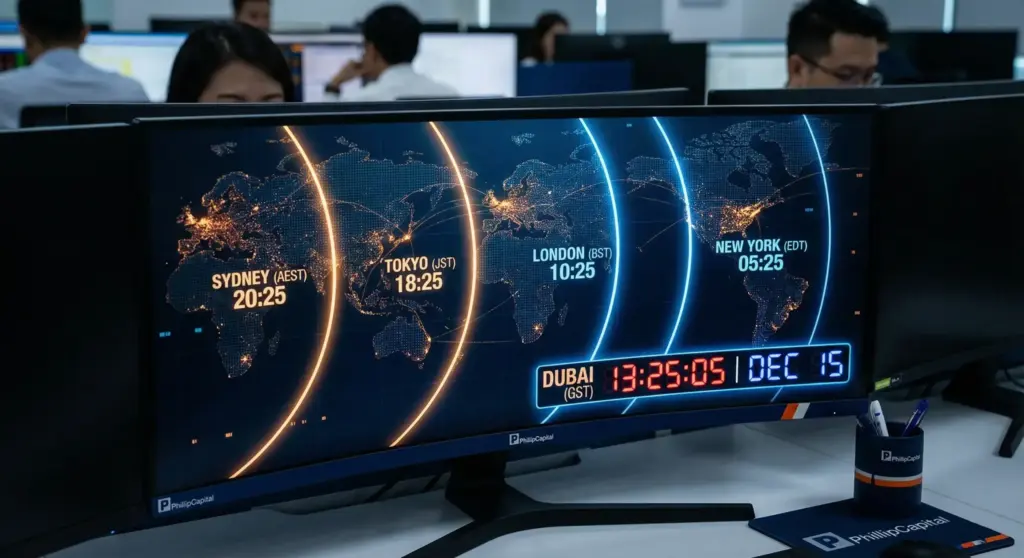
Since the market follows the sun, it cycles through four major financial hubs. For a trader based in Dubai (Gulf Standard Time), the schedule is incredibly convenient because the UAE is geographically positioned between the East and West.
Here is the breakdown of the major sessions in UAE time (approximate, subject to Daylight Savings changes):
- Sydney Session: Opens approx. 1:00 AM – Closes 10:00 AM (UAE Time). This is the start of the trading day. Volatility is generally lower here, with a focus on AUD and NZD pairs.
- Tokyo Session: Opens approx. 3:00 AM – Closes 12:00 PM (UAE Time). The Asian session picks up momentum. JPY pairs see the most action here.
- London Session: Opens approx. 11:00 AM – Closes 8:00 PM (UAE Time). This is the heavyweight session. London is the financial capital of the forex world, handling roughly 43% of all global transactions. Trends often begin here.
- New York Session: Opens approx. 4:00 PM – Closes 1:00 AM (UAE Time). The US dollar is involved in 90% of all trades, making this a highly volatile and liquid session.
Why is the market open 24/5, and does it ever close?
The market stays open 24 hours a day during the week because as one financial hub closes, another opens. However, it does close for the weekend.
- Market Open: Monday morning in New Zealand (which is roughly roughly roughly Sunday late night/Monday early morning in Dubai).
- Market Close: Friday afternoon in New York (which is roughly Saturday very early morning in Dubai).
It is important to note that while you can trade at 3:00 AM on a Tuesday in Dubai, liquidity might be thinner compared to the afternoon. Thin liquidity can sometimes lead to “slippage” or wider spreads, which is why understanding market structure is vital for risk management.


How do Public Holidays affect the Market Structure?
Since the market is decentralized, a public holiday in the UAE does not stop the global forex market. However, if it is a bank holiday in London (UK) or New York (USA), liquidity will drop drastically, and the market may become “rangy” (moving sideways).
Conversely, if it is a holiday in Japan but not in Europe, the JPY pairs might be quiet, but the EUR and GBP pairs will trade normally. A smart trader checks the economic calendar daily to see which centers are offline.
Does PhillipCapital DIFC offer access to all these sessions?
Yes. As a broker regulated by the DFSA (Dubai Financial Services Authority), PhillipCapital DIFC provides you with the infrastructure to trade major, minor, and exotic currency pairs 24 hours a day, 5 days a week. Whether you are an early riser trading the Tokyo breakout or an evening trader focusing on the US heavy hitters, our servers are connected to the global grid.
We combine this global access with local security. Your funds are segregated, and you are trading with a broker that has a physical presence right here in the Dubai International Financial Centre.
Ready to Trade Forex with Confidence?
Apply your knowledge of market structure and trading hours—open your live account and start trading today.


Disclaimer:
Trading foreign exchange and/or contracts for difference on margin carries a high level of risk, and may not be suitable for all investors as you could sustain losses in excess of deposits. The products are intended for retail, professional and eligible counterparty clients. Before deciding to trade any products offered by PhillipCapital (DIFC) Private Limited you should carefully consider your objectives, financial situation, needs and level of experience. You should be aware of all the risks associated with trading on margin. The content of the Website must not be construed as personal advice. For retail, professional and eligible counterparty clients. Before deciding to trade any products offered by PhillipCapital (DIFC) Private Limited you should carefully consider your objectives, financial situation, needs and level of experience. You should be aware of all the risks associated with trading on margin.
Rolling Spot Contracts and CFDs are complex instruments and come with a high risk of losing money rapidly due to leverage. 78% of our retail client accounts lose money while trading with us. You should consider whether you understand how Rolling Spot Contracts and CFDs work, and whether you can afford to take the high risk of losing your money.
Growth Investing
Growth Investing The High-Risk, High-Reward Strategy for UAE Investors Growth...
Read MoreComponents of Structured Products
Components of Structured Products A Detailed Guide for UAE Investors...
Read MoreInitial Public Offering Process guide
IPO (Initial Public Offering) Process From Private to Public In...
Read MoreForex Market Structure and Hours
Forex Market Structure and Hours The Complete Guide for UAE...
Read MoreTypes of Derivatives: Futures, Options, Swaps, and Forwards
Types of Derivatives Futures, Options, Swaps, and Forwards In the...
Read MoreBond Issuers Government vs Corporate Bonds
Bond Issuers Government vs Corporate Bonds What UAE Investors Need...
Read MoreWhat Are Equities and Shares
Demystifying the Market What Are Equities and Shares? The world...
Read MoreWhat is Spot FX Trading and How Does It Work?
Decoding the Market What is Spot FX Trading and How...
Read MoreWhat are Derivatives and Their Purpose
What are Derivatives and Their Purpose The financial world is...
Read MoreIntroduction to Stock Markets
Master the Basics: An Introduction to Stock Markets and Deliverable...
Read MoreIntroduction to the Forex Market
Introduction to the Forex Market : Your Gateway to Global...
Read MoreEssentials of Derivatives Trading
Mastering Market Moves: The Essentials of Derivatives Trading The financial...
Read MoreUnderstanding Bond Fundamentals: A Guide for Smart Investing
Understanding Bond Fundamentals: A Guide for Smart Investing In the...
Read More