Price-to-Book Ratio (P/B)

The Essential Guide for Identifying Undervalued Stocks

3D isometric infographic of a balance scale weighing a golden coin representing Market Price against a stack of accounting ledgers representing Book Value.

What Is the Price-to-Book Ratio (P/B) and How Is It Calculated?

The Price-to-Book Ratio (P/B) is a fundamental valuation metric used by investors to compare a company’s current market value to its book value. In essence, it tells you how much the equity market is willing to pay for each dollar of a company’s net assets. For value investors, the P/B ratio is a primary tool for spotting potential bargains in the global equity markets.

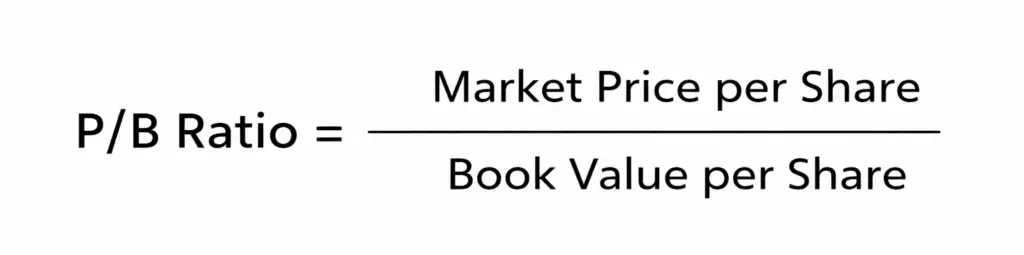
To understand this metric deeply, one must look at its two components:

  • Market Price per Share: The current trading price of the stock on an exchange.
  • Book Value per Share (BVPS): The theoretical value of shareholders’ equity if all assets were sold and liabilities paid off.

The Formula:

Alternatively, it can be calculated by dividing the company’s total Market Capitalization by its total Book Value (Total Assets minus Total Liabilities).

For investors analyzing Global Equities (Non-US), this ratio provides a “reality check” against market hype. It anchors the stock price to tangible balance sheet data rather than just future earnings projections, which can be volatile.

What Does a High vs. Low P/B Ratio Tell Investors?

Interpreting the P/B ratio requires context, as “good” or “bad” values often depend on the specific industry and market conditions.

What does a P/B ratio of less than 1.0 mean?

A P/B ratio under 1.0 often suggests that the market believes the company’s assets are undervalued, or that the business is earning a very poor return on its assets (ROA). For value investors, this is the “sweet spot” for investigation. It could indicate that if the company were liquidated today, shareholders might receive more than the current share price. However, investors must be cautious of “value traps”—companies facing fundamental issues like potential bankruptcy or declining industries.

What does a P/B ratio greater than 3.0 mean?

A higher P/B ratio typically indicates that investors expect high future growth and are willing to pay a premium for the company’s earnings potential. This is common in asset-light industries where the primary value comes from intellectual property rather than physical machinery.

Key Insight: When trading Deliverable Equity – US Stocks, you will often see widely varying P/B ratios. A software company might trade at 10x book value, while a manufacturing firm trades at 1.5x. Understanding these sector norms is vital for accurate valuation.

Start Building Your Value Portfolio

Access global markets and identify undervalued opportunities today

Why Is the P/B Ratio Critical for Banking and Financial Stocks?

The Price-to-Book ratio is arguably the most important valuation metric for the financial services sector, including banks, insurance companies, and investment firms.

Unlike technology or service companies, financial institutions hold assets that are marked to market (valued at current market prices) and are highly liquid. Their balance sheets consist primarily of cash, bonds, and loans, which makes their “Book Value” an extremely accurate representation of their tangible worth.

Ultra-realistic balance scale comparing financial assets and book value inside a modern institutional banking environment
  • Asset Quality: For banks, a P/B ratio significantly below 1.0 might signal that the market doubts the quality of the bank’s loan portfolio (i.e., fears of non-performing loans).
  • Return on Equity (ROE): There is a strong correlation between a bank’s P/B ratio and its ROE. Banks that generate higher returns on shareholder capital typically command higher P/B multiples.

For clients interested in GCC Stocks, where the banking sector is a dominant heavyweight, mastering the P/B ratio is essential for making informed decisions. It allows you to quickly compare the relative valuations of major regional banks against their net asset values.

Why Is the P/B Ratio Critical for Banking and Financial Stocks?

  • While both metrics are staples of fundamental analysis, they serve different purposes and answer different questions for the investor.

    • P/B Ratio (Balance Sheet Focus): Focuses on what the company owns. It is a measure of solvency and asset value. It is more stable because book value is cumulative and less volatile than quarterly earnings. It is best used for capital-intensive businesses (manufacturing, energy, finance).
    • P/E Ratio (Income Statement Focus): Focuses on what the company earns. It measures how much you are paying for every dollar of profit. It is highly sensitive to economic cycles and one-off accounting charges.

    When to use which? If you are evaluating a distressed company with negative earnings, the P/E ratio is useless (undefined). In this scenario, the P/B ratio becomes your primary guide to valuation, helping you assess if the stock is trading below its liquidation value.

    For a balanced portfolio, sophisticated investors often use Wealth Management & Structured Notes strategies that consider both asset protection (P/B focus) and earnings growth (P/E focus).

What Are the Limitations of Using P/B Ratio in Tech and Service Sectors?

  • The greatest limitation of the P/B ratio in the modern economy is its inability to account for intangible assets.

    In the digital age, companies like Alphabet (Google), Apple, or Microsoft derive the vast majority of their value from things that do not appear on the balance sheet in the same way a factory does:

    • Brand equity
    • Proprietary software and code
    • Patents and intellectual property
    • Human capital and R&D

    Because standard accounting principles (like GAAP or IFRS) often expense R&D costs rather than capitalizing them, the “Book Value” of a tech company is frequently understated. Consequently, their P/B ratios can appear astronomically high (e.g., 20x or 50x).

    If you are asking, “Is a high P/B ratio bad for tech stocks?” the answer is usually no. For these sectors, metrics like Price-to-Sales (P/S) or Enterprise Value-to-EBITDA are often more appropriate. Investors utilizing our Futures & Options platforms to hedge tech exposure should be wary of relying solely on P/B for valuation.

Refine Your Trading Strategy

Get expert insights and advanced tools for technical and fundamental analysis.

Conclusion: Integrating P/B into Your Investment Strategy

The Price-to-Book (P/B) ratio remains a cornerstone of value investing, offering a clear view of how the market values a company’s tangible assets. It is an indispensable tool for analyzing capital-intensive sectors like banking, real estate, and energy—key components of the GCC and global markets.

However, “Price-to-Book” should never be used in isolation. A robust investment strategy combines P/B with other metrics like Return on Equity (ROE) and Debt-to-Equity ratios to filter out value traps and identify genuine opportunities.

At PhillipCapital DIFC, we provide the multi-asset access and research tools necessary to apply these fundamental metrics effectively. Whether you are trading Indian Equity, Global Bonds, or CFDs, understanding the underlying value of your assets is the first step toward long-term wealth preservation and growth.

Frequently Asked Questions (FAQs)

Can a company have a negative P/B ratio?

Yes, this happens when a company’s liabilities exceed its assets, resulting in “negative shareholder equity.” This is often a red flag indicating financial distress or insolvency. However, it can sometimes occur in companies that have aggressively bought back their own shares (treasury stock), temporarily distorting the balance sheet.

Is the P/B ratio useful for analyzing tech stocks?

Generally, no. The P/B ratio is less effective for technology companies because their primary value lies in intangible assets like software, patents, and brand power, which are not always fully captured in the “Book Value.” For these sectors, investors often prefer using the Price-to-Earnings (P/E) or Price-to-Sales (P/S) ratios.

What is considered a "good" Price-to-Book ratio?

Traditionally, a P/B ratio under 1.0 is considered “good” by value investors, as it suggests you are paying less than the net asset value of the company. However, “good” is relative; a P/B of 3.0 might be excellent for a high-growth software firm, while a P/B of 0.8 could be expensive for a declining manufacturing business. Always compare the ratio against the industry average.

Does a P/B ratio under 1.0 always mean the stock is a bargain?

Not necessarily. While it can indicate an undervalued gem, it can also signal a “value trap”—a company with fundamental problems, declining assets, or looming litigation that the market has correctly priced down. Investors should always verify why the price is so low before buying.

Disclaimer:

Trading foreign exchange and/or contracts for difference on margin carries a high level of risk, and may not be suitable for all investors as you could sustain losses in excess of deposits. The products are intended for retail, professional and eligible counterparty clients. Before deciding to trade any products offered by PhillipCapital (DIFC) Private Limited you should carefully consider your objectives, financial situation, needs and level of experience. You should be aware of all the risks associated with trading on margin. The content of the Website must not be construed as personal advice. For retail, professional and eligible counterparty clients. Before deciding to trade any products offered by PhillipCapital (DIFC) Private Limited you should carefully consider your objectives, financial situation, needs and level of experience. You should be aware of all the risks associated with trading on margin.

Rolling Spot Contracts and CFDs are complex instruments and come with a high risk of losing money rapidly due to leverage. 78% of our retail client accounts lose money while trading with us. You should consider whether you understand how Rolling Spot Contracts and CFDs work, and whether you can afford to take the high risk of losing your money.