Sector Rotation

A Strategic Guide to Investing Through Economic Cycles

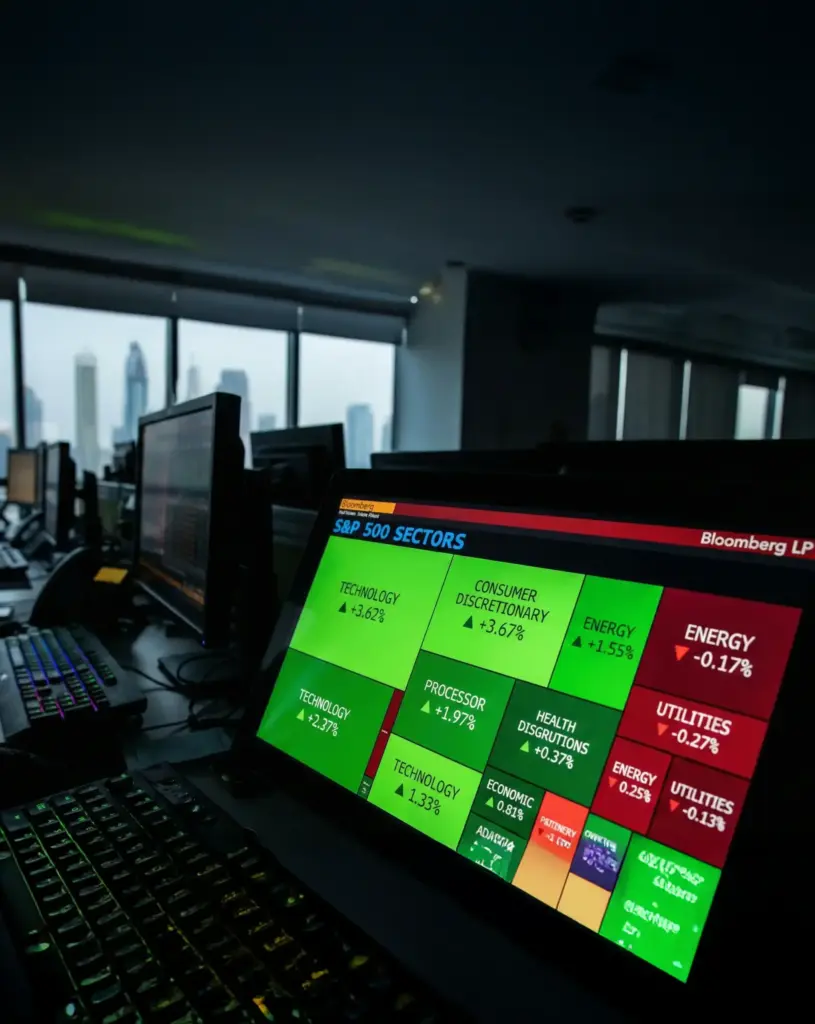
Close-up view of a Bloomberg terminal screen displaying a vibrant green and red heat map of S&P 500 sectors in a dim trading room.

What is Sector Rotation and why is it a critical strategy for professional investors?

Sector rotation is an active investment strategy that involves moving capital from one industry sector to another in anticipation of the next stage of the economic cycle. Unlike a passive “buy and hold” strategy, sector rotation assumes that the economy moves in predictable patterns—and that specific sectors perform better during different phases of those patterns.

For investors utilizing global market access, the primary objective is to capture “alpha”—excess returns above a benchmark—by overweighting sectors expected to outperform and underweighting those expected to lag. For instance, holding high-growth technology stocks during an economic boom and shifting toward defensive utilities during a slowdown.

This strategy requires a “top-down” approach. Investors must first analyze macroeconomic indicators—such as interest rates, inflation data, and GDP growth—before selecting individual equities. By leveraging the research and analysis available through sophisticated trading platforms, investors can identify which sectors are gaining momentum and which are losing steam, allowing for more dynamic portfolio management.

How does the Economic Business Cycle dictate market performance?

The premise of sector rotation relies heavily on the four distinct stages of the business cycle. Understanding where the global economy sits within this cycle is paramount for successful execution.

The Early Cycle (Recovery)

The early cycle marks the turnaround from a recession. Economic activity picks up, credit conditions loosen, and consumer confidence begins to rebound. Historically, this is often the most robust phase for equity performance.

During this phase, interest rates are typically low, encouraging borrowing and expansion. Investors often find that Consumer Discretionary and Financials outperform, as banks benefit from increased lending and consumers return to spending on non-essential goods.

The Mid Cycle (Expansion)

This is typically the longest phase of the business cycle. Growth is consistent, but the explosive momentum of the recovery phase stabilizes. The economy is healthy, but inflation may start creeping up, prompting central banks to consider tightening monetary policy.

In this environment, market leadership often shifts toward Information Technology and Industrials. These sectors thrive on consistent corporate spending and global demand. Investors utilizing Contracts for Difference (CFDs) can effectively trade the volatility that often accompanies the transition from early to mid-cycle.

The Late Cycle (Moderation)

As the economy overheats, inflation pressures rise, and growth rates slow. Central banks usually raise interest rates to cool the economy, which tightens liquidity.

This environment favors inflation-sensitive sectors. Energy and Materials often outperform here, as commodity prices tend to peak late in the cycle. Conversely, high-valuation growth stocks may suffer as the cost of capital increases.

The Recession Phase (Contraction)

Economic activity shrinks, corporate profits decline, and the market often enters a bearish trend. The goal here is capital preservation.

Investors typically flock to “defensive” sectors—industries that provide essential services regardless of the economic climate. Consumer Staples, Health Care, and Utilities become the safe havens of choice. Because demand for food, medicine, and electricity remains constant, these sectors tend to offer dividends and stability when the broader market falls.

Align Your Portfolio with Market Cycles

Access global exchanges and trade diverse sectors with Phillip Capital’s advanced platforms.

What are the most effective instruments for executing Sector Rotation?

Executing a sector rotation strategy requires instruments that offer liquidity, low transaction costs, and broad exposure.

  1. Exchange Traded Funds (ETFs): For most investors, ETFs are the primary vehicle for sector rotation. Rather than buying 20 different utility companies, an investor can purchase a single Utilities Select Sector ETF. This provides instant diversification within the specific sector.
  2. Individual Equities: For those seeking higher potential returns, selecting top-performing stocks within a favored sector is a viable approach. This requires deeper fundamental analysis but allows for greater precision.
  3. Futures and Options: Sophisticated investors often use Futures to hedge exposure or bet on the direction of a sector index without owning the underlying assets. This is particularly useful during the recession phase to hedge against downside risk.
  4. CFDs (Contracts for Difference): CFDs allow traders to speculate on the price movements of sector indices or specific stocks without owning the asset. This is crucial for sector rotation because it allows for short-selling. If an investor believes the Tech sector is overvalued, they can short a Tech CFD to profit from the decline.

Investors trading through Phillip Capital DIFC gain access to these diverse asset classes, ensuring they have the right tools to execute a rotation strategy efficiently across US, Asian, and European markets.

Trade Global ETFs and CFDs

Get competitive spreads and institutional-grade execution on sector-specific instruments

How can investors mitigate the specific risks associated with Sector Rotation?

While sector rotation offers the potential for significant returns, it is an active strategy that carries inherent risks, primarily centered around timing and transaction costs.

  • Timing Risk: The market looks forward, while economic data looks backward. If an investor waits for official GDP data to confirm a recession, the market may have already priced it in. Successful rotation requires analyzing leading indicators.
  • False Signals: Economic cycles do not always follow a smooth sine wave. A “soft landing” (where the economy slows but avoids recession) can catch defensive investors off guard as growth stocks rally unexpectedly.
  • Transaction Costs: unlike a buy-and-hold strategy, frequent rotation incurs trading fees and spreads. It is vital to use a broker that offers competitive pricing structures to ensure that transaction costs do not erode the alpha generated by the strategy.
  • Over-concentration: Shifting too heavily into a single sector violates the principles of diversification. Even if the macro analysis is correct, a regulatory change or natural disaster could impact that specific sector negatively.

To manage these risks, investors should maintain a core portfolio of diversified assets while using a satellite portion of their capital for sector rotation. Additionally, utilizing risk management tools such as stop-loss orders is essential when trading volatile sector shifts.

Frequently Asked Questions (FAQs)

Does sector rotation actually beat a "buy and hold" strategy?

It can, but it requires active management. While “buy and hold” matches the market’s average return, sector rotation aims to exceed it (generate alpha) by avoiding losing sectors. However, it carries higher risks due to potential timing errors and increased transaction costs compared to passive investing.

How often should I rotate my portfolio?

There is no fixed schedule (e.g., monthly or weekly). Instead, rotation should be event-driven based on shifts in economic data—such as changes in interest rates, inflation reports, or GDP growth. Most professional investors review their sector allocation quarterly or when a major macroeconomic shift occurs.

Which sectors are considered the safest during a market crash?

During recessions or crashes, investors flock to “Defensive” sectors—specifically Utilities, Consumer Staples, and Healthcare. These industries provide essential services (electricity, food, medicine) that people need regardless of the economy, making their stock prices more stable when the broader market falls.

A financial advisor's hand places a golden king chess piece on a strategic asset allocation graph on a desk with a city view.

Start Trading with PhillipCapital DIFC

Open Your Account Today

Conclusion

Sector rotation is a powerful strategy that allows investors to navigate the complexities of the global economy rather than being passive victims of market volatility. By understanding the interplay between the business cycle and market performance, traders can position their portfolios to capitalize on growth during expansions and preserve capital during contractions.

However, success requires discipline, access to real-time macroeconomic data, and a robust trading infrastructure. Whether you are using ETFs to capture broad trends or CFDs to tactically short fading sectors, the key lies in staying ahead of the curve.

For investors looking to implement sophisticated strategies like sector rotation, Phillip Capital DIFC provides the necessary ecosystem—from institutional-grade platforms to diverse global market access—to turn economic insights into actionable trading decisions.

Disclaimer:

Trading foreign exchange and/or contracts for difference on margin carries a high level of risk, and may not be suitable for all investors as you could sustain losses in excess of deposits. The products are intended for retail, professional and eligible counterparty clients. Before deciding to trade any products offered by PhillipCapital (DIFC) Private Limited you should carefully consider your objectives, financial situation, needs and level of experience. You should be aware of all the risks associated with trading on margin. The content of the Website must not be construed as personal advice. For retail, professional and eligible counterparty clients. Before deciding to trade any products offered by PhillipCapital (DIFC) Private Limited you should carefully consider your objectives, financial situation, needs and level of experience. You should be aware of all the risks associated with trading on margin.

Rolling Spot Contracts and CFDs are complex instruments and come with a high risk of losing money rapidly due to leverage. 78% of our retail client accounts lose money while trading with us. You should consider whether you understand how Rolling Spot Contracts and CFDs work, and whether you can afford to take the high risk of losing your money.