Bond Yield to Maturity (YTM): Understanding Bond Yield to Maturity...
Read MoreStock Valuation Methods
A Comprehensive Guide to Estimating Fair Value
Table of Contents
- Unlocking the True Worth of Your Investments
- What exactly is stock valuation, and why is it critical for investors?
- What is the difference between Absolute and Relative valuation methods?
- How does the Discounted Cash Flow (DCF) model work?
- What are the most reliable Relative Valuation ratios?
- Is there a specific method for valuing dividend-paying stocks?
- How do I choose the right valuation method for my trade?
- Can valuation methods be applied to other assets like Futures or Options?
Unlocking the True Worth of Your Investments
In the dynamic world of financial markets, the difference between price and value is the cornerstone of successful investing. Whether you are eyeing high-growth tech giants in the US markets or stable dividend-paying companies in the GCC region, understanding stock valuation methods is essential. It transforms you from a speculator into an informed investor.
At PhillipCapital DIFC, we believe that empowering our clients with deep market knowledge is as important as providing a robust trading platform. Below, we answer the most critical questions regarding how to value stocks effectively.

What exactly is stock valuation, and why is it critical for investors?
Stock valuation is the process of determining the intrinsic value (or “fair value”) of a company’s share. It is the financial detective work that tells you what a stock is actually worth, regardless of its current price on the ticker.
The market price of a stock is driven by supply and demand, news cycles, and investor sentiment. Often, this price deviates significantly from the company’s fundamental health.
- Undervalued: If the calculated intrinsic value is higher than the current market price, the stock may be a buying opportunity.
- Overvalued: If the market price is higher than the intrinsic value, it might be time to sell or avoid the asset.
For investors trading Global Stocks or Deliverable Equities through PhillipCapital DIFC, mastering valuation helps in building a portfolio that can withstand market volatility. It anchors your decisions in data rather than emotion, ensuring you don’t overpay for hype.
What is the difference between Absolute and Relative valuation methods?
Valuation strategies generally fall into two primary categories: Absolute and Relative. Understanding the distinction is vital for applying the right tool to the right asset.
- Absolute Valuation: This approach attempts to find a company’s intrinsic value based solely on its own fundamentals—specifically its cash flows, dividends, and growth rates. It does not worry about how other companies are performing. The most common model here is the Discounted Cash Flow (DCF) analysis. It is purely data-driven and focuses on the “present value” of the money the company will generate in the future.
- Relative Valuation: This method compares a company’s value to its competitors or industry peers. It asks, “Is this bank cheap compared to other banks in the UAE?” Investors use ratios/multiples like the Price-to-Earnings (P/E) or Price-to-Book (P/B) ratio to gauge value. This is faster and often more useful for short-term trading or when comparing stocks within the same sector, such as GCC Stocks or US Tech ETFs.
How does the Discounted Cash Flow (DCF) model work?
The Discounted Cash Flow (DCF) model is arguably the gold standard for absolute valuation. It operates on the principle that the value of a company today is the sum of all the cash it will generate in the future, discounted back to today’s dollars.
- Forecasting Free Cash Flow (FCF): An analyst projects the company’s revenue, expenses, and capital expenditures for the next 5 to 10 years to determine how much cash will be left over for shareholders.
- The Discount Rate: Future money is worth less than current money due to inflation and opportunity cost. We apply a discount rate (often the Weighted Average Cost of Capital, or WACC) to these future cash flows.
- Terminal Value: Since companies theoretically last forever, a “terminal value” is calculated to account for all cash flows beyond the forecast period.
While powerful, DCF is sensitive. A small change in your growth assumptions or discount rate can drastically change the final valuation. It is best used for stable, mature companies with predictable cash flows.
Ready to Apply These Strategies?
Access over 1 million stocks across global exchanges with a regulated broker.


What are the most reliable Relative Valuation ratios?
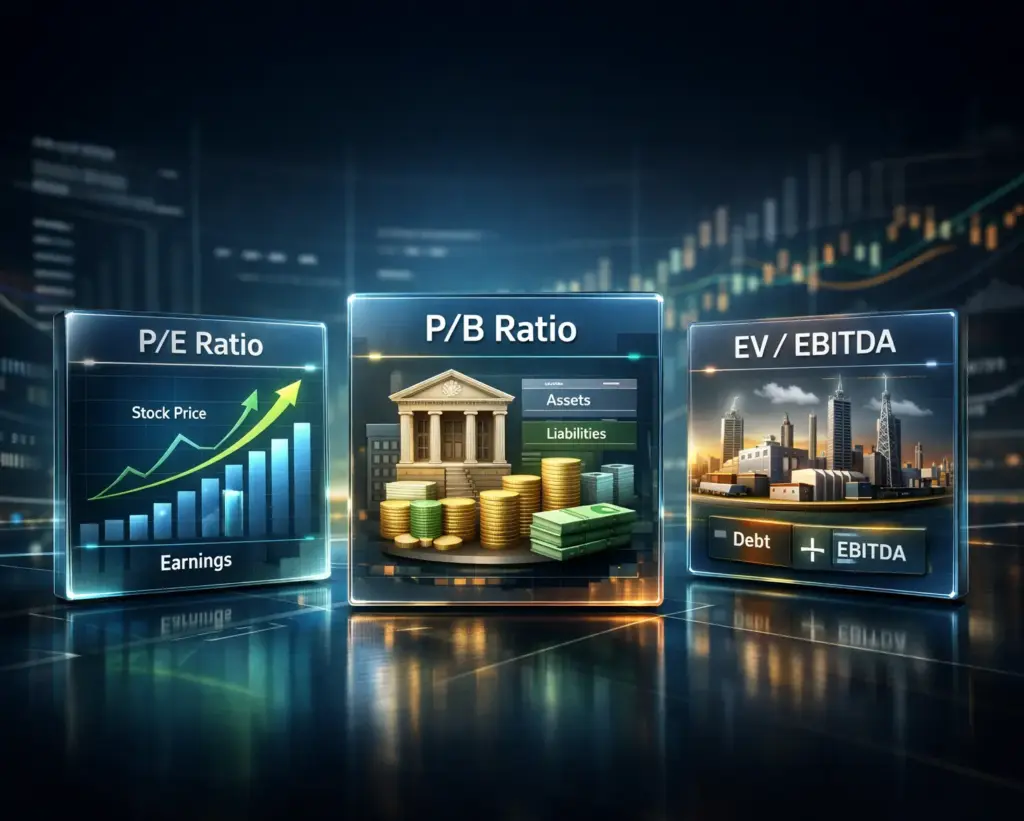
Relative valuation relies on “multiples.” Here are the three most widely used ratios for comparing stocks:
- Price-to-Earnings (P/E) Ratio: Calculated by dividing the share price by the Earnings Per Share (EPS). It tells you how much you are paying for every $1 of earnings. A high P/E usually suggests high growth expectations (common in US Tech stocks), while a low P/E might indicate a value bargain or a struggling company.
- Price-to-Book (P/B) Ratio: This compares the market value to the company’s book value (assets minus liabilities). It is exceptionally useful for valuing financial institutions and banks, which are prominent in the GCC Markets. A P/B under 1.0 can imply the stock is trading for less than the value of its assets.
- Enterprise Value-to-EBITDA (EV/EBITDA): This looks at the entire value of the firm (including debt) relative to its earnings before interest, taxes, depreciation, and amortization. It is often used for companies with heavy debt loads or large infrastructure assets, allowing for a cleaner comparison than the P/E ratio

Is there a specific method for valuing dividend-paying stocks?
Yes, for investors focused on income—such as those holding blue-chip stocks in our Wealth Management portfolios—the Dividend Discount Model (DDM) is highly effective.
The DDM (specifically the Gordon Growth Model) assumes that a stock is worth the sum of all its future dividend payments, discounted back to their present value.
- Formula: Value = Expected Dividend / (Required Rate of Return – Dividend Growth Rate).
This method is ideal for stable utility companies, REITs (Real Estate Investment Trusts), or established banks that have a long history of consistent dividend payouts. However, it is ineffective for high-growth tech companies that reinvest their profits rather than paying dividends.
How do I choose the right valuation method for my trade?
The “best” method depends entirely on the type of company and your investment horizon.
- For High-Growth Startups (e.g., AI or Tech): Traditional P/E ratios may be meaningless if the company isn’t profitable yet. Instead, look at Price-to-Sales (P/S) ratios or customer growth metrics.
- For Mature Industrial Firms: The DCF model or EV/EBITDA ratio is robust because their cash flows are predictable.
- For Banks and Real Estate: The Price-to-Book (P/B) ratio is the industry standard.
- For Short-Term Trading: If you are engaging in CFD Trading or Swing Trading, you might rely less on complex DCF models and more on relative valuation combined with technical analysis to spot short-term mispricing.
At PhillipCapital DIFC, we provide access to research tools and Institutional Services that help you analyze these metrics efficiently, ensuring your strategy aligns with the asset class you are trading.
Enhance Your Market Analysis
Speak to our experts about structured notes and portfolio management.

Can valuation methods be applied to other assets like Futures or Options?
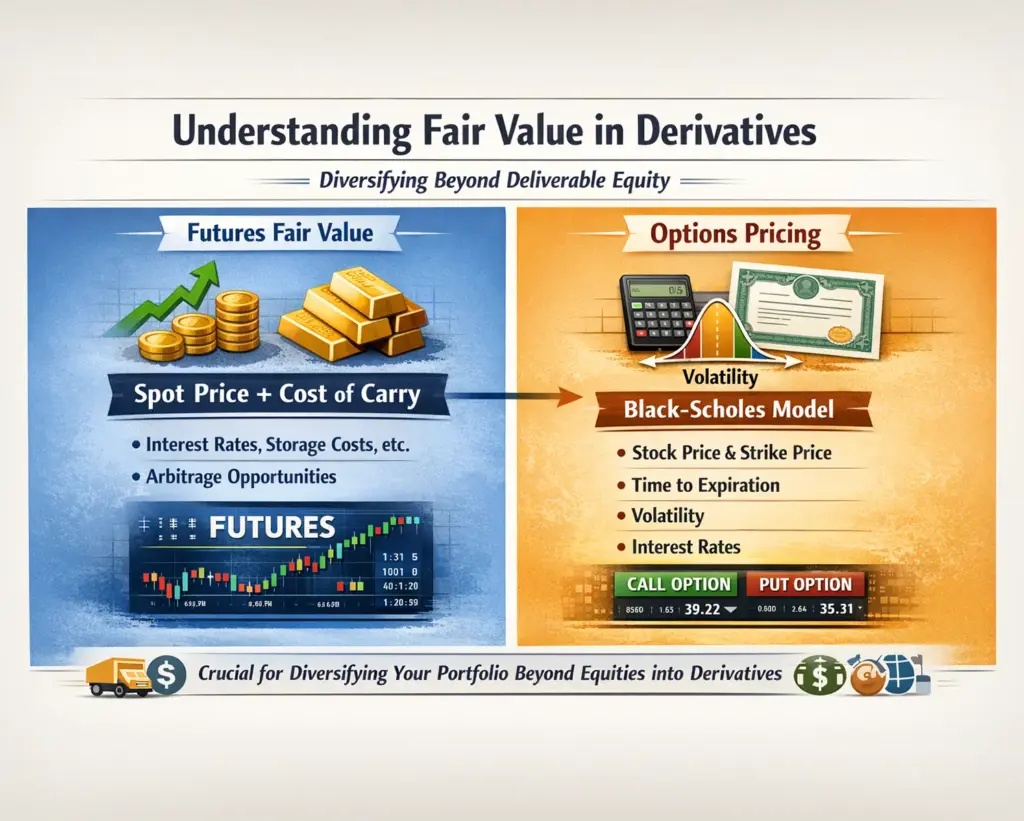
While traditional stock valuation methods (like P/E or DCF) are specific to equities, the concept of fair value applies everywhere.
- Futures: The fair value of a Futures Contract (e.g., on the DGCX) is determined by the spot price of the underlying asset plus the “cost of carry” (interest rates, storage costs, etc.). If the futures price deviates too far from this theoretical fair value, arbitrage opportunities arise.
- Options: Options are valued using complex mathematical models like Black-Scholes, which factor in the stock price, strike price, time to expiration, volatility, and interest rates.
Understanding these distinctions is crucial if you are diversifying your portfolio beyond Deliverable Equity into derivatives.
Conclusion: Making Valuation Work for You
Mastering stock valuation methods is not just about crunching numbers; it is about developing the discipline to distinguish between a company’s price and its true worth. Whether you are using a DCF model to analyze a long-term holding or checking P/E ratios for a quick comparison in the GCC Markets, these tools empower you to make decisions based on logic rather than speculation.
At PhillipCapital DIFC, we understand that successful investing requires both the right knowledge and the right platform. By combining these valuation techniques with our advanced trading tools and regulatory protection, you can navigate global financial markets with greater confidence and precision
Disclaimer:
Trading foreign exchange and/or contracts for difference on margin carries a high level of risk, and may not be suitable for all investors as you could sustain losses in excess of deposits. The products are intended for retail, professional and eligible counterparty clients. Before deciding to trade any products offered by PhillipCapital (DIFC) Private Limited you should carefully consider your objectives, financial situation, needs and level of experience. You should be aware of all the risks associated with trading on margin. The content of the Website must not be construed as personal advice. For retail, professional and eligible counterparty clients. Before deciding to trade any products offered by PhillipCapital (DIFC) Private Limited you should carefully consider your objectives, financial situation, needs and level of experience. You should be aware of all the risks associated with trading on margin.
Rolling Spot Contracts and CFDs are complex instruments and come with a high risk of losing money rapidly due to leverage. 78% of our retail client accounts lose money while trading with us. You should consider whether you understand how Rolling Spot Contracts and CFDs work, and whether you can afford to take the high risk of losing your money.
Understanding Futures Contracts
Understanding Futures Contracts Understanding Futures Contracts in Global Markets In...
Read MoreCalculating Bond Price And Yield
Calculating Bond Price And Yield Understanding Bond Valuation: A Comprehensive...
Read MoreEnterprise Value And Ev/Ebitda
Enterprise Value And EV/EBITDA Enterprise Value and EV/EBITDA: A Comprehensive...
Read MorePrice-to-Sales Ratio (P/S)
Price-to-Sales Ratio (P/S) Understanding the Price-to-Sales Ratio (P/S) in Modern...
Read MorePrice-to-Book Ratio
Price-to-Book Ratio (P/B) The Essential Guide for Identifying Undervalued Stocks...
Read MoreBond Pricing Fundamentals
Bond Pricing Fundamentals A Guide for Investors Table of Contents...
Read MorePrice-to-Earnings Ratio (P/E)
Price-to-Earnings Ratio (P/E) Table of Contents What is the Price-to-Earnings...
Read MoreBase Currency vs Quote Currency
Base Currency vs Quote Currency Table of Contents What is...
Read MoreShort-Term, Intermediate, and Long-Term Bonds
Bond Maturities Short-Term, Intermediate, and Long-Term Bonds Table of Contents...
Read MoreSector Rotation Strategy
Sector Rotation A Strategic Guide to Investing Through Economic Cycles...
Read MoreHow Structured Products Work
How Structured Products Work A Complete Guide for Investors Table...
Read MoreStock Valuation Methods
Stock Valuation Methods A Comprehensive Guide to Estimating Fair Value...
Read MoreMinor and Exotic Currency Pairs
Minor and Exotic Currency Pairs A Trader’s Guide to Global...
Read MoreLong vs Short Positions in Derivatives
Long vs Short Positions in Derivatives A Complete Guide for...
Read MoreInvestment Grade vs Non-Investment Grade Bonds
Investment Grade vs Non-Investment Grade Bonds A Guide for UAE...
Read MoreStock Market Hours and Session Trading
Stock Market Hours and Session Trading A Global Guide for...
Read MoreOver-the-Counter (OTC) vs Exchange-Traded Derivatives
Over-the-Counter (OTC) vs Exchange-Traded Derivatives A Complete Guide for UAE...
Read MoreBonds: Face Value, Par Value & Coupon Rate
Bonds: Face Value, Par Value & Coupon Rate When venturing...
Read MoreGrowth Investing
Growth Investing The High-Risk, High-Reward Strategy for UAE Investors Growth...
Read MoreComponents of Structured Products
Components of Structured Products A Detailed Guide for UAE Investors...
Read MoreInitial Public Offering Process guide
IPO (Initial Public Offering) Process From Private to Public In...
Read MoreForex Market Structure and Hours
Forex Market Structure and Hours The Complete Guide for UAE...
Read More