Structured Notes

The Complete Guide to Tailored Wealth Management in Dubai

In the dynamic financial landscape of the UAE, traditional investment vehicles like bonds and equities are often not enough to meet the specific risk-return appetites of sophisticated investors. Enter Structured Notes—a powerful tool in modern wealth management that bridges the gap between fixed income and market equity.

At PhillipCapital DIFC, we believe in empowering our clients with knowledge. This guide answers your most pressing questions about Structured Notes, detailing how they can enhance yields and protect capital in uncertain markets.

What Are Structured Notes and How Do They Fit into a Portfolio?

A Structured Note is a hybrid financial instrument that combines the features of a traditional bond with those of a derivative (like an option). Think of it as a pre-packaged investment strategy. Unlike a standard stock that moves 1-to-1 with the market, a Structured Note allows you to customize your payout.

Essentially, it is a debt obligation issued by a financial institution, but instead of paying a fixed interest rate, the return is linked to the performance of an underlying asset—such as a specific stock, a global index (like the S&P 500), commodities (like Gold), or even foreign currencies. This structure allows investors to achieve specific goals, such as generating higher yields than a bank deposit or protecting their initial capital against market downturns.

Why are they considered a "flexible" investment solution?

The beauty of Structured Notes lies in their versatility. They are not “one-size-fits-all.” At PhillipCapital DIFC, we can tailor these notes to match your specific market view.

  • Bullish? You can structure a note to accelerate returns if the market rises.
  • Sideways Market? You can generate high coupons (interest) even if the market stays flat.
  • Bearish? You can build in “capital protection” buffers that ensure you don’t lose money even if the market drops by a certain percentage.

Structured Investments, Designed Around You

Bespoke Structured Notes designed to match your objectives, risk appetite, and market perspective

How Do Structured Notes Work?

Digital illustration of a Structured Note concept, showing a glowing globe with stock market data (Apple Inc., FTSE 100) and floating currency symbols over a silver zero-coupon bond bar on a reflective desk

What are the main components that make up a Structured Note?

A typical note is constructed using two main building blocks:

  1. The Zero-Coupon Bond: This component is used to protect the principal. It ensures that a portion of your capital is preserved or returned at maturity.
  2. The Derivative Option: This is the risky part of the note that provides the potential for higher returns. It tracks the underlying asset (e.g., Apple stock or the FTSE 100).

When you invest, the issuer uses the majority of your funds to buy the bond and the remainder to purchase the option. The performance of that option determines your final payout.

What happens if the market goes down? Do I lose my money?

This depends entirely on the “protection barrier” set when you buy the note. This is a crucial concept for UAE investors to understand.

  • Hard Protection: Some notes offer 100% capital protection. If the market crashes, you still get your initial investment back (subject to issuer credit risk).
  • Soft Protection (Barriers): Many yield-enhancement notes have a “barrier,” often set at 60% or 70% of the initial price. As long as the underlying asset does not fall below this barrier during the term, you receive your full capital back plus your coupons. However, if the asset price breaches this barrier, your capital is at risk, similar to holding the stock directly.

Types of Structured Notes Available in Dubai

What are the most popular structures for investors at PhillipCapital DIFC?

While there are limitless variations, three specific types are highly popular among our clients:

  1. Reverse Convertibles: These are designed for “yield hunters.” They offer a high coupon rate (often significantly higher than standard bonds) regardless of how the market performs, provided the underlying asset doesn’t drop below a specific barrier.
  2. Autocallables: These are the most common. An Autocallable note has specific observation dates. If the underlying asset is at or above a certain level on that date, the note “calls” (ends early), paying you your capital plus a predefined bonus coupon. It’s excellent for recycling capital quickly in positive markets.
  3. Participation Notes: These allow you to participate in the upside of an asset (like a foreign index) often with a degree of capital protection attached, reducing the fear of entering a volatile market.

Not sure which structure suits your portfolio?

Explore Our Range of Trading Products & Solutions

Why should choose a Structured Note over buying the stock directly?

  • Enhanced Yield: In low-interest environments, Structured Notes can offer double-digit coupons that traditional fixed-income assets cannot match.
  • Defined Risk: You know your entry and exit scenarios before you invest. You know exactly how much the market can fall before your capital is touched.
  • Access: They provide easy access to difficult-to-enter markets or asset classes (like commodities or specific foreign sectors) within a single instrument.
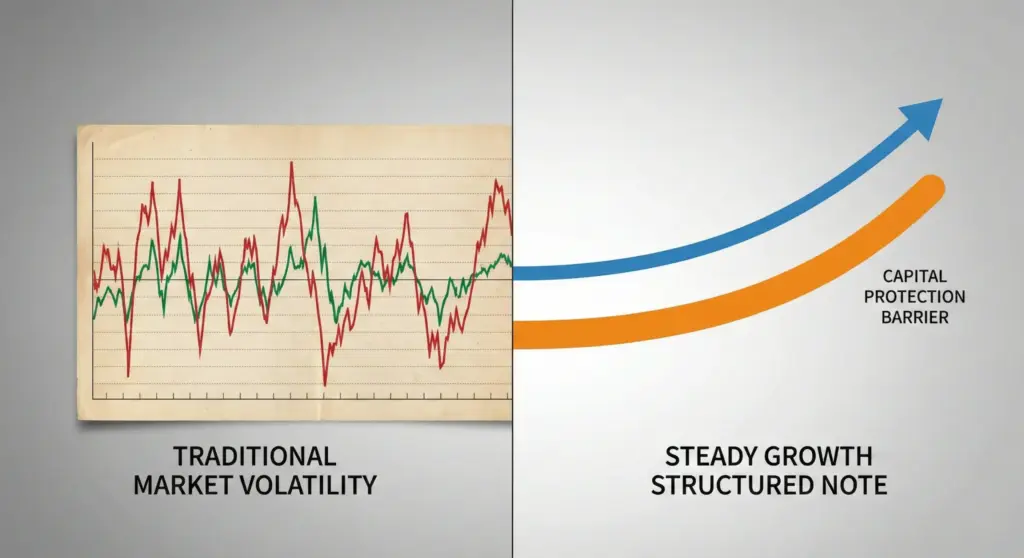
A split-screen infographic contrasting a volatile, jagged "Traditional Market Volatility" stock chart on the left with a smooth, upward-sloping "Steady Growth Structured Note" curve and a protective barrier on the right.

What are the risks need to be aware of?

Transparency is a core value at PhillipCapital. It is vital to understand the risks:

    • Credit Risk: A Structured Note is an unsecured debt of the issuer. If the issuing bank goes bankrupt (like Lehman Brothers in 2008), you could lose your investment, regardless of how the underlying asset performs. Tip: Always check the credit rating of the issuer.
    • Liquidity Risk: These notes are designed to be held until maturity. Selling them early on the secondary market can be difficult or result in a loss of value.
    • Market Risk: If the protection barrier is breached, you are exposed to the full loss of the underlying asset.

How do I start investing in Structured Notes in the UAE?

Investing in Structured Notes requires a regulated, experienced partner. As a firm regulated by the DFSA (Dubai Financial Services Authority), PhillipCapital DIFC ensures that every product offered is appropriate for your classification as an investor.

    1. Consultation: We begin by understanding your risk profile. Are you preserving wealth or aggressively growing it?
    2. Selection: We source notes from top-tier global investment banks to mitigate credit risk.
    3. Execution: We handle the trade and custody, providing you with regular reports on the performance of your notes.

Frequently Asked Questions (FAQs)

Why not just buy the ETF or stock directly?

It depends on your goal. Buying the stock directly gives you unlimited upside potential but 100% downside risk. Buying a Structured Note is for investors who are willing to cap their potential profit in exchange for a safety cushion against losses. It’s a trade-off: security and income vs. maximum growth.

Can I sell my Structured Note before the maturity date?

Technically, yes, but it is not recommended. Structured Notes are designed to be held until they mature. If you try to sell early (on the secondary market), you may get back significantly less than your initial investment because the price will fluctuate based on interest rates, time left, and market volatility.

What happens if my note gets "Autocalled" early? Is that good or bad?

It is generally considered “good” but comes with a catch. If a note is “Autocalled,” it means the market performed well, so the note ends early, and you get your capital back plus the agreed profit immediately. The “catch” is Reinvestment Risk: you now have cash back in your hand sooner than expected and must find a new place to invest it, potentially when interest rates or market deals are less attractive.

Conclusion

Structured Notes offer a unique “middle ground” for investors—providing the potential for equity-like returns with bond-like features. Whether you want to generate income in a flat market or protect your capital in a volatile one, these instruments can be tailored to meet your precise needs.

Disclaimer: Structured products involve derivatives and may not be suitable for all investors. Please ensure you fully understand the risks involved before trading.

Disclaimer:

Trading foreign exchange and/or contracts for difference on margin carries a high level of risk, and may not be suitable for all investors as you could sustain losses in excess of deposits. The products are intended for retail, professional and eligible counterparty clients. Before deciding to trade any products offered by PhillipCapital (DIFC) Private Limited you should carefully consider your objectives, financial situation, needs and level of experience. You should be aware of all the risks associated with trading on margin. The content of the Website must not be construed as personal advice. For retail, professional and eligible counterparty clients. Before deciding to trade any products offered by PhillipCapital (DIFC) Private Limited you should carefully consider your objectives, financial situation, needs and level of experience. You should be aware of all the risks associated with trading on margin.

Rolling Spot Contracts and CFDs are complex instruments and come with a high risk of losing money rapidly due to leverage. 78% of our retail client accounts lose money while trading with us. You should consider whether you understand how Rolling Spot Contracts and CFDs work, and whether you can afford to take the high risk of losing your money.

Ready to diversify your portfolio with sophisticated instruments?

Open Your Account Today