
implied volatility vs historical volatility Introduction Volatility sits at the...
Read MoreVIX Futures & Volatility Futures
Table of Contents
- Introduction
- What Is Market Volatility and Why Does It Matter to Investors?
- What Is the VIX Index and Why Is It Called the “Fear Index”?
- What Are VIX Futures?
- How Are VIX Futures Priced and Settled?
- What Is the Difference Between VIX Futures and Standard Futures Contracts?
- What Are Volatility Futures Beyond the VIX?
- Who Trades VIX Futures — and Why?
- How Can Investors Use VIX Futures for Portfolio Hedging?
- What Are the Key Risks of Trading VIX Futures?
- How Do VIX Futures Perform During Market Crashes?
- What Is VIX Term Structure and How Do Traders Use It?
- Can Retail Investors Trade VIX Futures?
- What Is the Role of Volatility Futures in a Diversified Portfolio?
- Conclusion and Key Takeaways
Introduction
Every experienced investor knows that markets don’t move in a straight line. Prices go up, they come down, and sometimes they swing wildly within a single trading session. This unpredictability is called market volatility — and for decades, investors could only watch it happen, unable to trade it directly.
That changed when the Chicago Board Options Exchange (CBOE) launched the VIX Index in 1993, followed by tradable VIX Futures in 2004. For the first time, investors gained a direct tool to trade — and hedge against — market uncertainty itself.
Today, VIX futures and volatility futures are essential instruments used by hedge funds, institutional traders, and an increasingly sophisticated retail investor community. They serve as a real-time barometer of market sentiment, a powerful hedging mechanism, and a speculative vehicle for those who understand how volatility behaves.
This guide explains everything you need to know — from the basics of what the VIX measures, to how these futures are priced, who uses them, and how they can fit into your investment strategy. Whether you are exploring futures trading for the first time or looking to deepen your understanding of derivatives markets, this comprehensive resource is designed for you.
What Is Market Volatility and Why Does It Matter to Investors?
Understanding Volatility in Simple Terms
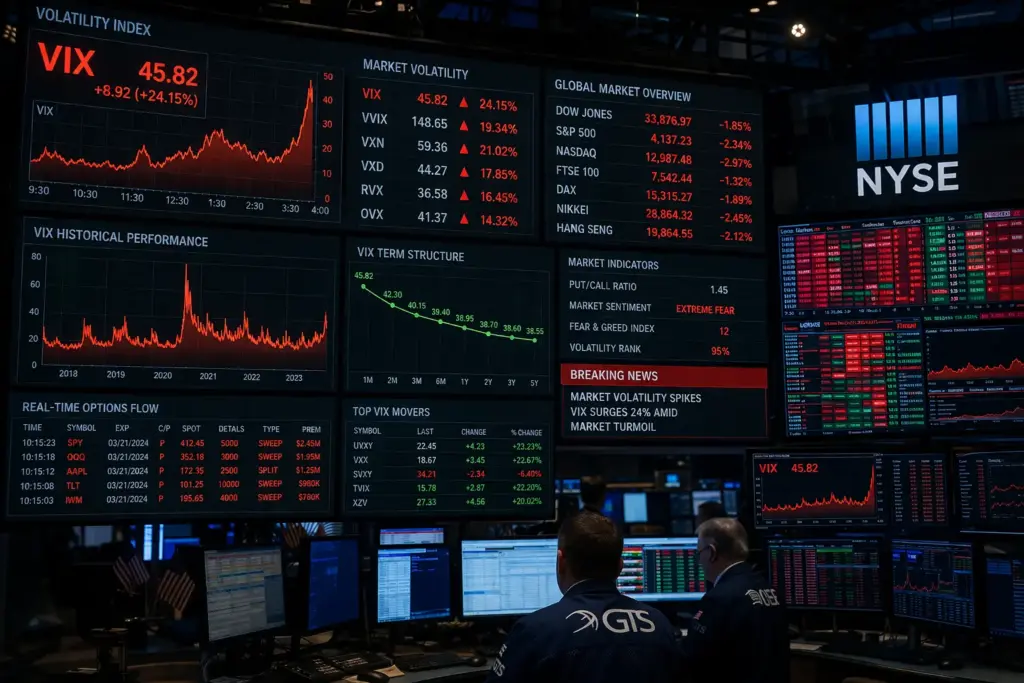
In financial markets, volatility refers to how much and how quickly the price of an asset — or the broader market — moves up or down over a given period. High volatility means large, rapid price swings. Low volatility means prices are relatively stable and calm.
Think of a calm ocean versus rough seas. A calm ocean represents a low-volatility market: prices move steadily, and investors can plan with reasonable confidence. Rough seas represent a high-volatility market: prices lurch dramatically in both directions, creating both opportunity and risk.
Why Volatility Is Central to Investment Decision-Making
Volatility matters to investors for several interconnected reasons:
Risk and uncertainty. When volatility is high, the future direction of prices becomes harder to predict. This uncertainty makes it more difficult to size positions, manage stop-losses, and plan exits. Portfolios that were comfortably positioned in calm markets can face rapid and painful losses during high-volatility episodes.
Options pricing. Volatility is the single most important input in options pricing models. Higher volatility means options premiums become more expensive, which impacts anyone using options for income generation or portfolio protection.
Investor sentiment. Volatility is often a direct reflection of fear, panic, or euphoria in markets. When investors are frightened — about a financial crisis, geopolitical event, or economic data — volatility surges. When confidence returns, it tends to fall.
Capital allocation. Institutional fund managers regularly adjust their portfolio allocations based on prevailing volatility levels. In high-volatility environments, the preference often shifts toward lower-risk assets like government bonds or cash — a movement that itself influences stock prices.
For anyone trading futures contracts or other derivatives, understanding volatility is not optional — it is fundamental. And this is precisely why dedicated instruments like VIX futures were created: to allow investors to trade volatility directly, rather than simply being subject to it.
What Is the VIX Index and Why Is It Called the "Fear Index"?
Defining the VIX
The VIX — officially the CBOE Volatility Index — is a real-time index published by the Chicago Board Options Exchange (CBOE) that measures the market’s expectation of volatility in the S&P 500 index over the next 30 days. It is calculated using the prices of S&P 500 options across a wide range of strike prices, reflecting how much traders are currently paying for protection against (or exposure to) large market swings.
The VIX is expressed as a percentage. A VIX reading of 15 suggests the market expects roughly 15% annualised volatility over the next month. A reading of 30 signals much higher expected turbulence. A reading above 40 is considered extreme fear territory, typically associated with severe market dislocations.
Why "Fear Index"?
The VIX earned the nickname “Fear Index” because of its historically strong inverse relationship with the S&P 500. When equity markets fall sharply — driven by investor fear, panic selling, or macro shocks — the VIX tends to spike dramatically. When markets recover and confidence returns, the VIX falls back to lower levels.
This makes intuitive sense: when investors rush to buy put options (essentially insurance policies against market declines), the demand pushes up the prices of those options, which in turn drives the VIX higher. The VIX, in a very real sense, measures how much the market is collectively willing to pay for protection — and that price goes up precisely when fear is highest.
Historical VIX Spikes
Some of the most significant VIX spikes in history align directly with periods of maximum market stress:
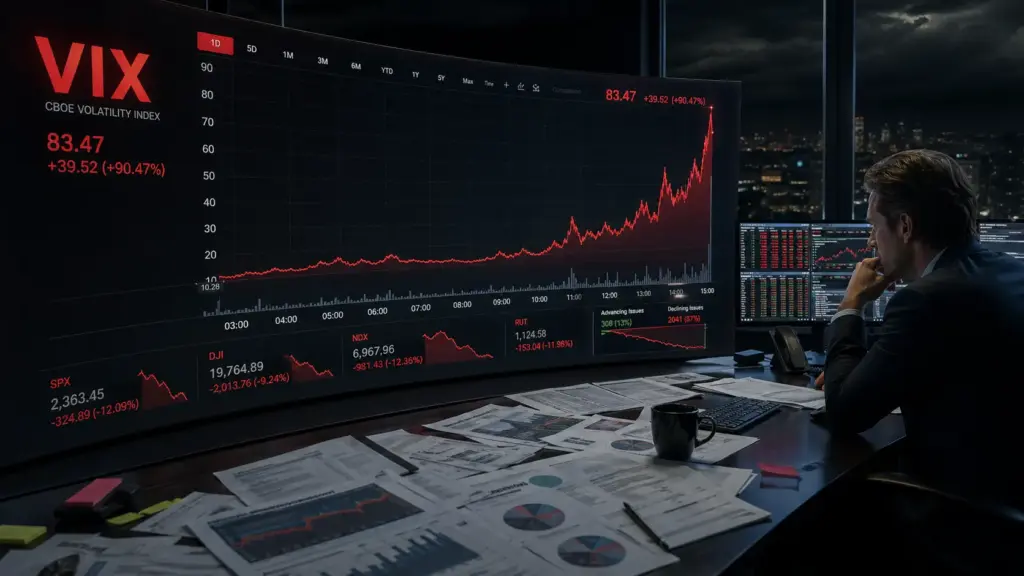
- 2008 Global Financial Crisis — The VIX reached an all-time closing high of approximately 80, reflecting the extreme panic that gripped global markets during the collapse of Lehman Brothers and the near-failure of the global banking system.
- March 2020 (COVID-19 Pandemic) — The VIX surged above 85 intraday as global markets experienced one of the fastest bear markets in history.
- 2010 Flash Crash — A brief but violent intraday spike illustrated how quickly fear could materialize.
- 2022 Rate Hike Cycle — As the U.S. Federal Reserve embarked on aggressive interest rate increases, the VIX remained elevated for an extended period as equity markets struggled.
Understanding the VIX’s historical behaviour provides critical context for anyone trading VIX futures, because these contracts are priced against expectations of future VIX levels — not necessarily current market prices.
What Are VIX Futures?
A Direct Definition
VIX futures are standardised exchange-traded contracts that allow investors to buy or sell the VIX at a predetermined price on a specified future date. They trade on the CBOE Futures Exchange (CFE) and are cash-settled — meaning that when the contract expires, the profit or loss is paid in cash rather than by delivering any underlying asset.
In simple terms: if you believe the VIX (and therefore market volatility) is going to rise — perhaps because you expect a major economic event to trigger market turbulence — you can buy VIX futures to potentially profit from that rise. Conversely, if you believe markets will remain calm and the VIX will stay low or decline, you can sell VIX futures.
How VIX Futures Were Created
VIX futures were introduced by the CBOE in March 2004, marking a landmark development in the history of financial derivatives. For the first time, investors could trade market volatility as an asset class in its own right — not indirectly through options strategies, but directly through a purpose-built futures contract.
This innovation addressed a long-standing desire among portfolio managers and risk professionals to have a clean, straightforward way to hedge against volatility spikes. Prior to VIX futures, achieving similar exposure required complex and expensive combinations of S&P 500 options.
Key Contract Specifications
Understanding the technical specifications of VIX futures helps investors manage positions precisely:
- Exchange: CBOE Futures Exchange (CFE)
- Underlying: The CBOE Volatility Index (VIX)
- Contract Multiplier: $1,000 per VIX point
- Tick Size: 0.05 VIX points ($50 per tick)
- Settlement: Cash-settled; final settlement is based on the Special Opening Quotation (SOQ) of the VIX on expiration Wednesday
- Expiration: The Wednesday that is 30 days before the third Friday of the following calendar month
- Available Maturities: Multiple monthly contracts listed simultaneously, typically extending 6–9 months into the future
These specifications mean that a single VIX futures contract has significant notional value. With the multiplier at $1,000 per VIX point, a contract traded at a VIX level of 20 represents $20,000 in notional exposure. This is important context for position sizing and margin management.
Understanding these mechanics is closely linked to broader knowledge of how derivatives basics work in global markets, including how leverage and margin function across different futures instruments.
Explore Futures & Options Trading at PhillipCapital DIFC
Access global derivatives markets including volatility products through a regulated DIFC broker.
How Are VIX Futures Priced and Settled?
Why VIX Futures Don't Match the Spot VIX
One of the most misunderstood aspects of VIX futures — and a source of costly mistakes for uninformed traders — is that VIX futures prices almost never match the current (spot) VIX level. The futures price reflects the market’s expectation of where the VIX will be at expiration, not where it is today.
This creates two common scenarios:
Contango: This is the most common condition. VIX futures trade above the current spot VIX because the market typically expects more uncertainty in the future than is present right now. In a contango environment, the futures curve slopes upward from left (near-term) to right (longer-dated). This has a significant practical consequence: investors who hold long VIX futures positions over time tend to experience “roll losses” — they continuously sell expiring lower-priced contracts and buy the next higher-priced month, creating a built-in drag on returns.
Backwardation: This occurs less frequently but is highly important. When the market is in acute distress — think a crisis moment — the near-term VIX futures trade above longer-dated ones, reflecting expectations that elevated volatility will eventually subside. Backwardation typically signals that the current fear is viewed as temporary.
Understanding whether the VIX futures curve is in contango or backwardation is crucial for anyone using these instruments, because the shape of the curve directly affects the profitability of long or short volatility strategies over time.
How Final Settlement Works
At expiration, VIX futures are settled using the Special Opening Quotation (SOQ) — a calculation based on the opening prices of S&P 500 options on the expiration morning. This value is published by the CBOE and is the definitive reference price against which all open contracts are settled.
Because the SOQ is based on opening option prices (which can differ substantially from prior-day closing prices), the final settlement can sometimes be surprising — particularly in markets that experience sharp overnight moves before expiration.
What Is the Difference Between VIX Futures and Standard Futures Contracts?
Key Structural Differences
VIX futures share the broad structure of other exchange-traded futures — they are standardised, margin-traded, and listed on a regulated exchange — but they have several distinctive characteristics that set them apart from more traditional contracts like crude oil, gold, or equity index futures.
No Deliverable Underlying Asset
Standard commodity futures (like crude oil or agricultural futures) ultimately reference a physical commodity. Standard financial futures reference an index or rate that, in theory, could be replicated. VIX futures, however, reference a calculated index of implied volatility. You cannot buy, hold, or deliver the VIX itself. This makes VIX futures purely a financial instrument, always cash-settled.
Mean-Reverting Nature
Stocks, commodities, and currency pairs can theoretically trend indefinitely in one direction. Volatility does not behave this way. The VIX is mean-reverting by nature — after spikes, it tends to return to its long-run average (historically in the 15–20 range). This fundamentally changes how directional trading strategies must be applied. Strategies that work for trending markets can destroy capital if applied naively to volatility futures.
Contango Drag
As discussed in the previous section, the persistent contango in VIX futures markets creates a structural drag for long-only holders. This is less of an issue in most commodity futures (where backwardation is common) and virtually irrelevant for most financial futures. It is a defining feature of volatility futures trading that must always be factored into position management.
Correlation Inversion During Stress
Most asset classes are positively correlated with equities during normal times. VIX futures are structurally negatively correlated with equities — they tend to gain value precisely when equity markets fall sharply. This unique characteristic is what makes them valuable as portfolio hedges, but it also means their behaviour is fundamentally different from commodities, currencies, or interest rate futures.
Investors who already have experience with other specific futures types — such as stock index futures or interest rate futures — will find that VIX futures require a distinct mental framework to trade effectively.
What Are Volatility Futures Beyond the VIX?
The Broader Universe of Volatility Products
While the VIX and its associated futures are by far the most widely known volatility instruments, the universe of volatility futures extends well beyond the U.S. equity market. Global exchanges have developed volatility products for other major asset classes and regional markets.
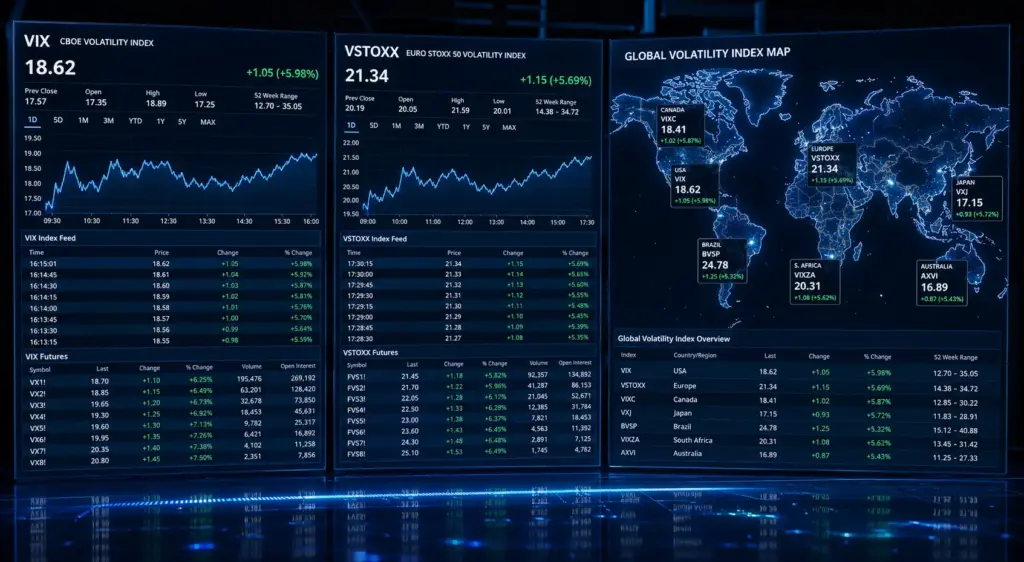
VSTOXX Futures (European Volatility)
The VSTOXX Index — published by Eurex — measures the implied volatility of the Euro Stoxx 50 index, functioning as the European equivalent of the VIX. VSTOXX futures allow investors to gain exposure to volatility in European equity markets and are actively traded by European institutional investors, hedge funds, and macro traders. The VSTOXX tends to spike sharply during European-specific crises (such as the Eurozone sovereign debt crisis) while sometimes moving independently of the VIX.
Variance Swaps (OTC Volatility Products)
While not futures in the strict exchange-listed sense, variance swaps are over-the-counter derivatives that allow sophisticated institutional investors to trade realised (or actual) volatility directly against implied (or expected) volatility. These instruments are widely used by hedge funds and banks to express more precise volatility views and are closely related in concept to exchange-traded volatility futures.
Volatility ETPs (Exchange-Traded Products)
Several exchange-traded products — including ETFs and ETNs — provide exposure to VIX futures indirectly, by holding rolling positions in front-month and second-month VIX futures contracts. Products in this category have attracted massive retail investor interest, though they carry significant complexity and are prone to substantial losses during periods of sustained low volatility (due to contango roll drag). They should not be confused with direct VIX futures positions.
Realised Volatility Futures
Some exchanges have experimented with contracts based on realised (historical) volatility — what markets have actually moved — as opposed to implied volatility (what markets expect to move). These are less liquid than VIX futures but represent an evolving frontier in volatility product development.
Who Trades VIX Futures — and Why?
Institutional Traders and Hedge Funds
The largest and most active participants in VIX futures markets are institutional investors and hedge funds. For this group, VIX futures serve multiple strategic purposes:
Portfolio hedging is the primary motivation. A fund manager with a large long equity portfolio can purchase VIX futures as a hedge. If markets fall sharply and the VIX spikes, the gains on the VIX futures position can offset — partially or substantially — the losses in the equity portfolio. This is far more straightforward than building complex options hedges, though it comes with its own costs.
Volatility arbitrage is another institutional use case. Sophisticated funds attempt to exploit price differences between implied volatility (as measured by VIX futures) and realised volatility (what markets actually do). If the VIX futures are pricing in more volatility than ultimately materialises, a short VIX position can generate profit — though this strategy requires rigorous risk management given the potential for sudden spikes.
Macro trading is widely practised by global macro funds, which use VIX futures to express directional views on market risk and global uncertainty. If a fund expects a central bank announcement, geopolitical event, or economic data release to trigger volatility, it may build a long VIX futures position ahead of that catalyst.
Market Makers and Prop Trading Firms
Market makers in the VIX futures space provide liquidity, continuously quoting buy and sell prices. Proprietary trading firms also participate actively, often using algorithmic strategies to capture small edges across the VIX futures term structure.
Sophisticated Retail Investors
While historically dominated by institutions, VIX futures are accessible to qualified retail investors through brokers with appropriate futures trading infrastructure. Retail traders typically approach VIX futures for:
- Short-term speculation on volatility direction (particularly around major events like Federal Reserve meetings or earnings seasons)
- Tactical hedging of equity portfolios during periods of perceived market fragility
- Term structure trades (e.g., going long near-term VIX futures and short longer-dated ones, or vice versa)
It is worth noting that VIX futures are not suitable for all investors. They require a solid understanding of how volatility behaves, how futures margins and roll costs work, and how the VIX’s mean-reverting nature differs from typical directional assets.
Start Your Futures Trading Journey with PhillipCapital DIFC
Open an account with a DFSA-regulated broker and access global futures markets.
How Can Investors Use VIX Futures for Portfolio Hedging?
The Core Logic of Volatility Hedging
The foundational reason many serious investors hold VIX futures is their negative correlation with equity markets during stress events. When equity markets fall dramatically, the VIX typically rises dramatically. This relationship makes VIX futures a natural counterweight to long equity exposure.
Consider the following: during the COVID-19 market crash in March 2020, the S&P 500 fell approximately 34% from its peak in just over a month, while the VIX surged from around 15 to above 85. An investor with a well-timed long VIX futures position could have generated significant gains during that same period, partially or fully offsetting equity losses.
Practical Hedging Approaches
Protective long positions. The most direct approach is simply buying VIX futures ahead of events where volatility is expected to rise. The challenge here is timing: VIX futures in contango will lose value over time even if the VIX remains stable, so holding long positions for extended periods incurs roll costs. Most practitioners use this approach tactically rather than as a permanent hedge.
Tail risk hedging. Some institutional investors allocate a small, defined percentage of their portfolio (often 1–5%) to long VIX futures or options on VIX futures as a permanent “tail risk hedge.” The idea is that this position will lose a small, manageable amount during normal market conditions (due to contango) but generate outsized gains during a crisis — effectively acting as portfolio insurance.
Dynamic hedging. More sophisticated managers dynamically adjust their VIX futures positions based on prevailing market conditions and the shape of the VIX term structure. When the curve is deeply in contango, they may reduce or eliminate long positions. When the curve flattens or moves toward backwardation (suggesting elevated near-term fear), they may increase exposure.
Pairs trading with equity futures. Some strategies combine short positions in equity index futures with long positions in VIX futures, creating a “long volatility, short equity” portfolio specifically designed to outperform during market dislocations.
Investors who already use instruments like stock index futures as part of their equity exposure management may find VIX futures a natural complement for the risk management side of their portfolio.
What Are the Key Risks of Trading VIX Futures?
Risk 1: Contango Erosion
As detailed earlier, the persistent contango structure of VIX futures creates a powerful headwind for long positions held over time. Each month, as the near-dated contract expires and the position “rolls” into the next month’s contract (which typically trades at a higher price), the investor effectively buys at a higher level than where they sold. Over extended periods — particularly in calm markets — this roll cost can be substantial, eroding returns even when the overall market has not moved dramatically against the position.
This risk is particularly acute for investors who hold VIX exposure through exchange-traded products (ETPs) designed to maintain constant VIX futures exposure, as these products automatically roll each month regardless of market conditions.
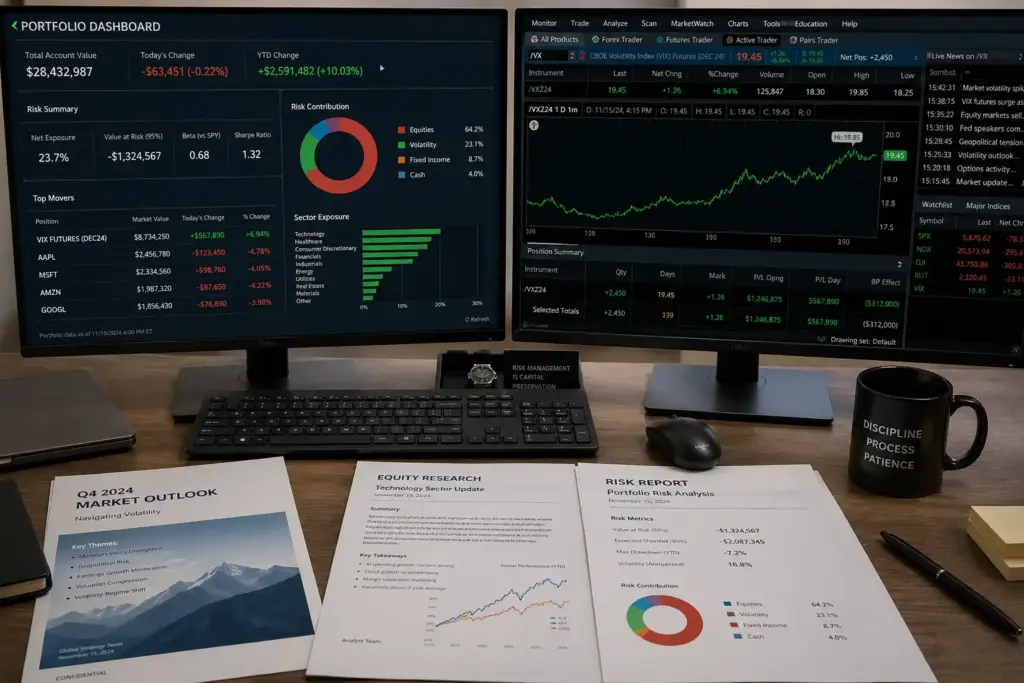
Risk 2: Sudden and Violent Reversals
VIX futures are subject to extreme moves that happen very quickly. The VIX can double or halve within days — or even hours — during crisis events. For investors with short VIX positions (betting on calm markets), this creates the risk of losses that far exceed typical expectations. February 2018 saw a famous example when the VIX doubled in a single day, leading to the implosion of several popular short-volatility ETPs and causing significant losses for investors who had been comfortably profiting from calm markets.
Risk 3: Mispriced Expectations
Because VIX futures reflect the market’s expectation of future volatility rather than actual volatility, they can be systematically mispriced. Markets sometimes remain calm for longer than the VIX futures curve implies (causing long positions to decay in value), or conversely, a volatility spike can arrive without warning from an unexpected geopolitical or macro event.
Risk 4: Complexity and Liquidity Dynamics
While the front two VIX futures contracts are typically liquid, longer-dated contracts (beyond 3–4 months) can have significantly wider bid-ask spreads and lower volume. During extreme market stress — precisely when you might most want to trade VIX futures — liquidity can briefly deteriorate even in front-month contracts, potentially leading to unfavourable fills on large orders.
Risk 5: Margin Requirements
VIX futures are margined instruments. During periods of high volatility, exchanges can raise margin requirements with little notice, potentially requiring investors to post additional collateral at short notice or face forced liquidation of positions at unfavourable prices.
Understanding the risk dimensions of derivatives trading is essential before entering the VIX futures market. These are not instruments suited to investors who are not comfortable with complex risk dynamics.
How Do VIX Futures Perform During Market Crashes?
The Crisis Premium of VIX Futures
History shows that VIX futures have delivered their most dramatic gains during periods of acute market stress — precisely when other assets are losing value most rapidly. This is the core proposition of volatility as a portfolio diversifier: it tends to be at its most valuable exactly when everything else is falling.
2008 Financial Crisis: During the peak crisis months of September–October 2008, front-month VIX futures moved from approximately 20–25 to levels approaching 80. An investor holding long VIX futures during this period would have seen extraordinary gains — gains that could have substantially cushioned the devastating losses in equity portfolios.
March 2020: The pandemic-induced crash saw the VIX futures curve go sharply into backwardation, with front-month contracts reaching levels not seen since 2008. Long VIX holders during this period experienced rapid and substantial appreciation. The speed of the move — from relative calm to extreme fear in a matter of weeks — illustrated how quickly long VIX positions can generate crisis-period returns.
Lessons for Strategic Positioning
Several important practical lessons emerge from studying VIX futures during crashes:
Timing matters enormously. The best VIX futures gains come in the first few days of a market dislocation, when the VIX moves most rapidly. By the time a crisis is fully underway and widely recognised, much of the VIX spike may already have occurred.
Entry prices significantly affect outcomes. Entering long VIX futures positions when the VIX is already elevated (say, above 30–40) provides far less upside than establishing positions when the VIX is low (below 15–20). This creates a counterintuitive dynamic: the best time to buy volatility insurance is when everything seems calm and markets are complacent.
Holding periods must be managed carefully. Even during genuine crises, the VIX rarely stays at extreme highs for long. The 2008 crisis peak of around 80 lasted only days before the VIX began to drift lower, even as equity markets remained under pressure. Long VIX positions initiated at the peak of fear can subsequently lose value even as the market crisis continues.
What Is VIX Term Structure and How Do Traders Use It?
Understanding the VIX Futures Curve
The VIX term structure refers to the relationship between VIX futures prices across different expiration months. At any given time, there are multiple VIX futures contracts trading — typically ranging from one month out to six or more months into the future — and these contracts are each priced differently, reflecting the market’s expectation of volatility at each point in time.
Plotting these prices from the nearest to the most distant expiration creates what traders call the VIX futures curve, and its shape carries significant information.
Three Key Term Structure Shapes
Normal Contango (Upward Sloping)
In calm market conditions, VIX futures typically trade in contango: near-dated contracts are priced lower than longer-dated ones. The curve slopes upward. This is the “normal” state of the VIX curve and reflects the general principle that more uncertainty exists the further into the future you look. Statistically, the VIX futures curve has been in contango roughly 75–80% of the time historically.
Flat Curve
A flat curve — where near-dated and longer-dated VIX futures are priced roughly equally — often signals transition periods. It can indicate that the market is moving from calm to turbulence (or vice versa) and may precede a significant change in volatility regime.
Backwardation (Downward Sloping)
When the VIX curve is in backwardation — near-dated contracts priced above longer-dated ones — it typically signals that acute market stress is being priced into the near term. This structure is far less common than contango and is strongly associated with crisis episodes. It often signals that fear is currently elevated but is expected to subside over time.
How Traders Exploit Term Structure
Sophisticated volatility traders actively exploit the VIX term structure through a variety of strategies:
Calendar spreads involve simultaneously buying one VIX futures contract and selling another with a different expiration, profiting from changes in the spread between the two rather than outright directional moves in the VIX.
Roll yield harvesting involves selling front-month VIX futures and buying them back closer to expiration as they “roll down” the contango curve — a strategy that can be profitable in persistently calm markets but carries severe risk of losses during volatility spikes.
Regime-based positioning involves shifting from short to long VIX positions (or vice versa) based on signals derived from the shape and steepness of the VIX term structure, on the thesis that the curve’s shape contains predictive information about future volatility.
These strategies sit within the broader landscape of trading strategies available to derivatives investors and require substantial experience and discipline to execute consistently.
Can Retail Investors Trade VIX Futures?
Accessibility and Requirements
Yes, qualified retail investors can access VIX futures — but doing so requires meeting certain account requirements and working with a broker that has the infrastructure to support exchange-traded futures trading.
To trade VIX futures directly, investors typically need:
A futures-enabled trading account. Not all retail brokerage accounts support direct futures trading. Investors need a specific futures trading account with an approved broker. In the UAE and DIFC context, investors must work with a DFSA-regulated entity authorised to provide access to international futures markets.
Adequate capital. Given that each VIX futures contract has a notional value of $1,000 per VIX point (so a contract at VIX 20 = $20,000 notional exposure), the margin requirements — though only a fraction of notional value — are still meaningful. Retail investors should approach position sizing conservatively.
Knowledge and experience. VIX futures are classified as complex derivatives in most regulatory frameworks. Regulators and reputable brokers expect investors to demonstrate a basic understanding of how futures work, how the VIX is calculated, and the key risks involved.
Alternatives for Retail Investors
Retail investors who are not yet ready to trade VIX futures directly have several alternatives:
VIX options (traded on the CBOE) provide leveraged, defined-risk exposure to volatility movements. Because the maximum loss on a long option position is the premium paid, this can be a more accessible starting point than outright futures.
Volatility-linked ETPs — while problematic as long-term holdings due to contango drag — can provide short-term tactical exposure to volatility for retail investors who understand the risks.
Structured notes and wealth management products offered by institutional brokers sometimes incorporate volatility components, providing exposure in a more packaged format suitable for investors who prefer not to manage futures positions directly. You can explore wealth management and structured product options as part of a broader investment approach.
What Is the Role of Volatility Futures in a Diversified Portfolio?
Volatility as an Asset Class
Over the past two decades, the investment community has increasingly recognised volatility as a genuine asset class — one with unique return characteristics that can meaningfully enhance a diversified portfolio’s risk-adjusted performance.
The key attribute that makes volatility valuable in a portfolio context is its non-correlation (and often negative correlation) with traditional assets like equities and corporate bonds, particularly during periods of market stress. This is the defining feature of an effective portfolio diversifier: an asset that provides returns precisely when the rest of the portfolio is struggling.
The Practical Portfolio Allocation
How volatility futures fit into a portfolio depends significantly on the investor’s objectives and risk tolerance:
As a permanent tail risk hedge. Some institutional portfolio managers maintain a small allocation (1–3% of portfolio value) to long VIX futures or options as ongoing “portfolio insurance.” In calm markets, this position will gradually lose value due to contango — acting like a recurring insurance premium. But during a severe market crisis, the position can generate returns of several hundred percent, dramatically cushioning the overall portfolio.
As a tactical overlay. Rather than maintaining a constant long volatility position, many investors use VIX futures tactically — increasing long exposure when they see warning signs of market stress (rising credit spreads, elevated geopolitical risk, deteriorating economic data) and reducing it when conditions stabilise.
As a complement to other derivatives. Investors who also use interest rate futures or currency futures to manage macro risk may find that VIX futures provide additional equity-specific risk mitigation that complements their existing hedging framework.
What the Academic Evidence Suggests
Multiple academic studies and practical analyses have confirmed that including a small, well-managed allocation to long volatility in a diversified portfolio can reduce maximum drawdowns and improve risk-adjusted returns over full market cycles — even accounting for the drag of contango during calm periods. The key qualifier is “well-managed”: unmanaged long VIX positions held passively through long periods of calm markets have historically destroyed capital, making active management essential.
Build a Smarter Portfolio with PhillipCapital DIFC
Explore institutional and retail investment solutions designed for sophisticated investors.
Conclusion and Key Takeaways
VIX futures and volatility futures represent one of the most intellectually demanding — and potentially rewarding — areas of the global derivatives markets. Unlike most asset classes, volatility does not trend indefinitely: it spikes, reverts, and cycles. Trading it successfully requires understanding not just market direction, but market psychology, term structure dynamics, and the mechanics of contango and roll costs.
For investors in the UAE and across global markets, VIX futures offer a rare instrument: one that tends to gain value precisely when everything else is falling, making it a powerful tool for portfolio protection in a well-constructed risk management framework.
Key Takeaways
The VIX measures fear. The CBOE Volatility Index reflects the market’s 30-day implied volatility expectation for the S&P 500, rising sharply during market stress and falling during calm periods.
VIX futures allow direct volatility trading. Since 2004, investors have been able to trade VIX futures on the CBOE Futures Exchange — going long to benefit from rising volatility, or short to benefit from calm, stable markets.
Contango is the biggest structural challenge. In approximately 75–80% of market conditions, VIX futures trade in contango, creating roll costs that erode long positions over time. Understanding and managing this dynamic is essential.
VIX futures are powerful hedging tools. Their negative correlation with equities during market stress makes them valuable as portfolio insurance — but timing and position sizing are critical to their effectiveness.
The VIX term structure tells a story. The shape of the VIX futures curve — whether in contango, flat, or backwardation — provides important information about current market sentiment and future volatility expectations.
Risk management is non-negotiable. VIX futures can experience sudden, violent moves in either direction. Appropriate position sizing, stop-loss discipline, and an understanding of the instruments’ unique characteristics are essential prerequisites for participation.
Retail investors can access these markets. Through qualified brokers with futures infrastructure, retail investors can participate in VIX futures — though doing so responsibly requires adequate capital, knowledge, and professional guidance.
Whether you are exploring volatility futures as a hedging mechanism, a speculative tool, or a portfolio diversifier, the foundation is the same: deep understanding, disciplined risk management, and access to the right market infrastructure.
Frequently Asked Questions (FAQs)
If the VIX spikes, why don't my VIX futures gains match it dollar for dollar?
Because VIX futures don’t track the spot VIX directly — they track where the market expects the VIX to be at expiration. When the spot VIX spikes, futures may not move as dramatically, especially if the market believes the spike is temporary and volatility will calm down soon. The further out the contract, the less it tends to react to short-term spikes. This is one of the most common surprises for new VIX futures traders.
Why do VIX ETPs like VXX keep losing value even when the market seems uncertain?
This is the contango problem. Products like VXX hold rolling positions in VIX futures, and since those futures are almost always priced above the spot VIX (contango — roughly 84% of the time historically), they continuously “buy high and sell low” as contracts roll over each month. Over time, this drag silently erodes value, even when volatility appears elevated. These products are built for short-term tactical use, not long-term holding.
Is buying VIX futures a reliable way to protect my stock portfolio during a crash?
It can be — but timing is everything. Long VIX futures positions deliver the biggest gains in the first days of a market shock, when the VIX moves fastest. If you wait until fear is already peaking, much of the move may be over. Also, holding long VIX futures through calm periods is costly due to contango. Most professionals use it as a tactical, time-limited hedge rather than a permanent portfolio position.
Can retail investors actually trade VIX futures, or is it only for institutions?
Retail investors can access VIX futures, but you need a futures-enabled trading account with a regulated broker — a standard stock brokerage account won’t work. You also need sufficient capital and a clear understanding of how futures margin works. For investors not yet ready for direct futures trading, VIX options or structured volatility products can provide a more accessible entry point into volatility exposure.
Ready to Explore Volatility Futures with a Regulated DIFC Broker?
PhillipCapital DIFC offers access to global futures markets, including volatility products, backed by decades of expertise.

Disclaimer:
Trading foreign exchange and/or contracts for difference on margin carries a high level of risk, and may not be suitable for all investors as you could sustain losses in excess of deposits. The products are intended for retail, professional and eligible counterparty clients. Before deciding to trade any products offered by PhillipCapital (DIFC) Private Limited you should carefully consider your objectives, financial situation, needs and level of experience. You should be aware of all the risks associated with trading on margin. The content of the Website must not be construed as personal advice. For retail, professional and eligible counterparty clients. Before deciding to trade any products offered by PhillipCapital (DIFC) Private Limited you should carefully consider your objectives, financial situation, needs and level of experience. You should be aware of all the risks associated with trading on margin.
Rolling Spot Contracts and CFDs are complex instruments and come with a high risk of losing money rapidly due to leverage. 78% of our retail client accounts lose money while trading with us. You should consider whether you understand how Rolling Spot Contracts and CFDs work, and whether you can afford to take the high risk of losing your money.

Rho and Interest Rate Sensitivity
Rho options greek interest rate sensitivity Introduction Most options traders...
Read More
Gamma Risk and Gamma Scalping
Gamma Risk and Gamma Scalping Gamma Risk and Gamma Scalping:...
Read More
Delta Hedging and Delta Neutrality
Delta Hedging and Delta Neutrality Delta Hedging and Delta Neutrality:...
Read More
The Greeks: Delta, Gamma, Theta, and Vega
Options Greeks : Delta, Gamma, Theta, Vega The Greeks: Delta,...
Read More
Black-Scholes Model Basics
Black-Scholes model Black-Scholes Model Basics: How Options Traders Understand Fair...
Read More
Options Exercise & Assignment
Options Exercise & Assignment Table of Contents Introduction What Does...
Read More
American vs European Options
American vs European Options Table of Contents Introduction What Is...
Read More
Options Expiration Dates
Options Expiration Dates Table of Contents Introduction What Is an...
Read More
Intrinsic Value and Time Value
Intrinsic Value and Time Value Introduction When you buy or...
Read More
In-the-Money, At-the-Money, Out-of-the-Money Options
In-the-Money, At-the-Money, Out-of-the-Money Options Introduction If you have started exploring...
Read More
Call Options Explained
Call Options Explained Table of Contents Introduction What Exactly Is...
Read More
Options Fundamentals
Options Fundamentals Table of Contents Introduction What Is an Option...
Read More
VIX Futures & Volatility Futures
VIX Futures & Volatility Futures Table of Contents Introduction What...
Read More
Precious Metals Futures
Precious Metals Futures What Are Precious Metals Futures? A Guide...
Read More
Agricultural Futures
Agricultural Futures Agricultural Futures: Hedging and Trading Strategies Agricultural futures...
Read More
Energy Futures Trading
Energy Futures Trading Introduction Energy is the lifeblood of the...
Read More
Commodity Futures
Commodity Futures What Are Commodity Futures? A Comprehensive Guide for...
Read More
Interest Rate Futures
Interest Rate Futures Mastering Interest Rate Futures: A Strategic Guide...
Read More

Cash Settlement vs Physical Delivery
Cash Settlement vs Physical Delivery in Trading Cash Settlement vs...
Read More
Futures Settlement Methods
Futures Settlement Methods Introduction Navigating the financial markets requires a...
Read More
Margin Calls & Mark-to-Market
Margin Calls & Mark-to-Market Table of Contents Introduction to Futures...
Read More
Initial vs. Maintenance Margin
Initial vs. Maintenance Margin Understanding Initial and Maintenance Margins: A...
Read More
Contango & Backwardation Explained
Contango and Backwardation Explained Contango and Backwardation Explained: Navigating Futures...
Read More