Floating Rate Bonds

Introduction

Interest rates move. That is one of the few certainties in financial markets. When rates rise, the fixed coupon on a traditional bond suddenly looks less attractive — its price falls, and investors are stuck earning less than the market now offers. Floating rate bonds were designed to solve exactly that problem.

Unlike conventional bonds that lock you into a set interest payment for the life of the instrument, floating rate bonds adjust their coupon periodically, tracking a benchmark rate as it moves up or down. For investors who want fixed income exposure without the full weight of interest rate risk, these instruments offer a compelling middle ground.

What Is a Floating Rate Bond?

A floating rate bond — also called a floating rate note or FRN — is a debt instrument whose interest payments are not fixed. Instead, the coupon adjusts at regular intervals (monthly, quarterly, or semi-annually) based on a reference benchmark interest rate, plus a fixed additional percentage called a “spread.”

The benchmark has historically been rates like LIBOR, but global markets have largely shifted to alternatives such as SOFR (Secured Overnight Financing Rate) in the US, EURIBOR in Europe, and similar equivalents in other regions. The spread on top of the benchmark compensates the investor for the credit risk of the specific issuer.

So if the benchmark rate is 4.5% and the bond carries a spread of 0.75%, the investor earns 5.25% for that period. When the benchmark rate moves to 5%, the coupon adjusts to 5.75% at the next reset date.

This floating mechanism makes these bonds fundamentally different from most of what people picture when they think of fixed income. To understand the broader landscape of how bonds are structured across categories, the Bond Types and Structures section on this site provides a useful starting point.

How Does the Coupon on a Floating Rate Bond Work?

The coupon is reset on a schedule defined in the bond’s terms — typically every three or six months. At each reset date, the new coupon is calculated using the prevailing benchmark rate at that time, plus the agreed spread.

Example:

  • Benchmark rate at reset: 4.00%
  • Spread: 1.00%
  • Coupon for next period: 5.00%

If the benchmark rises to 4.75% at the next reset:

  • New coupon: 5.75%

This means the investor’s income automatically increases when interest rates rise — something a standard fixed coupon bond cannot offer.

Some floating rate bonds include a floor — a minimum coupon level the payment cannot fall below — which protects investors if rates drop sharply. Others may include a cap, setting a maximum coupon, which benefits issuers.

Understanding how these coupon mechanics interact with bond pricing is core to fixed income analysis. For a deeper look at how bond prices are calculated in general, the Bond Pricing and Valuation resource is worth reviewing alongside this guide.

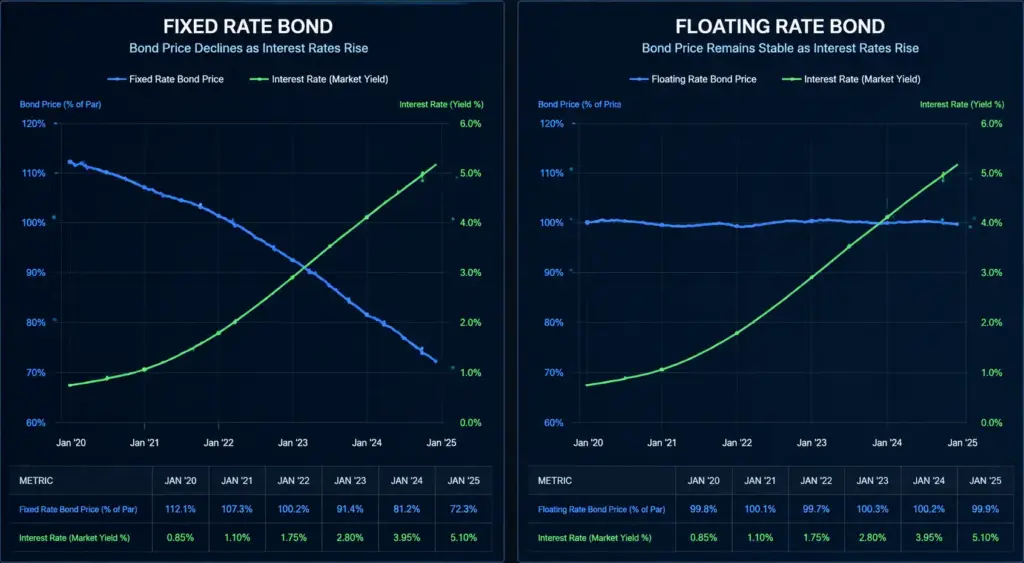
Split-screen financial dashboard comparing fixed-rate and floating-rate bonds during rising interest rates. The left chart shows a declining fixed bond price curve, while the right chart shows a stable floating-rate bond price, illustrating interest rate risk and bond price behavior.

How Are Floating Rate Bonds Different From Fixed Rate Bonds?

The most fundamental difference is how interest rate changes affect each type.

With a fixed rate bond, the coupon never changes after issuance. If market rates rise, the bond’s market price falls — because new bonds now offer higher coupons, making the older bond less attractive. Investors who hold to maturity receive exactly what was promised, but those who sell early may take a capital loss.

With a floating rate bond, the coupon adjusts to reflect current market rates. Because the income stays in line with the market, the bond’s price remains relatively stable — it does not suffer the same price decline that fixed rate bonds experience when rates rise.

This characteristic — lower duration and lower price sensitivity to rate changes — is what makes FRNs particularly valuable during rising rate environments.

Feature Fixed Rate Bond Floating Rate Bond
CouponSet at issuanceAdjusts periodically
Price sensitivity to ratesHighLow
Income predictabilityHighModerate
Inflation protectionLimitedBetter in rising rate periods

To understand the concept of duration and why it matters for managing interest rate risk, the Bond Duration and Risk page provides a clear explanation of how this metric works in practice.

Who Issues Floating Rate Bonds?

Floating rate bonds are issued across a wide range of entities:

Governments and Sovereign Bodies issue FRNs to manage their debt costs in uncertain rate environments. US Treasury FRNs are among the most widely traded. Many emerging market governments also issue floating rate instruments to appeal to international investors.

Corporations — particularly financial institutions such as banks — are major issuers of FRNs. Banks find floating rate debt particularly attractive because their own lending revenues also tend to rise with interest rates, creating a natural match between their assets and liabilities.

Supranational organisations such as the World Bank and regional development banks regularly issue FRNs as part of their global capital market programmes.

Structured vehicles — including asset-backed securities and collateralised loan obligations (CLOs) — often use floating rate structures at their core.

For investors based in the UAE and the broader GCC, access to global floating rate instruments — including sovereign and corporate bonds — is available through platforms like PhillipCapital DIFC’s Bond & Debentures service, which provides access to global fixed income markets.

Ready to Explore Global Bond Markets?

Access sovereign and corporate bonds — including floating rate instruments — through a DFSA-regulated broker.

What Are the Benefits of Investing in Floating Rate Bonds?

  1. Natural hedge against rising interest rates This is the headline advantage. When central banks tighten monetary policy and benchmark rates climb, FRN coupons rise with them. Fixed rate bondholders see their prices fall; FRN holders see their income increase.
  2. Lower price volatility Because the coupon adjusts to market conditions, FRNs trade close to their par value far more consistently than fixed rate bonds. For investors who prioritise capital stability over capital gains, this is a meaningful feature.
  3. Income that keeps pace with the market In a high and rising rate environment, the income from an FRN grows automatically. Investors are not locked into rates that were set months or years ago when conditions were different.
  4. Portfolio diversification Mixing floating and fixed rate bonds within a fixed income allocation gives a portfolio resilience across different interest rate scenarios. When rates are falling, fixed rate bonds outperform; when rates are rising, FRNs come into their own.

For investors looking to construct a diversified income-generating portfolio that spans multiple asset classes, Wealth Management and Structured Notes at PhillipCapital DIFC offers advisory support tailored to individual financial goals.

What Are the Risks Involved?

No investment is without risk. Floating rate bonds carry their own set of considerations:

Credit risk remains. If the issuer defaults, the floating structure provides no protection. Investors must still assess the creditworthiness of the borrower — government, corporate, or otherwise.

Income unpredictability is the flipside of the adjustment mechanism. In a falling rate environment, coupons decline, reducing income. Investors who rely on a steady, predictable income stream may find this unsettling.

Close-up of a financial professional pointing at a risk assessment chart with fluctuating interest rate curves on a tablet in a modern trading office environment.

Reference rate risk — the specific benchmark rate used can be subject to regulatory changes or market disruptions. The global transition away from LIBOR was a recent example of how reference rates themselves can change, affecting the mechanics of existing FRNs.

Liquidity risk can apply to less widely traded FRNs, particularly those issued by smaller corporates or in niche structured formats. Selling before maturity may involve wider bid-offer spreads.

Understanding the full spectrum of risks in bond investing — including those that apply regardless of whether a bond is fixed or floating — is covered in the Bond Basics section, which provides foundational context for new and experienced investors alike.

When Does a Floating Rate Bond Make Sense in a Portfolio?

The case for FRNs is strongest in specific market conditions and investor profiles:

When interest rates are rising or expected to rise: This is the classic use case. FRNs perform well as central banks tighten policy, whereas fixed rate bond prices fall. Investors anticipating a rate hiking cycle often rotate toward floating rate exposure.

When capital preservation matters: Because FRNs trade close to par value throughout their life, they are well suited to investors who cannot tolerate significant price swings in their bond holdings.

As a complement to longer-duration fixed income: Investors holding long-dated government or corporate bonds (which carry high interest rate sensitivity) can reduce overall portfolio duration by adding FRNs to the mix.

For institutional investors managing liability-sensitive portfolios: Banks, insurance companies, and corporate treasuries frequently use FRNs to match the floating rate nature of their own funding or operational costs.

It is also worth noting that floating rate structures appear within structured products and certain wealth management solutions. Investors interested in how these instruments fit within broader portfolio constructions can explore Structured Products Basics for related context.

Build a Smarter Fixed Income Portfolio

Speak to our team about accessing floating rate bonds and other fixed income instruments suited to your investment goals.

Conclusion & Key Takeaways

Floating rate bonds occupy an important and often underappreciated role in a well-structured investment portfolio. They are not a replacement for all fixed income — but in the right market environment and for the right investor profile, they offer a combination of income adaptability and price stability that fixed rate bonds simply cannot match.

Key takeaways from this guide:

  • Floating rate bonds pay a coupon that resets periodically, tied to a benchmark rate plus a fixed spread.
  • Their biggest advantage is low sensitivity to rising interest rates — the coupon rises with the market, keeping price stable.
  • Governments, banks, corporations, and structured vehicles are the primary issuers.
  • The main risks are credit risk, income unpredictability in falling rate environments, and potential liquidity constraints.
  • FRNs are most valuable when rates are rising, when capital preservation is a priority, or as a complement to longer-duration fixed income holdings.
  • Mixing floating and fixed rate bonds within a portfolio gives investors resilience across different interest rate cycles.

For investors in the UAE and the wider region looking to access a broad range of fixed income instruments — from sovereign bonds to corporate and structured debt — PhillipCapital DIFC provides a DFSA-regulated gateway to global bond markets, backed by decades of institutional expertise.

Start Investing in Global Fixed Income

Open an account with PhillipCapital DIFC and access bond markets across the globe — from a trusted, DFSA-regulated broker.

trading account opening uae banner

Frequently Asked Questions (FAQs)

Are floating rate bonds safe?

They carry less interest rate risk than fixed rate bonds, but they are not risk-free. Credit risk still applies — if the issuer defaults, the floating structure offers no protection. Government-issued FRNs are generally considered safer; corporate FRNs carry varying levels of risk depending on the issuer’s credit rating. Always check the issuer’s creditworthiness before investing.

Do floating rate bonds go up when interest rates rise?

Not in price — but in income, yes. When benchmark rates rise, the coupon on a floating rate bond increases at the next reset date, so you earn more. Unlike fixed rate bonds, the bond’s market price stays relatively stable because the coupon keeps pace with the market. This is precisely why investors turn to FRNs during rate-hiking cycles.

What is the difference between a floating rate bond and a fixed deposit?

A fixed deposit locks in both your capital and your interest rate for the full term — you know exactly what you will earn. A floating rate bond is a tradeable market instrument whose coupon adjusts periodically with a benchmark rate. FRNs offer the potential for rising income when rates climb, plus the option to sell before maturity — but they also carry credit and market risk that a bank deposit typically does not.

When should I avoid floating rate bonds?

When interest rates are falling or expected to fall significantly. In a declining rate environment, coupons reset lower at each period, reducing your income over time. Fixed rate bonds tend to outperform in that scenario because they lock in higher rates before the cuts take effect. FRNs are best suited to rising or stable rate environments.

Disclaimer:

Trading foreign exchange and/or contracts for difference on margin carries a high level of risk, and may not be suitable for all investors as you could sustain losses in excess of deposits. The products are intended for retail, professional and eligible counterparty clients. Before deciding to trade any products offered by PhillipCapital (DIFC) Private Limited you should carefully consider your objectives, financial situation, needs and level of experience. You should be aware of all the risks associated with trading on margin. The content of the Website must not be construed as personal advice. For retail, professional and eligible counterparty clients. Before deciding to trade any products offered by PhillipCapital (DIFC) Private Limited you should carefully consider your objectives, financial situation, needs and level of experience. You should be aware of all the risks associated with trading on margin.

Rolling Spot Contracts and CFDs are complex instruments and come with a high risk of losing money rapidly due to leverage. 78% of our retail client accounts lose money while trading with us. You should consider whether you understand how Rolling Spot Contracts and CFDs work, and whether you can afford to take the high risk of losing your money.