Zero-Coupon Bonds

Introduction

Most bonds pay you regular interest — every six months, a coupon lands in your account. Zero-coupon bonds work completely differently. They pay you nothing along the way. Instead, you buy them at a steep discount and receive the full face value at maturity. The difference between what you paid and what you receive is your return.

This structure makes zero-coupon bonds one of the most distinctive instruments in the fixed income world — and one of the most misunderstood. They carry unique advantages for long-term planning, but also specific risks that every investor should weigh carefully.

This guide answers the questions investors most often ask about zero-coupon bonds, in plain language.

What Is a Zero-Coupon Bond?

A zero-coupon bond is a type of fixed income security that does not pay periodic interest. Instead, it is issued at a price significantly below its face value and redeems at full face value at maturity.

The “coupon” in bond terminology refers to regular interest payments. A traditional bond might pay a 5% coupon annually. A zero-coupon bond pays a 0% coupon — hence the name. Your entire gain comes in one lump sum when the bond matures.

For example, you might purchase a zero-coupon bond with a $10,000 face value for $6,000 today. After ten years, you receive $10,000. That $4,000 difference represents your return over the holding period. Understanding this structure is fundamental to grasping how bond pricing and valuation works across different instrument types.

Ultrarealistic financial growth timeline displayed on a sleek glass desk, featuring an upward arrow symbolizing long-term investment growth and wealth accumulation in a professional blue and gold corporate setting.

How Does a Zero-Coupon Bond Actually Work?

Zero-coupon bonds use the concept of compounding in reverse — instead of earning interest that grows, you buy at a discount that reflects all future interest being stripped out upfront.

The price of a zero-coupon bond is determined by discounting the face value back to today using the prevailing interest rate and the number of years to maturity. The longer the maturity and the higher the interest rate environment, the deeper the discount.

Here is a simplified illustration:

  • Face value: $10,000
  • Maturity: 10 years
  • Implied annual yield: 5.17%
  • Purchase price today: ~$6,000

No payments are made during the 10-year period. At maturity, you receive $10,000 — no more, no less. The bond’s price will fluctuate in the market during those 10 years based on interest rate movements, but if you hold to maturity, your return is locked in.

This is why zero-coupon bonds are popular for goal-based investing — for instance, funding a child’s education or planning for retirement at a specific date. For investors looking to understand how interest rates affect bond values more broadly, the bond duration and risk framework explains the mechanics in depth.

Who Issues Zero-Coupon Bonds?

Zero-coupon bonds are issued by governments, government agencies, and corporations. They also arise when financial institutions strip the coupon payments from standard bonds to create synthetic zero-coupon instruments.

The most well-known zero-coupon bonds are US Treasury STRIPS (Separate Trading of Registered Interest and Principal of Securities). These are created by separating the interest and principal components of standard Treasury bonds, allowing each to be sold as a standalone zero-coupon security.

Other common issuers include:

  • National governments — issuing zero-coupon Treasury bills and bonds at a discount
  • Municipal governments — particularly for long-dated infrastructure financing
  • Corporations — issuing zero-coupon corporate bonds, typically with higher yields to reflect credit risk
  • Supranational organizations — such as the World Bank, for project financing

For investors in the UAE and broader Gulf region, access to these instruments through a regulated platform is key. PhillipCapital DIFC provides access to sovereign and corporate fixed income instruments through its bond and debentures trading service.

What Are the Main Benefits of Zero-Coupon Bonds?

Zero-coupon bonds offer a set of advantages that are genuinely hard to replicate with other fixed income instruments — particularly for long-term, goal-oriented investors.

Certainty of return: When you purchase a zero-coupon bond and hold it to maturity, your return is completely predictable from day one. There is no reinvestment risk — the problem regular bond investors face when they receive coupon payments and must reinvest them at whatever rate the market offers at that time. With a zero-coupon bond, the compounding is locked in at purchase.

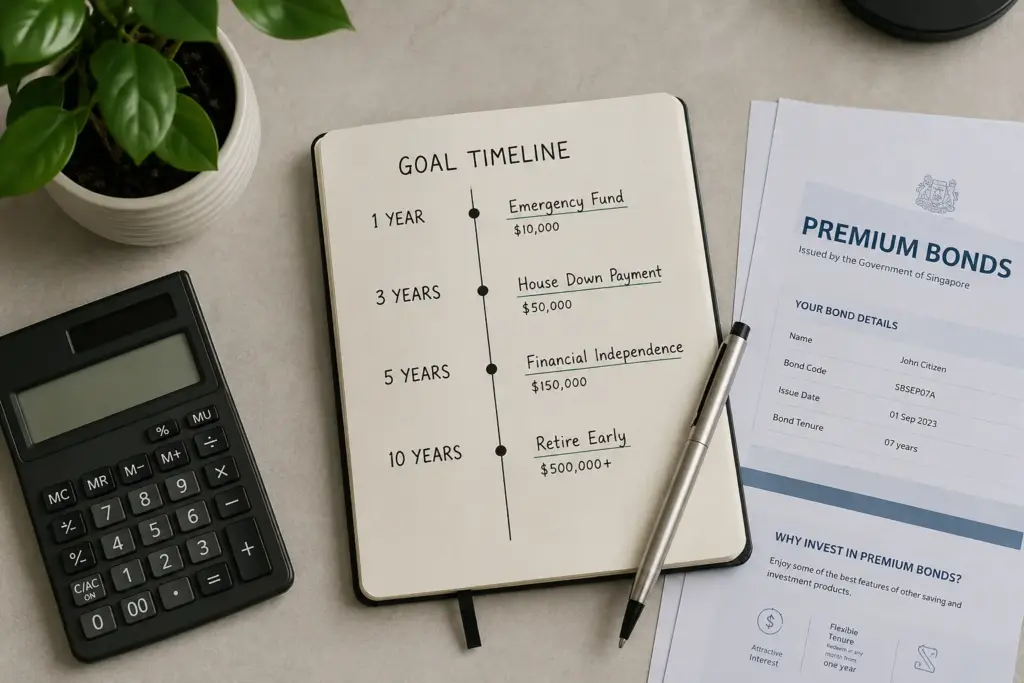
Overhead view of a financial planning workspace featuring a goal timeline notebook, calculator, potted plant, and bond investment documents on a light grey desk with warm lighting.

Deep discount pricing: Zero-coupon bonds allow you to deploy a relatively small amount of capital today in exchange for a guaranteed larger payout in the future. This makes them particularly attractive for investors planning for long-horizon goals.

Portfolio precision: Because they mature at an exact date and exact value, zero-coupon bonds are ideal for liability matching — a strategy used by pension funds, insurance companies, and individual investors who need a specific sum of money at a specific point in time.

Access to long-duration exposure: Zero-coupon bonds typically have the highest duration of any bond type, making them an effective tool for investors who want to position for falling interest rates. A solid understanding of bond types and structures helps investors appreciate where zero-coupon bonds sit within the broader fixed income spectrum.

Explore Fixed Income Options at PhillipCapital DIFC

Access a range of sovereign and corporate bond instruments through a DFSA-regulated broker.

What Are the Risks Investors Should Know?

Zero-coupon bonds carry a specific set of risks that differ meaningfully from regular coupon-paying bonds. Understanding these is essential before investing.

Interest rate sensitivity: Zero-coupon bonds have the highest duration of any bond — meaning their price is more sensitive to interest rate changes than any comparable coupon bond with the same maturity. If rates rise after you purchase a zero-coupon bond, its market value will fall more sharply than a regular bond would. This matters for investors who might need to sell before maturity.

Inflation risk: Since you receive no payments for potentially decades, inflation can erode the real purchasing power of that final lump sum. A $10,000 payout in 20 years will have significantly less purchasing power than $10,000 today if inflation runs high.

Liquidity risk: Zero-coupon bonds, particularly long-dated corporate issues, can have thin secondary markets. Selling before maturity at a fair price is not always straightforward.

Credit risk (for corporate issues): If a corporate issuer defaults, you may lose not only the expected return but part of the principal. Government-issued zero-coupon bonds carry far less credit risk but are not entirely risk-free for foreign investors exposed to currency fluctuations.

These risks connect directly to core concepts covered in bond basics — including yield, credit quality, and the relationship between price and interest rate movement.

How Are Zero-Coupon Bonds Taxed?

Tax treatment is one of the most important — and often overlooked — aspects of zero-coupon bonds. In many jurisdictions, investors pay tax on “phantom income”: interest that accrues each year even though no cash payment is received.

In the United States, for example, the IRS requires holders of zero-coupon bonds to report and pay tax on the “original issue discount” (OID) — the amount by which the bond accrues value each year — even though no cash is received until maturity. This creates a cash flow challenge: tax is due annually on income you haven’t yet received in hand.

This is why many investors hold zero-coupon bonds inside tax-deferred or tax-advantaged accounts such as IRAs, pension plans, or equivalent structures in other jurisdictions.

In the UAE, there is currently no personal income tax, which makes the phantom income issue largely irrelevant for resident individual investors. However, international investors and institutions should always consult with a tax advisor about their specific jurisdiction’s rules before investing in zero-coupon instruments.

How Do Zero-Coupon Bonds Compare to Regular Bonds?

The comparison between zero-coupon bonds and standard coupon bonds comes down to cash flow preference, investment horizon, and risk tolerance.

Feature Zero-Coupon Bond Regular Coupon Bond
Periodic incomeNoneYes — semi-annual or annual
Purchase priceDeep discount to face valueNear or at face value
Return certainty (hold to maturity)Very highHigh, but reinvestment risk exists
Interest rate sensitivityVery highModerate
Suitable for income needsNoYes
Suitable for income needsExcellentGood

Regular bonds are better suited for investors who need periodic income — retirees drawing a regular income, for instance. Zero-coupon bonds are better suited for investors who can commit capital for a long period without needing income along the way, and who want to lock in a specific future payout.

Investors building a diversified fixed income portfolio may benefit from holding both types. For those also considering other asset classes as part of a broader wealth strategy, PhillipCapital DIFC’s wealth management and structured notes service offers tailored portfolio construction support.

Access Global Bond Markets Through PhillipCapital DIFC

Open a trading account with a DFSA-regulated broker and invest in sovereign and corporate bonds.

trading account opening uae banner

Are Zero-Coupon Bonds Right for You?

Zero-coupon bonds are not a universal fit — their suitability depends heavily on your investment goals, time horizon, liquidity needs, and tax situation.

They are particularly well suited for:

  • Long-horizon investors saving toward a specific future goal (retirement, education, property purchase)
  • Institutional investors such as insurance companies and pension funds that need to match future liabilities with certainty
  • Investors in low-tax or zero-tax environments where phantom income taxation is not a concern
  • Tactical investors who want to take a high-conviction position on falling interest rates through maximum duration exposure

They are generally less suitable for:

  • Investors who need regular income from their fixed income portfolio
  • Investors with shorter time horizons who may need to sell before maturity
  • Those uncomfortable with large mark-to-market swings in the value of their holdings

For professional and institutional investors, PhillipCapital DIFC’s institutional services support fixed income portfolio construction tailored to sophisticated mandates.

Conclusion & Key Takeaways

Zero-coupon bonds occupy a unique and valuable corner of the fixed income market. They are simple in concept but carry specific characteristics that every investor should understand clearly before adding them to a portfolio.

Here is what to remember:

  • A zero-coupon bond pays no periodic interest. It is purchased at a discount and redeems at face value — your return is the difference.
  • The return is entirely predictable if held to maturity, with no reinvestment risk.
  • They carry the highest interest rate sensitivity (duration) of any bond type — a double-edged quality.
  • Tax treatment, particularly phantom income in many jurisdictions, requires careful planning. UAE-based investors face a simpler tax environment.
  • They are best used for long-horizon, goal-specific investing or institutional liability matching.
  • Issuers range from major governments (US Treasury STRIPS) to corporations, each with different credit profiles.

For investors ready to explore fixed income opportunities — including zero-coupon bonds, sovereign debt, and corporate bonds — PhillipCapital DIFC offers access to global bond markets through a DFSA-regulated platform with deep market expertise.

Explore Bond Investment Opportunities

PhillipCapital DIFC provides access to sovereign and corporate fixed income across global markets.

Frequently Asked Questions (FAQs)

If a zero-coupon bond pays no interest, how do you actually make money from it?

Your return comes entirely from the discount at which you buy it. You pay less than the bond’s face value today — say $6,500 for a $10,000 bond — and receive the full $10,000 at maturity. That gap is your profit, and it is locked in from the moment you purchase. There are no coupon payments, no reinvestment decisions — just a known outcome at a known date.

Can you lose money on a zero-coupon bond?

Yes — in two ways. First, if you sell before maturity, the market price may be lower than what you paid, especially if interest rates have risen since your purchase. Zero-coupon bonds are particularly sensitive to rate movements. Second, if the issuer defaults (more relevant for corporate bonds), you may not receive the full face value. Holding a government-issued zero-coupon bond to maturity is generally considered low risk, but it is not entirely risk-free.

Why do I owe tax on a zero-coupon bond when I receive no cash?

This catches many investors off guard. In several jurisdictions, including the US, tax authorities treat the annual price appreciation of a zero-coupon bond as taxable income — even though no payment has been received. This is called “phantom income” or original issue discount (OID). It is one key reason investors often hold zero-coupon bonds inside tax-deferred accounts such as pension plans or retirement wrappers to avoid paying tax on income they have not yet received in cash.

Are zero-coupon bonds a good investment right now?

They tend to perform best when interest rates are falling, since their prices rise sharply in that environment due to their high duration. When rates are rising or volatile, their market value can drop significantly. For long-term, goal-based investors — those saving toward a specific date — they remain a strong choice regardless of the rate cycle, provided the bond is held to maturity. Timing the market with zero-coupon bonds is a strategy better suited to experienced investors with a clear rate view.

Disclaimer:

Trading foreign exchange and/or contracts for difference on margin carries a high level of risk, and may not be suitable for all investors as you could sustain losses in excess of deposits. The products are intended for retail, professional and eligible counterparty clients. Before deciding to trade any products offered by PhillipCapital (DIFC) Private Limited you should carefully consider your objectives, financial situation, needs and level of experience. You should be aware of all the risks associated with trading on margin. The content of the Website must not be construed as personal advice. For retail, professional and eligible counterparty clients. Before deciding to trade any products offered by PhillipCapital (DIFC) Private Limited you should carefully consider your objectives, financial situation, needs and level of experience. You should be aware of all the risks associated with trading on margin.

Rolling Spot Contracts and CFDs are complex instruments and come with a high risk of losing money rapidly due to leverage. 78% of our retail client accounts lose money while trading with us. You should consider whether you understand how Rolling Spot Contracts and CFDs work, and whether you can afford to take the high risk of losing your money.