Convertible Bonds Explained:

Structure, Benefits, and Risks for Investors

Senior financial analyst reviewing a bond prospectus and financial market charts in a modern Dubai DIFC office during golden hour.

Introduction

Most bonds follow a familiar structure: an investor lends money, collects regular interest, and receives their principal back at maturity. Convertible bonds follow the same basic path — but with one significant difference built into the contract. At a defined point, the bondholder can choose to swap that debt instrument for shares in the issuing company, potentially capturing equity-style gains while still having enjoyed fixed income protection along the way.

This hybrid nature places convertible bonds in a category of their own within the broader bond types and structures landscape. They are neither a pure fixed income instrument nor a direct equity investment — and that ambiguity is precisely their appeal for certain investors. Understanding exactly how they are structured, what drives their value, and where they carry risk is the foundation for using them effectively in a portfolio.

What Is a Convertible Bond and How Does It Differ from a Regular Bond?

A convertible bond is a fixed income security issued by a corporation that grants the bondholder the right — but not the obligation — to convert the bond into a specified number of the issuer’s common shares during a defined conversion window, at a predetermined price. Until conversion occurs (or if it never does), the instrument behaves exactly like a conventional corporate bond: it pays a fixed coupon at regular intervals and returns the full face value at maturity.

The critical distinction from a standard bond lies in that embedded equity option. A regular bondholder’s upside is capped — they receive their coupons and their principal, nothing more, even if the company triples in value. A convertible bondholder, on the other hand, can participate in that equity appreciation if the company’s share price crosses the conversion threshold.

To understand what makes this option valuable, it helps to first be grounded in bond basics — specifically how coupon rates, face value, and maturity interact. Once that foundation is in place, the convertible’s additional equity layer becomes far easier to analyse. Importantly, because the embedded option has real value, issuers can price the bond with a lower coupon than they would need to offer on a plain vanilla corporate bond of equal maturity and credit risk. The investor accepts lower income in exchange for equity upside potential.

How Does the Conversion Mechanism Actually Work?

Two figures govern the conversion feature: the conversion ratio and the conversion price.

The conversion ratio specifies how many shares the holder receives for each bond converted. If the ratio is 25, one $1,000 face-value bond converts into 25 shares of the issuer’s stock.

The conversion price is simply the implied price per share at which conversion happens. Using the example above, $1,000 ÷ 25 shares = a conversion price of $40 per share.

Conversion only becomes financially rational when the company’s current market share price exceeds the conversion price — this is called being “in the money.” If the stock trades at $55, converting gives the bondholder shares worth $1,375 ($55 × 25) in exchange for a bond worth $1,000 at face value. That is a meaningful gain on top of any coupon income already collected.

If the share price never reaches the conversion price, the investor simply holds the bond to maturity and collects the principal. This floor protection is why convertibles are often described as offering “equity upside with bond-like downside protection” — though that description should always come with the caveat that bond-like protection still depends entirely on the issuer not defaulting.

It is also worth noting that convertible bonds are still subject to interest rate dynamics. The bond component responds to market rate movements just like any other fixed income instrument, meaning the relationship between bond prices and yields still applies. When interest rates rise, the bond floor of a convertible comes under pressure, compressing its price even if the equity story remains intact.

Trade Global Bonds with PhillipCapital DIFC

Access sovereign, corporate, and hybrid fixed income instruments across international markets.

Why Do Companies Choose to Issue Convertible Bonds?

From the issuer’s perspective, convertible bonds solve a specific financing problem: raising capital at a lower cost than a straight bond while deferring equity dilution until the business is more valuable.

Growth-stage companies — technology firms, biotech issuers, and capital-intensive businesses — frequently turn to convertibles when they need funding but either cannot access investment-grade bond rates or prefer not to issue new equity at what they consider a low valuation. By attaching the equity option, they offer investors additional compensation that allows the coupon to be set well below market rate for plain corporate debt.

The dilution angle matters too. No new shares are created when the convertible is issued — dilution only occurs if and when investors actually convert. If the share price never surpasses the conversion price, the company has effectively borrowed money at a below-market interest rate and repaid it in full at maturity without diluting existing shareholders at all. This makes convertibles a strategic, rather than a desperate, financing tool in many cases.

What Are the Real Advantages for Investors?

Convertible bonds offer several distinct advantages over both pure bonds and direct equity positions, making them a useful instrument for investors who want defined risk parameters without entirely sacrificing growth potential.

Downside floor. Assuming the issuer remains solvent, the bond structure gives the investor a recovery mechanism that a direct equity holding does not. If the company underperforms, the bondholder continues receiving coupons and gets principal back at maturity. Shareholders in the same scenario may see the stock fall significantly with no equivalent protection.

Equity participation without full equity risk. Investors who are cautiously optimistic about a company’s prospects — but unwilling to accept the full volatility of the stock — can express that view through a convertible. They participate in the upside above the conversion price while maintaining the bond’s fixed-income floor below it.

Portfolio diversification. Convertibles have a return profile that does not move in perfect lockstep with either bonds or equities. In practice, they tend to rise more than bonds in strong equity markets and fall less than stocks in weak markets, which is why they are sometimes used as a volatility-dampening tool in multi-asset portfolios alongside strategies managed through wealth management and structured notes.

Lower interest rate sensitivity than long bonds. Because convertibles typically have shorter effective durations than long-dated bonds — the equity component compresses the duration somewhat — they are less exposed to interest rate risk than, say, 20-year government bonds. Investors who track bond duration and its risk implications will appreciate this characteristic when navigating rising rate environments.

Explore Structured Investment Solutions

Discover how hybrid instruments and structured notes can work within your portfolio.

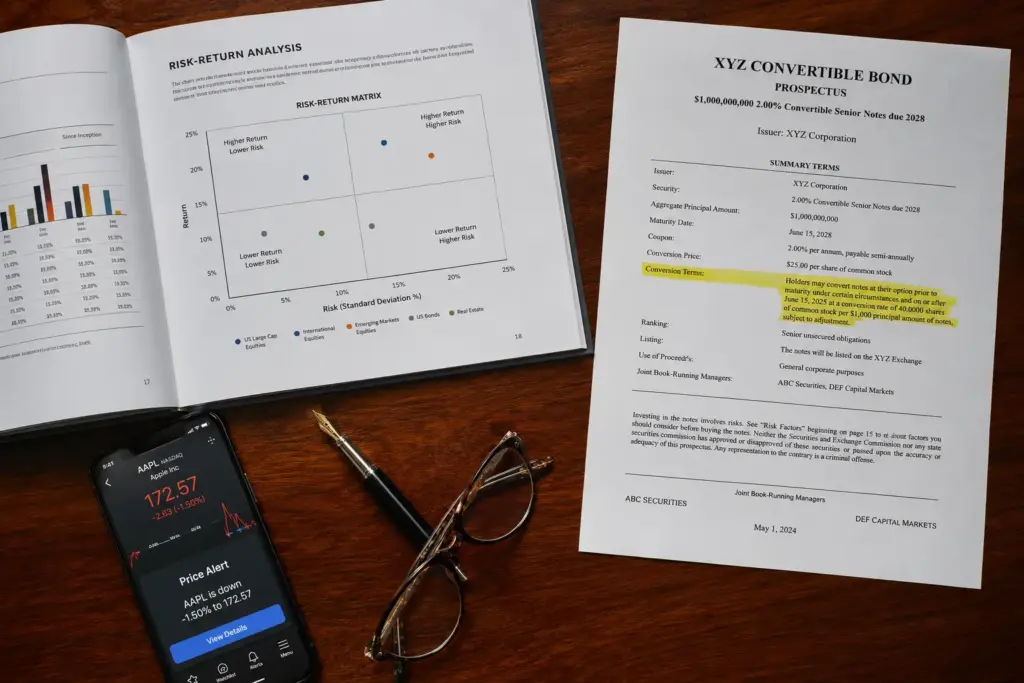
Overhead view of a financial analysis report featuring a risk-return matrix, bond prospectus with highlighted conversion terms, smartphone stock price alert, fountain pen, and reading glasses on a polished walnut boardroom table.

What Risks Should Investors Understand Before Buying?

The hybrid nature that makes convertibles attractive is also the source of their complexity — and their risk. Investors should approach these instruments with a clear understanding of the following:

Credit risk remains paramount. A convertible bond is still a corporate debt obligation. If the issuer becomes insolvent, the bondholder faces potential loss of both income and principal. Unlike investment-grade government bonds, most convertibles are issued by companies with sub-investment-grade or unrated credit profiles, making issuer due diligence essential.


Conversion does not guarantee profit. Converting into shares starts a new clock on a purely equity investment. If the company’s share price subsequently declines after conversion, the investor has locked in an equity loss. The bond safety net no longer exists once conversion is exercised.

Call provisions can cap your return. Many convertible bonds are also callable, meaning the issuer can redeem the bond before maturity — often when the share price has risen well above the conversion price, which is precisely when investors would most want to hold. A forced call can cut off the full equity participation investors were expecting.

Liquidity is often limited. Convertible bonds do not always have the same secondary market depth as major government or investment-grade corporate bonds. Selling before maturity can involve meaningful price impact, particularly for bonds issued by smaller companies.

Lower income than comparable straight bonds. Because you are paying for the equity option through a reduced coupon, the income generated is structurally lower than a plain bond of equal credit quality and maturity. Investors who need consistent high income may find this trade-off unfavourable. Reviewing bond yield to maturity comparisons across instrument types is a useful step when making this assessment.

For institutional investors with more complex portfolio mandates, convertible bond analysis spans credit research, equity analysis, and derivatives pricing simultaneously — which is why access to professional-grade research and execution matters, particularly for institutional fund and family office clients.

How Do Convertible Bonds Fit into a Portfolio Strategy?

Convertible bonds occupy a specific niche in asset allocation — they work best when an investor has a moderately bullish view on equities but wants to limit the severity of downside outcomes. They are not a replacement for a core bond allocation, nor are they a substitute for direct equity exposure. They function as a bridge between the two.

In practice, convertibles often appear in portfolios as a tactical position during periods of elevated equity market uncertainty, when investors want to remain invested in growth-oriented companies without accepting the full draw-down risk of their stock. They can also serve as a complement to short-term and intermediate-term bond holdings, adding equity optionality to what would otherwise be a purely income-driven fixed income sleeve.

For retail investors, the most practical route into convertible bonds is through professionally managed funds or structured products that bundle multiple convertibles into a single, diversified exposure. For direct investors with larger capital bases, access to specific convertible issues requires a brokerage relationship that covers global debt markets across multiple jurisdictions.

Start Investing in Global Fixed Income

Open your account and access bonds, debentures, and structured instruments with PhillipCapital DIFC.

trading account opening uae banner

Conclusion & Key Takeaways

Convertible bonds are a thoughtfully engineered instrument that reward investors who understand both fixed income and equity mechanics. The bond structure provides a measurable floor; the equity option provides a ceiling-free upside under the right conditions. In exchange for this flexibility, investors accept a lower coupon, a more complex risk profile, and the possibility that call provisions or poor equity performance can undermine the expected return.

The key questions before investing in any convertible bond are: What is the issuer’s credit standing? Is the current share price anywhere near the conversion price? Does the call schedule restrict your participation in potential upside? And does the lower coupon still make sense relative to alternatives of comparable maturity and credit quality? Answering these questions accurately — rather than relying on the hybrid label alone — is what separates informed convertible bond investing from speculative positioning.

Frequently Asked Questions (FAQs)

Are convertible bonds better than regular bonds?

Not categorically — it depends on your objective. If you want pure income with minimal complexity, a straight bond is simpler. Convertibles make sense when you want a degree of equity participation alongside the bond’s income floor, and you are comfortable with the additional risks that come with it.

What happens if I never convert my convertible bond?

The bond simply runs to maturity in the normal way. You continue collecting coupon payments throughout the term, and the issuer repays the full face value on the maturity date, provided they have not defaulted or called the bond early.

Can a company force conversion on a convertible bond?

Yes, in some cases. Mandatory convertibles require conversion on a set date regardless of the share price. Callable convertibles allow the issuer to redeem the bond early, which often has the practical effect of forcing investors to convert or accept the call price.

Do convertible bonds carry higher risk than regular corporate bonds?

They carry a different combination of risks — including credit risk, equity risk after conversion, call risk, and lower income — rather than simply “more” risk. Whether they are right for you depends on your tolerance for each of those specific risk types.

Disclaimer:

Trading foreign exchange and/or contracts for difference on margin carries a high level of risk, and may not be suitable for all investors as you could sustain losses in excess of deposits. The products are intended for retail, professional and eligible counterparty clients. Before deciding to trade any products offered by PhillipCapital (DIFC) Private Limited you should carefully consider your objectives, financial situation, needs and level of experience. You should be aware of all the risks associated with trading on margin. The content of the Website must not be construed as personal advice. For retail, professional and eligible counterparty clients. Before deciding to trade any products offered by PhillipCapital (DIFC) Private Limited you should carefully consider your objectives, financial situation, needs and level of experience. You should be aware of all the risks associated with trading on margin.

Rolling Spot Contracts and CFDs are complex instruments and come with a high risk of losing money rapidly due to leverage. 78% of our retail client accounts lose money while trading with us. You should consider whether you understand how Rolling Spot Contracts and CFDs work, and whether you can afford to take the high risk of losing your money.