

Z-spread vs OAS Z-Spread vs OAS: How These Two Bond...
Read MoreRepurchase Agreement (Repo)
Introduction
Every day, banks, governments, and institutional investors move trillions of dollars through one of the least talked-about corners of the financial system: the repo market. Repurchase agreements, or repos, keep short-term funding markets liquid, help central banks steer interest rates, and give bond holders a way to earn a return on securities that would otherwise sit idle. Yet most retail investors have never heard the term, even though it quietly influences the interest rates on their savings accounts and money market funds.
This guide breaks down repurchase agreements from first principles: what they are, how the mechanics actually work, who uses them, and why they matter to anyone following fixed income markets. Along the way, we will look at the difference between repos and reverse repos, the risks involved, and how repo activity connects to the broader bond market that PhillipCapital DIFC clients trade every day.
Table of Contents
- What Is a Repurchase Agreement (Repo)?
- How Does a Repo Transaction Actually Work?
- How Is the Repo Rate Different from a Bond’s Yield?
- What Types of Repurchase Agreements Exist?
- Who Uses Repos and Why?
- What Is the Role of Collateral and Haircuts in a Repo?
- What Is a Reverse Repo, and How Does It Differ from a Repo?
- What Risks Are Associated with Repo Transactions?
- How Do Central Banks Use Repos to Manage Monetary Policy?
- How Can Investors Access the Repo Market?
- Frequently Asked Questions
- Conclusion: Why Repos Matter to Every Fixed Income Investor
What Is a Repurchase Agreement (Repo)?
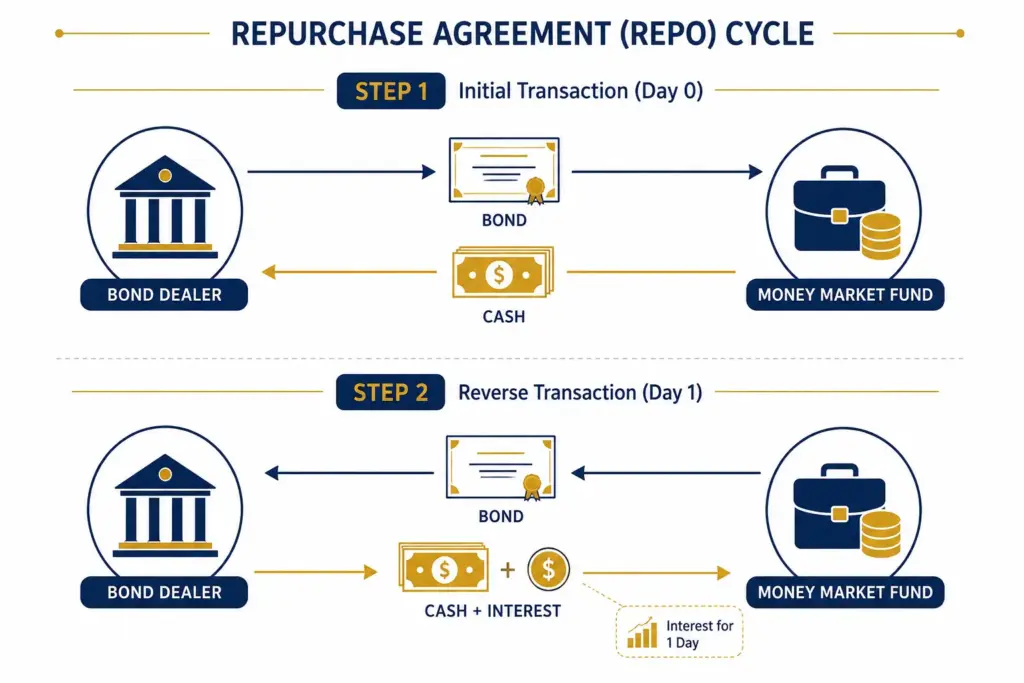
A repurchase agreement, or repo, is a short-term transaction in which one party sells a security, usually a government bond, and simultaneously agrees to buy it back at a slightly higher price on a specified future date. In substance, it works like a collateralized loan: the seller receives cash today and pays it back with interest, while the buyer holds the security as collateral until repayment.
Although a repo is structured legally as a sale and a subsequent repurchase, economically it functions as secured borrowing.
The party selling the security (and agreeing to buy it back) is the borrower of cash, while the party buying the security (and agreeing to sell it back) is the lender of cash. The difference between the sale price and the repurchase price represents the interest charged on the loan, commonly called the repo rate.
Repos typically use highly liquid, high-quality collateral such as government treasury bills, government bonds, or investment-grade corporate bonds. This is what allows the transaction to be arranged quickly, priced tightly, and unwound with minimal friction, even for very large sums of money.
Why the Repo Market Matters
The global repo market handles enormous daily volumes because it solves a basic problem: institutions holding large bond portfolios often need short-term cash, while other institutions holding surplus cash want a safe, short-term place to park it. A repo connects these two needs, using bonds as the bridge.
For readers who want the bigger picture of how these short-term funding markets fit together, our overview on Understanding the Money Market explains where repos sit alongside treasury bills, commercial paper, and interbank lending.
How Does a Repo Transaction Actually Work?
A repo works in two linked legs: an initial sale of securities for cash, followed by an agreed repurchase of the same (or equivalent) securities at a set future date and price. The gap between the two prices, annualized, gives the repo rate, which is effectively the cost of borrowing cash against that collateral.
Consider a simplified example. A bond dealer holds government bonds worth 10,000,000 AED and needs short-term cash. The dealer enters into an overnight repo with a money market fund, selling the bonds for 10,000,000 AED with an agreement to repurchase them the next day for 10,001,400 AED. That 1,400 AED difference reflects an annualized repo rate of roughly 5.11%, calculated on an overnight basis. The bond dealer gets same-day liquidity, and the money market fund earns a small, low-risk return secured against government bonds.
- Leg 1 (opening leg): Seller transfers securities to buyer; buyer transfers cash to seller.
- Leg 2 (closing leg): On the agreed date, buyer transfers the securities back; seller repays the cash plus interest.
- Term: Repos can be overnight, for a few days, or for a fixed term extending to several months.
- Legal ownership: During the life of the repo, legal title to the securities passes to the cash lender, which is what makes the arrangement secured.
Overnight vs. Term Repos
Most repo activity is overnight, meaning the transaction is unwound the next business day and, if both parties want to continue, a new repo can be arranged. Term repos, by contrast, lock in a rate and a maturity date ranging from a few days to several months, giving both counterparties more certainty over that period. Institutions managing predictable cash needs, such as month-end liquidity requirements, often prefer term repos to avoid daily renegotiation.
How Is the Repo Rate Different from a Bond's Yield?
The repo rate is the cost of short-term secured borrowing against a bond, while a bond’s yield reflects the return an investor earns from holding that bond to maturity or over a longer horizon. The two are related but measure fundamentally different things: one prices a short-term loan, the other prices ownership of a long-term cash flow stream.
A bond’s yield incorporates the bond’s coupon rate, its market price, its time to maturity, and the credit risk of the issuer. It answers the question: “What return will I earn if I buy and hold this bond?” The repo rate, on the other hand, answers a narrower question: “What does it cost me to borrow cash for a day, a week, or a month, using this bond as collateral?”
Because repo transactions are typically collateralized by very safe securities and settled quickly, repo rates tend to track closely with a country’s benchmark short-term interest rate, sitting near the overnight policy rate set by the central bank. Bond yields, by contrast, are shaped by the full shape of the yield curve, reflecting market expectations for interest rates and inflation over the entire life of the bond. Investors researching how these expectations get priced across maturities may find it useful to review our guide on the Fixed Income Yield Curve.
| Feature | Repo Rate | Bond Yield |
|---|---|---|
| What it measures | Cost of short-term secured cash borrowing | Return from holding a bond over its life |
| Typical time horizon | Overnight to a few months | Months to several decades |
| Primary driver | Central bank policy rate, collateral demand | Coupon, price, credit risk, maturity |
| Volatility | Can spike sharply around liquidity stress | Moves more gradually with rate expectations |
| Who sets it | Negotiated between counterparties, influenced by the central bank | Set by market supply and demand for the bond |
What Types of Repurchase Agreements Exist?
Repurchase agreements come in several structural variations, primarily distinguished by how the collateral is held and settled, rather than by the underlying economics of the loan. The three most common structures investors encounter are bilateral repos, tri-party repos, and held-in-custody repos.
Bilateral repos involve just two parties, the cash borrower and the cash lender, who negotiate terms directly and arrange settlement of the collateral between their own custodian accounts. This structure is common between large banks and dealers with established trading relationships.
Tri-party repos bring in a third-party clearing agent, typically a large custodian bank, that manages collateral allocation, valuation, and settlement on behalf of both counterparties. This reduces operational burden and settlement risk, which is why tri-party structures dominate the institutional repo market, particularly for large money market fund and dealer transactions.
Held-in-custody repos are less common today. In this structure, the seller retains physical custody of the collateral in a segregated account rather than transferring it to the buyer, which introduces additional counterparty risk since the buyer has less direct control over the securities backing the loan.
- General collateral (GC) repos: The buyer accepts any security from an agreed pool that meets minimum credit and liquidity standards, rather than one specific bond.
- Special (specific) repos: The buyer requires one particular security, often because that bond is in high demand for delivery elsewhere, which can push its repo rate below the general collateral rate.
- Open repos: Have no fixed maturity date and continue on a day-to-day basis until either party chooses to terminate.
Understanding these variations matters because the structure affects settlement speed, counterparty exposure, and pricing. Investors who want to see how these mechanics compare to standard bond settlement can review our article on Bond Trading Mechanics.
Start Building Your Fixed Income Portfolio
Access global bonds and debentures through a DFSA-regulated broker built for serious investors.
Who Uses Repos and Why?
Repos are used primarily by banks, primary dealers, money market funds, hedge funds, and central banks, each with a different motivation ranging from short-term funding to yield enhancement to monetary policy implementation. The common thread is that all participants are managing either a temporary cash shortfall or a temporary cash surplus.
- Bond dealers and broker-dealers use repos to finance their bond inventories. Rather than tying up capital in bonds they plan to hold only briefly, dealers repo out the bonds overnight to raise cash, repeating the process daily until the bonds are sold.
- Money market funds are major repo lenders, using repos as a safe, liquid place to park investor cash while earning a modest, low-risk return backed by government collateral.
- Hedge funds frequently use repos to finance leveraged bond positions, borrowing cash against bonds they already own to buy additional securities, a strategy sometimes described as a leveraged carry trade.
- Commercial banks use repos both to manage short-term liquidity and to meet regulatory reserve requirements efficiently.
- Central banks use repos as a monetary policy tool, injecting or withdrawing liquidity from the banking system to keep short-term interest rates within their target range, a topic covered in more depth later in this guide.
- Institutional investors and family offices may use repos or reverse repos to manage idle cash between investment decisions, earning interest rather than leaving funds uninvested.
Institutional clients working across fixed income, treasury management, or proprietary trading desks often need this kind of short-term liquidity infrastructure alongside their core securities trading. PhillipCapital DIFC’s Institutional Services for Funds and Family Offices support exactly this kind of multi-asset, liquidity-conscious portfolio management.
What Is the Role of Collateral and Haircuts in a Repo?
Collateral is the security pledged in a repo transaction, and the haircut is the discount applied to that collateral’s market value to protect the cash lender against price fluctuations or default risk. A larger haircut means the borrower must post more collateral value relative to the cash received, reducing the lender’s exposure if the collateral needs to be sold quickly.
For example, if a lender applies a 2% haircut on a bond worth 1,000,000 AED, the borrower can raise only 980,000 AED against it, not the full market value. This buffer protects the lender in case the bond’s price falls before the repo matures, or in case the borrower defaults and the lender needs to liquidate the collateral in the open market.
Haircut sizes vary based on several factors:
- Collateral quality: Government treasury securities typically carry small haircuts (often 0.5% to 2%) because they are highly liquid and low risk. Corporate bonds or less liquid securities require larger haircuts.
- Term of the repo: Longer-term repos generally carry higher haircuts than overnight repos, since there is more time for the collateral’s value to move.
- Market volatility: During periods of financial stress, haircuts across the market tend to rise sharply as lenders demand greater protection, which can itself tighten liquidity conditions.
- Counterparty creditworthiness: Borrowers with weaker credit profiles may face higher haircuts even when pledging identical collateral.
Haircuts also interact with margin calls. If the value of the pledged collateral falls during the life of the repo, the lender can issue a margin call requiring the borrower to post additional collateral or cash to restore the agreed haircut level, similar in principle to margin mechanics used in futures and CFD markets.
What Is a Reverse Repo, and How Does It Differ from a Repo?
A reverse repo is simply a repo viewed from the other side of the transaction: it describes the perspective of the party buying securities and lending cash, rather than the party selling securities and borrowing cash. Every repo transaction is simultaneously a repo for the cash borrower and a reverse repo for the cash lender; the terms describe the same trade from opposite vantage points.
The confusion around these terms usually comes from context rather than mechanics. When a central bank conducts a “reverse repo operation,” it is acting as the buyer of securities and lender of cash into the market, temporarily draining reserves from the banking system. When that same central bank conducts a “repo operation,” it is acting as the buyer of cash-equivalent liquidity, injecting reserves into the system against collateral. The labels shift depending on which institution’s transaction is being described.
| Aspect | Repo (Repurchase Agreement) | Reverse Repo |
|---|---|---|
| Who initiates it | The party needing cash (sells securities) | The party with surplus cash (buys securities) |
| Cash flow at start | Receives cash | Pays cash |
| Cash flow at maturity | Repays cash plus interest | Receives cash plus interest |
| Economic role | Secured borrowing | Secured lending |
| Common users | Bond dealers financing inventory | Money market funds, central banks managing liquidity |
Understanding which side of the transaction an institution occupies helps clarify financial news headlines. A report that “money market funds parked record sums in reverse repos” simply means those funds lent cash and received government securities as collateral in return, which is a routine, low-risk way to earn a short-term return on idle balances.
Bring Institutional-Grade Fixed Income Access to Your Portfolio
Trade global sovereign and corporate bonds with a broker regulated by the DFSA.

What Risks Are Associated with Repo Transactions?
While repos are generally considered low-risk because they are collateralized, they are not risk-free. The primary risks include counterparty default risk, collateral price risk, liquidity risk, and, during periods of severe market stress, the possibility that the repo market itself seizes up, as it briefly did during past episodes of acute financial disruption.
- Counterparty risk: If the cash borrower defaults before repurchasing the securities, the cash lender must sell the collateral in the open market. If the collateral has lost value or the market is illiquid at that moment, the lender may not fully recover the cash lent.
- Collateral (market) risk: Bond prices can move between the opening and closing legs of a repo, particularly for longer-term repos. Sharp price declines can erode the protective buffer provided by the haircut.
- Liquidity risk: In stressed conditions, some participants may be unable to roll over overnight repos, forcing a scramble for alternative funding. This is precisely the kind of dislocation that prompts central bank intervention, discussed in the next section.
- Operational and settlement risk: Errors or delays in transferring securities or cash, particularly in bilateral repos without a tri-party agent, can create short-term exposure even when both parties intend to fulfill their obligations.
- Rehypothecation risk: In some jurisdictions, the party receiving collateral may be permitted to re-use, or rehypothecate, that collateral in its own transactions. If the chain of rehypothecated collateral is disrupted, it can complicate the return of specific securities.
Because of these risks, most institutional repo participants rely on tri-party settlement, conservative haircuts, and diversified counterparty exposure to manage the downside, rather than concentrating large positions with a single trading partner.

How Do Central Banks Use Repos to Manage Monetary Policy?
Central banks use repo and reverse repo operations as a primary tool for steering short-term interest rates and managing liquidity in the banking system, injecting cash through repos when they want to ease conditions and draining cash through reverse repos when they want to tighten them. These operations are typically conducted with a select group of eligible counterparties, often called primary dealers.
When a central bank wants to add liquidity to the financial system, it conducts a repo operation: it purchases eligible securities from banks or primary dealers, temporarily injecting cash into the banking system, with an agreement to sell those securities back later. This tends to push short-term rates lower, since more cash is chasing the same short-term investment opportunities.
Conversely, when a central bank wants to withdraw liquidity, it conducts a reverse repo operation: it sells securities to eligible counterparties and simultaneously agrees to buy them back, pulling cash out of the system. This tends to support or raise short-term rates, since less cash is available in the overnight market.
The U.S. Federal Reserve, for example, operates both a Standing Repo Facility, which provides a backstop source of overnight funding to primary dealers against eligible securities, and an Overnight Reverse Repurchase Agreement facility, which allows a broad set of eligible counterparties to invest cash overnight against Treasury collateral, helping keep the federal funds rate within its target range.
Locally, the Central Bank of the UAE manages dirham liquidity through a comparable toolkit of domestic market operations, including its Overnight Deposit Facility and structural open market operations, which serve a similar liquidity-management function within the UAE banking sector.
Understanding this connection matters for investors: shifts in central bank repo activity often precede or accompany broader moves in short-term rates, money market yields, and, eventually, the shape of the yield curve itself.
How Can Investors Access the Repo Market?
Direct participation in the institutional repo market is generally limited to banks, primary dealers, large asset managers, and other institutional counterparties, but retail and professional investors gain indirect exposure to repo activity primarily through money market funds and short-term fixed income instruments. For most individual investors, this indirect route is both more practical and more appropriate than attempting to negotiate bilateral repo agreements.
- Money market funds: Many money market funds invest a portion of their portfolio directly in repos, particularly government-collateral repos, passing the resulting yield through to fund investors as part of the fund’s overall return.
- Short-term government securities: Investors seeking similar liquidity and safety characteristics without engaging in repo transactions directly can consider treasury bills and other short-dated government instruments, which our Primary vs Secondary Bond Markets guide explains in the context of how new and existing bonds are bought and sold.
- Institutional trading desks: Professional and institutional clients with sufficient scale and appropriate documentation may access repo financing directly through prime brokerage or institutional trading relationships to finance leveraged bond positions.
- Understanding repo-linked benchmarks: Investors evaluating floating rate instruments or short-term funds should also understand how repo-referenced benchmark rates feed into pricing, since many money market and short-duration products are priced with reference to overnight secured funding rates.
For UAE-based investors building a diversified fixed income allocation, working through a regulated broker with genuine access to global bond and debenture markets, along with institutional-grade market context, remains the most practical way to capture the liquidity benefits that the repo market provides indirectly.
Frequently Asked Questions (FAQs)
Is a repo the same as a loan?
Not legally, but economically, yes. A repo is structured as a sale and repurchase of securities, but it functions as a collateralized loan, with the price difference between the two legs representing the interest charged.
What happens if the repo counterparty defaults?
The non-defaulting party can typically sell the collateral in the open market to recover the cash owed. This is why haircuts exist, to provide a buffer in case the collateral’s value has fallen by the time it needs to be sold.
Why do repo rates sometimes spike sharply?
Repo rates can spike when demand for short-term cash outpaces available supply, often due to large, simultaneous funding needs across the market, such as quarter-end reporting dates or unexpected liquidity shortages, which is exactly the kind of stress central bank repo facilities are designed to relieve.
Can individual retail investors trade repos directly?
Direct bilateral or tri-party repo participation is generally reserved for institutional counterparties. Retail investors typically gain exposure indirectly through money market funds or short-term fixed income products rather than negotiating repo agreements themselves.
Conclusion: Why Repos Matter to Every Fixed Income Investor
Repurchase agreements may operate largely behind the scenes, but they form one of the load-bearing structures of global fixed income markets. They allow bond dealers to finance inventory, give money market funds a safe place to invest cash, and provide central banks with a precise tool for managing short-term interest rates. Every time you see a headline about the Federal Reserve’s repo operations or a central bank adjusting overnight liquidity, you are watching this mechanism in action.
For fixed income investors, understanding repos adds real depth to how you read the market: why short-term rates behave the way they do, how liquidity conditions shift around key dates, and how money market funds generate the yields they pass on to investors. Investors may consider building this understanding alongside a broader fixed income allocation as part of a well-diversified portfolio strategy.
PhillipCapital DIFC offers UAE-based investors access to global sovereign and corporate bonds, backed by DFSA regulation and institutional-grade market research, making it a practical starting point for putting fixed income knowledge into practice.
Ready to Diversify with Fixed Income?
Access sovereign and corporate bonds through PhillipCapital DIFC's regulated trading platform.
Disclaimer:
Trading foreign exchange and/or contracts for difference on margin carries a high level of risk, and may not be suitable for all investors as you could sustain losses in excess of deposits. The products are intended for retail, professional and eligible counterparty clients. Before deciding to trade any products offered by PhillipCapital (DIFC) Private Limited you should carefully consider your objectives, financial situation, needs and level of experience. You should be aware of all the risks associated with trading on margin. The content of the Website must not be construed as personal advice. For retail, professional and eligible counterparty clients. Before deciding to trade any products offered by PhillipCapital (DIFC) Private Limited you should carefully consider your objectives, financial situation, needs and level of experience. You should be aware of all the risks associated with trading on margin.
Rolling Spot Contracts and CFDs are complex instruments and come with a high risk of losing money rapidly due to leverage. 78% of our retail client accounts lose money while trading with us. You should consider whether you understand how Rolling Spot Contracts and CFDs work, and whether you can afford to take the high risk of losing your money.

Repurchase Agreements (Repos)
Repurchase Agreement (Repo) Introduction Every day, banks, governments, and institutional...
Read More
Understanding the Money Market
Understanding the Money Market Introduction Every investor eventually asks the...
Read More

Bond Trading Mechanics
Bond Trading Mechanics Table of Contents Introduction What Does Bond...
Read More
Primary vs Secondary Bond Markets
Primary vs Secondary Bond Markets Table of Contents Introduction What...
Read More
Bond Market Structure and Participants
Bond Market Structure and Participants Table of Contents Introduction What...
Read More
Deferred Coupon Bonds
Perpetual Bonds Table of Contents Introduction What Are Deferred Coupon...
Read More

Inflation-Linked Bonds
Inflation-Linked Bonds Introduction Inflation is the silent tax that erodes...
Read More
Convertible Bonds Basics
Convertible Bonds Explained: Structure, Benefits, and Risks for Investors Table...
Read More
Callable and Putable Bonds
Callable and Putable Bonds Table of Contents Introduction What Is...
Read More


Municipal Bonds and Tax Implications
Municipal Bonds & Tax Implications Introduction When investors look for...
Read More
Corporate Bonds and Corporate Credit
Government Bonds & Treasury Securities Guide Table of Contents Introduction...
Read More
Government Bonds & Treasury Securities
Government Bonds & Treasury Securities Guide Introduction When markets get...
Read More

Prepayment Risk and Extension Risk
Prepayment Risk & Extension Risk in Bonds Understanding Prepayment Risk...
Read More
Liquidity Risk in Fixed Income
Liquidity Risk in Fixed Income Understanding Liquidity Risk in Fixed...
Read More

Interest Rate Risk Management
Interest Rate Risk Management Master Interest Rate Risk Management in...
Read More

Bond Duration & Interest Rate Risk Explained
Bond Duration & Interest Rate Risk Explained Table of Contents...
Read More
Macaulay Duration Explained
Macaulay Duration Explained Macaulay Duration Explained: A Comprehensive Guide for...
Read More
Modified Duration and Its Impact on Price
Modified Duration and Its Impact on Bond Prices Introduction Navigating...
Read More
Understanding Bond Duration
Understanding Bond Duration Introduction When stepping into the fixed-income market,...
Read More
Bond Valuation Methods and Formulas
Bond Valuation Methods Mastering Bond Valuation Methods and Formulas: A...
Read More
The Inverse Relationship Between Bond Prices and Yields
The Inverse Relationship Between Bond Prices and Yields Table of...
Read More
Current Yield vs Yield to Maturity
Understanding Current Yield vs. Yield to Maturity Understanding Current Yield...
Read More