Bond Trading Mechanics

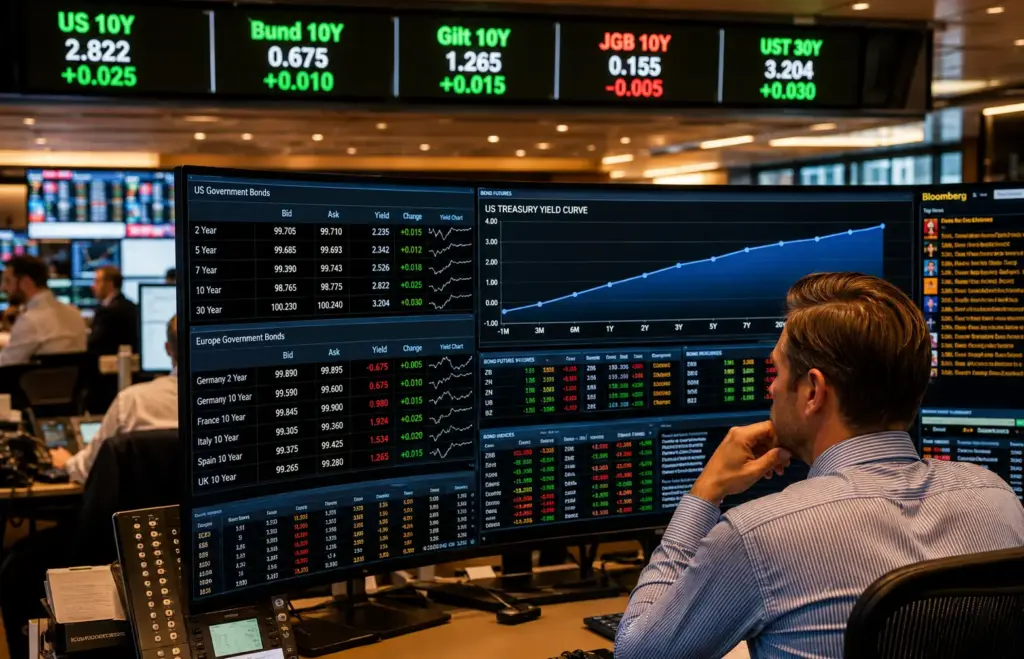
Bond trading mechanics with trader analyzing government bond yields and market prices

Introduction

Most investors understand what a bond is long before they understand how one is actually traded. A stock trade feels intuitive because prices flash on a screen and orders fill in seconds. Bond trading, by contrast, happens largely behind the scenes, through networks of dealers, brokers, and institutional desks rather than a single centralised exchange. For anyone building a fixed income allocation, understanding these mechanics is not optional trivia. It shapes the price you get, how quickly you can enter or exit a position, and how comfortable you should feel holding a bond until maturity versus trading it actively. 

This guide breaks down the mechanics of bond trading in plain language, covering how orders move from decision to settlement, why pricing works differently than in equities, and what every investor should check before placing a trade.

What Does Bond Trading Actually Mean?

Bond trading refers to the buying and selling of debt securities after they have already been issued. When a government or company first sells a bond, that happens in the primary market. Every transaction after that first sale, whether it happens a week later or ten years later, is part of the secondary market, and this is where the real mechanics of bond trading come into play.

Unlike a share of stock, a bond represents a loan with a fixed repayment schedule. This means its trading price is influenced by a different set of forces: prevailing interest rates, the remaining time to maturity, the issuer’s creditworthiness, and the coupon rate attached to the bond. If you are comparing structures across different issuers, reviewing the categories covered in bond types and structures is a useful starting point, since the trading behaviour of a government bond can differ meaningfully from that of a corporate or convertible bond.

Because bonds are priced off a constantly shifting yield curve rather than pure supply and demand alone, two bonds issued by the same entity but with different maturities can trade at noticeably different price movements on the same day, even though nothing about the issuer changed.

How Is a Bond Traded From Start to Finish?

A typical bond trade moves through a fairly consistent sequence, whether it is placed by a retail investor or an institutional desk.

Step one: Price discovery. The investor or their broker checks indicative prices from one or more dealers. Unlike listed equities, there is rarely one single visible price; instead, several dealers quote slightly different levels based on their own inventory and risk appetite.

Step two: Quote request and negotiation. For larger trades in particular, the investor’s broker requests a firm quote from a dealer, sometimes comparing quotes across two or three counterparties to secure a competitive price.

Step three: Trade execution. Once a price is agreed, the trade is confirmed, capturing the bond’s identifier, quantity, price, and settlement date.

Step four: Clearing and settlement. The trade is processed through a clearing system, and ownership transfers once cash and securities are exchanged, which is discussed in more detail later in this guide.

If this process feels more manual than a typical online stock purchase, that is because it genuinely is. Even electronic bond trading platforms are essentially organising this same dealer-based negotiation into a faster digital format rather than replacing it with a fully open order book. Investors exploring this asset class for the first time often benefit from reviewing bond basics before placing their first trade, since foundational concepts like face value and coupon rate directly affect how a trade is priced.

What Is the Difference Between the Primary and Secondary Bond Market?

The primary market is where a bond is born. A government or corporation issues new debt, often through an underwriting bank, and investors buy directly from that initial offering at face value or a set issue price. This is how the initial pool of government bonds, corporate bonds, and sovereign debt enters circulation, whether purchased through auctions or syndicated offerings.

The secondary market is everything that follows. Once bonds are issued, they can be bought and sold among investors for the remainder of their life until maturity or call. Prices in the secondary market move constantly, reflecting changes in interest rates, credit outlook, and overall demand for that maturity bracket.

For most individual and institutional investors accessing fixed income through a brokerage relationship, secondary market trading is where almost all activity happens. If you are researching specific opportunities across sovereign and corporate issuers, PhillipCapital DIFC’s Global Bond Market offering provides direct access to this secondary trading environment across multiple currencies and credit profiles.

Why Do Most Bonds Trade Over-the-Counter Instead of on an Exchange?

Unlike listed shares, the vast majority of bonds trade over-the-counter, commonly shortened to OTC. This means trades are negotiated directly between two parties, typically an investor’s broker and a dealer, rather than matched anonymously on a centralised exchange order book.

There is a practical reason for this. There are far more individual bond issues in existence than there are listed stocks, since every company and government can issue multiple bonds with different maturities, coupons, and currencies. Concentrating that volume onto a single exchange would fragment liquidity further rather than improving it. Instead, dealers hold inventories of various bonds and quote prices based on their own books, market conditions, and client demand.

This structure means that price transparency in bond trading works differently than it does for equities. Two investors buying the same bond on the same day, through different dealers, may see slightly different prices depending on which dealer’s inventory and spread applies. This is a normal feature of the market rather than a sign of unfair pricing, but it does mean shopping quotes across brokers can be worthwhile for larger positions.

How Does Bond Pricing Work During a Trade?

Bond prices move inversely to interest rates. When benchmark rates rise, existing bonds with lower fixed coupons become less attractive, so their market price falls to compensate new buyers with a higher effective yield. When rates fall, the reverse happens. This relationship is one of the most important mechanics to understand before placing any trade, and it is explored in far more depth in the dedicated guide on bond pricing and valuation.

At the point of trade, a bond’s quoted price is typically expressed as a percentage of its face value. A price of 98 means the bond is trading at 98% of face value, or a discount, while a price of 102 reflects a premium above face value. Traders also watch yield to maturity closely, since it captures the total return an investor would earn if the bond is held until it matures, factoring in the purchase price, coupon payments, and time remaining.

Duration is another factor that quietly shapes trading decisions, since it measures how sensitive a bond’s price is to interest rate changes. Longer-duration bonds tend to see larger price swings for the same change in rates, a concept covered in detail in bond duration and risk. Traders managing a portfolio of different maturities use this to judge how much price movement to expect from a given trade before it even settles.

Access Global Fixed Income Markets

Trade sovereign and corporate bonds across multiple currencies with a DFSA-regulated broker.

What Is the Bid-Ask Spread in Bond Trading?

Every bond quote consists of two prices: the bid, which is what a dealer will pay to buy the bond from you, and the ask, which is what they will charge to sell it to you. The gap between these two prices is the bid-ask spread, and it represents one of the main implicit costs of trading a bond, separate from any commission charged by a broker.

Spreads are not fixed. They widen and narrow based on how frequently a bond trades. A recently issued government bond from a major economy might have a spread of just a few cents per hundred dollars of face value, reflecting deep liquidity and constant dealer activity. An older corporate bond from a smaller issuer, traded infrequently, can carry a much wider spread, since the dealer holding it takes on more risk before finding a buyer.

For active traders, spread awareness matters as much as the headline yield. A bond offering a slightly higher yield but a much wider spread may end up costing more in practice once you account for the price paid on entry versus the price received on exit, particularly for shorter holding periods.

Financial broker reviewing bond trade confirmations in a modern Dubai office

What Role Do Bond Brokers and Market Makers Play?

Because bond trading is dealer-driven rather than exchange-driven, brokers and market makers sit at the centre of almost every transaction. A market maker is typically a bank or specialist dealer that holds an inventory of bonds and stands ready to buy or sell at quoted prices, absorbing short-term supply and demand imbalances.


A brokerage acts as the investor’s access point into this dealer network, sourcing competitive quotes, handling trade confirmation, and managing the settlement process on the client’s behalf. This is particularly relevant for larger denominations common in institutional-grade fixed income, where minimum investment amounts can run into tens or hundreds of thousands of dollars depending on the issuer and bond type.

Working with an established broker also matters for access. Many attractive corporate and sovereign issues are not widely advertised and are instead sourced through relationships and dealer networks, which is one of the reasons investors exploring this space often start with a regulated brokerage relationship rather than attempting to source bonds independently.

How Does Bond Settlement and Clearing Actually Happen?

Once a bond trade is agreed, it does not settle instantly the way many electronic stock trades do. Bond settlement typically follows a set cycle, commonly one or two business days after the trade date, though this can vary by market and bond type. During this window, the clearing process confirms trade details between both parties and prepares for the actual exchange of cash and securities.

On settlement day, ownership of the bond transfers from seller to buyer through a custodial or clearing system, while the corresponding cash payment moves in the opposite direction. For most retail and institutional investors accessing global fixed income, this settlement is handled through custody arrangements with the broker, meaning the bond is held securely on the investor’s behalf rather than requiring any physical transfer.

This settlement structure is one reason fixed income trading tends to feel slower and more deliberate than equity trading, and it is a detail worth understanding clearly before committing to larger positions, since funds are typically required to be in place ahead of the settlement date rather than at the moment the trade is agreed.

What Is Accrued Interest and Why Does It Matter When You Trade?

Bonds pay interest periodically, often every six months, but trading happens every business day in between those payment dates. To keep pricing fair, buyers compensate sellers for the interest that has accumulated since the last coupon payment, known as accrued interest.

In practice, this means the amount an investor actually pays for a bond, called the dirty price or full price, is higher than the quoted clean price by the amount of interest accrued up to the settlement date. On the next coupon date, the new owner receives the full interest payment, effectively being reimbursed for the accrued amount they paid at purchase.

This mechanic often surprises newer investors who expect the quoted price to be the final price. Understanding accrued interest is essential for correctly comparing bonds and for anticipating the true cash outlay required to settle a trade, particularly when trading bonds close to a coupon date.

Diversify With Structured Fixed Income Solutions

Combine traditional bonds with tailored structured notes for a more resilient portfolio.

Is the Bond Market Liquid Enough for Everyday Investors?

Liquidity varies enormously across the bond universe. Large, recently issued government bonds from major economies are among the most liquid instruments in global finance, trading in high volumes with tight spreads throughout the trading day. At the other end of the spectrum, smaller corporate issues or older bonds nearing maturity can trade infrequently, sometimes with days passing between transactions.

This liquidity spectrum has direct implications for trading mechanics. Highly liquid bonds allow investors to enter and exit positions with minimal price impact, while less liquid issues may require patience, wider spreads, or working an order through a broker over time rather than expecting an instant fill.

For investors building a fixed income allocation as part of a broader strategy discussed in fixed income markets, matching liquidity expectations to investment horizon is a practical way to avoid frustration. A long-term holder planning to keep a bond to maturity is far less affected by thin secondary market liquidity than a trader planning to exit within weeks.

Conclusion and Key Takeaways

Bond trading operates on a different rhythm than equity trading, built around dealer networks, negotiated pricing, and settlement cycles rather than a single visible exchange price. Understanding these mechanics changes how an investor approaches the market, from the moment a quote is requested through to the day cash and securities finally exchange hands.

Key takeaways:

  • Bond trading happens mostly over-the-counter through dealer networks rather than a centralised exchange.
  • Prices move inversely to interest rates, and yield to maturity captures total expected return.
  • The bid-ask spread reflects a bond’s liquidity and is a real cost of trading, separate from commissions.
  • Settlement typically takes one to two business days, and accrued interest adjusts the true price paid between coupon dates.
  • Liquidity varies widely across issuers and maturities, making it important to match trading expectations to the specific bond being considered.

Understanding these mechanics is the foundation for trading fixed income with confidence, whether the goal is steady income, portfolio diversification, or tactical positioning around interest rate cycles.

Frequently Asked Questions (FAQs)

How do beginners start trading bonds?

Most beginners start through a regulated broker offering access to government and corporate bonds, rather than trading directly with dealers, since a broker handles quote sourcing, execution, and settlement.

Why do bond prices go down when interest rates go up?   

A bond’s fixed coupon becomes less attractive when new bonds offer higher rates, so its market price falls until its yield matches current rate levels.

Can you sell a bond before it matures?  

Yes, bonds can be sold anytime in the secondary market before maturity, though the price received depends on current interest rates and the bond’s remaining liquidity.

What is a good yield for a bond right now?

There is no fixed “good” yield, since it depends on the issuer’s credit quality, maturity, and prevailing interest rate environment at the time of comparison.

Start Trading Global Fixed Income Today

Open an account with a trusted DFSA-regulated broker and access bonds across global markets.

trading account opening uae banner

Disclaimer:

Trading foreign exchange and/or contracts for difference on margin carries a high level of risk, and may not be suitable for all investors as you could sustain losses in excess of deposits. The products are intended for retail, professional and eligible counterparty clients. Before deciding to trade any products offered by PhillipCapital (DIFC) Private Limited you should carefully consider your objectives, financial situation, needs and level of experience. You should be aware of all the risks associated with trading on margin. The content of the Website must not be construed as personal advice. For retail, professional and eligible counterparty clients. Before deciding to trade any products offered by PhillipCapital (DIFC) Private Limited you should carefully consider your objectives, financial situation, needs and level of experience. You should be aware of all the risks associated with trading on margin.

Rolling Spot Contracts and CFDs are complex instruments and come with a high risk of losing money rapidly due to leverage. 78% of our retail client accounts lose money while trading with us. You should consider whether you understand how Rolling Spot Contracts and CFDs work, and whether you can afford to take the high risk of losing your money.