

Z-spread vs OAS Z-Spread vs OAS: How These Two Bond...
Read MoreUnderstanding the Money Market
Introduction
Every investor eventually asks the same question: where does short-term cash actually go when it isn’t sitting idle or locked into a long-term bond? The answer, in most cases, is the money market — the part of the financial system built specifically for lending and borrowing over periods shorter than a year.
This guide walks through what the money market is, how it works, who participates in it, and how its instruments differ from longer-dated fixed income products such as government and corporate bonds. Along the way, we’ll look at practical examples of common money market instruments, how their yields behave, and where this fits into a broader investment approach.
By the end, you should have a clear, first-principles understanding of the money market — enough to recognize its instruments when you see them and to know how they compare with other parts of the fixed income universe.
Table of Contents
- What Is the Money Market?
- How Does the Money Market Work?
- What Are the Main Money Market Instruments?
- Who Participates in the Money Market?
- Money Market vs Capital Market: What’s the Difference?
- How Are Money Market Yields Determined?
- What Role Does the Money Market Play in the Wider Economy?
- What Are the Risks of Money Market Instruments?
- How Can Investors Access the Money Market?
- Conclusion
- Frequently Asked Questions

What Is the Money Market?
The money market is the segment of the financial system where short-term debt instruments — typically maturing in one year or less — are issued, traded, and settled. It exists to help governments, banks, and corporations manage short-term cash needs, while giving investors a place to park money safely and earn a return.
Unlike the bond market, which deals with longer-dated instruments used to fund multi-year projects or capital expenditure, the money market is built around liquidity and capital preservation.
Instruments here are generally considered low-risk because of their short maturities and, in many cases, the strong credit quality of the issuers involved. Treasury bills, commercial paper, certificates of deposit, and repurchase agreements are the instruments investors encounter most often in this space.
The money market functions largely over-the-counter rather than on a centralized exchange, with transactions arranged directly between banks, corporate treasuries, money market funds, and central banks. Despite operating mostly out of public view, it is one of the largest and most closely watched parts of the global financial system, because interest rates set here influence borrowing costs across the entire economy.
How Does the Money Market Work?
The money market operates as a network of short-term lending and borrowing arrangements between banks, governments, corporations, and institutional investors, rather than as a single physical marketplace. Participants lend surplus cash to those who need it temporarily, in exchange for interest, using standardized short-term instruments.
At its core, the mechanics are straightforward. A government or company that needs cash for a short period — to cover payroll, settle supplier invoices, or bridge a temporary funding gap — issues a short-term instrument such as a Treasury bill or commercial paper note. Investors, including money market funds, banks, and large corporations with excess cash, purchase these instruments at a discount to their face value or in exchange for a stated interest payment.
Settlement in the money market tends to be fast, often same-day or next-day, which is part of what makes it so central to short-term liquidity management. Many transactions, particularly repurchase agreements, are collateralized, meaning the borrower pledges securities (often government bonds) as security for the cash borrowed. This collateralization, combined with short maturities, is a major reason money market instruments are generally viewed as lower-risk relative to longer-dated fixed income securities.
Because money market instruments mature so quickly, investors are constantly reinvesting as positions come due. This creates a rolling cycle of issuance and redemption that keeps large amounts of capital moving through the system on a near-continuous basis.
Ready to broaden your fixed income exposure beyond short-term instruments?
Explore government, corporate, and other bond structures suited to different time horizons and risk profiles.
What Are the Main Money Market Instruments?
The money market includes several distinct instrument types, each designed for a specific short-term funding purpose. The most common are Treasury bills, commercial paper, certificates of deposit, repurchase agreements, and banker’s acceptances — all maturing in a year or less.
Treasury bills (T-bills) are short-term debt securities issued by national governments to fund immediate budgetary needs. They are typically sold at a discount to face value, with the investor’s return coming from the difference between the purchase price and the amount received at maturity. Because they are backed by a sovereign government, T-bills are often viewed as among the safest instruments available in the money market.
Commercial paper is unsecured short-term debt issued by corporations, typically to fund working capital, inventory, or accounts receivable. It’s generally issued by companies with strong credit profiles, since commercial paper isn’t backed by collateral — investors are relying purely on the issuer’s creditworthiness.
Certificates of deposit (CDs) are time deposits issued by banks that pay a fixed interest rate over a set period, ranging from a few weeks to several months in a money market context. Unlike a regular savings account, funds in a CD are typically committed for the full term, though many CDs can be traded before maturity in a secondary market.
Repurchase agreements (repos) involve one party selling securities — often government bonds — to another with an agreement to repurchase them at a slightly higher price on a specified future date. Economically, a repo functions like a short-term, collateralized loan, and it’s one of the primary tools banks and central banks use to manage overnight liquidity.
Banker’s acceptances are short-term debt instruments guaranteed by a bank, historically used to finance international trade transactions. The bank’s guarantee reduces credit risk for the holder, making these instruments attractive to investors seeking short-dated, relatively secure paper.
| Instrument | Typical Issuer | Typical Maturity | Collateralized? |
|---|---|---|---|
| Treasury bills | National governments | Up to 1 year | No (sovereign backing) |
| Commercial paper | Corporations | Up to 270 days | No |
| Certificates of deposit | Banks | Weeks to 1 year | No |
| Repurchase agreements | Banks, dealers | Overnight to a few weeks | Yes (securities pledged) |
| Banker’s acceptances | Corporations (bank-guaranteed) | Up to 180 days | Bank guarantee |
Who Participates in the Money Market?
Money market participation spans central banks, commercial banks, corporate treasuries, institutional investors, and money market funds, each using the market for a different combination of funding, liquidity management, or short-term investment purposes.
Central banks are among the most influential participants, using money market operations — particularly repos and short-term lending facilities — to implement monetary policy and manage overnight interest rates. Their activity in this space has a direct bearing on borrowing costs throughout the wider economy.
Commercial banks use the money market to manage their day-to-day liquidity, borrowing from or lending to other banks to meet reserve requirements and cover short-term funding gaps. Corporations, meanwhile, participate on both sides: issuing commercial paper to raise short-term funds, and investing surplus cash in T-bills or CDs when they have more liquidity than they need.
Institutional investors — including pension funds, insurance companies, and asset managers — allocate a portion of their portfolios to money market instruments for capital preservation and liquidity, particularly when holding cash that may be needed on short notice. Money market mutual funds pool capital from individual and institutional investors to invest collectively in a diversified basket of these short-term instruments, offering retail investors indirect access to a market that might otherwise be difficult to enter directly given the large minimum transaction sizes common in this space.
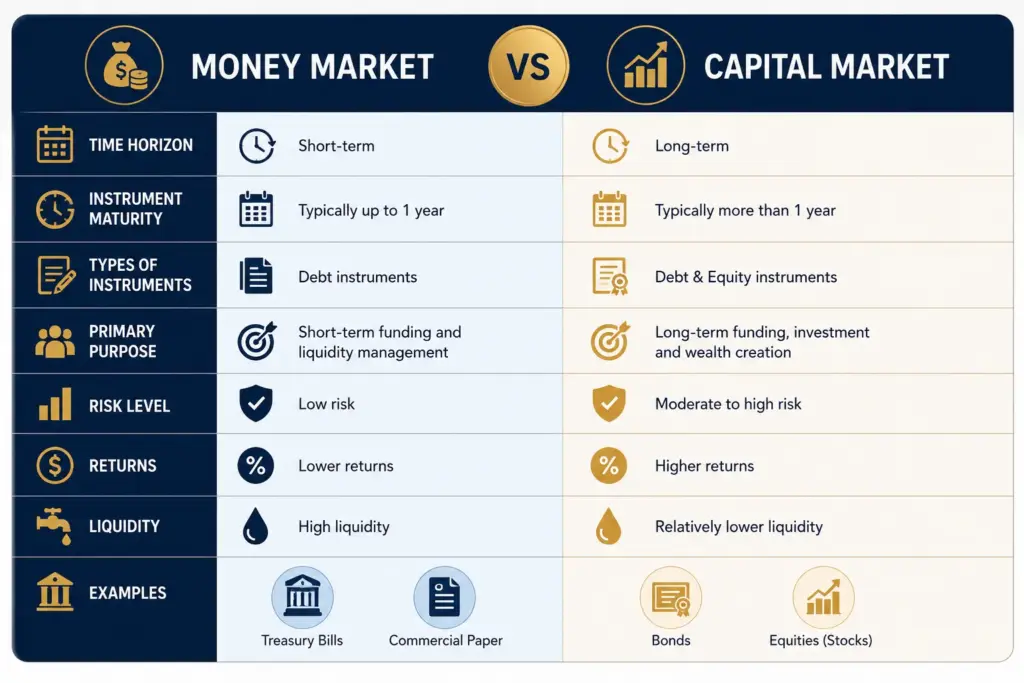
Money Market vs Capital Market
The money market and capital market both channel funds between borrowers and investors, but they differ fundamentally in maturity, purpose, and risk profile. The money market deals in instruments maturing within a year, prioritizing liquidity and capital preservation, while the capital market covers longer-term instruments like bonds and equities, prioritizing growth and income over an extended horizon.
Understanding this distinction matters because it shapes how each market is used within a portfolio.
Money market instruments are generally chosen for parking cash safely and earning modest returns over short holding periods. accepting a higher degree of price volatility and duration risk along the way.Capital market instruments — corporate bonds, government bonds with longer maturities, and equities — are chosen for building long-term wealth, generating steady income, or gaining exposure to company growth,
| Feature | Money Market | Capital Market |
|---|---|---|
| Typical maturity | Under 1 year | Over 1 year, often 5–30 years |
| Primary goal | Liquidity, capital preservation | Growth, income, long-term funding |
| Common instruments | T-bills, commercial paper, CDs, repos | Government/corporate bonds, equities |
| Price volatility | Generally low | Can be moderate to high |
| Typical investors | Banks, corporations, money market funds | Long-term investors, pension funds, retail investors |
| Liquidity/settlement | Very fast, often overnight | Varies by instrument |
Investors interested in how these longer-dated instruments trade once issued may find it useful to review how bond trading mechanics work in practice, which explains order execution and pricing conventions across the fixed income spectrum.
How Are Money Market Yields Determined?
Money market yields are shaped primarily by central bank policy rates, the credit quality of the issuer, and prevailing supply and demand for short-term funds. Because maturities are so short, money market instruments are highly sensitive to changes in official interest rates, often adjusting faster than longer-dated bonds.
When a central bank raises or lowers its benchmark policy rate, money market instruments tend to reprice quickly, since new issuance reflects the current rate environment almost immediately. This is different from longer-dated bonds, where existing issues carry fixed coupons and instead see their market prices — rather than newly issued yields — move in response to rate changes. Investors evaluating this relationship in more depth may want to review how the broader fixed income yield curve reflects expectations across different maturities, since money market rates effectively anchor the very short end of that curve.
Credit quality also plays a role, particularly for instruments like commercial paper that aren’t backed by a government guarantee. Corporate issuers with stronger credit ratings can typically borrow at lower rates than those with weaker credit profiles, since investors demand a higher yield to compensate for additional risk.
Supply and demand dynamics matter as well. During periods of market stress, demand for the safest instruments — particularly Treasury bills — can rise sharply as investors seek capital preservation, sometimes pushing yields on these instruments lower even while other short-term rates remain elevated.
Considering fixed income allocation as part of a broader portfolio strategy?
Speak with our team about aligning short-term liquidity needs with longer-term bond and debenture holdings.
What Role Does the Money Market Play in the Wider Economy?
The money market plays a foundational role in the economy by keeping short-term credit flowing between institutions, supporting monetary policy transmission, and providing a reliable venue for governments and corporations to manage day-to-day funding needs. Its smooth functioning underpins confidence across the broader financial system.
Central banks rely heavily on money market instruments and operations, particularly repos, to implement monetary policy. When a central bank wants to influence short-term interest rates, it often does so by adjusting the terms at which it lends to or borrows from banks in the money market, which then ripples out into broader lending rates across the economy. The Federal Reserve’s open market operations are a widely referenced example of how a central bank uses short-term instruments to steer policy rates, while regionally, the Central Bank of the UAE plays an equivalent role in managing liquidity and short-term rates within the UAE financial system.
Beyond monetary policy, the money market provides an essential liquidity buffer for governments financing budget deficits on a rolling basis and for corporations managing seasonal or short-term cash flow gaps. Because these transactions typically settle quickly, the money market also acts as a shock absorber during periods of financial stress, allowing institutions to access short-term funding even when longer-term capital markets become more difficult to navigate.
What Are the Risks of Money Market Instruments?
While money market instruments are generally considered low-risk relative to longer-dated securities, they are not risk-free. Key risks include credit risk on the part of the issuer, interest rate risk affecting reinvestment returns, and liquidity risk during periods of market-wide stress.
Credit risk is most relevant for instruments like commercial paper and banker’s acceptances, which depend on the financial strength of the issuing company or guaranteeing bank rather than a sovereign guarantee. A downgrade in an issuer’s creditworthiness can affect both the yield investors demand and, in more severe cases, the issuer’s ability to roll over maturing debt.
Interest rate risk in the money market shows up differently than in the bond market. Because maturities are so short, price sensitivity to rate changes is limited. The bigger concern is reinvestment risk — the possibility that, as short-term instruments mature, investors are forced to reinvest at lower prevailing rates if the interest rate environment has shifted downward.
Liquidity risk, while typically low under normal conditions, can increase sharply during periods of financial stress, when demand for cash across the system rises simultaneously and short-term credit markets can seize up. This dynamic was evident in several past episodes of financial market disruption, when even highly rated short-term instruments became temporarily harder to trade at expected prices.
Understanding how these dynamics interact with the underlying structure of debt markets more broadly can help put money market risk in context. Investors exploring this connection may find it useful to review bond market structure and the different types of participants involved in fixed income trading generally.
How Can Investors Access the Money Market?
Individual investors typically access the money market indirectly through money market mutual funds, rather than purchasing instruments like commercial paper or large-denomination CDs directly, since minimum transaction sizes in the institutional money market are often prohibitively large for retail participants.
Money market funds pool capital from many investors to purchase a diversified portfolio of short-term instruments, offering participants exposure to the money market’s liquidity and relative safety without requiring direct access to institutional trading desks. These funds typically aim to maintain a stable share price while distributing income generated from the underlying instruments.
For investors seeking direct exposure to specific government-issued short-term paper, some brokers and platforms provide access to Treasury bill auctions or secondary market trading, though minimum investment sizes and settlement processes vary by jurisdiction. Institutional and professional investors, by contrast, often participate directly in repo transactions, commercial paper issuance, and interbank lending as part of broader treasury and liquidity management operations.
Investors weighing whether to hold assets at the short end of the yield curve versus committing to longer maturities may benefit from comparing how bonds are priced and valued in the primary and secondary markets, which provides useful context on how money market instruments fit within a broader fixed income allocation strategy.
Conclusion
The money market may operate largely behind the scenes, but it plays an outsized role in how governments, banks, and corporations manage short-term cash — and in how central banks steer interest rates across the wider economy. For investors, understanding its instruments and mechanics adds an important layer to any fixed income strategy, whether the goal is capital preservation, liquidity management, or simply understanding how short-term rates connect to the longer end of the yield curve.
Key Takeaways:
- The money market covers debt instruments maturing in one year or less, prioritizing liquidity and capital preservation over long-term growth.
- Common instruments include Treasury bills, commercial paper, certificates of deposit, repurchase agreements, and banker’s acceptances — each suited to a different borrower and risk profile.
- Central banks, commercial banks, corporations, and money market funds are the primary participants, each using the market for a distinct funding or liquidity purpose.
- Money market yields move quickly with central bank policy rates, unlike bond prices, which adjust more gradually to changing conditions.
- While generally lower-risk than longer-dated securities, money market instruments still carry credit, reinvestment, and liquidity risk that investors should weigh carefully.
- Most individual investors access this market indirectly through money market funds rather than trading instruments like commercial paper directly.
Frequently Asked Questions (FAQs)
Is the money market safe for beginners?
Money market instruments are generally considered lower-risk than longer-dated bonds or equities due to their short maturities and, in many cases, strong issuer credit quality. That said, they still carry credit and liquidity risk, so investors should evaluate the underlying issuer and fund structure carefully before allocating capital.
What's the difference between a money market fund and a savings account?
A money market fund invests in a portfolio of short-term debt instruments and its returns fluctuate with prevailing short-term rates, while a savings account is a bank deposit product with a rate set directly by the bank. Money market funds are not typically covered by the same deposit protections as bank savings accounts, so the risk profile differs.
Why do money market rates change so quickly compared to bond yields?
Because money market instruments mature so frequently, new issuance constantly reprices to reflect current interest rate conditions, whereas existing bonds carry fixed coupons set at issuance. This makes money market rates a fast-moving reflection of current central bank policy and short-term credit conditions.
Can money market instruments lose value?
While rare for high-quality instruments like Treasury bills, money market instruments can lose value if the issuer’s creditworthiness deteriorates or, in stressed conditions, if liquidity dries up and holders need to sell before maturity. Diversification across issuers and instrument types is one way investors manage this risk.
Disclaimer:
Trading foreign exchange and/or contracts for difference on margin carries a high level of risk, and may not be suitable for all investors as you could sustain losses in excess of deposits. The products are intended for retail, professional and eligible counterparty clients. Before deciding to trade any products offered by PhillipCapital (DIFC) Private Limited you should carefully consider your objectives, financial situation, needs and level of experience. You should be aware of all the risks associated with trading on margin. The content of the Website must not be construed as personal advice. For retail, professional and eligible counterparty clients. Before deciding to trade any products offered by PhillipCapital (DIFC) Private Limited you should carefully consider your objectives, financial situation, needs and level of experience. You should be aware of all the risks associated with trading on margin.
Rolling Spot Contracts and CFDs are complex instruments and come with a high risk of losing money rapidly due to leverage. 78% of our retail client accounts lose money while trading with us. You should consider whether you understand how Rolling Spot Contracts and CFDs work, and whether you can afford to take the high risk of losing your money.

Repurchase Agreements (Repos)
Repurchase Agreement (Repo) Introduction Every day, banks, governments, and institutional...
Read More
Understanding the Money Market
Understanding the Money Market Introduction Every investor eventually asks the...
Read More

Bond Trading Mechanics
Bond Trading Mechanics Table of Contents Introduction What Does Bond...
Read More
Primary vs Secondary Bond Markets
Primary vs Secondary Bond Markets Table of Contents Introduction What...
Read More
Bond Market Structure and Participants
Bond Market Structure and Participants Table of Contents Introduction What...
Read More
Deferred Coupon Bonds
Perpetual Bonds Table of Contents Introduction What Are Deferred Coupon...
Read More

Inflation-Linked Bonds
Inflation-Linked Bonds Introduction Inflation is the silent tax that erodes...
Read More
Convertible Bonds Basics
Convertible Bonds Explained: Structure, Benefits, and Risks for Investors Table...
Read More
Callable and Putable Bonds
Callable and Putable Bonds Table of Contents Introduction What Is...
Read More


Municipal Bonds and Tax Implications
Municipal Bonds & Tax Implications Introduction When investors look for...
Read More
Corporate Bonds and Corporate Credit
Government Bonds & Treasury Securities Guide Table of Contents Introduction...
Read More
Government Bonds & Treasury Securities
Government Bonds & Treasury Securities Guide Introduction When markets get...
Read More

Prepayment Risk and Extension Risk
Prepayment Risk & Extension Risk in Bonds Understanding Prepayment Risk...
Read More
Liquidity Risk in Fixed Income
Liquidity Risk in Fixed Income Understanding Liquidity Risk in Fixed...
Read More
Interest Rate Risk Management
Interest Rate Risk Management Master Interest Rate Risk Management in...
Read More

Bond Duration & Interest Rate Risk Explained
Bond Duration & Interest Rate Risk Explained Table of Contents...
Read More
Macaulay Duration Explained
Macaulay Duration Explained Macaulay Duration Explained: A Comprehensive Guide for...
Read More
Modified Duration and Its Impact on Price
Modified Duration and Its Impact on Bond Prices Introduction Navigating...
Read More
Understanding Bond Duration
Understanding Bond Duration Introduction When stepping into the fixed-income market,...
Read More
Bond Valuation Methods and Formulas
Bond Valuation Methods Mastering Bond Valuation Methods and Formulas: A...
Read More
The Inverse Relationship Between Bond Prices and Yields
The Inverse Relationship Between Bond Prices and Yields Table of...
Read More
Current Yield vs Yield to Maturity
Understanding Current Yield vs. Yield to Maturity Understanding Current Yield...
Read More