Call Options Explained

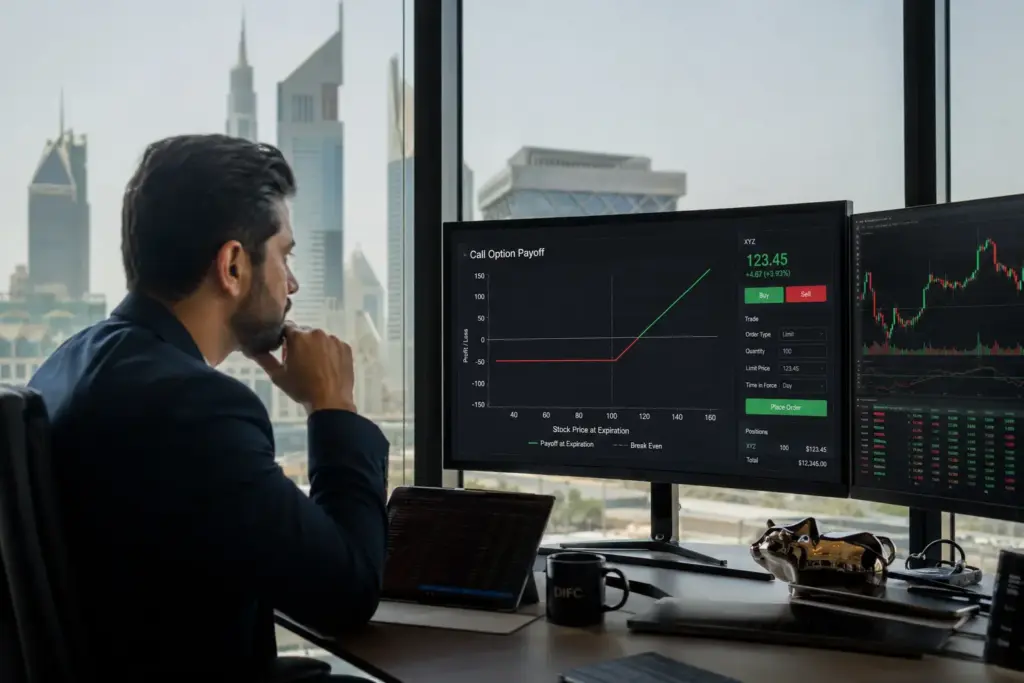
Professional trader analyzing a call option payoff chart on multiple monitors in a modern Dubai office overlooking the DIFC skyline with live stock market data and bullish price charts.

Introduction

A call option is one of the simplest, yet most powerful, tools available to investors who want to benefit from a rising market without committing the full capital required to buy the asset outright. For both new and experienced traders across the UAE, call options offer a defined-risk way to participate in upside potential, whether on individual stocks, indices, or commodities. This guide builds on the foundational concepts covered in our earlier breakdown of options fundamentals, focusing specifically on how call options work, when they make sense, and what risks every buyer should understand before placing a trade.

What Exactly Is a Call Option?

A call option is a contract that gives the buyer the right, but never the obligation, to purchase an underlying asset at a fixed price, known as the strike price, within a specific time frame. The seller of the call (also called the “writer”) takes on the opposite obligation: if the buyer chooses to exercise the option, the seller must deliver the asset at the agreed strike price, regardless of how high the market has climbed.

This right-without-obligation structure is what separates options from other exchange traded derivatives. A trader buying a call is essentially paying a small, known cost today (the premium) for the chance to benefit from a much larger price movement later, while strictly limiting how much they can lose if the trade doesn’t work out. This asymmetry between limited downside and open-ended upside is precisely why call options are popular among investors who want leveraged exposure without leveraged risk.

To make this concrete, consider a stock trading at $150. A trader who believes the price will rise might buy a call option with a strike price of $160, expiring in two months, for a premium of $4 per share (or $400 per standard contract covering 100 shares). The trader is not buying the stock; they are buying the right to buy it later at $160, no matter how high it actually trades by expiry.

How Does Buying a Call Option Work in Practice?

Using the example above, the trader has paid $400 for the right to buy 100 shares at $160 each, anytime before the option expires in two months. Several outcomes are possible from here, and walking through them helps clarify how value flows through the contract.

If the stock rises to $172 before expiry, the option now has $12 of intrinsic value per share ($172 minus the $160 strike), worth $1,200 across the contract. After subtracting the original $400 premium, the trader’s profit is $800, a 200% return on the capital risked, even though the underlying stock only moved up by roughly 15%. This leverage effect is the central appeal of call options: a moderate move in the underlying can produce a much larger percentage gain on the premium paid.

If the stock only rises to $158, still below the $160 strike, the option has no intrinsic value at expiry and the trader would let it expire worthless, losing the full $400 premium. Importantly, the loss is capped there. Unlike owning the stock directly on margin, or trading futures contracts where losses can technically exceed the initial deposit, a call option buyer can never lose more than the premium paid, no matter how far the stock falls.

Trade Global Options with Confidence

Access calls, puts, and multi-leg strategies across 15+ regulated exchanges.

What Happens at Expiry If the Stock Doesn't Move as Expected?

Every call option eventually reaches its expiration date, and what happens next depends entirely on where the stock price sits relative to the strike. If the stock is trading above the strike price, the option is in-the-money, and most brokers will automatically exercise it on the holder’s behalf, or the trader can choose to sell the option itself to capture the value without ever taking delivery of the shares.

If the stock is trading at or below the strike price, the option is out-of-the-money or at-the-money, and it simply expires with no value. No further action is required from the buyer; the position closes itself, and the maximum loss is locked in at the premium already paid. This is fundamentally different from the obligation-based structure of standardized futures, where a position must be actively closed or rolled before expiry to avoid unwanted settlement.

Many traders choose to close their call option position before expiry rather than letting it run to the final date, since selling the option in the open market lets them capture time value that would otherwise decay to zero. This is a key reason experienced investors closely track how option premiums behave, a topic covered in more detail in our broader guide to options fundamentals.

Why Do Investors Use Call Options Instead of Buying the Stock Outright?

The most obvious reason is capital efficiency. Buying 100 shares of a $150 stock outright would require $15,000 in capital. Buying a call option to gain exposure to the same upside might cost only a few hundred dollars in premium, freeing up the remaining capital for other opportunities or simply reducing the amount put at risk on a single idea.

Call options are also used by long-term shareholders who want to add temporary upside exposure without disturbing their core holdings, and by institutional desks looking to express a short-term bullish view on an index or commodity without taking on the full notional exposure of the underlying position. This is closely related to the distinction between notional and market value, since a relatively small premium can control a much larger amount of underlying exposure.

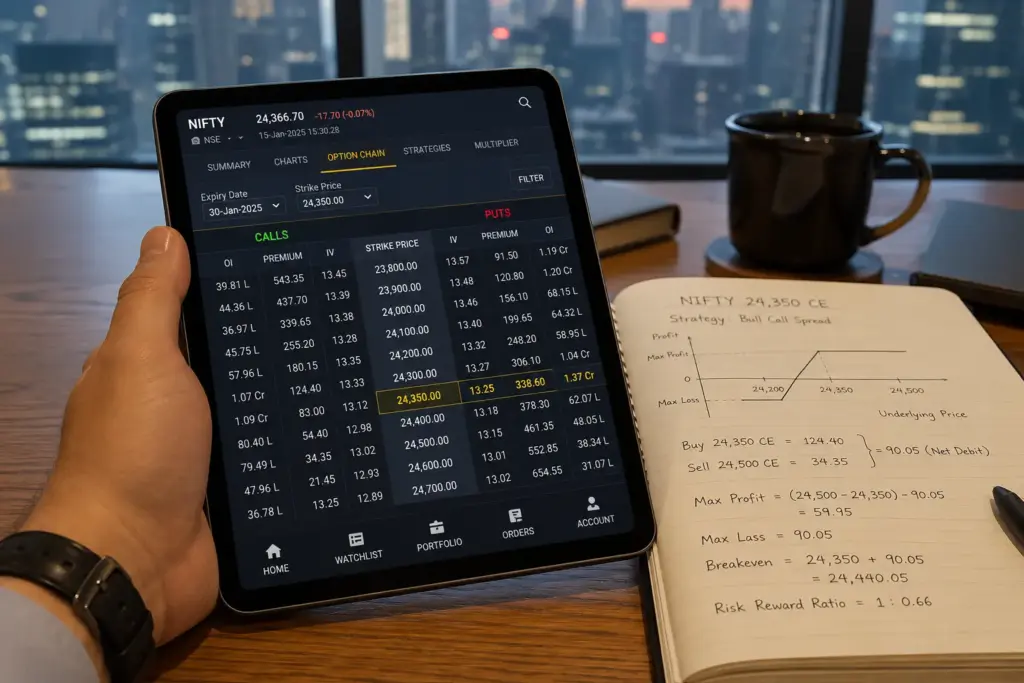
options chain analysis tablet profit loss calculation trading desk

A third common use is combining call options with other instruments as part of broader strategies, such as protective structures seen in capital protection arrangements, where a portion of capital is allocated to options precisely because they cap the downside while preserving upside participation.

Access 24/5 DGCX-Listed Derivatives

Trade currencies, metals, and indices with institutional-grade execution.

What Are the Key Risks of Trading Call Options?

While the maximum loss on a long call is capped at the premium paid, that does not mean call options are risk-free. The most common way traders lose money on calls is simply being right about the direction but wrong about the timing — the stock may eventually rise above the strike, but if it happens after the option has already expired, the position is worthless regardless of the later move.

Time decay, often referred to by the Greek letter theta, works against every option buyer. As expiry approaches, the time value portion of the premium erodes, accelerating in the final weeks of the contract’s life. A call option that is only slightly out-of-the-money can still lose significant value purely from the passage of time, even if the stock price barely moves.

Volatility also plays a role. Since premiums are partly priced on the market’s expectation of future price swings, a drop in implied volatility can reduce the value of a call option even while the stock price stays flat or rises modestly. This is why understanding premium pricing mechanics, covered in our options fundamentals guide, matters just as much as having a correct directional view.

How Do Call Options Compare to Buying Futures Contracts?

Both call options and long futures positions let a trader benefit from a rising market, but the risk profile is fundamentally different. A futures contract obligates the holder to transact at the agreed price, meaning losses can grow as the market moves against the position, with no natural ceiling on the downside without active risk management. A call option, by contrast, defines the maximum loss upfront as the premium paid, regardless of how far the underlying falls.

Futures generally require posting margin rather than paying a premium, and that margin is returned (adjusted for gains or losses) rather than spent. A call premium, on the other hand, is a sunk cost paid for the right to participate, similar to an insurance payment that is not refunded if unused. Investors weighing these two instruments often benefit from reviewing the broader mechanics covered in our guide to futures contracts, since the choice between the two frequently comes down to whether a trader wants defined risk with a premium cost, or full market exposure with margin-based leverage.

Conclusion: Key Takeaways

  • A call option grants the buyer the right, not the obligation, to purchase an asset at a fixed strike price before expiry.
  • The maximum loss for a call buyer is always limited to the premium paid, while the potential gain is theoretically unlimited as the underlying rises.
  • Time decay and changes in implied volatility can erode a call option’s value even when the directional view turns out to be correct.
  • Compared to buying the underlying asset directly, call options offer significant capital efficiency, since a small premium controls a much larger notional exposure.
  • Compared to futures contracts, call options trade an upfront premium cost for strictly defined downside risk, rather than the open-ended exposure that comes with an obligation to transact.

Call options are a foundational building block for more advanced derivatives strategies, and understanding how they behave under different market conditions is an essential step before exploring multi-leg options strategies or combining them with futures positions. As a DFSA-regulated broker, PhillipCapital DIFC supports investors building this knowledge progressively, from the basics through to active execution.

Speak to Our Derivatives Desk

Get tailored guidance on options and futures strategies for your portfolio.

Frequently Asked Questions (FAQs)

What happens if I don't sell my call option before it expires?

If the stock is above the strike price at expiry, the option is usually exercised automatically and you receive the shares (or the cash equivalent) at the strike price. If it’s below the strike, the option simply expires worthless and you lose the premium paid — no further action is needed.

Can I lose more money than I paid for a call option?

No. As a buyer, your maximum loss is always limited to the premium you paid, no matter how far the stock price falls. This is different from owning shares on margin, where losses can run much higher.

Is buying a call option the same as buying the stock?

No. Buying a call only gives you the right to purchase the stock at a fixed price later, for a small premium. Buying the stock means you own it outright immediately, with no expiry date and full capital committed upfront.

Do I need to own 100 shares to trade a call option?

No. Standard contracts typically represent 100 shares, but you don’t need to already own any shares to buy a call. You only need enough capital to cover the premium.

Disclaimer:

Trading foreign exchange and/or contracts for difference on margin carries a high level of risk, and may not be suitable for all investors as you could sustain losses in excess of deposits. The products are intended for retail, professional and eligible counterparty clients. Before deciding to trade any products offered by PhillipCapital (DIFC) Private Limited you should carefully consider your objectives, financial situation, needs and level of experience. You should be aware of all the risks associated with trading on margin. The content of the Website must not be construed as personal advice. For retail, professional and eligible counterparty clients. Before deciding to trade any products offered by PhillipCapital (DIFC) Private Limited you should carefully consider your objectives, financial situation, needs and level of experience. You should be aware of all the risks associated with trading on margin.

Rolling Spot Contracts and CFDs are complex instruments and come with a high risk of losing money rapidly due to leverage. 78% of our retail client accounts lose money while trading with us. You should consider whether you understand how Rolling Spot Contracts and CFDs work, and whether you can afford to take the high risk of losing your money.