Perpetual Bonds Table of Contents Introduction What Are Deferred Coupon...
Read MoreOptions Fundamentals
Table of Contents

Introduction
Options are among the most flexible tools available to investors who want to manage risk or position for market movement without committing the full value of an asset upfront. For institutional desks and serious retail traders across the UAE, understanding options is the gateway to more advanced derivatives strategies. This guide breaks down options fundamentals in plain English, using one running example throughout, so every concept builds on the same numbers instead of floating as an abstract definition
What Is an Option in Simple Terms?
An option is a contract that gives the buyer the right, but not the obligation, to buy or sell an underlying asset at a fixed price within a set time frame. Unlike a futures contract, which obligates both parties to transact, an option buyer can simply let the contract expire worthless if the trade no longer makes sense.
Example to follow throughout this guide: Suppose a stock is trading at $100. You buy a call option with a strike price of $105, expiring in one month, for a premium of $2 per share (options typically control 100 shares per contract, so the total cost is $200).
This single example will be used to explain every concept below, so keep these four numbers in mind: stock price $100, strike $105, premium $2, expiry 1 month.
What Are the Two Main Types of Options?
There are only two basic option types, and every strategy is built from combinations of these two.
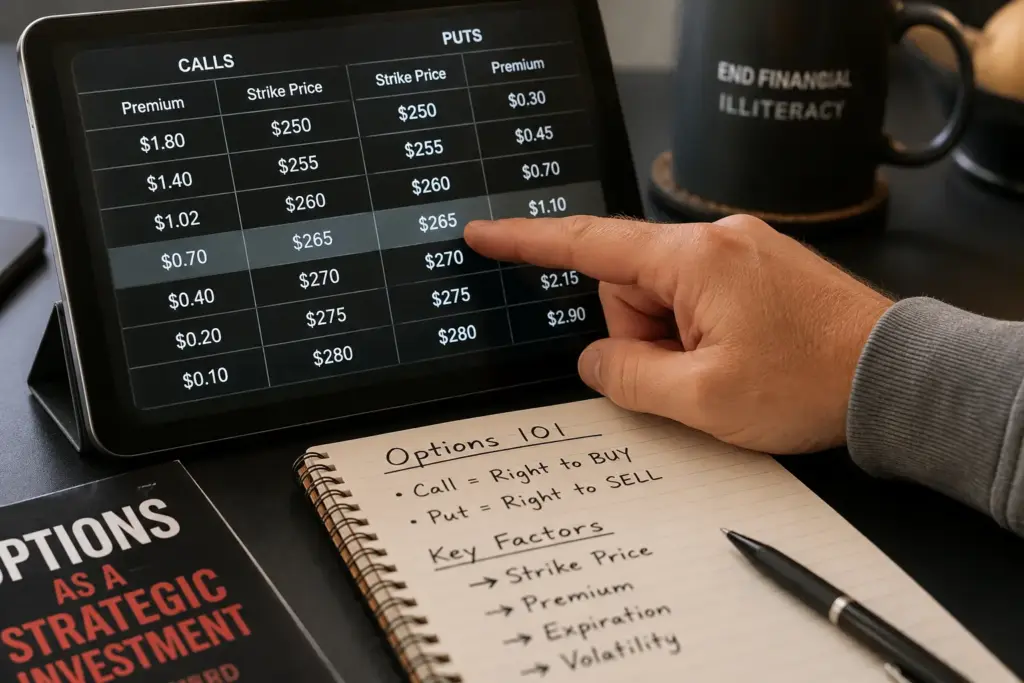
| Feature | Call Option | Put Option |
|---|---|---|
| Right granted to buyer | Right to buy the asset | Right to sell the asset |
| Used when trader expects | Price to rise | Price to fall |
| Buyer’s maximum loss | Premium paid | Premium paid |
| Buyer’s maximum gain | Unlimited (in theory) | Capped at strike price minus premium |
| Common use case | Speculation on upside, leveraged exposure | Hedging existing holdings, downside protection |
Using our example: a $105 call bought for $2 profits if the stock rises above $107 (strike + premium) before expiry. A $105 put bought for $2 would instead profit if the stock fell below $103, making it the natural choice if you already own the stock and want downside insurance rather than upside exposure. This concept builds directly on broader derivatives basics, where understanding obligation versus right is the first distinction every trader should master.
Ready to Trade Futures & Options?
Access 15+ global exchanges with institutional-grade execution.
How Does an Option Premium Actually Work?
The $2 premium in our example is not a random number — it is made up of two parts. Intrinsic value is what the option would be worth if exercised right now: since the stock at $100 is below the $105 strike, intrinsic value is $0. Time value is the extra amount paid for the chance the stock moves favorably before expiry, which in this case is the entire $2 premium, since intrinsic value is zero.
If the stock later rises to $108 with two weeks left to expiry, the option would then have $3 of intrinsic value ($108 − $105) plus some remaining time value, so the premium would be higher than $2. This is why option premiums change constantly even when the strike price never moves — they react to the underlying price, time remaining, and market volatility.
What Key Terms Should Every Beginner Know?
Every beginner should be comfortable with a short list of terms, each of which maps directly onto our running example. The strike price is the fixed price at which the option can be exercised — $105 here. The premium is the price paid to buy the option — $2 per share, or $200 per contract. The expiration date is the last day the option can be exercised — one month from purchase in our case. From there, three terms describe where the stock price sits relative to the strike: in-the-money (ITM) means exercising now would be profitable, which would require the stock to be above $105; out-of-the-money (OTM) means exercising now would not be profitable, which is true at purchase since the stock sits at $100; and at-the-money (ATM) simply means the stock price equals the strike price, i.e. exactly $105.

At the moment of purchase in our example, the call is out-of-the-money because the $100 stock price is below the $105 strike. It only becomes in-the-money if the stock climbs past $105 before expiry. Many of these terms overlap with concepts used when comparing notional value versus market value, since the actual exposure an option controls is often far larger than the premium paid for it.
How Does an Option Differ From a Futures Contract?
| Feature | Options | Futures |
|---|---|---|
| Obligation | Buyer has a right, not an obligation | Both parties are obligated to transact |
| Maximum loss for buyer | Limited to premium paid | Potentially unlimited, tied to price movement |
| Upfront cost | Premium only | Margin requirement, no premium |
| Typical use | Defined-risk speculation or hedging | Direct exposure to price movement |
If our $100 stock instead had a futures contract at $105, you would be obligated to buy at $105 regardless of where the price ends up — there is no “letting it expire worthless” option. This distinction matters when deciding which instrument fits your market view, a topic explored further in our breakdown of futures contracts and how they are structured for delivery or cash settlement.
Diversify with DGCX-Listed Derivatives
Trade currencies, metals, and indices with 24/5 execution.
Why Do Traders and Institutions Use Options?
Options serve three broad purposes, each with a different relationship to risk:
- Hedging – An investor holding the underlying stock might buy a put (like our $105 put example) to protect against a price drop, paying the premium as insurance.
- Speculation – A trader with no existing position might buy the $105 call purely betting on upside, risking only the $200 premium rather than $10,000+ to buy 100 shares outright.
- Income Generation – An existing shareholder could sell (write) a call against shares already owned, collecting the $2 premium as income, accepting that the shares may be called away if the price rises past $105.
Institutional desks frequently combine options with long or short positions in the underlying market, a practice closely tied to understanding long versus short positioning in derivatives more broadly. For UAE-based investors, options also offer a capital-efficient way to gain exposure to global indices and commodities without holding the full underlying position.
Conclusion: Key Takeaways
- An option gives the buyer the right, not the obligation, to transact at a fixed strike price before expiry.
- Calls suit a bullish view; puts suit a bearish view or act as portfolio insurance.
- Premium combines intrinsic value (profit if exercised today) and time value (the cost of remaining possibility).
- A buyer’s maximum loss is always capped at the premium paid, unlike futures, where both sides carry open-ended risk.
- Options are used for hedging, speculation, and income generation — often in combination with an existing market position.
Options trading involves risk and may not be suitable for all investors; please review the Risk Disclosure Statement before trading. As a DFSA-regulated broker, PhillipCapital DIFC supports investors building this knowledge step by step, from fundamentals through to execution.
Speak to Our Derivatives Desk
Get tailored guidance on options and futures strategies.
Frequently Asked Questions (FAQs)
No, not as a buyer. If you purchase a call or put option, your maximum loss is limited to the premium you paid. Unlike owning a stock on margin, an option buyer’s downside is fixed and known upfront — the worst case is the option expiring worthless.
Not when used correctly. Options are based on real probabilities tied to price, time, and volatility, and many professional investors use them specifically to reduce risk through hedging rather than to gamble. The “gambling” reputation usually comes from beginners trading without understanding strike price, expiry, or position sizing.
When you buy a stock, you own a share with no expiration date. An option only gives you the right to buy or sell at a set price within a limited time, which is why options cost much less upfront but require the price move to happen before expiry.
There is no fixed minimum, since a single option contract can cost anywhere from a few dollars to a few hundred dollars depending on the strike and premium. Most brokers do require account approval based on your trading experience and risk profile before granting access to options trading.
Disclaimer:
Trading foreign exchange and/or contracts for difference on margin carries a high level of risk, and may not be suitable for all investors as you could sustain losses in excess of deposits. The products are intended for retail, professional and eligible counterparty clients. Before deciding to trade any products offered by PhillipCapital (DIFC) Private Limited you should carefully consider your objectives, financial situation, needs and level of experience. You should be aware of all the risks associated with trading on margin. The content of the Website must not be construed as personal advice. For retail, professional and eligible counterparty clients. Before deciding to trade any products offered by PhillipCapital (DIFC) Private Limited you should carefully consider your objectives, financial situation, needs and level of experience. You should be aware of all the risks associated with trading on margin.
Rolling Spot Contracts and CFDs are complex instruments and come with a high risk of losing money rapidly due to leverage. 78% of our retail client accounts lose money while trading with us. You should consider whether you understand how Rolling Spot Contracts and CFDs work, and whether you can afford to take the high risk of losing your money.
Inflation-Linked Bonds
Inflation-Linked Bonds Introduction Inflation is the silent tax that erodes...
Read MoreConvertible Bonds Basics
Convertible Bonds Explained: Structure, Benefits, and Risks for Investors Table...
Read MoreCallable and Putable Bonds
Callable and Putable Bonds Table of Contents Introduction What Is...
Read MoreMunicipal Bonds and Tax Implications
Municipal Bonds & Tax Implications Introduction When investors look for...
Read MoreCorporate Bonds and Corporate Credit
Government Bonds & Treasury Securities Guide Table of Contents Introduction...
Read MoreGovernment Bonds & Treasury Securities
Government Bonds & Treasury Securities Guide Introduction When markets get...
Read More