Options Strike Price Table of Contents Introduction What Is a...
Read MoreIntrinsic Value and Time Value
Introduction
When you buy or sell an options contract, the price you pay — known as the premium — is not a single number pulled from thin air. It is made up of two very distinct components: intrinsic value and time value. Understanding how these two forces interact is one of the most important steps in learning to trade options with clarity and confidence. Whether you are exploring exchange traded derivatives for the first time or you are already familiar with how futures and options trading works in global markets, this guide will walk you through both concepts in plain language — with practical examples that actually make sense.
Table of Contents

What Is an Option's Premium Made Of?
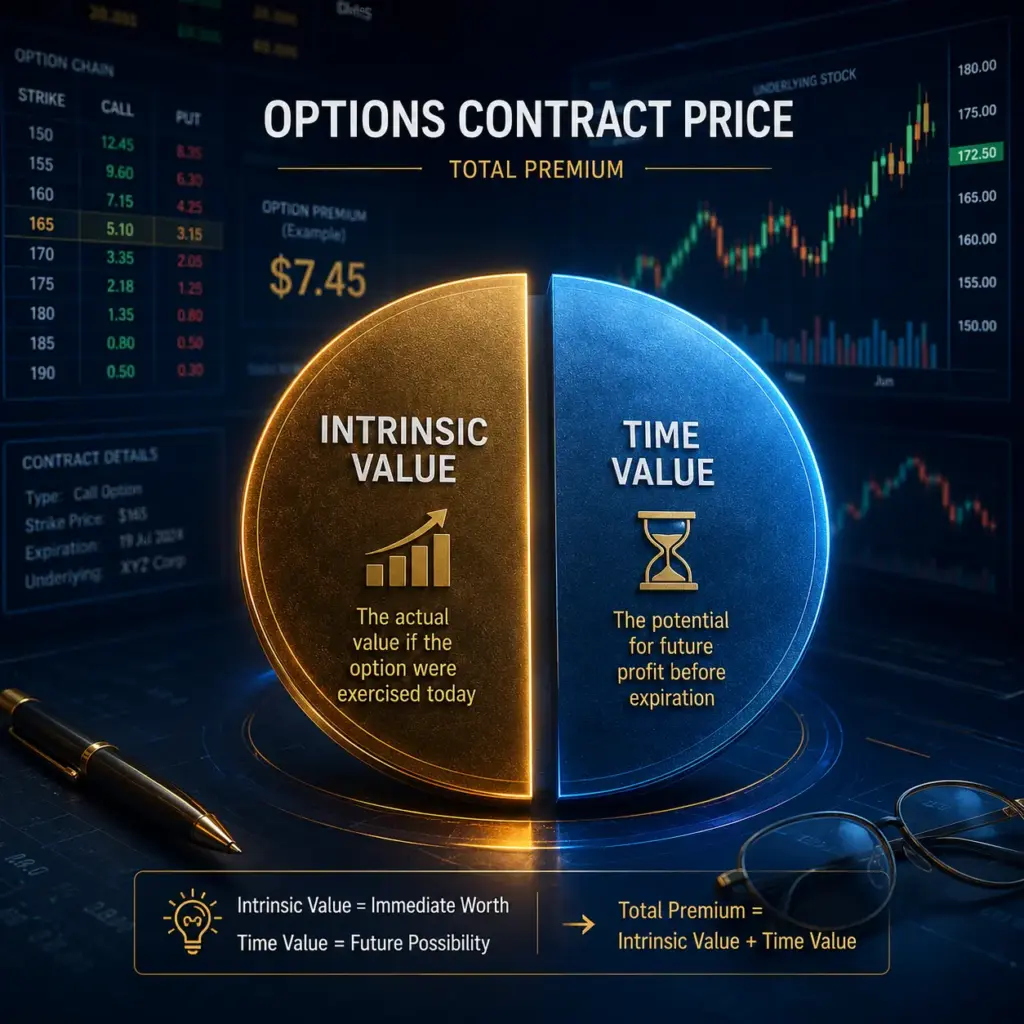
Every options contract has a price — the premium — that a buyer pays to hold the right (but not the obligation) to buy or sell an underlying asset at a set price before a certain date. This premium is not arbitrary. It is the sum of exactly two parts: intrinsic value and time value.
Think of it this way. If you are buying a call option on a stock currently trading at $110 with a strike price of $100, there is already a $10 real-world advantage built into that contract. That is intrinsic value — the measurable, immediate worth. On top of that, traders will also pay extra because the contract still has time left before expiry, during which the price could move even further in your favour. That extra amount is the time value.
So the full formula is straightforward:
Option Premium = Intrinsic Value + Time Value
What Is Intrinsic Value in Options?
Intrinsic value is the portion of an option’s premium that reflects real, concrete value right now — not potential, not hope, just actual financial advantage if the contract were exercised at this very moment.
An option has intrinsic value only when it is ‘in the money’ (ITM):
For a call option, intrinsic value exists when the current market price of the underlying asset is above the strike price.
For a put option, intrinsic value exists when the current market price is below the strike price.
If the option is ‘at the money’ (ATM) or ‘out of the money’ (OTM), the intrinsic value is zero — the contract has no immediate exercise advantage. You can read more about these moneyness states in our guide on ITM, ATM, and OTM options.
How Is Intrinsic Value Calculated?
For a Call Option:
Intrinsic Value = Current Market Price − Strike Price (if positive, else zero)
Example: If a crude oil futures call option has a strike price of $80 and the current market price is $87, the intrinsic value is $7. If the market price were $78, the intrinsic value would be $0 — not negative.
For a Put Option:
Intrinsic Value = Strike Price − Current Market Price (if positive, else zero)
Example: If a put option has a strike of $80 and the market is trading at $73, the intrinsic value is $7. If the market is at $84, the intrinsic value is $0.
Intrinsic value can never be negative. It is either a positive number or zero. This is why options are considered asymmetric instruments — the most a buyer can lose is the premium paid, while the upside can be substantial.
Trade Futures & Options with a DFSA-Regulated Broker
Access global derivatives markets through a trusted, regulated platform in the DIFC
What Is Time Value in Options?
Time value is the portion of the premium that goes beyond intrinsic value. It reflects the market’s expectation that the underlying asset’s price could move further in a favourable direction before the option expires. Think of time value as the price of possibility.
Even if an option currently has zero intrinsic value — that is, it is at the money or out of the money — it will still carry time value as long as there is time left before expiry. This is because there remains a genuine probability that the price will move in the buyer’s favour.
Time Value = Option Premium − Intrinsic Value
For example, if a call option with a $100 strike is priced at $12, and the underlying is trading at $105 (giving $5 of intrinsic value), then the time value is $7. That $7 is what traders are paying for time and potential.

What Drives Time Value?
Time value is not a fixed or static number. Several forces push it up or pull it down:
1. Time to Expiry
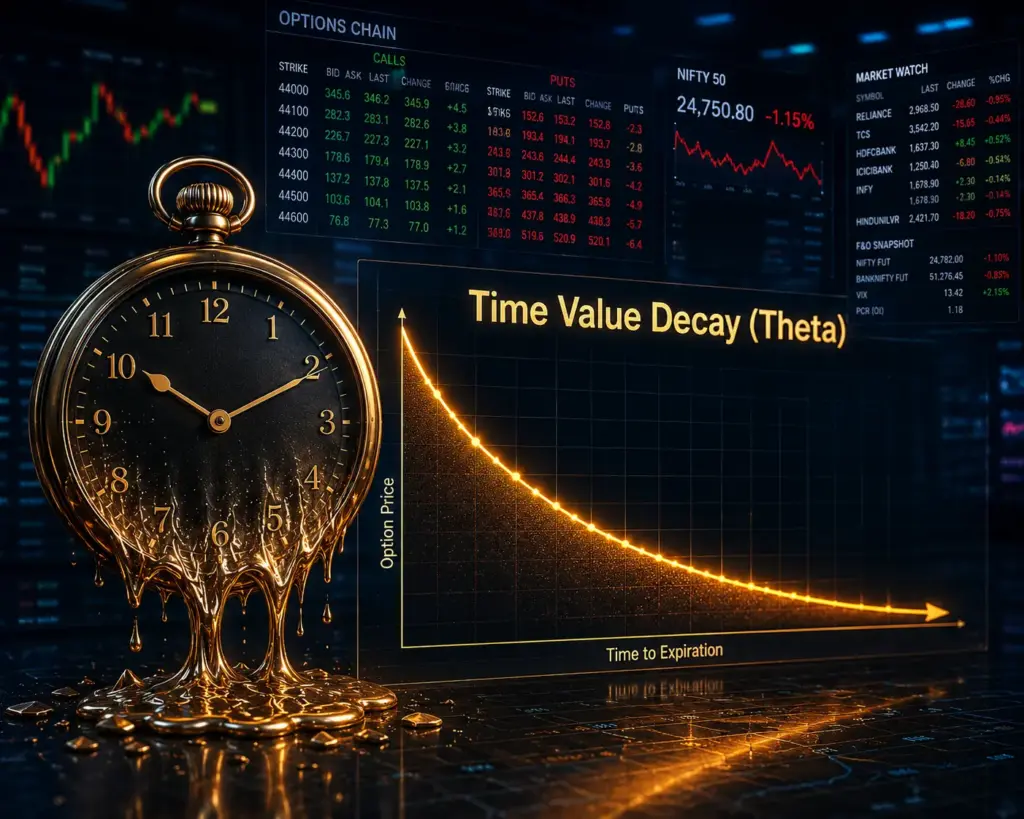
The more time remaining on a contract, the higher the time value — simply because more can happen. A contract expiring in six months carries more time value than one expiring next week. As expiry approaches, time value shrinks steadily. This erosion is known in the industry as theta decay.
2. Implied Volatility
Volatility is a major driver of time value. When markets expect significant price swings — for example, around major economic announcements or geopolitical events — implied volatility rises, and so does the time value embedded in options premiums. This is why options can become significantly more expensive before key market events. Understanding how underlying assets are priced is also valuable — you can explore more in our derivatives basics section.
3. Distance from the Strike Price
At-the-money options tend to carry the highest time value relative to their premium. Deep in-the-money options have most of their value in intrinsic terms, while deep out-of-the-money options have very low time value because the probability of them reaching the strike before expiry is low.
4. Interest Rates
Prevailing interest rates affect the cost of carrying positions and can have a marginal influence on time value — particularly for longer-dated options on interest rate sensitive assets.
Start Trading with a DFSA-Licensed Broker in Dubai
Open an account with PhillipCapital DIFC and access global futures, options, and more.

How Do Intrinsic Value and Time Value Change as Expiry Approaches?
As an option moves closer to its expiry date, one thing becomes certain: time value declines. This is one of the most important dynamics in options trading, and it accelerates in the final weeks and days before expiry. Traders refer to this as the ‘theta effect’ or simply time decay.
Here is how the two components typically evolve:
Intrinsic value stays the same or changes only based on the movement of the underlying asset’s market price relative to the strike. It is not affected by the passage of time itself.
Time value, on the other hand, steadily erodes as expiry approaches. At expiry, time value is zero. The option is worth only what it is intrinsically worth — if anything.
This has a critical implication: if you hold an out-of-the-money option as expiry nears, and the underlying price does not move in your favour, you will watch the entire premium decay to zero. Understanding futures contracts alongside options can help you choose the right instrument based on your time horizon and risk tolerance.
For option sellers, time decay is beneficial — they receive the premium upfront and benefit as time value erodes. For option buyers, time decay works against them, which is why timing and direction both matter when buying options.
Why Does This Matter for Your Trading Decisions?
Knowing the split between intrinsic value and time value directly shapes how you approach every option trade. Here are the practical implications:
When Buying Options
You are paying for both intrinsic and time value. If you buy an in-the-money option, most of your premium is intrinsic — that is relatively ‘safer’ in the sense that the real value is already there. If you buy an out-of-the-money option, you are paying mostly for time value, which means the underlying must move significantly in your direction before expiry for the trade to be profitable.
When Selling Options
Sellers collect the premium, including time value. Since time value declines predictably towards expiry, sellers benefit from holding positions as time passes — provided the market does not move sharply against them. Many professional traders use strategies built around collecting time value premium, which is one reason why options are versatile tools across global markets and asset classes.
Choosing Between Strike Prices
A deeper in-the-money option has more intrinsic value and less time value, making it behave more like the underlying asset itself. An at-the-money option has maximum time value relative to its premium, making it highly sensitive to changes in volatility and time. Out-of-the-money options are largely time value — high risk, but also potentially high reward if the market moves dramatically.
Explore Our Full Range of Trading Products
From CFDs and Spot FX to institutional derivatives — all under DFSA regulation.
Conclusion: Key Takeaways
Intrinsic value and time value are the two building blocks of every options premium. Together, they tell you what you are really paying for — and whether the price reflects real advantage or future potential.
Here are the essential points to carry forward:
- An option’s premium = Intrinsic Value + Time Value.
- Intrinsic value is the immediate, exercisable advantage — it is real value right now.
- Time value represents the probability of further favourable movement before expiry.
- Time value decays as expiry approaches — this is theta decay, and it accelerates in the final days.
- Implied volatility, time to expiry, and distance from the strike all influence how much time value an option carries.
- Option buyers pay for time value and need the market to move in their favour. Option sellers collect time value and benefit from the passage of time.
Whether you are just beginning your journey into options or you are refining your trading strategy, understanding these two components gives you a far clearer picture of pricing and risk. At PhillipCapital DIFC, our platform provides access to a broad range of exchange traded derivatives across global markets — backed by decades of expertise and regulated by the DFSA.
Frequently Asked Questions (FAQs)
Yes — and this is actually very common. Any option that is at the money or out of the money has zero intrinsic value, but it will still carry time value as long as expiry hasn’t arrived. Traders pay that time value because there is still a chance the price moves in their favour before the contract expires. Once expiry hits, time value becomes zero regardless.
This is theta decay at work. In the early life of an option, time value erodes slowly because there is still plenty of opportunity for the market to move. As expiry approaches, that window shrinks rapidly — and so does the time value. The final 30 days before expiry typically see the steepest decay. This is why holding an out-of-the-money option right up to expiry is a high-risk strategy.
Yes. When the market expects larger price swings — measured as implied volatility — time value rises. More expected movement means a greater probability that an option could end up in the money, so traders are willing to pay more for that possibility. This is why options premiums spike before major events like earnings announcements or central bank decisions.
Not exactly. Intrinsic value tells you the exercise value of the option right now — but your actual profit depends on what you paid for the premium. If you paid $9 for a call option that now has $5 of intrinsic value, you are still at a loss. Profit is only realised when the market price moves far enough to cover your full premium cost, including the time value you originally paid.
Disclaimer:
Trading foreign exchange and/or contracts for difference on margin carries a high level of risk, and may not be suitable for all investors as you could sustain losses in excess of deposits. The products are intended for retail, professional and eligible counterparty clients. Before deciding to trade any products offered by PhillipCapital (DIFC) Private Limited you should carefully consider your objectives, financial situation, needs and level of experience. You should be aware of all the risks associated with trading on margin. The content of the Website must not be construed as personal advice. For retail, professional and eligible counterparty clients. Before deciding to trade any products offered by PhillipCapital (DIFC) Private Limited you should carefully consider your objectives, financial situation, needs and level of experience. You should be aware of all the risks associated with trading on margin.
Rolling Spot Contracts and CFDs are complex instruments and come with a high risk of losing money rapidly due to leverage. 78% of our retail client accounts lose money while trading with us. You should consider whether you understand how Rolling Spot Contracts and CFDs work, and whether you can afford to take the high risk of losing your money.
Intrinsic Value and Time Value
Intrinsic Value and Time Value Introduction When you buy or...
Read MoreIn-the-Money, At-the-Money, Out-of-the-Money Options
In-the-Money, At-the-Money, Out-of-the-Money Options Introduction If you have started exploring...
Read MoreCall Options Explained
Call Options Explained Table of Contents Introduction What Exactly Is...
Read MoreOptions Fundamentals

Options Fundamentals Table of Contents Introduction What Is an Option...
Read MoreVIX Futures & Volatility Futures
VIX Futures & Volatility Futures Table of Contents Introduction What...
Read MorePrecious Metals Futures

Precious Metals Futures What Are Precious Metals Futures? A Guide...
Read MoreAgricultural Futures

Agricultural Futures Agricultural Futures: Hedging and Trading Strategies Agricultural futures...
Read MoreEnergy Futures Trading

Energy Futures Trading Introduction Energy is the lifeblood of the...
Read MoreCommodity Futures

Commodity Futures What Are Commodity Futures? A Comprehensive Guide for...
Read MoreInterest Rate Futures

Interest Rate Futures Mastering Interest Rate Futures: A Strategic Guide...
Read MoreCash Settlement vs Physical Delivery
Cash Settlement vs Physical Delivery in Trading Cash Settlement vs...
Read MoreFutures Settlement Methods
Futures Settlement Methods Introduction Navigating the financial markets requires a...
Read MoreMargin Calls & Mark-to-Market
Margin Calls & Mark-to-Market Table of Contents Introduction to Futures...
Read MoreInitial vs. Maintenance Margin
Initial vs. Maintenance Margin Understanding Initial and Maintenance Margins: A...
Read MoreContango & Backwardation Explained
Contango and Backwardation Explained Contango and Backwardation Explained: Navigating Futures...
Read MoreForward-Looking Basis

Forward-Looking Basis in Futures Trading Table of Contents Introduction What...
Read MoreFutures Pricing And Valuation
Futures Pricing And Valuation Table of Contents What is the...
Read MoreHow Futures Exchanges Work
How Futures Exchanges Work Understanding the Mechanics of Global Futures...
Read MoreUnderstanding Futures Contracts
Understanding Futures Contracts Understanding Futures Contracts in Global Markets In...
Read MoreLong vs Short Positions in Derivatives
Long vs Short Positions in Derivatives A Complete Guide for...
Read MoreOver-the-Counter (OTC) vs Exchange-Traded Derivatives
Over-the-Counter (OTC) vs Exchange-Traded Derivatives A Complete Guide for UAE...
Read MoreTypes of Derivatives: Futures, Options, Swaps, and Forwards
Types of Derivatives Futures, Options, Swaps, and Forwards In the...
Read MoreWhat are Derivatives and Their Purpose
What are Derivatives and Their Purpose The financial world is...
Read More