In-the-Money, At-the-Money, Out-of-the-Money Options Introduction If you have started exploring...
Read MorePut Options Explained
Introduction
Markets don’t only move up. Every experienced investor eventually faces a stretch where prices fall, sometimes sharply, and the instruments that protect or profit from that decline become just as important as the ones that ride the upside. Put options are the primary tool the derivatives market offers for exactly this scenario. They give you a defined, contractual way to benefit from, or insure against, a falling asset price, without the unlimited risk that comes with strategies like short-selling. For traders and institutions accessing global futures and options markets, understanding how puts behave is just as essential as understanding their better-known counterpart, the call option. This guide walks through the mechanics, the use cases, and the real risks involved, using plain language and worked numbers throughout.
What Is a Put Option?
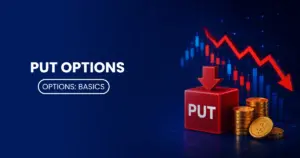
A put option is a contract that gives the holder the right, but not the obligation, to sell a specific underlying asset at a predetermined price, known as the strike price, before or on a set expiration date. In exchange for this right, the buyer pays a premium to the seller (also called the writer) of the contract.
The mechanics work in the buyer’s favor when prices fall. If the market price of the asset drops below the strike price, the put option gains intrinsic value, because the holder can sell at a price that is now higher than what the open market offers. If the asset’s price instead stays above the strike, the put has no intrinsic value and may simply expire worthless, in which case the buyer’s loss is capped at the premium already paid.
This asymmetry, a fixed, known maximum loss for the buyer against potentially significant gains, is the defining feature of options as an asset class. It mirrors the logic explained in our companion piece on call options, except the directional bet runs in the opposite direction: calls reward a rising market, puts reward a falling one.
It’s worth being precise about terminology here too. The strike price is fixed for the life of the contract and does not move with the market. The premium, by contrast, fluctuates constantly based on how far the market price sits from the strike, how much time remains until expiration, and how volatile the underlying asset is. These same variables, time, volatility, and distance from strike, govern every option contract, which is why a solid grounding in options fundamentals makes put strategies far easier to evaluate.
Trade Options With a Regulated Broker
Access global options markets through a DFSA-regulated platform built for both retail and institutional clients.
How Does Buying a Put Option Actually Work?
The clearest way to understand a put is to walk through a complete example from entry to expiry.
Suppose a stock is trading at $100 per share. You believe the price may fall over the next two months, so you buy a put option with a $95 strike price, paying a premium of $3 per share (options are typically quoted per share but traded in contracts representing 100 shares, so the actual cost would be $300 per contract).
Scenario A: The stock falls to $80. Your put is now deep in-the-money. You have the right to sell at $95 a stock that only trades at $80 in the open market, a $15 per share advantage. Subtracting the $3 premium you paid, your net profit is $12 per share, or $1,200 per contract. You would typically realize this gain by selling the option itself at its new, higher market price, rather than exercising it, since that is usually the more capital-efficient route for retail investors.
Scenario B: The stock stays flat at $100 or rises. Your strike price of $95 is now below the market price, so the put has no intrinsic value. As expiration approaches, the option’s remaining value (its time value) decays toward zero. You let it expire, and your total loss is the $3 premium paid, $300 per contract, no more.
This example illustrates the central appeal of buying puts: the downside is fixed and known on day one, while the upside scales directly with how far the price falls below the strike. This stands in sharp contrast to a futures contract, where a position taken on margin can generate losses well beyond the original margin deposit if the market moves against you without limit.
Explore Exchange-Traded Derivatives
Diversify across commodities, indices, and currencies with access to 15+ global exchanges.

Why Do Investors Use Put Options?
Put options serve two genuinely different purposes, and the strategy you choose depends entirely on which one applies to you.
The first use is hedging. An investor holding a long-term equity portfolio worth, say, $500,000 may be reluctant to sell positions just because of short-term uncertainty, perhaps ahead of an earnings season or a macroeconomic announcement. Instead of liquidating holdings, they can buy puts on an index or on individual stocks within the portfolio. If the market falls, the gains on the puts offset some or all of the losses on the underlying holdings, functioning much like an insurance policy. The premium paid is the cost of that insurance, and like any insurance, it is money well spent if the protected event occurs, and a sunk cost if it doesn’t.
The second use is speculation. A trader with no existing stock position who believes a company, sector, or index is overvalued and due for a correction can buy puts purely to profit from that view. This approach requires far less capital than short-selling the stock outright, since the trader only pays the premium rather than posting margin against an unlimited-risk short position, and the maximum loss is always defined in advance.
Institutional desks frequently blend these two motives, layering protective puts over core holdings while simultaneously running speculative put positions on names they expect to underperform. This kind of structured, multi-leg approach is a natural extension of the foundational concepts covered in our broader look at options fundamentals, and it’s why institutional and family office clients often work directly with a dedicated trading desk rather than executing single-leg trades in isolation.
Put Options vs. Other Ways to Profit From a Falling Market
Put options are not the only way to position for a decline, and it helps to know how they compare to the alternatives.
Short-selling involves borrowing shares and selling them, hoping to buy them back later at a lower price. The profit potential is capped (a stock can only fall to zero), but the loss potential is theoretically unlimited if the price rises instead, since there is no ceiling on how high a stock can climb. Puts flip this risk profile: your loss is capped at the premium, while your profit potential, though large, is also bounded by the fact that the stock can’t fall below zero.
Inverse or leveraged instruments, where available, track a falling market directly but typically come with daily rebalancing mechanics that make them unsuitable for holding over longer periods.
Futures contracts can also be sold to express a bearish view, and they avoid the time decay that erodes an option’s value. However, futures carry margin obligations that scale with daily price moves, meaning a sustained rally against your position can trigger margin calls well before any predefined loss limit. Put options, by contrast, never ask you for additional capital once the premium is paid; whatever happens to the underlying price, your maximum loss was set the moment you entered the trade.
Speak to Our Trading Specialists
Get tailored guidance on options strategies suited to your risk profile and market outlook.
What Are the Risks of Trading Put Options?
The defined-risk nature of buying puts is genuinely attractive, but it does not mean the strategy is risk-free, and the risks differ sharply depending on which side of the contract you’re on.
For buyers, the main risk is time decay. Options lose value as expiration approaches, a process known as theta decay, and this erosion accelerates in the final weeks of the contract’s life. A trader can be entirely correct that a stock will eventually fall, yet still lose money if the decline happens too slowly or too late relative to the option’s expiration date. Implied volatility also matters: if you buy a put when volatility (and therefore the premium) is already elevated, even a correct directional call may not be profitable once volatility subsequently falls and compresses the option’s price.
For sellers (writers) of put options, the risk profile is the mirror opposite of the buyer’s, and considerably more serious. A put seller collects the premium upfront but takes on the obligation to buy the underlying asset at the strike price if the buyer chooses to exercise. If the asset price collapses well below the strike, the seller can be forced to buy at a price far above current market value, with losses that can substantially exceed the premium originally received.
Margin requirements, leverage, and position sizing all compound these risks. Before entering any options trade, retail and professional investors alike should size positions according to their overall risk tolerance and treat the premium paid (or the margin posted, if selling) as capital genuinely at risk.
Conclusion: Key Takeaways
- A put option gives the holder the right, but not the obligation, to sell an asset at a fixed strike price before expiration.
- Buyers of puts have a clearly defined maximum loss, limited to the premium paid, while the profit potential grows as the underlying price falls further below the strike.
- Puts serve two core purposes: hedging an existing portfolio against downside risk, and speculating on a price decline with less capital than short-selling requires.
- Sellers (writers) of puts face significantly larger and less predictable risk than buyers, since they may be obligated to purchase the asset at the strike price even after a sharp decline.
- Time decay and implied volatility both materially affect an option’s value well before its expiration date, and should factor into any entry or exit decision.
Frequently Asked Questions (FAQs)
Yes. If the underlying asset’s price remains above the strike price through expiration, the put carries no intrinsic value, and the holder’s loss is limited to the premium originally paid.
Generally no. When buying a put, your maximum loss is capped at the premium paid, whereas a direct stock position can lose a much larger portion of its value if the price falls sharply.
No. Options do not entitle the holder to dividends, since the option itself does not represent ownership of the underlying shares.
Most brokers will automatically exercise an in-the-money put on your behalf at expiration. If the put is out-of-the-money, it simply expires with no value and no further action is required.
Disclaimer:
Trading foreign exchange and/or contracts for difference on margin carries a high level of risk, and may not be suitable for all investors as you could sustain losses in excess of deposits. The products are intended for retail, professional and eligible counterparty clients. Before deciding to trade any products offered by PhillipCapital (DIFC) Private Limited you should carefully consider your objectives, financial situation, needs and level of experience. You should be aware of all the risks associated with trading on margin. The content of the Website must not be construed as personal advice. For retail, professional and eligible counterparty clients. Before deciding to trade any products offered by PhillipCapital (DIFC) Private Limited you should carefully consider your objectives, financial situation, needs and level of experience. You should be aware of all the risks associated with trading on margin.
Rolling Spot Contracts and CFDs are complex instruments and come with a high risk of losing money rapidly due to leverage. 78% of our retail client accounts lose money while trading with us. You should consider whether you understand how Rolling Spot Contracts and CFDs work, and whether you can afford to take the high risk of losing your money.
Call Options Explained
Call Options Explained Table of Contents Introduction What Exactly Is...
Read MoreOptions Fundamentals
Options Fundamentals Table of Contents Introduction What Is an Option...
Read MoreVIX Futures & Volatility Futures
VIX Futures & Volatility Futures Table of Contents Introduction What...
Read MorePrecious Metals Futures

Precious Metals Futures What Are Precious Metals Futures? A Guide...
Read MoreAgricultural Futures

Agricultural Futures Agricultural Futures: Hedging and Trading Strategies Agricultural futures...
Read MoreEnergy Futures Trading

Energy Futures Trading Introduction Energy is the lifeblood of the...
Read MoreCommodity Futures

Commodity Futures What Are Commodity Futures? A Comprehensive Guide for...
Read MoreInterest Rate Futures

Interest Rate Futures Mastering Interest Rate Futures: A Strategic Guide...
Read MoreCash Settlement vs Physical Delivery
Cash Settlement vs Physical Delivery in Trading Cash Settlement vs...
Read MoreFutures Settlement Methods
Futures Settlement Methods Introduction Navigating the financial markets requires a...
Read MoreMargin Calls & Mark-to-Market

Margin Calls & Mark-to-Market Table of Contents Introduction to Futures...
Read MoreInitial vs. Maintenance Margin
Initial vs. Maintenance Margin Understanding Initial and Maintenance Margins: A...
Read MoreContango & Backwardation Explained
Contango and Backwardation Explained Contango and Backwardation Explained: Navigating Futures...
Read MoreForward-Looking Basis

Forward-Looking Basis in Futures Trading Table of Contents Introduction What...
Read MoreFutures Pricing And Valuation

Futures Pricing And Valuation Table of Contents What is the...
Read MoreHow Futures Exchanges Work

How Futures Exchanges Work Understanding the Mechanics of Global Futures...
Read MoreUnderstanding Futures Contracts
Understanding Futures Contracts Understanding Futures Contracts in Global Markets In...
Read MoreLong vs Short Positions in Derivatives
Long vs Short Positions in Derivatives A Complete Guide for...
Read MoreOver-the-Counter (OTC) vs Exchange-Traded Derivatives
Over-the-Counter (OTC) vs Exchange-Traded Derivatives A Complete Guide for UAE...
Read MoreTypes of Derivatives: Futures, Options, Swaps, and Forwards
Types of Derivatives Futures, Options, Swaps, and Forwards In the...
Read MoreWhat are Derivatives and Their Purpose
What are Derivatives and Their Purpose The financial world is...
Read MoreEssentials of Derivatives Trading
Essentials of Derivatives Trading The financial world is vast, and...
Read More