Options Exercise & Assignment Table of Contents Introduction What Does...
Read MoreSector Classification Systems
Introduction
Every listed company belongs somewhere. Whether it makes smartphones, drills for oil, or issues insurance, it fits into a broader group of similar businesses. Sector classification systems are the frameworks that organise thousands of stocks into these logical groups, making it possible to compare companies fairly, build diversified portfolios, and spot where the real market movement is happening. For anyone trading deliverable equities, understanding these systems is a foundational step in industry and sector analysis. This guide breaks down how sector classification works, the major systems used worldwide, and how investors can put them to practical use.
Table of Contents
- What Is Sector Classification and Why Does It Matter?
- What Are the Main Sector Classification Systems Used Globally?
- How Is the GICS Structure Organised?
- How Do Classification Systems Support Portfolio Diversification?
- How Should Sector Classification Feed Into Fundamental Analysis?
- What Is the Difference Between a Sector and an Industry?
- How Does Sector Classification Vary Across Global Markets?
- Conclusion and Key Takeaways
- FAQs
What Is Sector Classification and Why Does It Matter?
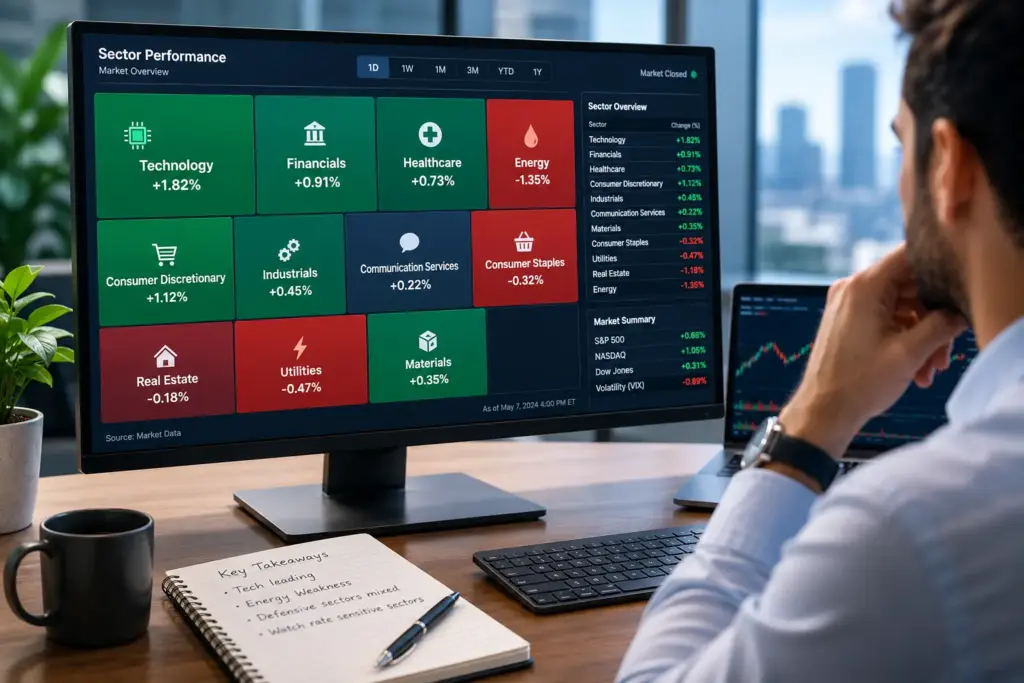
Sector classification is the process of grouping publicly traded companies according to the core business activity that generates most of their revenue. Instead of evaluating thousands of individual stocks one by one, investors and analysts can look at economic groups, such as energy, healthcare, or financials, and understand how each group behaves under different market conditions. This structure matters because it shapes index construction, guides asset allocation, and helps investors avoid unintentional concentration in one part of the economy. When reviewing equities and shares, sector context often explains price movements that a single-company view would miss.
What Are the Main Sector Classification Systems Used Globally?
Two frameworks dominate global markets. The Global Industry Classification Standard (GICS), developed by MSCI and S&P, organises companies into 11 sectors and is the backbone of most major indices, including the S&P 500. The Industry Classification Benchmark (ICB), maintained by FTSE Russell, is widely used across European and Asian exchanges and follows a similar top-down logic. Government agencies also use older systems such as SIC and NAICS codes for regulatory and statistical reporting, though these are less common in day-to-day investment research. Most brokers and data providers default to GICS or ICB because both update periodically to reflect how industries evolve, such as the separation of communication services from technology in recent years.

How Is the GICS Structure Organised?
GICS works in four layers: sector, industry group, industry, and sub-industry. At the top sit 11 broad sectors, including Energy, Materials, Industrials, Financials, Healthcare, and Information Technology. Each sector splits into industry groups, which split further into industries, and finally into sub-industries that describe very specific business lines. A retail bank and an insurance company both sit under Financials at the sector level, but they diverge sharply once you drill into their industry group. This layered design allows an investor to zoom out for a macro view of the market or zoom in to compare direct competitors within the same niche.
Explore US Stocks, ETFs & ADRs
Access companies across every major GICS sector through PhillipCapital DIFC's international equities offering.
How Do Classification Systems Support Portfolio Diversification?
Diversification only works if the assets in a portfolio do not all react the same way to the same event. Sector classification gives investors a practical map for spreading risk across groups that respond differently to interest rate changes, commodity prices, or consumer demand. A portfolio weighted entirely in technology stocks may look diversified by company count, yet still carry concentrated risk if the sector as a whole falls out of favour. By checking sector weightings against a benchmark, investors can identify gaps or overexposure before it becomes a problem. This is particularly relevant when building exposure through global stock markets, where sector balance often matters more than country selection alone.
How Should Sector Classification Feed Into Fundamental Analysis?
Ratios and financial statements only tell part of the story unless they are read in context. A debt-to-equity ratio considered high for a technology firm might be entirely normal for a utility company, given how differently these sectors are capitalised. Effective fundamental analysis for stocks always benchmarks a company against its sector peers rather than the market as a whole. Metrics such as profit margins, revenue growth, and return on equity vary widely by sector due to differences in capital intensity, regulation, and business cycles, so sector-relative comparison produces far more meaningful conclusions than absolute numbers alone.
Diversify Across GCC Markets
Add regional depth to your portfolio with direct access to leading Gulf-listed companies.

What Is the Difference Between a Sector and an Industry?
The terms sector and industry are often used loosely, but classification systems treat them as distinct levels. A sector is the broadest grouping, such as Consumer Discretionary, while an industry is a narrower slice within it, such as Automobiles or Hotels and Leisure. Two companies in the same sector can operate in entirely different industries with little competitive overlap. Understanding this distinction helps investors read research reports accurately and avoid assuming that “sector performance” applies evenly to every company inside it. It also clarifies why some stocks correlate closely with sector-wide trends while others move largely on company-specific news.
How Does Sector Classification Vary Across Global Markets?
While GICS and ICB provide a shared language, sector composition differs significantly by country and exchange. A commodity-exporting economy may have a market dominated by Energy and Materials, while a services-driven economy may be weighted heavily toward Financials and Technology. Investors trading across borders need to recognise that a “balanced” sector allocation in one market can look very different in another. This is one reason many investors combine IPO market activity tracking with sector data, since new listings often shift the sector balance of an entire exchange over time.
Conclusion: Key Takeaways
Sector classification systems turn a sprawling universe of stocks into a structured, comparable framework. GICS and ICB remain the two most widely used standards, each organising companies from broad sectors down to specific sub-industries. For investors, the real value lies in application: using sector context to diversify intelligently, benchmark fundamentals accurately, and understand how global market composition shapes portfolio outcomes. Whether reviewing a single balance sheet or building a multi-market portfolio, sector awareness adds a layer of clarity that raw stock-picking alone cannot provide.
Frequently Asked Questions (FAQs)
GICS is the most widely used system globally, forming the basis for major indices like the S&P 500 and MSCI benchmarks.
GICS currently organises the market into 11 broad sectors, each split further into industry groups, industries, and sub-industries.
No. While GICS and ICB provide a shared structure, the actual weight of each sector varies widely depending on a country’s economic makeup.
Sector weightings reveal hidden concentration risk and help investors ensure their holdings are not overly dependent on one part of the economy.
Build a Globally Diversified Equity Portfolio
Get tailored guidance on structuring sector and geographic exposure across your holdings.
Disclaimer:
Trading foreign exchange and/or contracts for difference on margin carries a high level of risk, and may not be suitable for all investors as you could sustain losses in excess of deposits. The products are intended for retail, professional and eligible counterparty clients. Before deciding to trade any products offered by PhillipCapital (DIFC) Private Limited you should carefully consider your objectives, financial situation, needs and level of experience. You should be aware of all the risks associated with trading on margin. The content of the Website must not be construed as personal advice. For retail, professional and eligible counterparty clients. Before deciding to trade any products offered by PhillipCapital (DIFC) Private Limited you should carefully consider your objectives, financial situation, needs and level of experience. You should be aware of all the risks associated with trading on margin.
Rolling Spot Contracts and CFDs are complex instruments and come with a high risk of losing money rapidly due to leverage. 78% of our retail client accounts lose money while trading with us. You should consider whether you understand how Rolling Spot Contracts and CFDs work, and whether you can afford to take the high risk of losing your money.
American vs European Options
American vs European Options Table of Contents Introduction What Is...
Read MoreOptions Expiration Dates
Options Expiration Dates Table of Contents Introduction What Is an...
Read MoreIntrinsic Value and Time Value
Intrinsic Value and Time Value Introduction When you buy or...
Read MoreIn-the-Money, At-the-Money, Out-of-the-Money Options
In-the-Money, At-the-Money, Out-of-the-Money Options Introduction If you have started exploring...
Read MoreCall Options Explained
Call Options Explained Table of Contents Introduction What Exactly Is...
Read MoreOptions Fundamentals
Options Fundamentals Table of Contents Introduction What Is an Option...
Read MoreVIX Futures & Volatility Futures
VIX Futures & Volatility Futures Table of Contents Introduction What...
Read MorePrecious Metals Futures

Precious Metals Futures What Are Precious Metals Futures? A Guide...
Read MoreAgricultural Futures
Agricultural Futures Agricultural Futures: Hedging and Trading Strategies Agricultural futures...
Read MoreEnergy Futures Trading
Energy Futures Trading Introduction Energy is the lifeblood of the...
Read MoreCommodity Futures
Commodity Futures What Are Commodity Futures? A Comprehensive Guide for...
Read MoreInterest Rate Futures
Interest Rate Futures Mastering Interest Rate Futures: A Strategic Guide...
Read MoreCash Settlement vs Physical Delivery
Cash Settlement vs Physical Delivery in Trading Cash Settlement vs...
Read MoreFutures Settlement Methods
Futures Settlement Methods Introduction Navigating the financial markets requires a...
Read MoreMargin Calls & Mark-to-Market
Margin Calls & Mark-to-Market Table of Contents Introduction to Futures...
Read MoreInitial vs. Maintenance Margin
Initial vs. Maintenance Margin Understanding Initial and Maintenance Margins: A...
Read MoreContango & Backwardation Explained
Contango and Backwardation Explained Contango and Backwardation Explained: Navigating Futures...
Read MoreForward-Looking Basis
Forward-Looking Basis in Futures Trading Table of Contents Introduction What...
Read MoreFutures Pricing And Valuation
Futures Pricing And Valuation Table of Contents What is the...
Read MoreHow Futures Exchanges Work
How Futures Exchanges Work Understanding the Mechanics of Global Futures...
Read MoreUnderstanding Futures Contracts
Understanding Futures Contracts Understanding Futures Contracts in Global Markets In...
Read MoreLong vs Short Positions in Derivatives
Long vs Short Positions in Derivatives A Complete Guide for...
Read More