Ex-Dividend Date Explained Ex-Dividend Date Explained: Rules, Timeline and Examples...
Read MoreCash and Stock Dividends Explained
Cash and Stock Dividends Explained: Types, Differences and How They Work
When a company shares its profit with its owners, the payment can arrive in two very different forms: money in a brokerage account or extra shares in a portfolio. Both are called dividends, but they change cash flow, share count and the way a position behaves in different ways.
This guide explains each type with worked examples, a side-by-side comparison and the key dates that decide who gets paid. It also covers how dividends work across US, global and GCC stocks, and what investors may want to check before relying on dividend income.
Table of Contents
- What Are Dividends and Why Do Companies Pay Them?
- How Does a Cash Dividend Work?
- What Is a Stock Dividend and How Does It Work?
- Cash Dividends vs Stock Dividends: What Are the Real Differences?
- Which Dates Decide Who Receives a Dividend?
- Are There Other Ways Companies Pay Dividends?
- How Do Dividends Work for US, Global and GCC Stocks?
- What Should Investors Check Before Relying on a Dividend?
- What Mistakes Do Investors Often Make With Dividends?
- Frequently Asked Questions About Cash and Stock Dividends
- Conclusion: What Should Investors Take Away?
What Are Dividends and Why Do Companies Pay Them?
A dividend is a portion of a company’s profit paid to its shareholders. Companies pay dividends to share success with owners, signal confidence in future earnings, and attract investors who value regular income. Not every company pays one, because many prefer to reinvest profits into growth.
A company’s board of directors decides whether to pay a dividend, how much to pay and in what form. The payment normally comes from profits the business has already earned and kept, known as retained earnings. Mature, steady businesses tend to pay dividends more often, while fast-growing companies usually keep their cash to fund expansion.
Dividends are also one half of an investor’s total return. The other half is any change in the share price. The dividend yield, which is the annual dividend per share divided by the current share price, is the figure most investors use to compare how much income different shares produce.
How Does a Cash Dividend Work?
A cash dividend is a payment of money, set per share, that a company makes to its shareholders out of profit. The board announces the amount, and the money is credited to the investor’s brokerage account on the payment date. It is the most common dividend type worldwide.
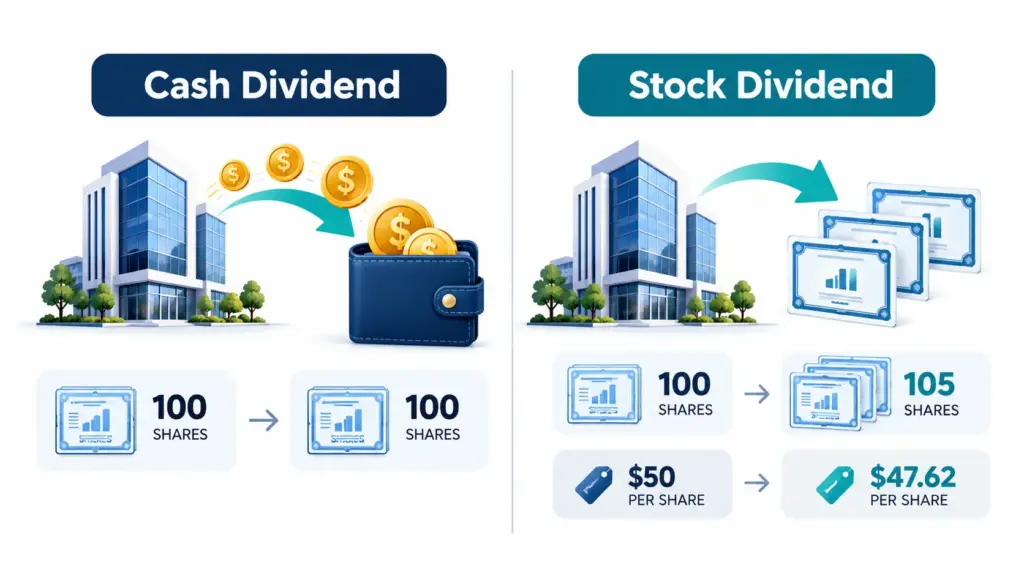
The calculation is simple. If a company declares a cash dividend of $0.40 per share and an investor holds 1,000 shares, the payment is $400. The investor can spend that cash, hold it or use it to buy more shares. Because the company pays real money out of its balance sheet, its cash reserves fall by the total amount distributed.
What Are the Main Kinds of Cash Dividends?
Companies use several labels for cash payments, and the differences affect how reliable the income may be.
- Regular dividends are paid on a predictable schedule, often quarterly, semiannually or annually, and companies generally try to keep them stable or grow them over time.
- Special dividends are one-off payments, often made after an unusually strong year or an asset sale, and investors should not expect them to repeat.
- Interim dividends are paid part-way through the financial year, before full-year results are final.
- Final dividends are paid after the year ends, usually once shareholders have approved the amount.
Explore Dividend-Paying Companies Around the World
Access global equities through a DFSA-regulated broker based in Dubai.
What Is a Stock Dividend and How Does It Work?
A stock dividend gives shareholders additional shares instead of cash, usually as a percentage of the shares they already own. A 5% stock dividend, for example, adds five new shares for every 100 held. The company keeps its cash, and each share then represents a slightly smaller slice of the business.
Consider an investor with 1,000 shares priced at $50, a position worth $50,000. After a 5% stock dividend, the investor holds 1,050 shares. The share price typically adjusts to about $47.62, because the same company value is now spread across more shares. The position is still worth roughly $50,000 immediately afterwards, before any normal market movement.
Several points are worth knowing:
- Every shareholder receives new shares in proportion to their holding, so each investor’s percentage ownership of the company stays the same.
- Companies may choose stock dividends to conserve cash for investment or debt repayment while still rewarding shareholders.
- When the percentage produces a fraction of a share, brokers often settle that fraction in cash.
- A stock dividend is not the same as a stock split, although both increase the number of shares. A split usually uses a larger ratio, such as two new shares for each one held, and is treated differently in a company’s accounts.

Cash Dividends vs Stock Dividends: What Are the Real Differences?
The core difference is what the investor receives. A cash dividend pays out money, while a stock dividend adds shares and leaves the cash inside the company. A cash payout lowers the share price by roughly the payment on the ex-dividend date, while a stock dividend spreads the same value across more shares.
Cash Dividends and Stock Dividends Compared
| Feature | Cash Dividend | Stock Dividend |
|---|---|---|
| What the investor receives | Money credited to the brokerage account | Additional shares of the same company |
| Number of shares held | Stays the same | Increases |
| Effect on share price | Falls by roughly the dividend amount on the ex-dividend date | Adjusts lower in proportion to the new shares issued |
| Effect on company cash | Cash leaves the company | Cash stays in the company |
| Ownership percentage | Unchanged | Unchanged, if all shareholders receive the same percentage |
| Usable as income | Yes, immediately | Only by selling some shares |
| Tax treatment | Varies by country and investor | Varies by country, investor and type of stock dividend |
Neither form creates value out of thin air. In both cases, the company’s total worth is shared among investors, only in a different shape. The right fit depends on whether an investor needs income now or values a growing share count, and that is a personal decision rather than a general rule.
Which Dates Decide Who Receives a Dividend?
The ex-dividend date matters most. Investors must own the shares before that date to receive the upcoming dividend, while buyers on or after it do not. Three other dates frame the process: declaration, record and payment. The sequence below shows how each fits.
- Declaration date: The board announces the dividend, including the amount per share and the other key dates.
- Ex-dividend date: The first trading day on which a new buyer no longer qualifies for the declared dividend, so the share price usually drops by about the dividend amount.
- Record date: The day the company checks its register to see who the official shareholders are.
- Payment date: The day the cash or new shares reach shareholders’ accounts.
Settlement cycles affect how the ex-dividend and record dates relate. In markets that settle trades one business day after the trade date (T+1), such as the United States, the ex-dividend date is typically the same as the record date. Other markets may use different gaps, so investors should confirm each date in the company’s announcement.
Are There Other Ways Companies Pay Dividends?
Companies also pay dividends as scrip dividends, through dividend reinvestment plans and, rarely, as property dividends. These variations change how the payout reaches the investor, even though the underlying idea is still sharing profit with shareholders.
- Scrip dividends let shareholders choose to receive new shares instead of the cash dividend, which lets the company keep cash while still offering a cash alternative.
- Dividend reinvestment plans (DRIPs) automatically use cash dividends to buy more shares of the same company, and availability depends on the company or the broker.
- Property dividends pay shareholders in assets other than cash or shares, such as shares in a subsidiary, and they are uncommon.
- Liquidating dividends return a shareholder’s original capital rather than profit, and they often appear when a company is winding down or selling major assets.
How Do Dividends Work for US, Global and GCC Stocks?
Cash dividends are the norm on US, global and GCC stocks, but payment timing, currency and withholding tax differ by market. ETFs usually pass through the income their holdings generate, and ADRs typically pay dividends in US dollars after conversion. Investors should check each announcement for the exact terms.
Differences by market include:
- US stocks: Many US companies pay dividends quarterly, and announcements show the amount, ex-dividend date and payment date clearly.
- Global non-US stocks: Some European and Asian companies pay semiannually or annually, often in the local currency, so exchange rates affect what an investor in another currency finally receives.
- GCC stocks: Dividends are commonly approved at the annual general meeting and paid once a year, and some GCC-listed companies also issue bonus shares, which work much like stock dividends.
- ETFs: Funds either distribute the dividends their holdings receive or reinvest them inside the fund, depending on the fund’s structure.
- ADRs: An American Depositary Receipt is a US-traded certificate representing shares of a foreign company, and its dividends are usually converted to dollars, with depositary fees possibly deducted.
Foreign dividends may also face withholding tax, which is tax deducted at source by the country where the company is based. The rate depends on that country’s rules and any tax treaty, so investors should check how their own situation is treated. PhillipCapital DIFC gives investors access to US stocks, ETFs and ADRs, global non-US stocks and GCC stocks through one regulated broker.
Invest Across US Stocks, ETFs and ADRs
Trade deliverable US equities from Dubai with a DFSA-regulated broker.
What Should Investors Check Before Relying on a Dividend?
Before relying on a dividend, investors may check the payout ratio, dividend yield, earnings stability and free cash flow behind it. A high yield alone can signal risk, because it may result from a falling share price rather than a generous company. Sustainable dividends are backed by steady profit and cash.
These measures help assess whether a payout looks sustainable:
- Payout ratio: The percentage of earnings paid out as dividends, where a very high figure leaves little room for a bad year.
- Dividend yield: The annual dividend divided by the share price, which is best read alongside the company’s earnings trend rather than on its own.
- Free cash flow: The cash left after running and investing in the business, which is what ultimately funds dividend payments.
- Dividend history: A record of stable or rising payments suggests discipline, although the past never guarantees the future.
- Valuation context: A dividend share can still be expensive, so valuation measures such as the price-to-earnings ratio help put the yield in perspective.
Investors who want to go further can explore the stock valuation learning hub for yield and cash flow tools. A real example of a yield-focused approach is covered in our guide to the Dogs of the Dow strategy.
What Mistakes Do Investors Often Make With Dividends?
The most common mistakes are chasing the highest yield, expecting free money around the ex-dividend date, and treating dividends as guaranteed. Each ignores how prices, costs and company finances really behave. Awareness of these traps helps investors set realistic expectations for dividend income.
- Chasing yield: A very high yield can reflect a share price that has fallen because the market doubts the dividend will last.
- Buying just for the payout: The share price normally drops by about the dividend amount on the ex-dividend date, so buying purely to collect it does not create an automatic gain.
- Assuming stock dividends add value: New shares arrive, but the price adjusts, so the total position value does not rise on that basis alone.
- Ignoring withholding tax and fees: Foreign dividends may be reduced by tax or depositary charges before they arrive.
- Over-concentrating in one sector: Companies in the same industry can cut dividends together during a downturn, which is why diversification across sectors and markets matters.
- Treating dividends as certain: Boards can reduce or suspend dividends at any time, particularly when earnings fall.
Frequently Asked Questions (FAQs)
Neither is automatically better, because it depends on whether an investor wants income now or prefers to hold more shares. A cash dividend provides spendable money, while a stock dividend increases the share count without changing the position’s immediate value. Each investor’s goals and tax situation will shape the choice.
Yes, the share price usually falls by roughly the dividend amount on the ex-dividend date. This happens because the company’s value is reduced by the cash paid out. Other market factors also move prices that day, so the drop is an approximation rather than an exact figure.
In principle, yes, because owning the shares before the ex-dividend date qualifies the holder for the payment. However, the price typically adjusts downward on the ex-dividend date, so the payout does not create guaranteed profit. Trading costs and tax can also reduce the net result.
No, although both increase the number of shares an investor holds. A stock dividend usually adds a small percentage of new shares, while a split uses a larger ratio and is accounted for differently. Neither changes the company’s total value on its own.
Conclusion: What Should Investors Take Away?
Cash dividends deliver money and reduce a company’s reserves, while stock dividends deliver extra shares and leave cash in the business. Both share profit with owners, and neither adds value on its own. What differs is how the payout fits an investor’s income needs, tax position and preference for a larger share count.
The ex-dividend date, the market where the shares trade and the sustainability of the payout all deserve attention before any dividend is treated as dependable. Investors may consider reviewing payout ratios, free cash flow and valuation alongside the yield.
Speak With Our Team About Dividend-Paying Equities
Talk to a DFSA-regulated broker in DIFC about the markets and products available to you.
Disclaimer:
Trading foreign exchange and/or contracts for difference on margin carries a high level of risk, and may not be suitable for all investors as you could sustain losses in excess of deposits. The products are intended for retail, professional and eligible counterparty clients. Before deciding to trade any products offered by PhillipCapital (DIFC) Private Limited you should carefully consider your objectives, financial situation, needs and level of experience. You should be aware of all the risks associated with trading on margin. The content of the Website must not be construed as personal advice. For retail, professional and eligible counterparty clients. Before deciding to trade any products offered by PhillipCapital (DIFC) Private Limited you should carefully consider your objectives, financial situation, needs and level of experience. You should be aware of all the risks associated with trading on margin.
Rolling Spot Contracts and CFDs are complex instruments and come with a high risk of losing money rapidly due to leverage. 78% of our retail client accounts lose money while trading with us. You should consider whether you understand how Rolling Spot Contracts and CFDs work, and whether you can afford to take the high risk of losing your money.
Cash and Stock Dividends
Cash and Stock Dividends Explained Cash and Stock Dividends Explained:...
Read MoreUnderstanding Dividends

Dividend Investing: A Practical Guide for Beginners Dividend Investing: A...
Read MoreIndustry Growth Prospects

Industry Growth Prospects Table of Contents Introduction What Are Industry...
Read MoreRegulatory Environment Impact

Regulatory Environment Impact on Stocks Table of Contents Introduction What...
Read MoreSupply Chain Analysis

Supply Chain Analysis for Equity Investors Table of Contents Introduction...
Read MoreMarket Share Analysis

Market Share Analysis How Investors Measure Company Dominance in an...
Read MoreCompetitive Positioning

Competitive Positioning Table of Contents Introduction What Is Competitive Positioning...
Read MoreIndustry Analysis Framework

Sector Classification Systems Table of Contents Introduction What Is an...
Read MoreSector Classification Systems

Sector Classification Systems Introduction Every listed company belongs somewhere. Whether...
Read MoreWorking Capital Analysis

Working Capital Analysis Introduction When you look at a company’s...
Read MoreCurrent Ratio vs Quick Ratio

Current Ratio and Quick Ratio Table of Contents Introduction What...
Read Moredebt-to-equity ratio

Debt-to-Equity Ratio Table of Contents Introduction What is the Debt-to-Equity...
Read MoreProfit Margins & Profitability
Profit Margins and Profitability Introduction When you look at a...
Read MoreRevenue Growth Analysis
Revenue Growth Analysis Table of Contents Introduction What Is Revenue...
Read MoreStatement of Changes in Equity
Statement of Changes in Equity Table of Contents Introduction What...
Read MoreCash Flow Statement Analysis
Cash Flow Statement Analysis Table of Contents Introduction What Is...
Read MoreUnderstanding Balance Sheets
Understanding Balance Sheets Understanding Balance Sheets: A Complete Guide for...
Read MoreFundamental Analysis for Stocks

Fundamental Analysis for Stocks Mastering Fundamental Analysis for Stocks: A...
Read MoreDiscounted Cash Flow (DCF) Model

Discounted Cash Flow (DCF) Model Understanding the Discounted Cash Flow...
Read MoreIntrinsic Value Calculation

Intrinsic Value Calculation Guide to Stock Valuations Intrinsic Value Calculation:...
Read Moreunderstanding dividend yield investment guide

Dividend Yield The Strategic Guide to Dividend Yield: Maximizing Passive...
Read MoreEnterprise Value And Ev/Ebitda

Enterprise Value And EV/EBITDA Enterprise Value and EV/EBITDA: A Comprehensive...
Read MorePrice-to-Sales Ratio (P/S)

Price-to-Sales Ratio (P/S) Understanding the Price-to-Sales Ratio (P/S) in Modern...
Read More