

Dividend Investing: A Practical Guide for Beginners Dividend Investing: A...
Read MoreDividend Investing: A Practical Guide for Beginners
Dividend Investing: A Practical Guide
Dividend investing is a strategy built around owning shares in companies that share part of their profits with shareholders on a regular basis. Instead of relying only on a rising share price, investors receive cash payments along the way, which many find makes long-term stock ownership feel more tangible and steady.
A dividend is not a promise, though. Companies can raise, reduce or cancel payouts, and a very high payout can sometimes signal trouble rather than strength. This guide explains how dividends work, how to read dividend yield and payout ratio, the main styles of dividend investing, and the risks worth understanding before building an income-focused portfolio.
Whether you are new to the stock market or refining an existing approach, the sections below follow the questions investors most often ask, in a logical order from first principles to practical steps.
Table of Contents
- What Is Dividend Investing and How Does It Work?
- How Do Companies Pay Dividends, and What Are the Key Dates?
- What Are the Main Types of Dividends?
- How Is Dividend Yield Calculated, and What Does It Really Tell You?
- What Makes a Dividend Sustainable?
- Dividend Growth, High Yield or Dividend ETFs: Which Approach Fits Which Investor?
- How Does Reinvesting Dividends Change Long-Term Outcomes?
- Where Can Investors Access Dividend-Paying Stocks From Dubai?
- What Are the Risks of Dividend Investing?
- What Common Mistakes Should Dividend Investors Avoid?
- How Can a Beginner Start Building a Dividend Portfolio?
- Frequently Asked Questions About Dividend Investing
- Final Thoughts on Dividend Investing
What Is Dividend Investing and How Does It Work?
Dividend investing means buying shares mainly for the cash distributions a company pays out of its profits. A dividend is simply a portion of earnings returned to shareholders, usually per share held. Investors can spend the income or reinvest it to buy more shares.
Companies have two broad choices with the profit they earn: keep it inside the business to fund growth, or return some of it to owners. Mature, cash-generating businesses often lean towards paying dividends because they have fewer opportunities to reinvest every dirham or dollar at high returns. Younger growth companies usually keep their profits and pay little or nothing.
For an investor, this creates two sources of potential return. The first is income, which is the dividend itself. The second is capital appreciation, which is any rise in the share price over time. Dividend investing puts extra weight on the first source, while still caring about the second, because a company that pays out cash but steadily loses value is rarely a good outcome.
How Do Companies Pay Dividends, and What Are the Key Dates?
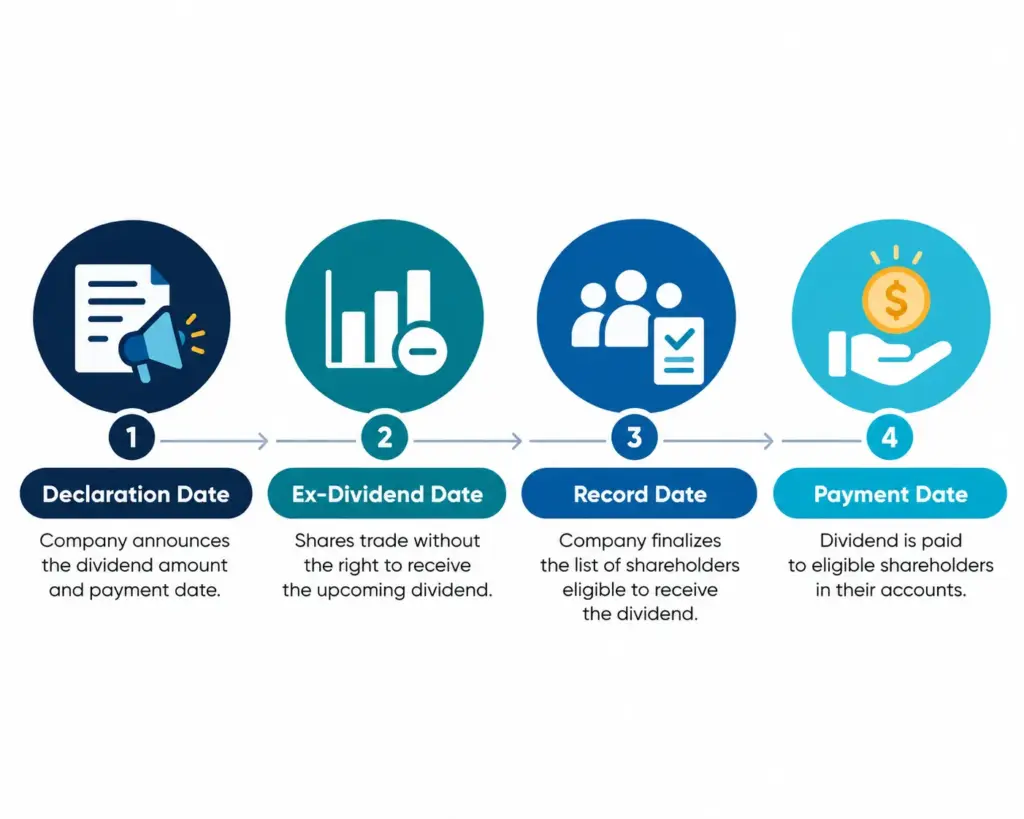
A company’s board declares a dividend, sets the amount, and fixes four key dates: declaration, ex-dividend, record and payment. Investors generally must own the shares before the ex-dividend date to receive the upcoming payout. The cash then arrives in the brokerage account on the payment date.
Here is what each date means :
- The declaration date is when the board announces the dividend amount and the schedule for paying it.
- The ex-dividend date is the cut-off: investors who buy on or after this date do not receive the declared dividend, while those who already owned the shares do.
- The record date is when the company checks its register to confirm who the eligible shareholders are.
- The payment date is when the cash is actually distributed to eligible shareholders.
On the ex-dividend date, a share price typically adjusts downward by roughly the amount of the dividend, because that cash is leaving the company. This is why buying a stock just before the ex-dividend date does not create free money. The investor receives the dividend but owns a share that is worth slightly less.
Payment frequency varies by market. Many US companies pay quarterly, while companies in other regions often pay twice a year or annually. Investors comparing stocks across markets should look at the annual total rather than a single payment.
Why the timeline matters in practice
Knowing these dates helps investors avoid confusion when they see a price dip on the ex-dividend date, and it helps them plan cash flow. An investor relying on dividends for regular expenses may prefer to understand each holding’s payment calendar rather than assume payments arrive evenly.
Open a pathway to global dividend payers
PhillipCapital DIFC gives investors in the UAE access to listed equities across several markets.
What Are the Main Types of Dividends?
The main types of dividends are cash dividends, stock dividends, special dividends, scrip dividends and property dividends. Cash dividends are by far the most common. Each type affects an investor’s holdings and income differently, so it helps to know which one a company is paying.
- Cash dividends are payments made directly in currency, usually through the investor’s brokerage account, and they are what most people mean by a dividend.
- Stock dividends give shareholders additional shares instead of cash, which increases the share count without any money changing hands.
- Special dividends are one-off payments, often made after an unusually strong year or an asset sale, and investors should not assume they will repeat.
- Scrip dividends let shareholders choose between receiving cash or additional shares, giving flexibility in how the payout is taken.
- Property dividends distribute assets other than cash or shares, such as shares in a subsidiary, and are relatively rare.
Regular dividends and special dividends deserve extra attention. A company that pays a steady regular dividend is signalling an ongoing commitment, while a special dividend is a bonus that may never be repeated. Mixing the two up can lead to overestimating future income.
How Is Dividend Yield Calculated, and What Does It Really Tell You?
Dividend yield is the annual dividend per share divided by the current share price, shown as a percentage. It tells investors how much income a share generates relative to its cost. A higher yield means more income per unit invested, but it does not by itself indicate quality.
The formula is simple: annual dividend per share divided by share price, multiplied by 100. As a hypothetical example, a company paying 2 per share in dividends over a year, with a share price of 50, has a yield of 4%. If the share price falls to 40 while the dividend stays at 2, the yield rises to 5%, even though investors are worse off.
This last point is the most important lesson about yield. Because yield moves inversely with price, an unusually high number can mean the market expects the dividend to be cut. Investors sometimes call this a yield trap: a stock that looks attractive on income but carries a high chance of a payout reduction or a falling share price.
Yield is best used as a starting filter rather than a final answer. It is one of several valuation measures, alongside the price-to-earnings ratio and others, and you can see how these tools fit together in our stock valuation methods guide. Comparing a company’s yield with its own history and with peers in the same sector is more useful than comparing it with unrelated industries.
What Makes a Dividend Sustainable?
A dividend is sustainable when a company can keep paying it from genuine profits and cash flow without straining its finances. The key checks are the payout ratio, free cash flow coverage, debt levels and earnings stability. A sustainable dividend matters more than a high one.
Investors typically examine four areas:
- The payout ratio compares dividends to earnings per share, so a company paying 2 per share from earnings of 5 per share has a payout ratio of 40%, leaving room to absorb a weaker year.
- Free cash flow coverage checks whether the cash the business actually generates, after spending on operations and investment, is enough to fund the dividend, since accounting profit and cash are not the same thing.
- Debt levels matter because heavy borrowing means interest payments can compete with dividends for the same cash.
- Earnings stability shows how predictable the business is, as companies with steady demand tend to maintain payouts more reliably than highly cyclical ones.
A payout ratio above 100% means the company is paying out more than it earns and is likely drawing on reserves or borrowing. That can be temporary, but it is rarely a comfortable long-term position.
These checks rely on reading financial statements. Our fundamental analysis resource explains how to read income statements and cash flow, which is where most of this information lives.
Understand the product before you place a trade
Speak with PhillipCapital DIFC to learn how CFD margin and charges work on its platform.
Dividend Growth, High Yield or Dividend ETFs: Which Approach Fits Which Investor?
There are three common ways to pursue dividend income: dividend growth stocks, high-yield stocks and dividend-focused ETFs. Growth-oriented payers favour rising income over time, high-yield stocks favour income today, and ETFs spread the risk across many companies. The right mix depends on goals and risk tolerance.
Dividend growth investing focuses on companies that consistently raise their payouts. The starting yield is often modest, but rising dividends can help income keep pace with inflation over long periods. You can read more about this approach in the dividend growth investing material in our trading strategies library.
High-yield investing targets companies already paying a large share of their price as income. It can suit investors who need income sooner, but it demands closer scrutiny of sustainability, as discussed earlier.
Dividend ETFs bundle many dividend-paying stocks into one fund, so a single weak payer has less impact on the total. They trade like shares, though the fund’s rules decide which companies are included and how often the portfolio changes.
Three dividend investing approaches compared
| Comparison point | Dividend growth stocks | High-yield stocks | Dividend ETFs |
|---|---|---|---|
| Main goal | Rising income over time | Higher income today | Diversified dividend exposure |
| Typical starting yield | Lower to moderate | Higher | Varies by fund strategy |
| Main risk | Slower income in early years | Dividend cuts and falling prices | Fund fees and index rules |
| Diversification | Depends on how many stocks are held | Often concentrated in a few sectors | Built in across many holdings |
| Effort required | Moderate research on company quality | Higher research on sustainability | Lower, but fund selection still matters |
Many investors combine approaches rather than choosing only one. For example, an investor might hold an ETF for broad exposure and a smaller set of individual stocks for specific income goals.
How Does Reinvesting Dividends Change Long-Term Outcomes?
Reinvesting dividends means using each payout to buy more shares instead of taking cash. Over time, the extra shares earn their own dividends, creating a compounding effect. The longer the holding period, the more reinvestment can influence the total return of a dividend portfolio.
Consider a hypothetical example. An investor owns 100 shares priced at 50 each, with a 4% yield, producing 200 in annual dividends. Reinvesting that 200 buys 4 more shares at the same price. The next year’s dividend is now calculated on 104 shares, and if the company also raises its dividend per share, the income grows from two directions at once.
Many brokers and companies offer automatic reinvestment, often called a dividend reinvestment plan, though availability depends on the market and the product. Investors who do not need the income immediately often find that reinvesting keeps the process disciplined and reduces the temptation to spend.
Reinvestment is not always the right choice. Investors who rely on dividends for living costs will take the cash, and those whose portfolio has become too concentrated in one holding may prefer to redirect payouts elsewhere. The decision should follow the investor’s goals rather than a fixed rule.
Where Can Investors Access Dividend-Paying Stocks From Dubai?
Investors in the UAE can access dividend-paying stocks through regulated brokers offering US, global and GCC equities. PhillipCapital DIFC, regulated by the DFSA, provides access to US stocks, ETFs and ADRs, global non-US stocks and GCC stocks, giving investors a range of markets from a single relationship.
Each market tends to have its own dividend culture and its own considerations:
- US stocks, ETFs and ADRs include many long-established dividend payers and a wide range of dividend-focused ETFs.
- Global non-US equities allow investors to diversify across regions and currencies, with payout habits that differ by country.
- GCC stocks give investors regional exposure to companies listed close to home.
Cross-border investing adds two practical points. Dividends may be paid in a foreign currency, which means exchange rates can affect the value of the income when converted. Some countries also apply withholding tax to dividends paid to foreign investors, and the treatment depends on the issuer’s country and the investor’s own circumstances. Investors should confirm the position with a qualified tax adviser.
Start building your dividend watchlist
See how PhillipCapital DIFC supports investors looking for dividend-paying US stocks and ETFs.
What Are the Risks of Dividend Investing?
The main risks of dividend investing are dividend cuts, falling share prices, concentration in a few sectors, inflation, interest rate changes and currency movements. Dividends are never guaranteed, and a company can reduce or stop payments at any time, often when investors rely on them most.
- Dividend cut risk is the possibility that a company lowers or suspends its payout because of weaker earnings, high debt or a change in strategy.
- Share price risk means the value of the shares can fall by more than the dividends received, leaving the overall return negative.
- Concentration risk appears when many dividend payers sit in the same industries, such as banks, utilities or energy, so one sector setback affects much of the portfolio.
- Inflation risk arises when the dividend stays flat while living costs rise, reducing what the income can buy.
- Interest rate risk can matter because rising rates may make fixed-income alternatives more appealing, which can put pressure on dividend stock prices.
- Currency risk affects investors who receive dividends in a foreign currency, since conversion rates can raise or lower the income in their home currency.
Diversification across sectors, regions and company sizes is the most common way investors manage these risks, though it can never remove them entirely.
What Common Mistakes Should Dividend Investors Avoid?
The most common mistakes are chasing the highest yield, ignoring payout sustainability, holding too few stocks, overlooking taxes and treating dividends as guaranteed income. Avoiding these errors tends to matter more than finding a perfect stock, because they are the source of most avoidable losses.
- Chasing the highest yield without checking why it is high often leads to buying a company whose payout is about to be cut.
- Ignoring the payout ratio and cash flow means missing early warning signs that a dividend is under strain.
- Concentrating in a handful of stocks or one sector leaves the income stream exposed to a single point of failure.
- Forgetting about currency and withholding tax can make the real income lower than the headline figure suggests.
- Judging performance by dividends alone ignores share price changes, which can outweigh the income in either direction.
A useful habit is to review each holding at least once a year, checking whether earnings still support the dividend and whether the original reason for owning the stock still holds.
How Can a Beginner Start Building a Dividend Portfolio?
A beginner can start by defining an income goal, choosing a mix of dividend stocks or ETFs, checking sustainability, spreading holdings across sectors and reviewing the portfolio regularly. Starting simple and diversified is generally more practical than trying to find the single best dividend stock.
A sensible sequence looks like this:
- Clarify the goal. Decide whether the priority is income now, income growth over time, or reinvestment for long-term compounding, since each leads to a different mix.
- Choose the vehicle. Decide between individual stocks, dividend ETFs, or a blend, based on how much time you have for research.
- Screen for quality. Use yield as a first filter, then check the payout ratio, cash flow coverage and debt, as covered earlier in this guide.
- Spread holdings across sectors and, where suitable, across markets and currencies.
- Decide on reinvestment. Choose whether payouts are taken as cash or used to buy more shares.
- Review regularly. Revisit each holding at least annually and after major company news.
Those building a larger or more complex portfolio, including family offices and funds, may also want to discuss structure and execution with a dedicated team.
Frequently Asked Questions (FAQs)
Is dividend investing a good strategy for beginners?
Dividend investing can suit beginners because it offers a clear framework and regular income. It rewards patience and basic research rather than market timing. However, dividends are not guaranteed, so beginners should diversify and understand the risks before relying on the income.
What is a good dividend yield?
There is no single good yield, because it depends on the sector, the company’s history and its ability to keep paying. A very high yield can signal risk. Investors usually compare a yield with peers and check sustainability, as explained in the section on how yield is calculated.
How much money is needed to live off dividends?
The amount depends on desired annual income and the portfolio’s average yield. Required capital equals desired income divided by yield. As a hypothetical case, 10,000 of annual income at a 4% yield would need 250,000 invested, before any taxes and with no guarantee that payouts stay constant.
Are dividends guaranteed?
No, dividends are not guaranteed. A company’s board decides each payout and can reduce, suspend or cancel it at any time. Past payments do not ensure future ones, which is why checking earnings and cash flow coverage matters.
Build a strategy that fits your goals
Speak with the PhillipCapital DIFC team about market access, account options and the services available to retail, professional and institutional investors.
Final Thoughts on Dividend Investing
Dividend investing rewards investors who focus on sustainability rather than the headline yield. Understanding how dividends are declared and paid, how to read yield and payout ratio, and where the risks sit gives a stronger base than any single stock pick. Diversification, regular reviews and clear goals do most of the work.
Disclaimer:
Trading foreign exchange and/or contracts for difference on margin carries a high level of risk, and may not be suitable for all investors as you could sustain losses in excess of deposits. The products are intended for retail, professional and eligible counterparty clients. Before deciding to trade any products offered by PhillipCapital (DIFC) Private Limited you should carefully consider your objectives, financial situation, needs and level of experience. You should be aware of all the risks associated with trading on margin. The content of the Website must not be construed as personal advice. For retail, professional and eligible counterparty clients. Before deciding to trade any products offered by PhillipCapital (DIFC) Private Limited you should carefully consider your objectives, financial situation, needs and level of experience. You should be aware of all the risks associated with trading on margin.
Rolling Spot Contracts and CFDs are complex instruments and come with a high risk of losing money rapidly due to leverage. 78% of our retail client accounts lose money while trading with us. You should consider whether you understand how Rolling Spot Contracts and CFDs work, and whether you can afford to take the high risk of losing your money.

Industry Growth Prospects
Industry Growth Prospects Table of Contents Introduction What Are Industry...
Read More
Regulatory Environment Impact
Regulatory Environment Impact on Stocks Table of Contents Introduction What...
Read More
Supply Chain Analysis
Supply Chain Analysis for Equity Investors Table of Contents Introduction...
Read More
Market Share Analysis
Market Share Analysis How Investors Measure Company Dominance in an...
Read More
Competitive Positioning
Competitive Positioning Table of Contents Introduction What Is Competitive Positioning...
Read More
Industry Analysis Framework
Sector Classification Systems Table of Contents Introduction What Is an...
Read More
Sector Classification Systems
Sector Classification Systems Introduction Every listed company belongs somewhere. Whether...
Read More
Working Capital Analysis
Working Capital Analysis Introduction When you look at a company’s...
Read More
Current Ratio vs Quick Ratio
Current Ratio and Quick Ratio Table of Contents Introduction What...
Read More
debt-to-equity ratio
Debt-to-Equity Ratio Table of Contents Introduction What is the Debt-to-Equity...
Read More

Profit Margins & Profitability
Profit Margins and Profitability Introduction When you look at a...
Read More
Revenue Growth Analysis
Revenue Growth Analysis Table of Contents Introduction What Is Revenue...
Read More
Statement of Changes in Equity
Statement of Changes in Equity Table of Contents Introduction What...
Read More
Cash Flow Statement Analysis
Cash Flow Statement Analysis Table of Contents Introduction What Is...
Read More
Understanding Balance Sheets
Understanding Balance Sheets Understanding Balance Sheets: A Complete Guide for...
Read More

Fundamental Analysis for Stocks
Fundamental Analysis for Stocks Mastering Fundamental Analysis for Stocks: A...
Read More
Discounted Cash Flow (DCF) Model
Discounted Cash Flow (DCF) Model Understanding the Discounted Cash Flow...
Read More
Intrinsic Value Calculation
Intrinsic Value Calculation Guide to Stock Valuations Intrinsic Value Calculation:...
Read More


understanding dividend yield investment guide
Dividend Yield The Strategic Guide to Dividend Yield: Maximizing Passive...
Read More
Enterprise Value And Ev/Ebitda
Enterprise Value And EV/EBITDA Enterprise Value and EV/EBITDA: A Comprehensive...
Read More
Price-to-Sales Ratio (P/S)
Price-to-Sales Ratio (P/S) Understanding the Price-to-Sales Ratio (P/S) in Modern...
Read More
Price-to-Book Ratio
Price-to-Book Ratio (P/B) The Essential Guide for Identifying Undervalued Stocks...
Read More
Price-to-Earnings Ratio (P/E)
Price-to-Earnings Ratio (P/E) Table of Contents What is the Price-to-Earnings...
Read More