Ex-Dividend Date Explained Ex-Dividend Date Explained: Rules, Timeline and Examples...
Read MoreEx-Dividend Date Explained
Ex-Dividend Date Explained: Rules, Timeline and Examples
Buy a share on Tuesday and you might expect the next dividend to be yours. Buy the same share a day or two later and you might miss it, even though the company pays all its shareholders on one date. The rule behind this is the ex-dividend date, a cut-off that decides who receives an upcoming payout.
This guide explains what the ex-dividend date is, how it fits with the other three dividend dates, and what usually happens to the share price when it arrives. It also covers how the US move to faster settlement changed the timing, how the date works for US, GCC and global stocks, and the mistakes that cost investors dividends they thought they had earned.
Everything here is educational. It describes how markets generally work and is not a recommendation to buy or sell any security.
Table of Contents
- What Is an Ex-Dividend Date?
- How Do the Four Key Dividend Dates Work Together?
- Do Investors Receive the Dividend If They Buy on the Ex-Dividend Date?
- What Happens to the Share Price on the Ex-Dividend Date?
- How Did T+1 Settlement Change the Ex-Dividend Date?
- How Does the Ex-Dividend Date Work for US, GCC and Global Stocks?
- Is Buying Just Before the Ex-Dividend Date a Smart Strategy?
- Do Ex-Dividend Dates Affect ETFs, Options, CFDs and Short Positions?
- What Mistakes Do Investors Make Around Ex-Dividend Dates?
- How Can Investors Check an Ex-Dividend Date?
- Frequently Asked Questions About Ex-Dividend Dates
- Key Takeaways on the Ex-Dividend Date
What Is an Ex-Dividend Date?
The ex-dividend date is the first trading day on which a new buyer of a stock no longer qualifies for the company’s next declared dividend. Investors who own the shares before that day keep the right to the payout. Investors who buy on or after it do not receive that dividend.
A dividend is a portion of a company’s profit paid to its shareholders, usually in cash. “Ex” simply means “without,” so a stock trading ex-dividend trades without the right to the upcoming payment attached.
Exchanges set this date, not the company on its own. Shares change hands all day and a trade takes time to settle, which means the market needs a clear, shared cut-off to avoid arguments over who was entitled to what. The ex-dividend date is that cut-off.

How Do the Four Key Dividend Dates Work Together?
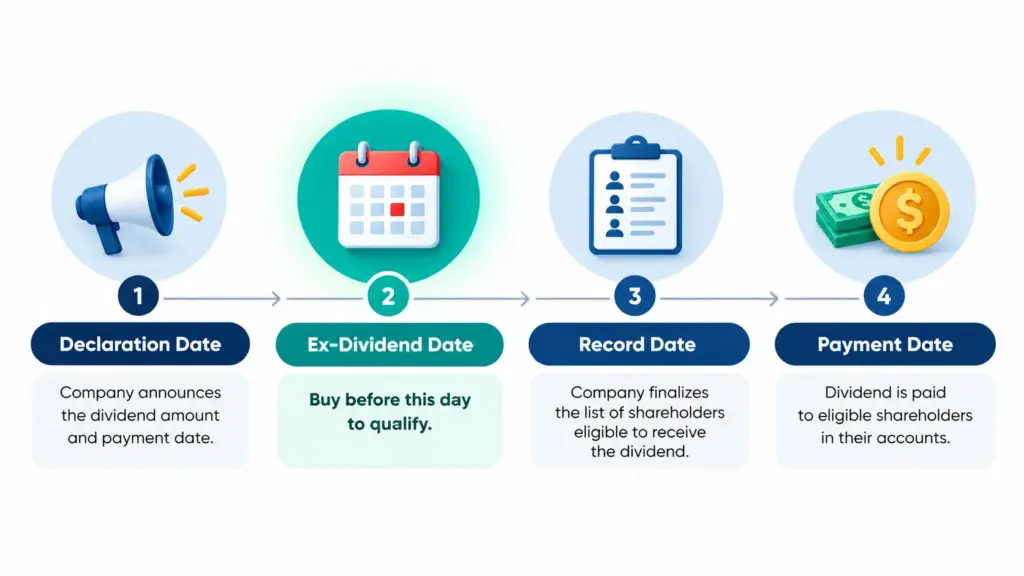
Every dividend follows four dates: declaration, ex-dividend, record and payment. The company announces the payout on the declaration date, the ex-dividend date sets the buying cut-off, the record date fixes the shareholder list, and the payment date is when cash arrives. Of the four, investors who buy and sell actively watch the ex-dividend date most closely.
The table below puts the four dates side by side so the sequence is easy to follow.
The Four Dividend Dates Compared
| Date | What happens | Why it matters to investors |
|---|---|---|
| Declaration date | The board announces the dividend amount, the record date and the payment date | It confirms the dividend is real and gives the schedule |
| Ex-dividend date | New buyers stop qualifying for this dividend | Buying before it secures the payout; buying on or after it does not |
| Record date | The company checks its register to see who owns the shares | It fixes the list of shareholders who are paid |
| Payment date | The dividend is paid to eligible shareholders | It is when cash reaches the account, often weeks after the other dates |
The ex-dividend date usually falls on or just before the record date. The reason is settlement: a share must be settled in the buyer’s name by the record date, so the market closes the entitlement window a little earlier. We return to this point in the T+1 section below.
Follow Dividend-Paying Stocks Across Global Markets
Explore how investors in Dubai can access international equities through a DFSA-regulated broker.
Do Investors Receive the Dividend If They Buy on the Ex-Dividend Date?
No. An investor who buys on the ex-dividend date or later does not receive that dividend, because the trade settles after the shareholder list is fixed. Owning the shares at the close of the trading day before the ex-dividend date is what generally secures the payout, even if the investor sells on the ex-dividend date itself.
A simple example makes this concrete. Imagine a fictional company that declares a dividend of USD 0.40 per share, with the ex-dividend date falling on a Thursday. The figures are illustrative only.
- An investor who buys on Tuesday qualifies, because the shares were bought before the cut-off.
- An investor who buys on Wednesday also qualifies, because Wednesday is the last trading day before the ex-dividend date.
- An investor who buys on Thursday does not qualify, because Thursday is the ex-dividend date and new buyers are now excluded.
- An investor who has held the shares for years and sells on Thursday morning still receives the dividend, because ownership was in place before the cut-off.
Some corporate actions follow different rules. Very large special dividends and stock dividends can be handled differently by exchanges, so investors should read the exchange notice for any unusual payout.
What Happens to the Share Price on the Ex-Dividend Date?
The share price usually opens lower by roughly the dividend amount, because cash is leaving the company and new buyers are not entitled to it. The drop is not a loss in value for existing holders, who receive that cash instead. Normal market moves can easily hide or exaggerate the adjustment.
Take the fictional company above. If the shares close at USD 20.00 on Wednesday, the reference price on Thursday adjusts to about USD 19.60, which is the old price less the USD 0.40 dividend. An existing holder owns a share worth about USD 19.60 plus USD 0.40 in cash, so the total is unchanged. The numbers are illustrative.
This matters for dividend yield, which is the annual dividend divided by the share price, shown as a percentage. After a price drop, the yield can look higher on paper without the company becoming any more generous. Looking at yield alongside earnings and payout sustainability gives a fuller picture.
How Did T+1 Settlement Change the Ex-Dividend Date?
Since May 28, 2024, most US stock trades settle one business day after the trade date, a cycle known as T+1. Under T+1, the US ex-dividend date generally falls on the same day as the record date. Under the older T+2 cycle, it typically came one business day earlier. Investors should still confirm dates for each stock.
Settlement is the final step of a trade, when the buyer’s cash and the seller’s shares actually change hands. The US Securities and Exchange Commission explains the move from T+2 to T+1, including the May 28, 2024 compliance date, in its investor bulletin on the new T+1 settlement cycle.
The practical result is that the window between buying a stock and being listed as its owner shrank by a day. An investor who read older guides saying “buy at least two days before the record date” may be working from outdated timing.
How Does the Ex-Dividend Date Work for US, GCC and Global Stocks?
The concept is the same everywhere: owning the shares before the ex-dividend date secures the dividend. The details differ by exchange, including settlement timing, payment currency and withholding tax. Investors should check each exchange or company announcement rather than assume that US rules apply to every market.
Ex-Dividend Mechanics Across Markets
| Feature | US stocks, ETFs and ADRs | GCC stocks | Global non-US stocks |
|---|---|---|---|
| Who sets the date | The exchange, based on the company’s announced record date | Each GCC exchange under its own rules | The local exchange where the stock is listed |
| Settlement cycle | T+1 for most trades | Set by each exchange; confirm before trading | Varies by country |
| Payment currency | Typically US dollars | Typically the local currency, such as AED or SAR | Typically the home market currency |
| Tax considerations | US withholding tax may apply to non-US investors; confirm the current rate | Rules differ by country and company | Withholding tax may apply in the company’s home market |
| Where to confirm | Company investor relations page and exchange notices | Exchange and company disclosures | Local exchange and company disclosures |
PhillipCapital DIFC offers access to US stocks, ETFs and ADRs, GCC stocks and global non-US stocks, so the same investor may hold shares that follow three different sets of dividend rules. For ADRs, which are certificates representing shares of a foreign company, dividends are typically declared in the home currency and paid in US dollars after conversion
Access US Stocks, ETFs and ADRs From Dubai
Invest in leading US companies and funds that pay regular dividends, with the support of a DFSA-regulated broker.
Is Buying Just Before the Ex-Dividend Date a Smart Strategy?
Usually it is not a reliable shortcut. Because the price tends to drop by about the dividend amount on the ex-dividend date, a buyer receives the payout but owns a share that is worth less. Taxes and trading costs can erase the gap. The tactic is called dividend capture and carries real risk.
Investors who try it should weigh several factors:
- The share price may fall by more than the dividend, leaving the investor with a net loss.
- Withholding tax on the dividend can reduce the cash received, sometimes by more than the investor expected.
- Commissions and the bid-ask spread, which is the gap between the buying and selling price, are paid on both the purchase and the sale.
- A short holding period offers no protection if the company announces bad news or cuts its dividend.
A more patient approach looks at the quality and growth of a company’s dividend over years rather than around a single date. Our guide to dividend and other trading strategies sets out how long-term dividend investing differs from short-term timing.
Do Ex-Dividend Dates Affect ETFs, Options, CFDs and Short Positions?
Yes, though each instrument handles dividends differently. ETFs have their own ex-dividend dates, option holders do not receive dividends but see prices adjust, CFD positions usually receive or pay a cash adjustment, and short sellers owe the dividend. The product terms always decide the exact treatment.
- ETFs: Funds that distribute income set an ex-dividend date for each distribution, and the same buy-before-the-date rule applies to the fund’s shares.
- Options: Holders of options on a stock do not receive its dividend. Option prices tend to adjust ahead of the ex-dividend date, and buyers of American-style calls sometimes consider early exercise to capture a large dividend.
- CFDs: Long positions typically receive a cash adjustment equal to the dividend, while short positions typically pay it. The exact terms vary by product, so investors should read the contract specifications.
- Short positions: An investor who has sold shares short and holds the position over the ex-dividend date generally has to pay the equivalent dividend to the lender of the shares.
What Mistakes Do Investors Make Around Ex-Dividend Dates?
The most common mistakes are confusing the ex-dividend date with the record date, buying on the ex-dividend date itself, and assuming a falling price signals a problem. Each one is avoidable by checking the official dates before placing a trade and understanding how the price adjusts.
- Treating the record date as the buying deadline. The ex-dividend date is the deadline that matters, because it comes first or on the same day.
- Buying on the ex-dividend date and expecting the dividend. New buyers on that day are excluded from the payout.
- Panicking at the ex-dividend price drop. The adjustment is a normal result of the dividend leaving the company.
- Chasing a high yield without checking sustainability. A very high yield can mean the share price has fallen because the market doubts the payout will last.
- Ignoring tax and currency effects. Withholding tax and exchange rates can change the amount that actually reaches the account.
- Assuming every market follows US timing. GCC and other non-US exchanges set their own rules.
How Can Investors Check an Ex-Dividend Date?
Investors can confirm an ex-dividend date from the company’s investor relations page, the exchange’s corporate action notices, or the broker’s platform. The declaration announcement lists the amount, the record date and the payment date, and the ex-dividend date is set by the exchange from that schedule.
- Find the declaration announcement. Companies publish it on their investor relations page and through the exchange.
- Note the record date and payment date. These anchor the schedule.
- Confirm the ex-dividend date with the exchange or broker. Do not rely on a single third-party website.
- Check the settlement cycle for that market. It decides how far before the record date the cut-off falls.
- Review the company’s ability to keep paying. Ratios such as the payout ratio and dividend yield are covered in our stock valuations learning hub.
- Allow for tax and currency effects. Investors may consider speaking with a tax adviser about their own position.
Frequently Asked Questions (FAQs)
Yes. An investor who owned the shares before the ex-dividend date still receives the dividend even if the shares are sold on the ex-dividend date itself. Entitlement is decided by ownership at the cut-off, not by how long the shares are held afterward.
Not always. The record date is when the company checks its shareholder register, while the ex-dividend date is the first day new buyers are excluded. Under US T+1 settlement the two generally fall on the same day, but other markets can differ.
The price typically adjusts downward by about the dividend amount because new buyers no longer receive it. Existing holders are compensated with the cash payment, so total value is broadly unchanged. Other market factors can add to or offset the move.
No action is usually required. If the shares are held in the account before the ex-dividend date, the dividend is credited automatically on the payment date, after any applicable tax is withheld. Investors should check their account statements to confirm receipt.
Have Questions About Dividend Investing?
Speak with the PhillipCapital DIFC team about accessing dividend-paying stocks and ETFs across global markets.
Key Takeaways on the Ex-Dividend Date
The ex-dividend date is the buying cut-off for a dividend. Owning the shares before it secures the payout, buying on or after it does not, and the share price typically adjusts by about the dividend amount on that day. Since the US moved to T+1 settlement, the US ex-dividend date generally matches the record date, while GCC and other markets follow their own timing.
Investors may consider confirming dates through official announcements, weighing tax and currency effects, and judging a dividend by its sustainability rather than a single date. Dividend capture around the cut-off is rarely the easy gain it appears to be.
Disclaimer:
Trading foreign exchange and/or contracts for difference on margin carries a high level of risk, and may not be suitable for all investors as you could sustain losses in excess of deposits. The products are intended for retail, professional and eligible counterparty clients. Before deciding to trade any products offered by PhillipCapital (DIFC) Private Limited you should carefully consider your objectives, financial situation, needs and level of experience. You should be aware of all the risks associated with trading on margin. The content of the Website must not be construed as personal advice. For retail, professional and eligible counterparty clients. Before deciding to trade any products offered by PhillipCapital (DIFC) Private Limited you should carefully consider your objectives, financial situation, needs and level of experience. You should be aware of all the risks associated with trading on margin.
Rolling Spot Contracts and CFDs are complex instruments and come with a high risk of losing money rapidly due to leverage. 78% of our retail client accounts lose money while trading with us. You should consider whether you understand how Rolling Spot Contracts and CFDs work, and whether you can afford to take the high risk of losing your money.
Cash and Stock Dividends
Cash and Stock Dividends Explained Cash and Stock Dividends Explained:...
Read MoreUnderstanding Dividends

Dividend Investing: A Practical Guide for Beginners Dividend Investing: A...
Read MoreIndustry Growth Prospects

Industry Growth Prospects Table of Contents Introduction What Are Industry...
Read MoreRegulatory Environment Impact

Regulatory Environment Impact on Stocks Table of Contents Introduction What...
Read MoreSupply Chain Analysis

Supply Chain Analysis for Equity Investors Table of Contents Introduction...
Read MoreMarket Share Analysis

Market Share Analysis How Investors Measure Company Dominance in an...
Read MoreCompetitive Positioning

Competitive Positioning Table of Contents Introduction What Is Competitive Positioning...
Read MoreIndustry Analysis Framework

Sector Classification Systems Table of Contents Introduction What Is an...
Read MoreSector Classification Systems

Sector Classification Systems Introduction Every listed company belongs somewhere. Whether...
Read MoreWorking Capital Analysis

Working Capital Analysis Introduction When you look at a company’s...
Read MoreCurrent Ratio vs Quick Ratio

Current Ratio and Quick Ratio Table of Contents Introduction What...
Read Moredebt-to-equity ratio
Debt-to-Equity Ratio Table of Contents Introduction What is the Debt-to-Equity...
Read MoreProfit Margins & Profitability
Profit Margins and Profitability Introduction When you look at a...
Read MoreRevenue Growth Analysis
Revenue Growth Analysis Table of Contents Introduction What Is Revenue...
Read MoreStatement of Changes in Equity
Statement of Changes in Equity Table of Contents Introduction What...
Read MoreCash Flow Statement Analysis
Cash Flow Statement Analysis Table of Contents Introduction What Is...
Read MoreUnderstanding Balance Sheets
Understanding Balance Sheets Understanding Balance Sheets: A Complete Guide for...
Read MoreFundamental Analysis for Stocks

Fundamental Analysis for Stocks Mastering Fundamental Analysis for Stocks: A...
Read MoreDiscounted Cash Flow (DCF) Model

Discounted Cash Flow (DCF) Model Understanding the Discounted Cash Flow...
Read MoreIntrinsic Value Calculation

Intrinsic Value Calculation Guide to Stock Valuations Intrinsic Value Calculation:...
Read Moreunderstanding dividend yield investment guide

Dividend Yield The Strategic Guide to Dividend Yield: Maximizing Passive...
Read MoreEnterprise Value And Ev/Ebitda

Enterprise Value And EV/EBITDA Enterprise Value and EV/EBITDA: A Comprehensive...
Read MorePrice-to-Sales Ratio (P/S)

Price-to-Sales Ratio (P/S) Understanding the Price-to-Sales Ratio (P/S) in Modern...
Read More