

One-Touch and No-Touch Features Table of Contents Introduction What Are...
Read MoreAutocallable Structure
Table of Contents
Introduction
Structured products have become an increasingly important part of modern investment portfolios, particularly for investors looking to generate above-average returns in uncertain market conditions. Among the most widely used structured products globally, autocallable structures stand out for their unique design — they can automatically return your capital (and a premium) before the product’s scheduled maturity, under the right market conditions.
For investors in the UAE and wider Middle East region, understanding how autocallables work is especially relevant as institutional and high-net-worth clients increasingly seek yield-enhancing alternatives to conventional fixed-income instruments. This guide breaks down everything you need to know — simply and clearly.
What Is an Autocallable Structure?
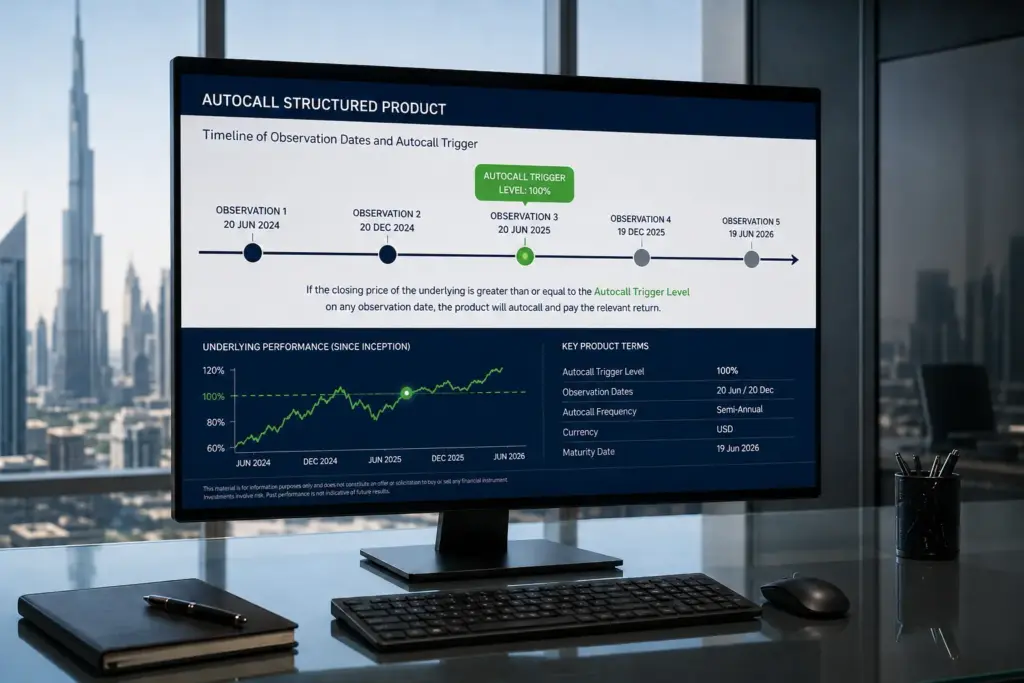
An autocallable is a type of structured investment product that has the potential to be “called” — meaning redeemed early — automatically if a pre-defined market condition is met on a specific observation date. The word “auto” refers to this automatic feature; no active decision is required from the investor or the issuer once the product is live.
These products are typically linked to an underlying asset — most commonly a stock index (such as the S&P 500 or Euro Stoxx 50), a single equity, a basket of shares, or even a commodity. The product observes the performance of this underlying asset at set intervals (monthly, quarterly, or annually). If the underlying is at or above a certain level on any observation date, the product is called, the investor receives their initial capital back plus a pre-agreed coupon or premium.
If it isn’t called on that date, the product continues to the next observation date and repeats the check. This process runs until the product either gets called early or reaches final maturity.
Autocallables sit within the broader category of structured products, which combine elements of fixed income with derivatives to create customised risk-return profiles. If you’re new to this space, it helps to first read up on structured products basics before diving deeper into specific types like autocallables.
How Does the Autocall Mechanism Work?
Let’s use a straightforward example. Suppose you invest AED 100,000 in a 3-year autocallable note linked to a major stock index. The terms are:
- Autocall trigger: 100% of the initial index level (the index must be at or above where it started)
- Observation dates: Every 6 months (6 total over 3 years)
- Coupon: 8% per year (paid if the product is called, or accrued if not)
At the first 6-month observation, the index is up 5%. Since it’s at or above the trigger level, the product autocalls. You receive your AED 100,000 back plus 4% (half of the 8% annual coupon) — that’s AED 4,000 profit in just 6 months.
If the index had been below the trigger at month 6, no call occurs. The product moves forward to the 12-month observation, and the coupon continues to accrue. If it calls at month 12, you receive 8% (a full year’s coupon). This “memory” feature — where missed coupons are paid out when the product finally calls — is a common and attractive feature in many autocallable designs.
Understanding how the timing of returns and the observation schedule interact is key. Investors familiar with types of structured products will recognise that the autocall mechanism is what distinguishes this category from simpler capital-protected notes.
What Is a Barrier in an Autocallable Product?
The barrier is one of the most critical features of any autocallable. It is a predefined level of the underlying asset — typically expressed as a percentage of its starting value — below which the investor’s capital protection disappears at maturity.
For example, a product might have a barrier set at 60% of the starting index level. This means:
- If the index never falls below 60% of its starting value during the product’s life (or at maturity, depending on the barrier type), your capital is fully returned at the end.
- If the index does breach the 60% barrier at the relevant point, you are exposed to the full loss of the index. If the index is down 45% at maturity, you could lose 45% of your investment.

There are two common barrier types to be aware of:
European barrier (point-in-time): Only the level at final maturity matters. The index can fall below the barrier during the product’s life, but as long as it recovers above it by the end, your capital is safe.
American barrier (continuous): If the index falls below the barrier at any point during the product’s life, the capital protection is removed — regardless of where the index ends up at maturity.
The European barrier offers greater protection and is generally preferred by more conservative investors.
What Returns Can an Investor Expect?
Autocallable products are generally designed to offer enhanced yields compared to traditional fixed-income instruments like government bonds or corporate bonds. Depending on market conditions, product structure, and the volatility of the underlying asset, coupons on autocallables can range anywhere from 6% to 15%+ per annum — making them particularly interesting in low-yield or moderate-yield environments.
The higher the volatility of the underlying asset, the higher the potential coupon, because the option structures embedded in the product become more valuable. However, higher volatility also typically means greater risk — including a higher probability that the barrier could be breached.
It is worth noting that returns are not guaranteed. The coupon is conditional on the product being called or on the barrier not being breached. If the market performs poorly throughout the entire product life and the barrier is breached at maturity, the investor participates fully in the downside of the underlying asset.
For investors seeking yield-enhancing investment products through wealth management solutions, autocallables can be a powerful tool — but they must be assessed carefully against individual risk appetite and financial objectives. PhillipCapital’s wealth management and structured notes service helps clients evaluate such opportunities in a structured and informed way.
Discover Tailored Structured Notes at PhillipCapital DIFC
Our wealth management team helps investors access professionally structured products aligned with your goals and risk profile.
Who Are Autocallable Structures Suitable For?
Autocallable products are generally most suitable for:
- Investors seeking enhanced yield above what bonds or savings products typically offer, and who are comfortable accepting some equity market risk to achieve it.
- Moderate risk investors who believe the underlying market (index or equity) is unlikely to collapse significantly, but who are not necessarily expecting strong positive returns either.
- Investors with a medium-term horizon (typically 1–5 years) who can commit capital for the duration of the product.
- High-net-worth and sophisticated investors who understand derivatives-linked payoffs and structured instruments.
Autocallables are generally not appropriate for investors who need guaranteed capital protection, require immediate liquidity, or have very short investment time horizons. Understanding your own risk profile before investing is essential.
For context, investors exploring structured products often also consider bond and debenture investments alongside autocallables — as bonds provide fixed income with more predictable capital repayment, offering a useful comparison point.

What Are the Key Risks?
There are several risk factors every investor should carefully consider:
- Barrier breach and capital loss: If the underlying falls significantly and breaches the barrier, you can lose a substantial portion of your invested capital at maturity. This is the most significant risk.
- No guaranteed return date: Since the autocall depends on market conditions, you cannot predict exactly when your capital will be returned. In a prolonged bear market, the product may run its full term without being called.
- Missed upside: If the underlying asset performs extremely well, your gain is capped at the agreed coupon. You do not participate in the full upside of the market.
4. Issuer/counterparty risk: Autocallables are issued by financial institutions. If the issuer faces financial difficulty, it could affect repayment, regardless of how the underlying has performed.
5. Liquidity risk: These are not typically exchange-traded products. Selling before maturity can be difficult or costly.
Understanding these risk dimensions is part of building a sound overall portfolio strategy. Investors familiar with derivatives basics will recognise that the embedded options in autocallables are what drive both the attractive coupons and these risk trade-offs.
Autocallables vs. Traditional Bonds
This is one of the most common questions investors ask when first encountering structured products. Here’s a clear comparison:
| Feature | Autocallable Note | Traditional Bond |
|---|---|---|
| Return | Conditional coupon (higher potential) | Fixed coupon (predictable) |
| Capital Protection | Conditional (barrier-dependent) | Generally full repayment at maturity |
| Liquidity | Limited (OTC, not exchange-traded) | Often more liquid (exchange-listed) |
| Maturity | Variable (can call early) | Fixed |
| Market Exposure | Linked to equity/index | Credit risk of issuer |
| Upside Participation | Capped at coupon | None (fixed income) |
In short, traditional bonds offer more predictability. Autocallables offer the potential for higher yield in exchange for accepting conditional capital protection and equity market risk. The choice between the two — or a combination — depends entirely on the investor’s goals, time horizon, and risk tolerance.
Understand the Full Range of Investment Products?
Explore What PhillipCapital DIFC Has to Offer From global equities and bonds to structured notes — discover a comprehensive suite of products built for serious investors.
Conclusion & Key Takeaways
Autocallable structures are sophisticated yet increasingly accessible investment products that offer the potential for attractive, above-market returns — under the right conditions. Their defining feature — the automatic early redemption mechanism — makes them particularly interesting for investors who want to generate yield without taking on unlimited downside risk, provided the market does not fall dramatically.
However, they are not without risks. The barrier feature means your capital can be at significant risk if markets perform poorly, and the variable redemption timeline means you cannot always plan precisely when your funds will be returned.
Key Takeaways:
- Autocallables are early-redemption structured products that pay a conditional coupon if the underlying asset is at or above a set trigger level on observation dates.
- The barrier determines capital protection — if breached (especially with American barriers), your capital is fully at risk at maturity.
- Coupons can be significantly higher than traditional bonds, typically 6%–15%+ per annum, depending on market conditions and structure.
- They are best suited for moderate-risk investors with medium-term horizons who understand equity market exposure.
- Risks include barrier breach, no guaranteed call date, capped upside, issuer risk, and limited liquidity.
- Always compare autocallables against alternatives like bonds or direct equity exposure before committing capital.
If you’re considering structured products as part of your investment portfolio, speaking with an experienced financial professional is essential. PhillipCapital DIFC has been serving investors across the UAE and Middle East for over two decades, offering access to a wide range of structured investment solutions tailored to individual needs.
Ready to Learn More or Get Started?
Connect with PhillipCapital DIFC for expert guidance on structured products and portfolio solutions.
Frequently Asked Questions (FAQs)
Can I lose all my money in an autocallable product?
Losing your entire investment is uncommon but not impossible. Your capital is genuinely at risk only if the underlying asset collapses so severely that it falls well below the barrier and stays there through maturity. For example, on a product with a 60% barrier, the underlying would need to drop more than 40% — and not recover — for you to face significant losses. The deeper the barrier, the more protection you have. That said, these are not capital-guaranteed products, and investors should treat them accordingly.
What happens if the autocall never triggers during the product's life?
If the underlying never reaches the autocall trigger on any observation date, the product simply runs to its scheduled maturity — typically 3 to 5 years. At that point, two outcomes are possible: if the underlying is still above the barrier, you receive your full capital back (plus any accrued coupon). If the barrier has been breached, you receive capital reduced in line with the underlying’s fall. The product does not “expire worthless” like an option — there is always a maturity payoff scenario.
Why is the coupon on an autocallable higher than a regular bond?
You are essentially being compensated for two things: accepting that your returns are conditional (not guaranteed), and taking on downside equity risk if the market falls sharply. The bank issuing the product embeds options into the structure, and the premium collected from selling those options is what funds the attractive coupon. Higher underlying volatility means higher option premiums — and therefore higher potential coupons. It is yield in exchange for risk, not yield for free.
Is an autocallable the same as a structured deposit or a capital-protected note?
No — these are meaningfully different. A structured deposit is bank-deposit-based, often fully capital protected, and covered by deposit protection schemes. A capital-protected note guarantees return of your principal at maturity regardless of market performance. An autocallable offers only conditional capital protection via a barrier — if that barrier is breached, capital is at risk. Autocallables typically offer higher potential returns than either of the above, but with less certainty on capital preservation. Always read the product term sheet carefully to understand which category a product falls into.
Disclaimer:
Trading foreign exchange and/or contracts for difference on margin carries a high level of risk, and may not be suitable for all investors as you could sustain losses in excess of deposits. The products are intended for retail, professional and eligible counterparty clients. Before deciding to trade any products offered by PhillipCapital (DIFC) Private Limited you should carefully consider your objectives, financial situation, needs and level of experience. You should be aware of all the risks associated with trading on margin. The content of the Website must not be construed as personal advice. For retail, professional and eligible counterparty clients. Before deciding to trade any products offered by PhillipCapital (DIFC) Private Limited you should carefully consider your objectives, financial situation, needs and level of experience. You should be aware of all the risks associated with trading on margin.
Rolling Spot Contracts and CFDs are complex instruments and come with a high risk of losing money rapidly due to leverage. 78% of our retail client accounts lose money while trading with us. You should consider whether you understand how Rolling Spot Contracts and CFDs work, and whether you can afford to take the high risk of losing your money.

Barrier Levels and Payoff Impact
Barrier Levels and Payoff Impact Introduction Structured products often look...
Read More
Continuous vs Discrete Observation
Continuous vs Discrete Observation Table of Contents Introduction What Does...
Read More


Barrier Levels and Types
Barrier Levels and Types Introduction Structured products are built around...
Read More
Contingent Conversion Features
Contingent Conversion Features Introduction Structured products have evolved considerably over...
Read More
Early Redemption Features
Early Redemption Features Table of Contents Introduction What Is an...
Read More
Coupon Payments in Autocalls
Coupon Payments in Autocalls Table of Contents Introduction What Is...
Read More
Observation Dates
Observation Dates Introduction If you have ever explored structured products...
Read More
Autocall Mechanics
Autocall Mechanics Introduction If you’ve come across the term “autocallable...
Read More
Autocallable Structures
Autocallable Structure Table of Contents Introduction What Is an Autocallable...
Read More
Knock-In and Knock-Out Features
Knock-In and Knock-Out Features Table of Contents Introduction What Are...
Read More

Participation Structures in Structured Products
Participation Structures Maximizing Market Opportunities: A Guide to Participation Structures...
Read More
Zero Capital Protection
Zero Capital Protection Understanding Zero Capital Protection: Risks, Rewards, and...
Read More
Full Capital Protection
Full Capital Protection Understanding Full Capital Protection in Structured Products:...
Read More
Partial Capital Protection
Partial Capital Protection Partial Capital Protection: The Strategic Bridge Between...
Read More
Capital Protection Structures
Capital Protection Structures Strategic Wealth Preservation: A Comprehensive Guide to...
Read More

How Structured Products Work
How Structured Products Work A Complete Guide for Investors Table...
Read More

Components of Structured Products
Components of Structured Products A Detailed Guide for UAE Investors...
Read More
Introduction to Structured Products
Introduction to Structured Products In today’s dynamic financial landscape, traditional...
Read More